
 Buy Crypto
- Markets
 Futures
- Spot
- Copy Trade
- Earn
- More
Solana Ecosystem Civil War Erupts: Jupiter and Kamino Fall Out, Foundation Urges Peace

Original Title: "Solana's Top Two Lending Protocols Clash, Foundation Steps In to Mediate"
Original Author: Azuma, Odaily Planet Daily
This past weekend, the top two lending protocols on Solana, Jupiter Lend and Kamino, got into a heated dispute.
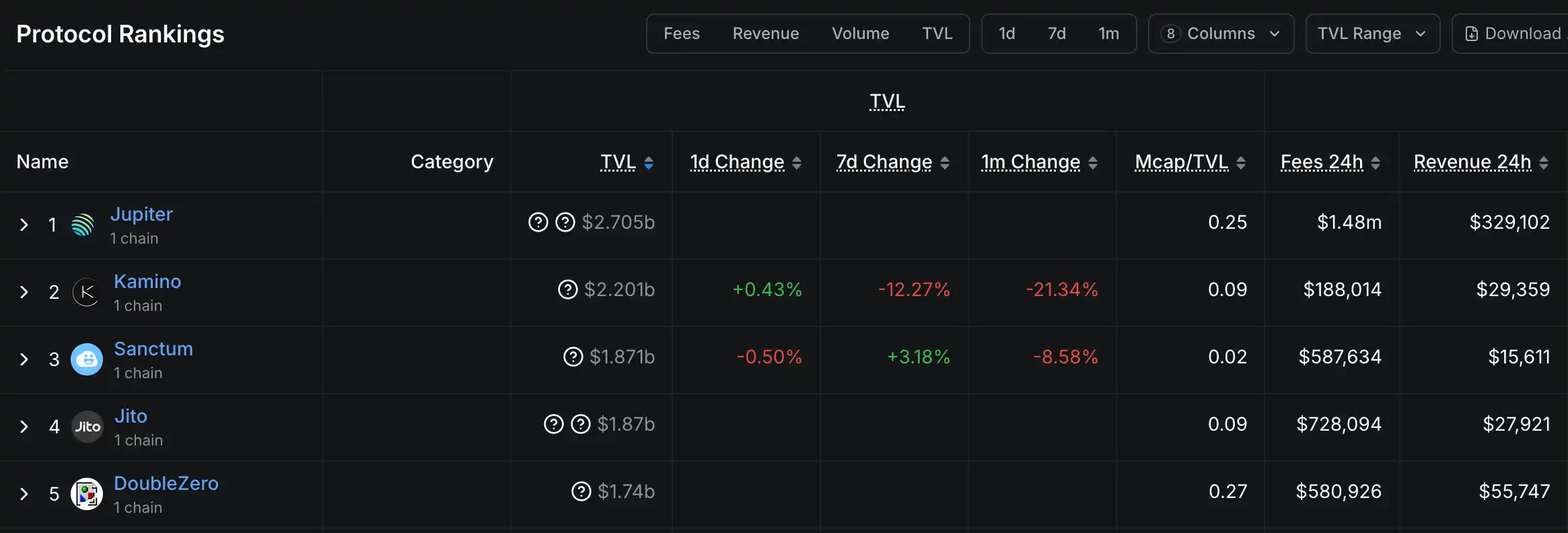
· Odaily Note: According to Defillama data, Jupiter and Kamino are the two protocols with the highest Total Value Locked (TVL) in the Solana ecosystem.
Event Background: Jupiter's Deleted Tweet
The root of the conflict can be traced back to August of this year when Jupiter's official account, prior to the launch of its lending product Jupiter Lend, repeatedly emphasized the product's "risk isolation" feature (related posts have been deleted), meaning there would be no risk cross-contamination between different lending pools.
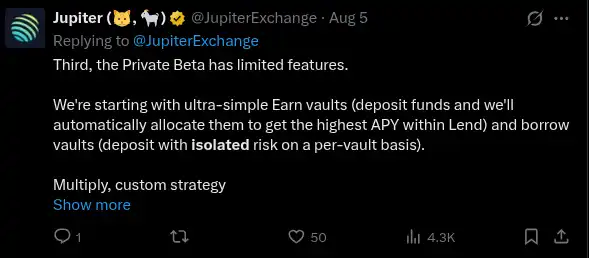
However, the design of Jupiter Lend post-launch did not align with the market's common understanding of a risk-isolation model. In the general market view, a DeFi lending pool considered to have risk isolation is a structure that partitions risks of different assets or markets from each other, preventing a single asset default or a market collapse from affecting the entire protocol's lending pool. The main features of this structure include:
· Pool Segregation: Different asset types (such as stablecoins, volatile assets, NFT collateral, etc.) are allocated to independent lending pools, each pool having separate liquidity, debt, and risk parameters.
· Collateral Segregation: Users can only use assets within the same pool as collateral to borrow other assets, cutting off cross-pool risk transmission.
However, Jupiter Lend actually supports using re-collateralization (reusing collateral deposited elsewhere in the protocol) to enhance capital efficiency, meaning that the collateral deposited in the treasury is not completely isolated from each other. Samyak Jain, co-founder of Jupiter, explained that the lending pools in Jupiter Lend are "in a sense 'isolated' as each pool has its own configuration, cap, liquidation threshold, liquidation penalty, etc., and the re-collateralization mechanism is just to optimize capital efficiency.
While Jupiter has a more detailed explanation in its product documentation about Jupiter Lend, objectively speaking, the early promotional material did mention "risk isolation," which indeed deviated somewhat from the widely accepted market understanding, raising suspicions of misleading information.
Clash Erupts: Kamino Launches an Attack
On December 6, Kamino co-founder Marius Ciubotariu took this opportunity to criticize Jupiter Lend and banned Kamino's migration tool to Jupiter Lend.
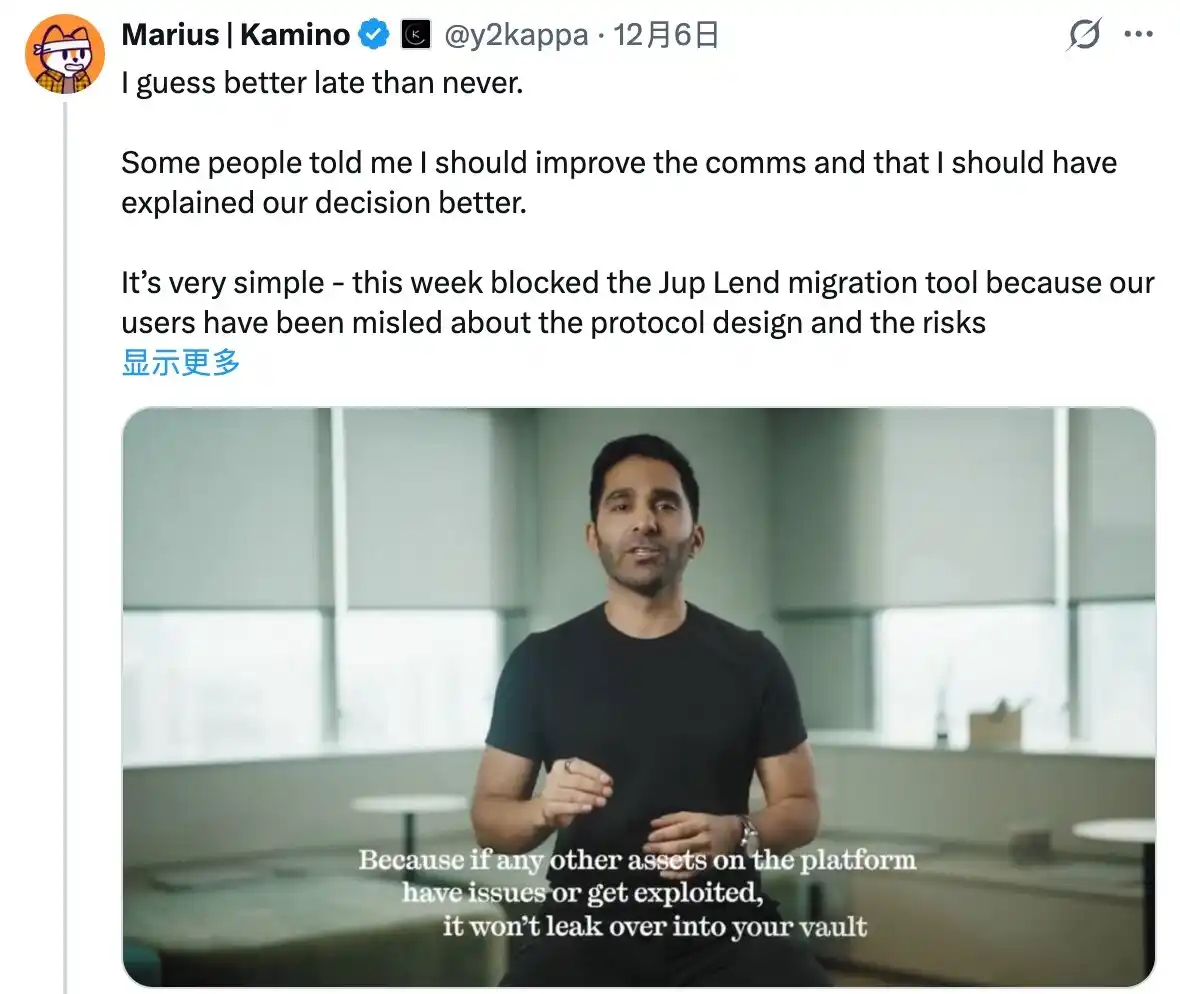
Marius stated: "Jupiter Lend repeatedly claims that there is no cross-contamination between assets, which is completely unfounded. In reality, in Jupiter Lend, if you deposit SOL and borrow USDC, your SOL will be lent to other users engaging in yield farming using JupSOL and INF, and you will bear all the risks of these yield farming collapses or asset defaults. There is no isolation measure here, and there is complete cross-contamination, contrary to the advertising and what people have been told... In traditional finance (TradFi) and decentralized finance (DeFi), information such as whether collateral is rehypothecated or whether there is contagion risk is important information that must be clearly disclosed, and no one should provide vague explanations about it."
After Kamino's challenge, discussions surrounding the design of Jupiter Lend quickly ignited the community. Some agreed that Jupiter was suspected of false advertising — for example, Penis Ventures CEO 8bitpenis.sol ranted that Jupiter had been lying openly from the start, deceiving users; while others believed that Jupiter Lend's design model balanced security and efficiency, and Kamino's attack was merely for market competition with impure motives — such as overseas KOL letsgetonchain, who stated, "Jupiter Lend's design achieves both capital efficiency in a money pool model and some risk management capabilities of a modular lending protocol... Kamino cannot stop people from migrating to better technology."
Under intense pressure, the Jupiter team quietly deleted the early posts, but this triggered an even larger scale of FUD. Subsequently, Jupiter's Chief Operating Officer Kash Dhanda also came forward to admit that the team's previous claims on social media about Jupiter Lend having "zero contagion risk" were inaccurate and apologized, stating that a correction statement should have been issued simultaneously with the post deletion.
Core Contradiction: The Definition of "Risk Isolation"
Amidst the current community's divergent attitudes, the fundamental disagreement seems to lie in the different groups' varying definitions of the term "Risk Isolation."
From Jupiter and its supporters' perspective, "Risk Isolation" is not a completely static concept, leaving room for certain design considerations. Although Jupiter Lend does not follow the typical risk isolation model, it also does not fall under a fully open fund pool model. While sharing a common permissive liquidity layer for re-collateralization, each lending pool can be independently configured with its own asset limits, liquidation thresholds, and liquidation penalties.
Conversely, in Kamino and its supporters' view, any allowance for re-collateralization is a complete denial of "Risk Isolation," and project teams should not resort to vague disclosures and false marketing to deceive users.
Upper-layer Consciousness: Some Watch the Fire Burn, While Others Try to Extinguish It
Aside from the controversy between the two sides and within the community, another noteworthy aspect of this turmoil is the varied upper-layer attitudes within the Solana ecosystem.
Firstly, there is Multicoin, the most influential voice within the Solana ecosystem. As an investor in Kamino, Multicoin partner Tushar Jain directly questioned Jupiter's actions, stating that they are either "incompetent or malicious, but neither possibility is forgivable" — objectively, his statement significantly exacerbated the situation.
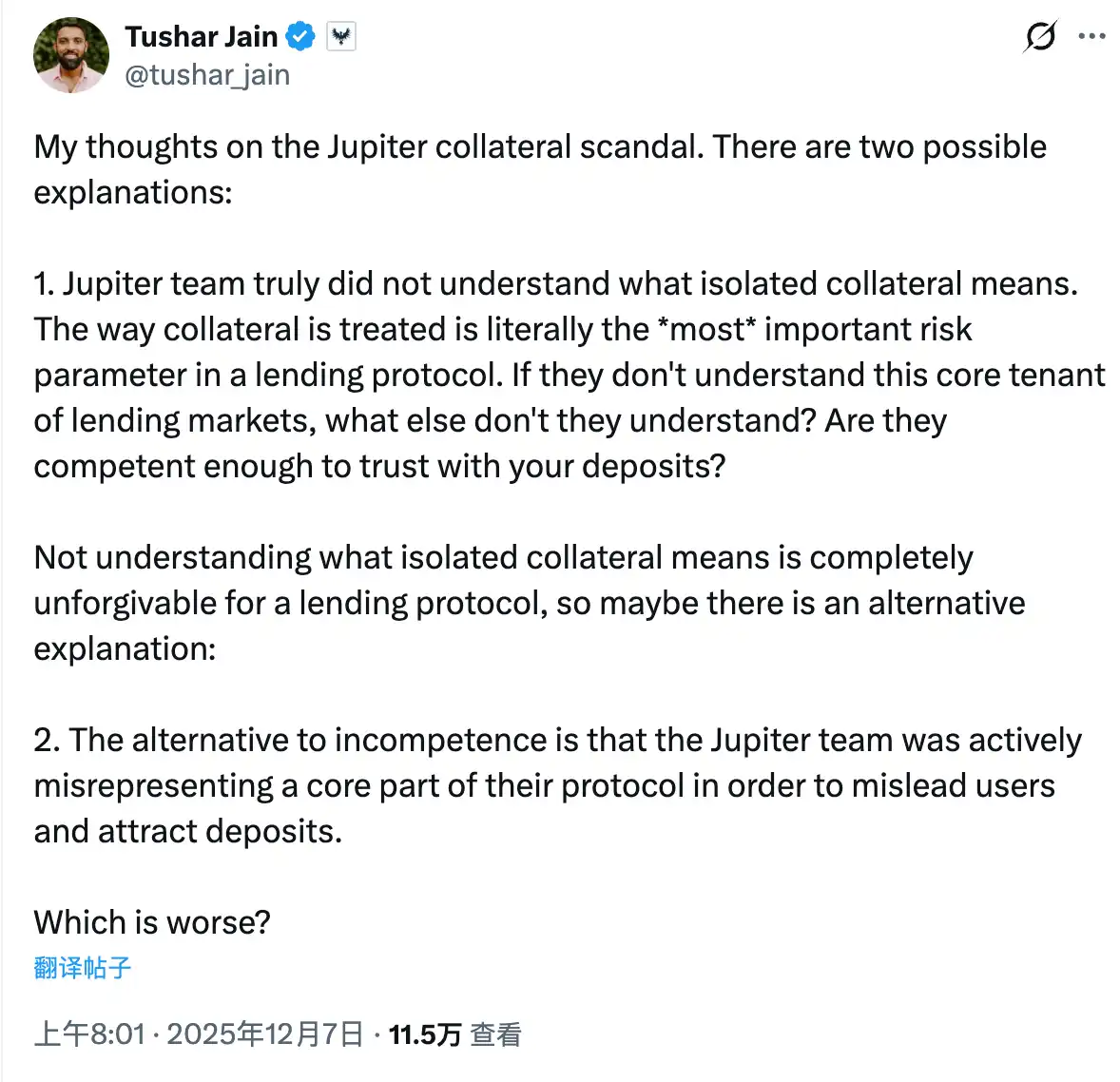
Tushar stated: "There are two possible explanations for the controversy surrounding Jupiter Lend. One is that the Jupiter team genuinely does not understand the meaning of isolated collateral. The collateral handling is the most critical risk parameter in a lending protocol. If they do not even grasp this core principle of the lending market, what else have they misunderstood? Is their expertise sufficient to reassure depositors? Not understanding the meaning of isolated collateral in a lending protocol is entirely unforgivable. The other possibility is that the Jupiter team is not incompetent but deliberately distorting a core part of their protocol to deceive users and attract deposits."
Evidently, Tushar's motives are very clear: to take this opportunity to assist Kamino in attacking its competitors.
Another important statement from the upper-level consciousness comes from the Solana Foundation. As the parent ecosystem, Solana clearly does not want to see the two main players in the ecosystem overly confrontational, which would ultimately lead to the ecosystem as a whole falling into internal strife.
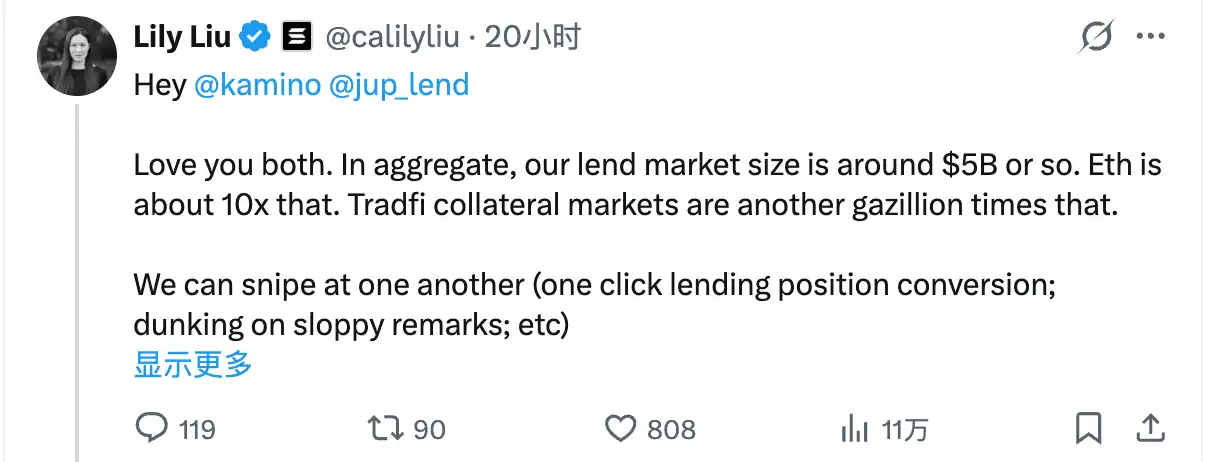
Yesterday afternoon, Solana Foundation President Lily Liu posted on Platform X calling on the two projects and advocating for peace, saying: "Love you guys. Overall, our lending market currently has a size of about $5 billion, while Ethereum's ecosystem is roughly 10 times that size. As for the collateral market in traditional finance, it is many times larger than this number. We can choose to attack each other, but we can also choose to look further ahead—first unite to capture market share from the entire crypto market, and then together march into the vast world of traditional finance.
To sum it up simply—Stop quarreling, or else Ethereum will benefit from our quarrel!
The Logic Behind It, the Battle for Solana's Lending Leader
Looking at the development and market environment data of Jupiter Lend and Kamino, although this storm seemed to have arisen suddenly, it appears to be an inevitable collision that was only a matter of time.
On one hand, Kamino (highlighted in red in the image below) had long held the position of the leading lender in the Solana ecosystem, but since Jupiter Lend (highlighted in blue in the image below) went live, it has captured a large market share and has become the only entity in the Solana ecosystem that can challenge the former.
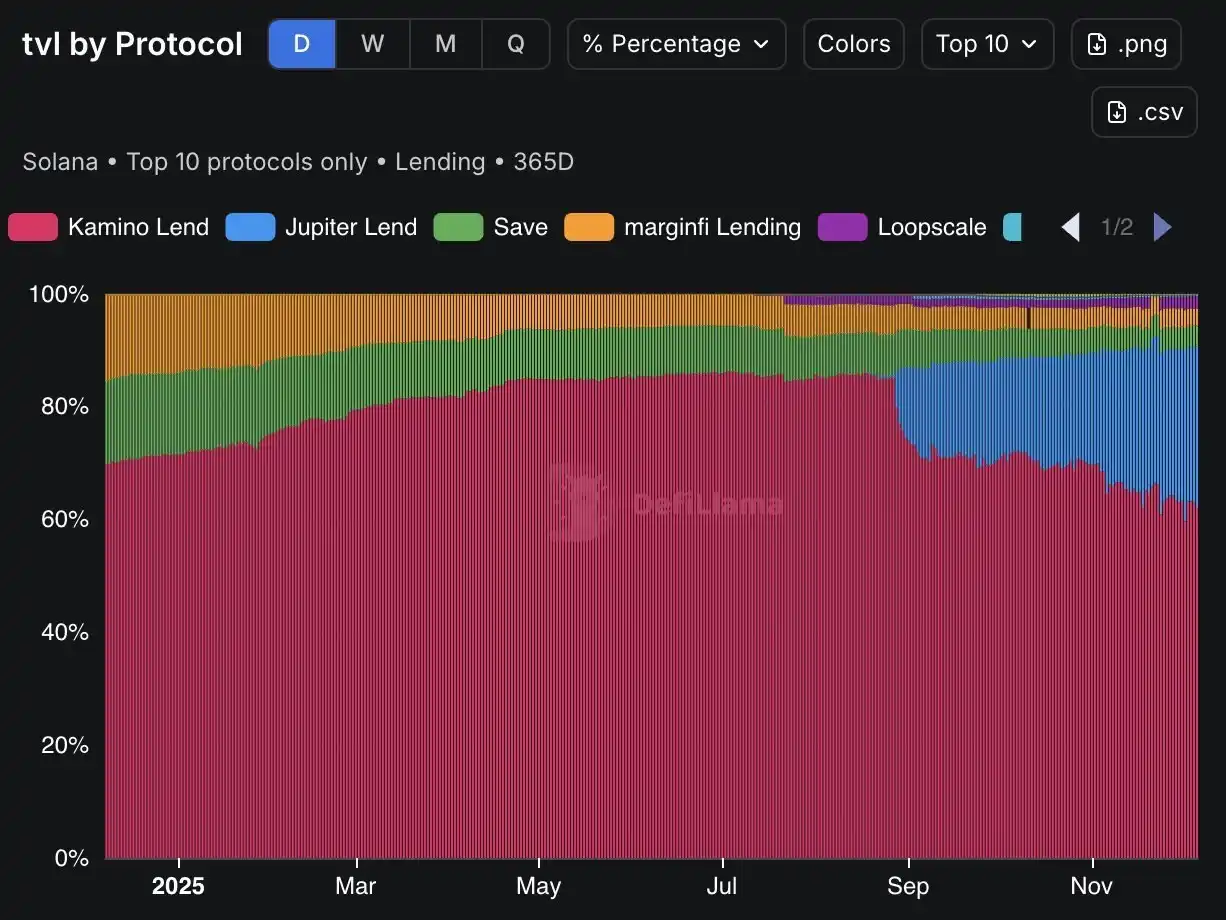
On the other hand, since the bloodbath on October 11, the market liquidity has significantly tightened, the overall TVL of the Solana ecosystem has continued to decline, and multiple projects collapsing due to rug pulls have made the DeFi market extremely sensitive to "security."
During a more favorable market environment with sufficient incremental funding, Jupiter Lend and Kamino coexisted relatively peacefully since there was money to be made by both parties, and it seemed like they would only continue to earn more... But as the market shifted to a zero-sum game, the competition between the two sides became more intense, and security issues conveniently became the most effective attack surface—although Jupiter Lend has never experienced a security breach in its history, mere suspicions about its design are enough to raise users' vigilance.
Perhaps to Kamino, now is the perfect opportunity to severely weaken their opponent.
You may also like

The 17-Year Mystery Will Be Solved, Who is Satoshi Nakamoto?

5 Minutes to Make AI Your Second Brain

Uniswap is trapped in an innovation dilemma

What is the key to competition in crypto banking?

The flow of stablecoins and the spillover effects in the foreign exchange market

After two years, Hong Kong's first batch of stablecoin licenses finally issued: HSBC, Standard Chartered make the cut
The person who helped TAO rise by 90% has now single-handedly crashed the price again today

3-Minute Guide to Participating in the SpaceX IPO on Bitget

Top 5 Cryptos to Buy in 2026 Q1: A ChatGPT Deep Dive Analysis
Explore the top 5 cryptos to buy in Q1 2026 including BTC, ETH, SOL, TAO, and ONDO. See price outlooks, key narratives, and institutional catalysts shaping the next market move.

How to Earn $15,000 with Idle USDT Before Altcoin Season 2026
Wondering if altcoin season is coming in 2026? Get the latest market update, and learn how to turn your idle stablecoins waiting for entry into extra rewards up to 15,000 USDT.
Can You Win Joker Returns Without Large Trading Volume? 5 Mistakes New Players Make In WEEX Joker Returns Season 2
Can small traders win WEEX Joker Returns 2026 without huge volume? Yes—if you avoid these 5 costly mistakes. Learn how to maximize card draws, use Jokers wisely, and turn small deposits into 15,000 USDT rewards.

Altcoin Season 2026: 4 Stages to Profit (Before the Crowd FOMO In)
Altcoin Season 2026 is starting — discover the 4 key stages of capital rotation (from ETH to PEPE) and how to position before the peak. Learn which tokens will lead each phase and avoid missing the rally.

Will Alt season come in 2026? 5 Tips to Spot the Next 100x Crypto Opportunities
Will altcoin season arrive in 2026? Discover 5 rotation stages, early signals smart traders watch, and the key crypto sectors where the next 100x altcoin opportunities may emerge.

The bear market has arrived, and cryptocurrency ETF issuers are also getting involved

The richest man had a quarrel with his former boss

BTC Firm Above 70K! Saylor’s "Institutional Logic" vs. Moon’s "Retail Faith": Who is Really Harvesting the Market?
Bitcoin is holding firm above the $70,000 support level following a massive short squeeze that liquidated $427 million. As the "Four-Year Cycle" narrative shifts, the market is split: Michael Saylor’s cold, institutional "indiscriminate stacking" vs. Carl Moon’s high-energy retail "hopium." This article decodes these two polar-opposite strategies for the 2026 bull run and reveals how WEEX’s institutional-grade liquidity and AI trading tools empower every type of investor to convert market volatility into profit.

The Girl Who Created the SBTI Test: A Story of a Doomed Cyber Love, an E-Widow Ratfolk



 App
App