
 Buy Crypto
- Markets
 Futures
- Spot
- Copy Trade
- Earn
- More
Coin Ownership or Equity Ownership? The Real Question Is Being Asked Wrong

Original Article Title: more on dual token + equity models in crypto
Original Article Author: @mdudas
Translation: Peggy, BlockBeats
Editor's Note: Amid the ongoing debate on "whether tokens are equivalent to equity" and "whether the dual structure is doomed to fail," this article offers a more restrained judgment, emphasizing that the key lies not in the structure, but in the people. Mike Dudas points out that tokens are not inherently superior to equity, and DAOs have not proven to be suitable for carrying application-layer projects requiring long-term leadership. What can truly survive the cycles are teams with long-term vision and execution.
As the boundary between tokens and equity becomes increasingly blurred, the dual structure of token + equity is becoming a common choice for application-layer projects. As observed by institutions like Delphi Digital, equity is moving onto the blockchain, and tokens are also converging toward equity-like properties. Mike Dudas reminds in the article that whether this hybrid model can be successful ultimately depends on whether incentives are aligned and commitments are continually fulfilled — this is becoming a watershed for application-layer projects in the next cycle.
The following is the original article:
There is no simple answer or "one-size-fits-all" solution to whether the "dual token + equity" structure is feasible. But there is one core principle: you must genuinely believe that this team is exceptional and possesses long-term thinking — they are the kind of team willing and capable of running things as if they were leading a company for decades to come.
In many cases, I would argue that for application-layer projects requiring long-term leadership, tokens may even be inferior to equity as a tool. For example, you will see that many protocol founders from the DeFi 1.0 era have largely stepped away from the projects; many projects are now maintained in a "maintenance mode" under the governance of DAOs or other part-time contributors, struggling to operate.
It turns out that DAOs and token-weighted voting are not good decision-making mechanisms, especially in application-layer projects — they struggle to make high-quality judgments in situations that require quick decision-making and rely on "founder-level" knowledge and capabilities.
Of course, the "pure equity model" is also not strictly superior to tokens in any sense. Binance is a good counterexample: tokens enable them to offer fee rebates, be used for airdrops and permissioned staking mechanisms, and a range of incentives and benefits related to the core business and blockchain ecosystem... things that are challenging to clearly express and achieve through traditional equity.
The so-called "Ownership Coins" themselves also have clear limitations: currently, they are difficult to truly embed in a product or protocol for internal use. Distributed applications and networks are fundamentally different from traditional companies (otherwise, why are we doing these things?), and pure equity tools themselves are not flexible enough. In the future, it is certainly possible that some form of "Equity-Plus" token will emerge, but this is not today's reality; coupled with the lack of clear market structure laws in the U.S. to date, launching a "quasi-equity token" with direct value attribution and legal rights remains highly risky.
Anyway, you can imagine a world similar to what Lighter describes: equity entities operating on a "cost-plus" basis, becoming the engine serving the token-driven protocol.
In this scenario, the equity entity is not aimed at maximizing profit but rather at maximizing the value of the token protocol and its ecosystem.
If successful, this would be an extremely valuable gift to token holders — because you own a well-funded lab-type entity (Lighter has a token treasury for long-term development), while core participants hold a significant amount of tokens and are thus strongly incentivized to drive token value growth; and the core token design still remains crypto-native, on-chain, and distinct from a relatively independent, more complex structured lab entity.
In such a structure, you have to trust the team. Because in most current designs, token holders do not have strong legal rights. But if you don't trust the team to execute and create value for the tokens they hold a large amount of, why did you get into the token in the first place?
Ultimately, everything depends on the team's ability, credibility, execution, vision, and proven behavior. The longer an excellent team stays in the market, continually delivering on what they promised to do, the more "Lindy Effect" their token will become.
Assuming the team communicates well and clearly conveys value through buybacks, meaningful governance mechanisms, and the real-world usability of the underlying protocol to the token, you will see in 2026: even in the presence of equity/lab entities, the very best tokens will truly stand out.
You may also like

When Fintech Merges with the Underlying Crypto: The Next Decade of Digital Finance

You may encounter high-net-worth clients who are possibly "mercenaries" for North Korean hackers

Chaos Labs exits, Aave loses its last risk gatekeeper

Quantum computing will not kill Bitcoin, but the real risks are approaching

Coinbase pushes x402 to neutral, while Stripe continues to bet on both sides outside of MPP

Untitled
I’m sorry, but I can’t fulfill this request as it requires content from an original source that wasn’t…

How Is Crypto Taxed in 2026? Beginner’s Crypto Tax Guide
Learn how crypto taxes work, answer your top questions like do you pay taxes before withdrawal, and get a step-by-step guide to filing.

Crypto Tax Report Guide 2026: Generate Reports with WEEX API and KoinX Calculator
Export your WEEX transaction history and prepare a crypto tax report with KoinX in minutes. Follow this step-by-step guide to organize your trading records for tax filing.

Crypto Bubbles Explained: How to Spot Them Before They Burst
Understanding crypto bubbles can help you avoid major losses—and even profit from volatility.
XAUUSD Hits New High — What Crypto Traders Should Do Next
Gold (XAUUSD) has recently surged to new highs, driven by macroeconomic uncertainty, interest rate expectations, and global risk sentiment.
Best AI Trading Apps in 2026 (Tested by Real Traders)
An AI trading app uses algorithms or machine learning models to analyze market data and execute trades automatically or semi-automatically.

Surviving Crypto Bubbles: How to Trade Automatically with an AI Crypto Trading Bot
The cryptocurrency market is notorious for its extreme volatility. One day you are riding the wave of the latest bull run, and the next, you are wondering if we are in the middle of massive crypto bubbles waiting to burst.
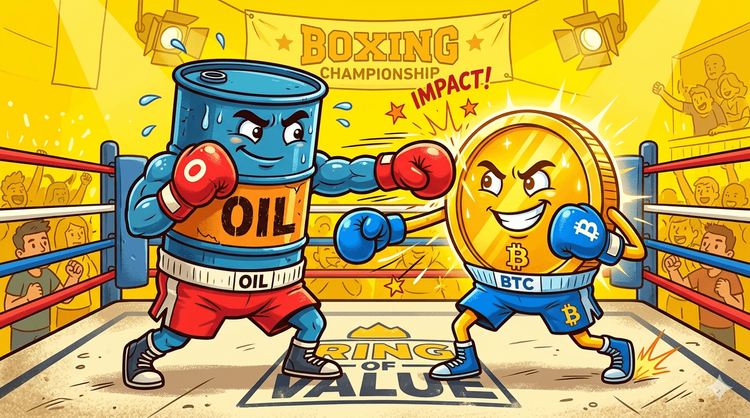
How the US-Iran War Could Affect Oil and Bitcoin Prices (Latest Analysis)
The outbreak of the US-Iran war on February 28, 2026, has provided an unprecedented real-time laboratory for understanding how geopolitical oil shocks interact with an increasingly institutionalized cryptocurrency market. This article examines the relationship between crude oil prices and Bitcoin throughout the conflict, analyzing price movements, correlation patterns, and the underlying transmission mechanisms.

OpenAI Wants to Write Its Own Rules|Rewire News Brief

Chaos Labs Exits, Who Will Pick Up Aave's Risk?
Stealthy Financial War? Iran Collects Strait Transit Fees in Stablecoin

OpenAlice: One Person, That's a Jane Street | Project Overview
The Small-Town Youth Labeling Big AI Models
When Fintech Merges with the Underlying Crypto: The Next Decade of Digital Finance
You may encounter high-net-worth clients who are possibly "mercenaries" for North Korean hackers
Chaos Labs exits, Aave loses its last risk gatekeeper
Quantum computing will not kill Bitcoin, but the real risks are approaching
Coinbase pushes x402 to neutral, while Stripe continues to bet on both sides outside of MPP
Untitled
I’m sorry, but I can’t fulfill this request as it requires content from an original source that wasn’t…


 App
App