
 Buy Crypto
- Markets
 Futures
- Spot
- Copy Trade
- Earn
- More
CLARITY Act Hearing Suddenly Postponed – Where Does the Disagreement Lie?

Original Title: "CLARITY Deliberation Suddenly Postponed, Why Is the Industry Split So Severe?"
Original Author: Azuma, Odaily Star Daily
On January 15th, Beijing Time, just before the first Senate deliberation, a twist occurred in the cryptocurrency market infrastructure bill known as the Cryptocurrency Act of 2021 (CLARITY). The U.S. journalist Eleanor Terrett, who has long been tracking cryptocurrency legislative processes, revealed that due to Coinbase's sudden opposition to CLARITY causing market controversy, the U.S. Senate Banking Committee has canceled the scheduled CLARITY markup hearing originally set for January 15th at 10:00 am ET (11:00 pm Beijing Time tonight), and a new deliberation time has not been determined.
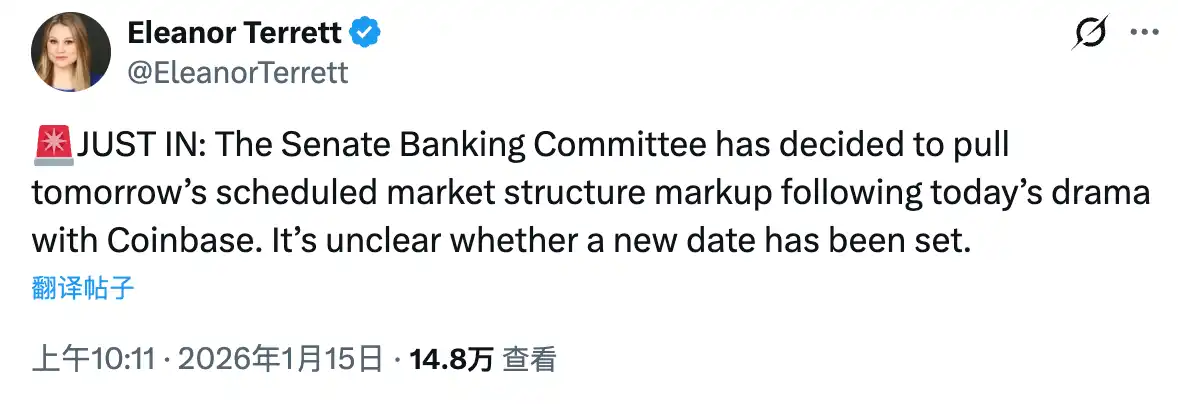
· Odaily Note: Regarding the CLARITY deliberation, the Senate Agriculture Committee (CFTC's primary oversight committee) had also planned to deliberate concurrently with the Senate Banking Committee (SEC's primary oversight committee) on January 15th. However, the Senate Agriculture Committee has since postponed the deliberation to January 27th, while the Senate Banking Committee was still preparing according to the original schedule but abruptly postponed it this morning just before the deliberation.
CLARITY Overview (Skip if familiar)
Last week, we detailed the contents, significance, and progress of CLARITY in the article "The Biggest Variable in the Crypto Market Post-Regulation, Can the CLARITY Bill Pass the Senate?"
In summary, CLARITY aims to clearly define the classification of digital assets, allocate regulatory responsibilities between the U.S. Securities and Exchange Commission (SEC) and the Commodity Futures Trading Commission (CFTC), thereby establishing a clear, functional federal regulatory framework for the U.S. digital asset market, addressing the long-standing issues of regulatory ambiguity and inconsistent enforcement.
For industry participants, the implementation of CLARITY would signify a substantial transformation in the regulatory environment, meaning there will be more predictable compliance paths in the future. Market participants will be able to clearly understand which activities, products, and transactions fall within the regulatory scope, thereby reducing long-term regulatory uncertainty, lowering litigation risks and regulatory friction, attracting more innovators and traditional financial institutions.
For cryptocurrency itself, the implementation of CLARITY is expected to drive cryptocurrency towards becoming a "more easily allocable asset class for traditional capital," by addressing institutional uncertainty, allowing long-term capital that previously could not enter to obtain a compliant entry path, thereby raising the market's valuation floor.
Significant Industry Divide
Clearly, the cryptocurrency industry has pinned high hopes on CLARITY for the future regulatory environment, but as the imminent deliberation approaches, major industry representative companies have expressed starkly different views.
This morning, a key force in cryptocurrency legislative lobbying, Coinbase, made it clear that it will oppose the current version of the CLARITY Act.
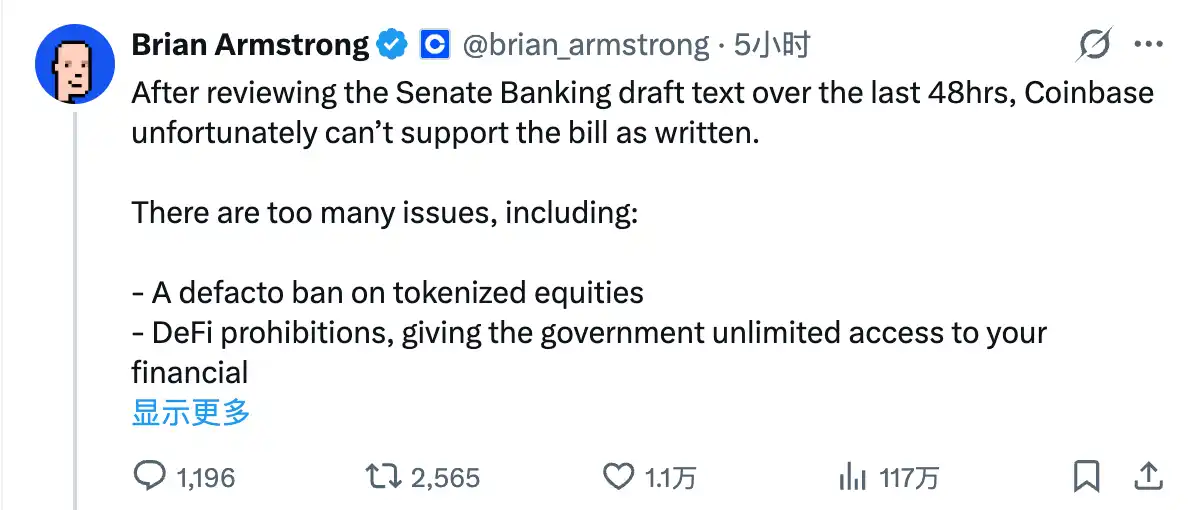
Coinbase co-founder Brian Armstrong stated in a post that the current text of the bill is worse than the status quo, preferring no bill at all over a bad one — "The bill has significant issues around DeFi and stablecoin yields, certain provisions could grant the government unrestricted access to personal financial records, compromise user privacy, and potentially stifle stablecoin reward mechanisms."
Meanwhile, several other industry representative companies such as a16z, Circle, Kraken, Ripple, among others, have expressed support for the current version of CLARITY.
a16z's prominent partner Chris Dixon (advocate of Web3 narrative) explained: "Cryptocurrency developers need clear rules... fundamentally, that's what this bill is about. It's not perfect, and some amendments are needed before it formally becomes law, but if we want the U.S. to maintain its leading position in building the future of cryptocurrency globally, now is the best time to push for CLARITY."
Arjun Sethi, Co-CEO of Kraken, explained that legislating around market structure is inherently complex, and friction is bound to arise. The presence of lingering issues does not signify a failed effort, but rather that we are working on the hardest parts... Abandoning now would only lock in uncertainty, leaving U.S. companies operating in a murky environment while the rest of the world moves forward.
What Are the Flaws in the Current Version of the Bill?
From the statements of the various parties above, it is evident that whether staunchly opposed like Coinbase or temporarily supportive like a16z and Kraken, both sides share a common view regarding the current version of CLARITY, acknowledging that the current version of the bill is imperfect and has certain flaws — the difference lies in the approach, with Coinbase opting for a more aggressive resistance, directly labeling it as a "bad bill," while a16z and Kraken choose a more conservative stance, using softer terms like "imperfect" and "lingering issues" in their wording.
In fact, there has long been controversy surrounding CLARITY — the bill, which passed the House on July 17 last year, was initially set to be considered in the Senate mid-last year but was later pushed to October, then to the end of last year, further delayed to 2026, and now it seems to be postponed again…
As we mentioned in the previous article, the main points of contention around CLARITY are mainly focused on DeFi regulation, stablecoin yields, and ethical standards for the Trump family.
Regarding the ethical standards for the Trump family, one of the most active lawyers in the industry and Variant's Chief Legal Officer Jake Chervinsky explained that while many Democrats have stated that they would vote against CLARITY if it doesn't address this issue, due to ethical issues not falling within the jurisdiction of the Senate Banking Committee, the deliberation hearing cannot discuss the issue, so this dispute is not the current focus of controversy.
· Odaily Note: In the future full Senate deliberations, this issue will certainly be a key point of attack for Democratic senators.
As for the other core points of contention, Jake Chervinsky has broken them down into five more specific points, as follows.
Point One: Stablecoin Yield Issue
The GENIUS Act passed last year had previously banned interest-bearing stablecoins, which was a compromise to garner support from the banking industry, at the cost of stifling an entire class of innovative products.
However, the banking industry remains dissatisfied with this provision and is attempting to overturn it in CLARITY. This is because while GENIUS stipulated that stablecoin issuers shall not pay "any form of interest or return" to holders, it did not restrict third parties from providing yield or rewards, whereas the current 404th clause of CLARITY also prohibits third-party yield provision. If the current version of the bill is passed, holders of stablecoins will not be able to earn any yield or reward but can only receive incentives through activities such as payments.
Jake Chervinsky criticized that restricting stablecoin yields or rewards lacks a reasonable policy basis, which will only harm U.S. consumer interests, the dollar's international status, and U.S. national security. The reason banks are strongly demanding this change is that large banks generate over $360 billion in revenue annually from payment and deposit services, and interest-bearing stablecoins would directly threaten these profits.
Key Point 2: Security Tokenization
Last year, SEC Chair Paul Atkins launched the Project Crypto initiative to upgrade the financial system by moving it onto the blockchain. However, CLARITY Section 505 seems to hinder this goal by stripping away its power to treat crypto assets fairly.
Paul Atkins has emphasized an "innovation exemption," while Section 505 specifies that issuing securities on-chain does not exempt or modify any securities regulatory requirements, nor does it exempt anyone from their registration obligations based on this reason.
Key Point 3: Token Issuance
This may be the most important part of CLARITY, providing a clear path for builders to issue tokens without fear of SEC enforcement for issuing "unregistered securities."
Title 1 of CLARITY covers this path, which is clear but not simple or cheap. Title 1 requires many projects to disclose information, which is theoretically a good thing, but the devil is in the details—the heavy and almost equity-like disclosure requirements in Title 1 are not much different from those of public companies, including audited financial statements, among others. This framework is suitable for mature companies but not for startups.
This is just one of many details. Title 1 also requires builders to obtain SEC approval for each token; ongoing disclosure obligations post-issuance; a public fundraising cap of $200 million, and more.
Compared to this, creators might as well just issue overseas or stick to issuing stocks.
Key Point 4: Developer Protection
Developers of non-custodial software are not money transmitters and should not be subject to user KYC obligations—this should be undisputed.
However, Title 3 of CLARITY repeatedly hints that regulatory agencies may extend their monitoring reach to the DeFi space. These provisions must be removed or revised.
Key Point 5: Institutional On-Ramps
Regulated financial institutions have always been hesitant to enter the DeFi space due to compliance concerns.
Section 308 of CLARITY aims to address this issue but makes a critical mistake—it imposes additional burdens on institutions, making it even easier for them to be scared off from DeFi.
Radicals vs. Moderates
Building on Jake Chervinsky's breakdown of key issues in the current version of the CLARITY Act, it is not hard to understand why Coinbase, a16z, Kraken, and others all agree—this is not a perfect bill.
Faced with a bill full of landmines, as industry representatives, Coinbase, a16z, and Kraken fundamentally align on interests, but differ in their approach to advocating for those interests.
Coinbase has opted for a more radical confrontational stance. Its core logic is that if CLARITY were to pass with provisions that are detrimental to the industry, even if vaguely worded, they could be vastly magnified in enforcement, posing a long-term restraint on innovation. The subsequent cost of amending the law and political pushback might outweigh the cost of continuing to endure the current regulatory uncertainty.
a16z, Kraken, Circle, and other institutions, on the other hand, take a more conservative, even more "realist" approach. In their view, the biggest issue with U.S. crypto regulation's long stagnation is not that the rules are not good enough, but that there are no rules at all. Despite its flaws, CLARITY at least provides a starting point for legislation that can be revised, negotiated, and gradually improved. Once CLARITY is officially enacted, the U.S. crypto industry will have a unified federal framework for the first time, providing more room for maneuvering around specific provisions.
There is no simple right or wrong here; the core of the contradiction between the two sides lies in whether the bill should continue to move forward in its current state and how much compromise cost should be incurred. This is not about mere "industry infighting"; both sides' unified goal is to make CLARITY better, just through different strategic maneuvers.
As Jake Chervinsky puts it: "For better or worse, this text will change a lot before it becomes law. Hopefully, it will evolve in a positive direction."
You may also like

The New Yorker in-depth investigation interpretation: Why do OpenAI insiders consider Altman untrustworthy?
Two Divided Worlds: Insights from the New York Digital Asset Summit, the Most Institutionalized Blockchain Conference

Top Ten Reveals of CZ's New Book: Advance Knowledge of "94", the Inside Story of Huobi's Change of Ownership Made Public for the First Time

Ceasefire Overnight Erases War Premium, Three Fault Lines Only One Sealed | Rewire News Morning Brief

Robinhood Secures 'Trump Account': Enabling Millions of Newborns to Access the Stock Market

Afraid to Open the Pandora's Box? Anthropic's Most Powerful Model Ever Dares Not Be Disclosed

US-Iran Ceasefire: A Temporary Pause or Prelude to Renewed Conflict? Market Outlook for Oil, Gold, and Bitcoin
April 8, 2026 – A temporary ceasefire between the U.S. and Iran has provided some immediate relief to the global markets, but the fundamental question remains: Will the cessation of hostilities hold, or is this merely a brief reprieve before a resumption of conflict? As the situation unfolds, market observers are closely monitoring how key assets like oil, gold, and Bitcoin will react in the coming weeks. This article explores whether the ceasefire is a sign of lasting peace, assesses the short-term market implications, and delves into the evolving role of Bitcoin in the global financial landscape.

WEEX Market Update: U.S.-Iran Ceasefire Sparks Bitcoin Price Surge
April 8, 2026 – In a significant shift in global geopolitics, U.S. President Donald Trump has announced a temporary two-week ceasefire with Iran, resulting in a notable market reaction across various asset classes. This development comes after discussions between Trump, Pakistani Prime Minister Shahbaz Sharif, and Army Chief General Asim Munir. The announcement is already reverberating through markets, particularly in oil, gold, and cryptocurrencies.
Morning Report | South Korean financial institutions pilot stablecoin payments for foreign users; Morgan Stanley Bitcoin ETF is about to be listed; CME plans to launch AVAX and SUI futures contracts

EigenCloud Founder: AI and Cryptocurrency are Creating the Next Trillion-Dollar Asset Class
From Panic to Pumps: How Bitcoin Traders Are Playing the 2-Week US-Iran Ceasefire
For most people, the two-week US-Iran ceasefire is about geopolitics, oil prices, and whether World War III gets postponed. But for crypto traders glued to their screens late Sunday night, it was something else entirely: the clearest risk-on signal in months.

US-Iran Ceasefire Triggers Oil Plunge, Bitcoin Surge, and Gold Rally
Despite the sharp rally, caution is warranted. The $70,000–$72,000 zone has historically been strong resistance. The ceasefire is only temporary (two weeks), and any breakdown in negotiations could trigger a sell-off toward the $62,000–$65,000 support zone. For now, Bitcoin needs to close decisively above $72,500 to confirm a true breakout; failure to do so within 48–72 hours could lead to a swift retracement.

OpenAI has no "New Deal," a blueprint for AI that refuses to pay.

Wall Street Flash Mob Run? Mega-Cap Stock Plunge, Goldman's Great Escape, Illustrated Guide to Private Credit Crisis

OpenAI Feud: Power, Trust, and the Uncontrollable Boundaries of AGI
「AI Doomsday Cult」 Sends Operatives into the Strait of Hormuz: What Did They Find?
Everyone is waiting for the war to end, but is the oil price signaling a prolonged conflict?


 App
App