
 Buy Crypto
- Markets
 Futures
- Spot
- Copy Trade
- Earn
- More
Bitcoin Drops Below $86,000, but Is the Plunge Just Getting Started?

Original Article Title: "Bitcoin Price Drops Back to $10,000?! Bloomberg Expert Gives Most Pessimistic Prediction"
Original Article Author: Seed.eth, via Bitpush News
This past weekend, the crypto market did not see a sentiment recovery. After several days of narrow range trading, Bitcoin came under pressure on Sunday evening to Monday during the US stock market session, dropping below the $90,000 whole number level, with the intraday low briefly touching near $86,000. ETH dropped 3.4% to $2,980; BNB dropped 2.1%; XRP dropped 4%; SOL dropped 1.5% to around $126. Among the top ten cryptocurrencies by market cap, only TRX recorded a slight increase of less than 1%, while the rest were in a correction phase.
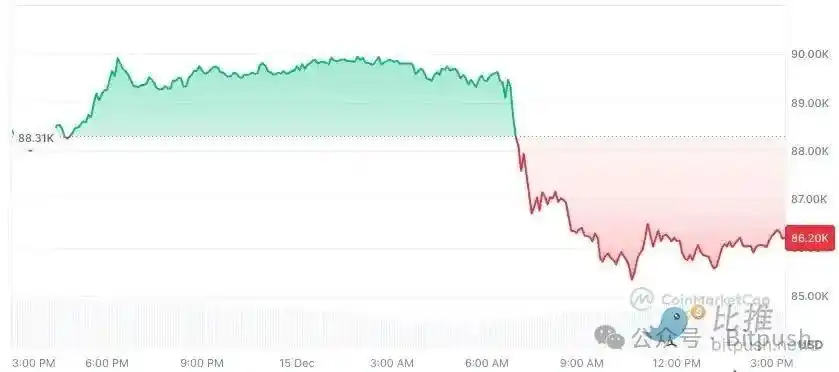
From a timing perspective, this was not an isolated correction. Since hitting a new all-time high in mid-October, Bitcoin has retraced more than 30%, and each rebound has appeared brief and hesitant. While ETF inflows have not shown systemic outflows, the marginal inflow has significantly slowed down, making it difficult to provide the market with the "sentiment cushion" as before. The crypto market is transitioning from unilateral optimism to a more complex and patience-testing phase.
Against this backdrop, Mike McGlone, Senior Commodity Strategist at Bloomberg Intelligence, released a new report placing Bitcoin's current trend into a broader macro and cyclical framework and made a highly unsettling judgment: Bitcoin is likely to return to $10,000 by 2026, which is not an alarmist statement, but one of the potential outcomes under a special "deflation" cycle.
The controversy surrounding this view is not just about the "low" number itself, but because McGlone does not view Bitcoin as an independent crypto asset, but rather reexamines it within the long-term coordinates of "global risk assets-liquidity-wealth reversion."
"Inflation After Deflation"? McGlone Focuses Not on Crypto, but on Cyclical Turning Points
To understand McGlone's judgment, the key is not how he views the crypto industry, but how he understands the macro environment of the next stage.
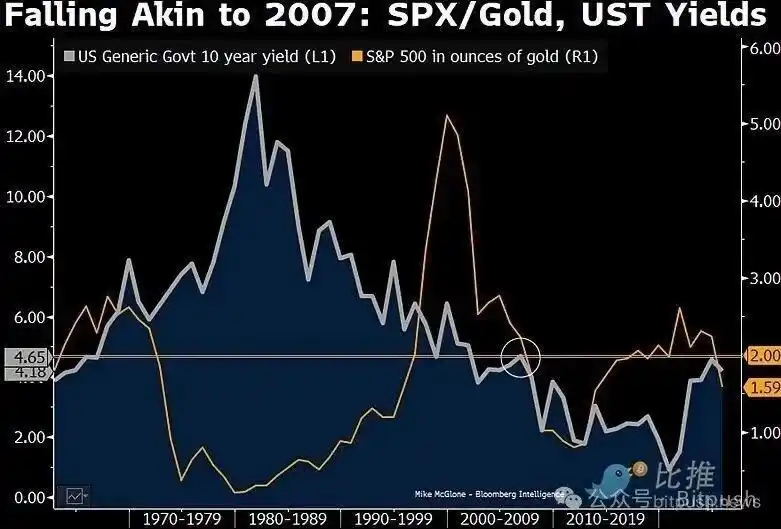
In his latest view, McGlone repeatedly emphasizes a concept: Inflation / Deflation Inflection. In his view, the global market is standing near such a key turning point. With major economies seeing peak inflation and growth momentum slowing down, asset pricing logic is transitioning from "inflation combat" to dealing with "inflation after deflation"—the stage where prices fall across the board after the inflation cycle ends. He wrote, "Bitcoin's downward trend may replicate the situation the stock market faced in 2007 in response to the Fed's policies."
This is not his first time issuing a bearish warning. As early as November last year, he predicted that Bitcoin would drop to the $50,000 mark.
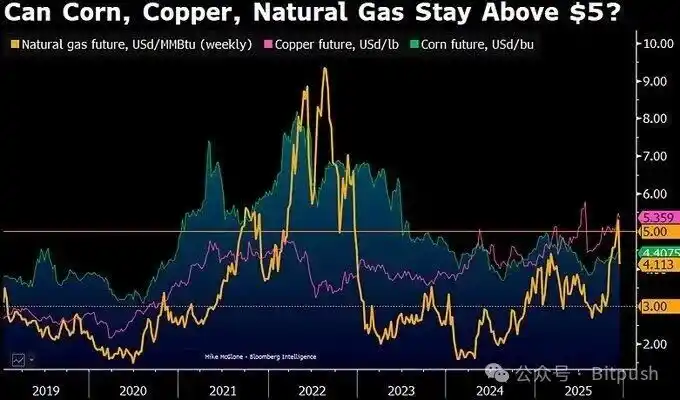
He pointed out that around 2026, commodity prices may fluctuate around a key axis—natural gas, corn, copper, and other core commodities' "inflation-deflation divide line" may settle near $5, and among these commodities, only assets like copper, which have genuine industrial demand support, may still be above this axis by the end of 2025.
McGlone noted: When liquidity recedes, the market will reevaluate "real demand" versus "financialization premium." In his framework, Bitcoin is not "digital gold" but an asset highly correlated to risk appetite and speculative cycles. When the inflation narrative recedes and macro liquidity tightens, Bitcoin often tends to reflect these changes earlier and more dramatically.
McGlone believes that his logic is not based on a single technical level but on the overlay of three long-term paths.
Firstly, it is mean reversion after extreme wealth creation. McGlone has long emphasized that Bitcoin is one of the most extreme wealth amplifiers in a global loose monetary environment over the past decade. When the growth rate of asset prices significantly outpaces economic activity and cash flow growth for an extended period, reversion tends to be not gentle but severe. Historically, whether it's the US stock market in 1929 or the tech bubble in 2000, a common feature at the top stage is that the market repeatedly searches for a "new paradigm" at highs, and the subsequent correction often far exceeds the most pessimistic expectations at that time.
Secondly, it is the relative pricing relationship between Bitcoin and gold. McGlone places particular emphasis on the Bitcoin/gold ratio. This ratio was around 10x at the end of 2022, then rapidly expanded under the bull market drive, reaching over 30x at one point in 2025. However, this ratio has since fallen by about 40% this year, dropping to around 21x. In his view, if deflationary pressures persist and gold remains strong due to safe-haven demand, a further return of the ratio to historical ranges is not a radical assumption.
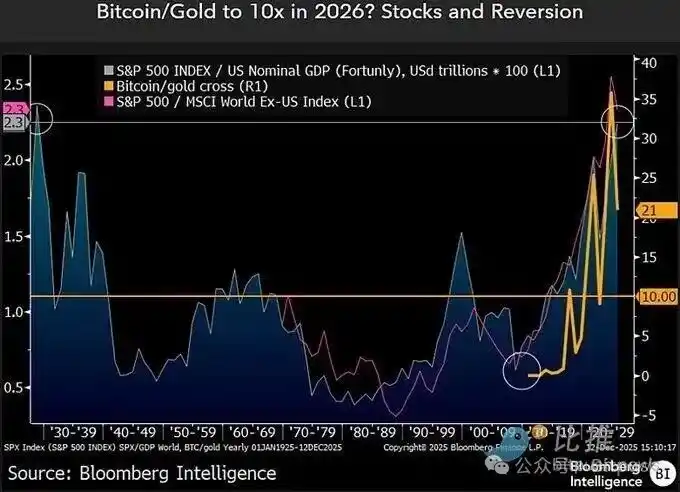
Thirdly, it is a systemic issue in the speculative asset supply environment. Although Bitcoin itself has a clear total supply limit, McGlone has repeatedly pointed out that what the market is truly trading is not the "uniqueness" of Bitcoin but the risk premium of the entire crypto ecosystem. When millions of tokens, projects, and narratives compete for the same slice of risk budget, during a deflationary cycle, the entire sector tends to be uniformly discounted, and Bitcoin finds it challenging to completely detach from this repricing process.
It should be noted that Mike McGlone is not a bull or bear spokesperson for the crypto market. As a senior commodity strategist at Bloomberg, he has long studied the cyclical relationship between crude oil, precious metals, agricultural products, interest rates, and risk assets. While his predictions may not always be pinpoint accurate, his value lies in: he often poses structural counter questions when market sentiment is most unanimous.
In his latest remarks, he also took the initiative to review his own "mistakes," including underestimating the timing of gold breaking $2,000 and deviations in his judgment of the U.S. bond yields and stock market rhythm. But in his view, these deviations have repeatedly confirmed one thing: the market is most prone to trend illusion before a cyclical turning point.
Other Voices: Divergence is Widening
Of course, McGlone's judgment is not market consensus. In fact, the attitudes of mainstream institutions are showing significant divergence.
Traditional financial institutions such as Standard Chartered have recently significantly lowered Bitcoin's medium to long-term price targets, reducing the 2025 target from around $200,000 to about $100,000, and also adjusting the 2026 speculative space from around $300,000 to about $150,000. In other words, institutions no longer assume that ETFs and corporate allocations will continue to provide marginal buying pressure in any price range.
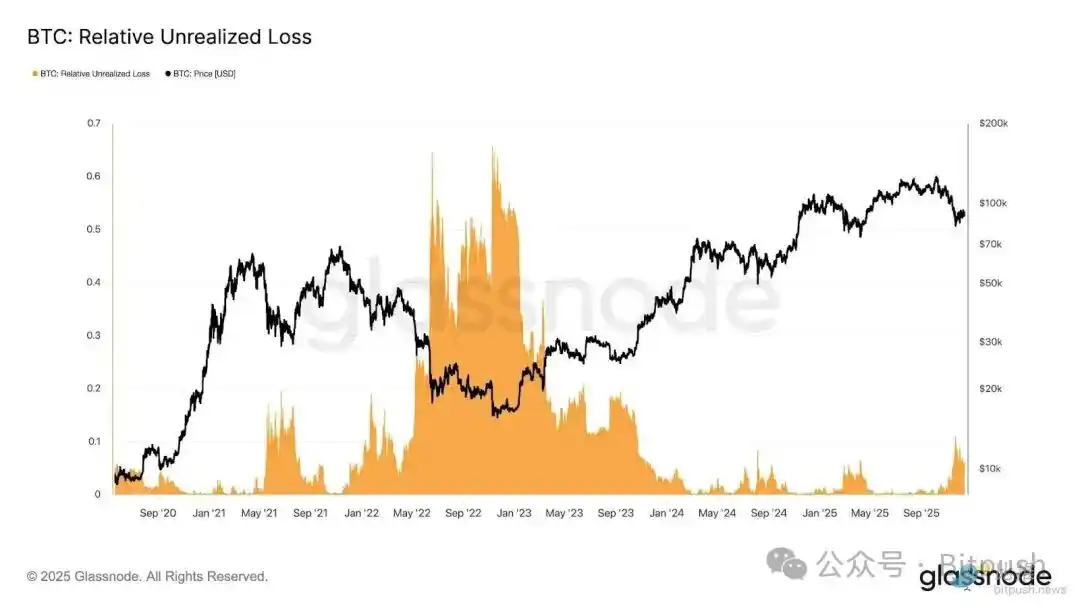
Research from Glassnode points out that Bitcoin's range-bound price action between $80,000 and $90,000 has put pressure on the market, with the intensity of this pressure akin to the trend at the end of January 2022. The current market's relative unrealized losses are approaching 10% of the market cap. Analysts further explain that such market dynamics reflect a state of "constrained liquidity, sensitive to macro shocks," but have not yet reached the level of typical bear market capitulation (panic selling).
10x Research, which leans more towards quantitative and structural research, has come to a more direct conclusion: they believe that Bitcoin has entered the early stages of a bear market, with on-chain indicators, fund flows, and market structure all indicating that the downward cycle has not yet run its course.
From a broader time perspective, the current uncertainty surrounding Bitcoin is no longer just an issue within the crypto market itself but is firmly embedded in the global macro cycle. The upcoming week is seen by many strategists as the most crucial macro window of the year-end—where the European Central Bank, Bank of England, and Bank of Japan will sequentially announce interest rate decisions, while the U.S. will see a series of delayed employment and inflation data releases, providing a belated "reality check" for the market.
The Federal Reserve sent an unusual signal at its December 10 interest rate meeting: not only did it cut rates by 25 basis points, but there were also rare dissenting votes, with Powell bluntly stating that job growth in recent months may have been overestimated. This week's intense macro data releases will reshape the market's core expectations for 2026—whether the Federal Reserve can continue to cut rates or has to hit the pause button for a longer period. For risk assets, this answer may be more important than any single asset's bull or bear debate.
You may also like

After two years, Hong Kong's first batch of stablecoin licenses finally issued: HSBC, Standard Chartered make the cut

The person who helped TAO rise by 90% has now single-handedly crashed the price again today

3-Minute Guide to Participating in the SpaceX IPO on Bitget

Top 5 Cryptos to Buy in 2026 Q1: A ChatGPT Deep Dive Analysis
Explore the top 5 cryptos to buy in Q1 2026 including BTC, ETH, SOL, TAO, and ONDO. See price outlooks, key narratives, and institutional catalysts shaping the next market move.

How to Earn $15,000 with Idle USDT Before Altcoin Season 2026
Wondering if altcoin season is coming in 2026? Get the latest market update, and learn how to turn your idle stablecoins waiting for entry into extra rewards up to 15,000 USDT.
Can You Win Joker Returns Without Large Trading Volume? 5 Mistakes New Players Make In WEEX Joker Returns Season 2
Can small traders win WEEX Joker Returns 2026 without huge volume? Yes—if you avoid these 5 costly mistakes. Learn how to maximize card draws, use Jokers wisely, and turn small deposits into 15,000 USDT rewards.

Altcoin Season 2026: 4 Stages to Profit (Before the Crowd FOMO In)
Altcoin Season 2026 is starting — discover the 4 key stages of capital rotation (from ETH to PEPE) and how to position before the peak. Learn which tokens will lead each phase and avoid missing the rally.

Will Alt season come in 2026? 5 Tips to Spot the Next 100x Crypto Opportunities
Will altcoin season arrive in 2026? Discover 5 rotation stages, early signals smart traders watch, and the key crypto sectors where the next 100x altcoin opportunities may emerge.

The bear market has arrived, and cryptocurrency ETF issuers are also getting involved

The richest man had a quarrel with his former boss

BTC Firm Above 70K! Saylor’s "Institutional Logic" vs. Moon’s "Retail Faith": Who is Really Harvesting the Market?
Bitcoin is holding firm above the $70,000 support level following a massive short squeeze that liquidated $427 million. As the "Four-Year Cycle" narrative shifts, the market is split: Michael Saylor’s cold, institutional "indiscriminate stacking" vs. Carl Moon’s high-energy retail "hopium." This article decodes these two polar-opposite strategies for the 2026 bull run and reveals how WEEX’s institutional-grade liquidity and AI trading tools empower every type of investor to convert market volatility into profit.

The Girl Who Created the SBTI Test: A Story of a Doomed Cyber Love, an E-Widow Ratfolk

B.AI Officially Launched: Building AI Agent Financial Bedrock Platform, Driving AGI Era Business Underlying Logic

B.AI Officially Launched: Breaking Down A2A Collaboration Barriers to Unlock the Smart Body Economy's Full Potential
We helped Xu Mingxing write a book called "<OK Life>".

Rare APY of 400%, is TradeXYZ handing out money to oil bulls?
a16z: Perpetual Contracts are Rewriting Global Trading Rules

Bitcoin Hits $73,000 Triggering $427M Short Liquidation | Carl Moon: $200,000 is the Target
April 9, 2026 (UTC+0), 22:17. Bitcoin (BTC) executed a high-velocity surge within minutes, heavy-hitting the $73,000 psychological barrier and touching a local high near $74,000. While the price has since retraced to consolidate above $72,000, this "instant ambush" successfully completed a $427M liquidation of short positions.
After two years, Hong Kong's first batch of stablecoin licenses finally issued: HSBC, Standard Chartered make the cut
The person who helped TAO rise by 90% has now single-handedly crashed the price again today
3-Minute Guide to Participating in the SpaceX IPO on Bitget
Top 5 Cryptos to Buy in 2026 Q1: A ChatGPT Deep Dive Analysis
Explore the top 5 cryptos to buy in Q1 2026 including BTC, ETH, SOL, TAO, and ONDO. See price outlooks, key narratives, and institutional catalysts shaping the next market move.
How to Earn $15,000 with Idle USDT Before Altcoin Season 2026
Wondering if altcoin season is coming in 2026? Get the latest market update, and learn how to turn your idle stablecoins waiting for entry into extra rewards up to 15,000 USDT.
Can You Win Joker Returns Without Large Trading Volume? 5 Mistakes New Players Make In WEEX Joker Returns Season 2
Can small traders win WEEX Joker Returns 2026 without huge volume? Yes—if you avoid these 5 costly mistakes. Learn how to maximize card draws, use Jokers wisely, and turn small deposits into 15,000 USDT rewards.


 App
App