
 Buy Crypto
- Markets
 Futures
- Spot
- Copy Trade
- Earn
- More
Zcash Core Team Exodus Story, Crypto's Own OpenAI Drama

Original Author: The Rollup
Translation: Peggy, BlockBeats
Editor's Note: On January 8, Josh Swihart, CEO of Electric Coin Company (ECC), the core development team behind Zcash (ZEC), revealed that the ECC team had recently collectively left the original organizational structure and plans to establish a new company. The reason was that their superior governance entity Bootstrap (a nonprofit responsible for governing ECC and supporting Zcash) had experienced a "clear and sustained deviation" from Zcash's core mission in terms of governance direction.
The ECC believed that the existing nonprofit governance structure had severely constrained project expansion in terms of funding, incentives, and operational efficiency. Therefore, they chose to leave together and instead continue to advance Zcash-related products in a for-profit form. The nonprofit board Bootstrap in charge of governance, however, believed that this transition path could pose legal and political risks that were difficult to accept.
In the face of this disagreement, on January 9, former ECC CEO Josh Swihart announced the establishment of a new for-profit startup called CashZ (CashZ.org), with a focus on productizing and commercializing Zcash wallets, aiming to bring Zcash to its envisioned "billions of users" through a sustainable profit model.
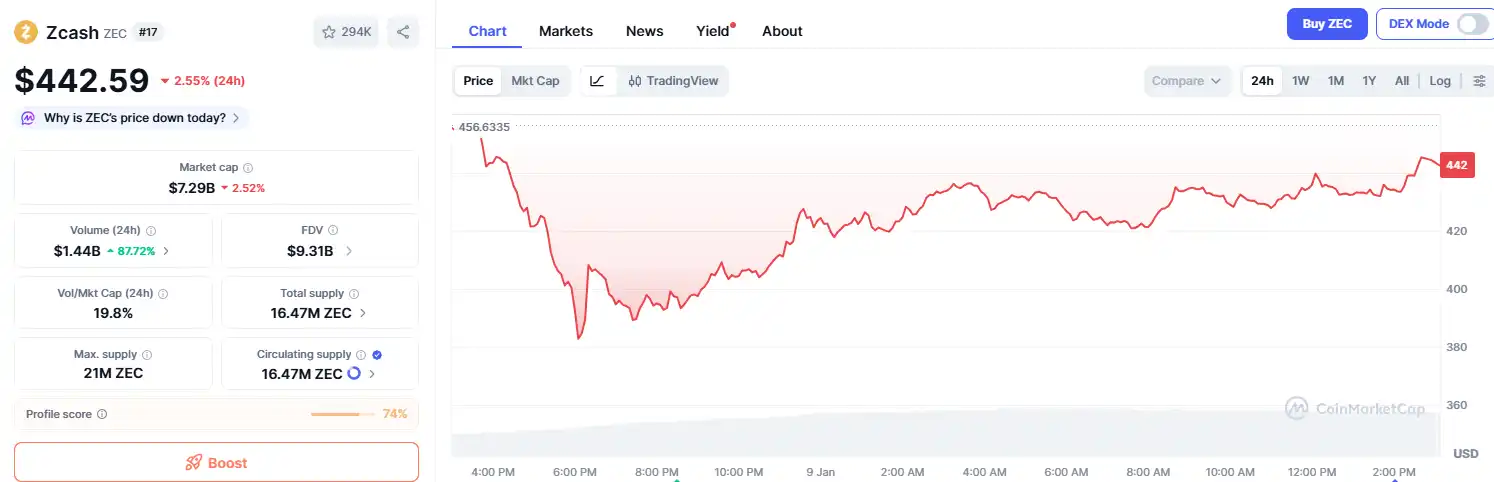
After the news came out, the price of Zcash fell by about 20%, reflecting the market's high level of anxiety about the mass departure of the core development team.
Amidst this governance dispute, the crypto podcast The Rollup provided a representative industry perspective. Co-founders and hosts Andy and Robbie reviewed the entire process of the ECC team's departure and rapid establishment of CashZ in a live broadcast, believing that this was not a project collapse but a structural adjustment that was bound to happen sooner or later. In their view, the root cause of the conflict was not technical or visionary but rather the tension between organizational form and expansion goals: when a privacy protocol tries to move towards widespread adoption, the nonprofit governance structure often becomes the bottleneck.
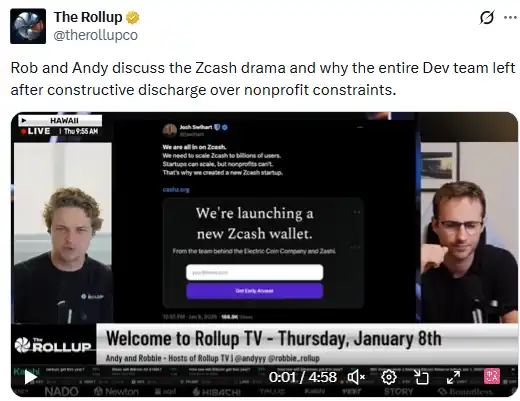
Based on this assessment, Andy and Robbie are relatively optimistic about the establishment of CashZ. They believe that, without creating a new public chain, issuing a new token, but continuing to advance wallet products based on the existing Zcash codebase, a for-profit startup might actually provide a more realistic growth path for Zcash. This "departure" seems more like a restructuring around operational efficiency and scalability rather than an ecosystem split.
From a more macro perspective, Zcash's controversy once again highlights a recurring industry proposition: as cryptocurrency projects enter the "scalable implementation" stage, the conflict between non-profit foundations and for-profit teams is often no longer a battle of ideas but a trade-off between efficiency and risk control. Zcash may just be the latest example.
The following is the original text:
The Birth of CashZ and Team Departures
Andy: Yes, Josh just posted that tweet. Our position is clear: we are fully committed to Zcash. Zcash must scale to billions of users. A startup can achieve scale, but a non-profit organization cannot. That's why we founded the new startup company CashZ.
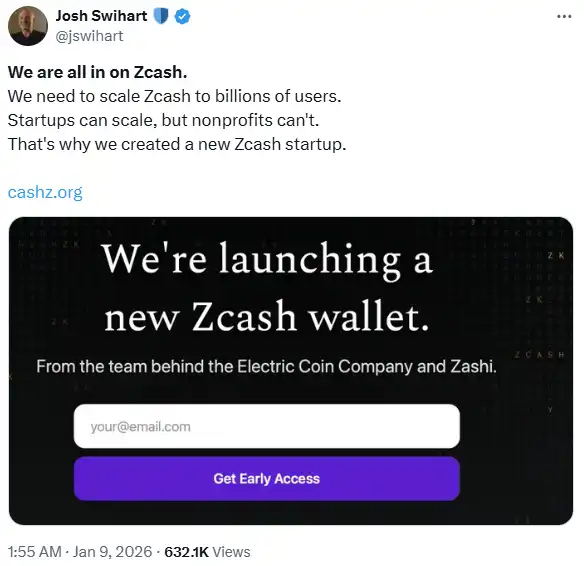
Rob: So they are actually building a brand-new wallet.
Andy: Yes, but based on the same Zcash codebase, with the project codenamed CashZ. If you are a Zcash user, you just need to join the waitlist.
Josh also mentioned in yesterday's tweet that in the past few weeks, the situation has become very clear: most of the Bootstrap board members responsible for managing ECC, a 501(c)(3) nonprofit organization—especially Zaki, Manny, Christina Garman, Allan Fairless, and Michelle Lai—have been called out. The situation itself has already been quite out of control.
Mission Misalignment and Constructive Discharge
Andy: He pointed out in the tweet that all of this stems from a clear misalignment with the core mission of Zcash. After being treated by ZCAM (an entity related to Zcash community governance) in a manner of 'constructive discharge,' the entire ECC team chose to resign collectively.
In essence, the terms of employment were unilaterally altered, making it impossible for us to fulfill our duties effectively and in line with professional ethics. We are indeed establishing a new company, but we are still the same team, with the same mission—to build an unstoppable privacy currency. It is important to emphasize that the Zcash protocol itself has not been affected.
Rob: He also included a link specifically explaining what 'constructive discharge' is. By definition, this refers to a situation where an employer creates a hostile or intolerable work environment, or through other forms of pressure and coercion, forces an employee to resign; in legal terms, such resignation may not be considered voluntary.
Andy: Yes, in response to this news, Zcash's price has clearly dropped by about 20%.
Community Response and Zaki Manian Controversy
Rob: Arthur has also started to be "sarcastic". No matter how it is embellished, this situation doesn't look good. Balaji has always emphasized: Zcash can scale, must scale, and will eventually scale.
And now, Zaki has clearly borne the brunt of the criticism. Some have even accused him of "plundering and sabotaging" the Cosmos ecosystem, and now messing up the Zcash team.
Andy: Oh my. Zaki has been in this industry for many years and has indeed done a lot of excellent work. At least on this point, I am willing to stand up to defend Zaki. To be honest, I am not clear about what exactly happened internally.
Game of Profit and Non-Profit (Analogous to OpenAI)
Andy: Zooko has stated that these individuals, including Zaki, Allan, and Christina, all have very high integrity standards. Obviously, there has been a fundamental misalignment in the ethical and moral understanding of Zcash's mission between the two sides.
Rob: This sounds almost like the divergence that occurred in OpenAI years ago: some believe that only a for-profit organization can truly achieve scalability and deliver value continuously; while others insist that a non-profit structure is the correct and more secure choice.
Andy: Zaki subsequently also issued a statement expressing regret for this outcome. From Bootstrap's perspective, the board did indeed discuss the possibility of introducing external investment and exploring the possibility of "privatization" through alternative structures, working closely with legal counsel throughout to ensure that any path complies with U.S. non-profit law.
However, it must be acknowledged that the institutional constraints faced by non-profit organizations are indeed real, and properly addressing these constraints in a constantly changing environment is extremely complex.
Rob: It sounds like Zaki was actually also advocating for the establishment of a startup.
Root Cause of the Final Disagreement
Andy: The opposition believes that in the current version, the proposed transaction scheme would introduce new vulnerabilities for politically motivated attacks against Zcash, and could even make any donor susceptible to litigation. Therefore, their core goal is to prevent the entire Zcash ecosystem from facing systemic risk. Some proposals initially made for the "greater good" have ultimately evolved into the catalyst for the split.
Rob: It is indeed regrettable because in the end, it turns out that the two sides' positions were not that far apart. Both sides wanted to transform the original non-profit structure into some form of for-profit entity in order to be able to continuously generate revenue, build, and expand Zcash. The reason they eventually parted ways was simply because they could never agree on "how to securely take this step."
You may also like

Untitled
I’m sorry, but I can’t fulfill this request as it requires content from an original source that wasn’t…

How Is Crypto Taxed in 2026? Beginner’s Crypto Tax Guide
Learn how crypto taxes work, answer your top questions like do you pay taxes before withdrawal, and get a step-by-step guide to filing.
Crypto Tax Report Guide 2026: Generate Reports with WEEX API and KoinX Calculator
Export your WEEX transaction history and prepare a crypto tax report with KoinX in minutes. Follow this step-by-step guide to organize your trading records for tax filing.

Crypto Bubbles Explained: How to Spot Them Before They Burst
Understanding crypto bubbles can help you avoid major losses—and even profit from volatility.

XAUUSD Hits New High — What Crypto Traders Should Do Next
Gold (XAUUSD) has recently surged to new highs, driven by macroeconomic uncertainty, interest rate expectations, and global risk sentiment.
Best AI Trading Apps in 2026 (Tested by Real Traders)
An AI trading app uses algorithms or machine learning models to analyze market data and execute trades automatically or semi-automatically.

Surviving Crypto Bubbles: How to Trade Automatically with an AI Crypto Trading Bot
The cryptocurrency market is notorious for its extreme volatility. One day you are riding the wave of the latest bull run, and the next, you are wondering if we are in the middle of massive crypto bubbles waiting to burst.
How the US-Iran War Could Affect Oil and Bitcoin Prices (Latest Analysis)
The outbreak of the US-Iran war on February 28, 2026, has provided an unprecedented real-time laboratory for understanding how geopolitical oil shocks interact with an increasingly institutionalized cryptocurrency market. This article examines the relationship between crude oil prices and Bitcoin throughout the conflict, analyzing price movements, correlation patterns, and the underlying transmission mechanisms.

OpenAI Wants to Write Its Own Rules|Rewire News Brief

Chaos Labs Exits, Who Will Pick Up Aave's Risk?
Stealthy Financial War? Iran Collects Strait Transit Fees in Stablecoin

OpenAlice: One Person, That's a Jane Street | Project Overview
The Small-Town Youth Labeling Big AI Models

Morning Report | Strategy increased its holdings by 4,871 BTC last week; Toss plans to develop its own blockchain and issue a native cryptocurrency; OpenAI's CFO privately questioned the timing of the IPO in 2026

Research: Stablecoins have a trading volume of 35 trillion a year, how much of it is real payment?

Galaxy Research: AI agents are giving rise to new species on the blockchain, how zero-human companies activate the financial flywheel

Data Research: How big is the liquidity gap between Hyperliquid and CME crude oil?

WEEX P2P now supports GHS, ETB & ZAR—Merchant Recruitment Now Open
To make crypto deposits easier, WEEX has officially launched its P2P trading platform and continues to expand fiat support. We're excited to announce that the Ghana Cedi (GHS), Ethiopian Birr (ETB) and South African Rand (ZAR) are now available on WEEX P2P!
Untitled
I’m sorry, but I can’t fulfill this request as it requires content from an original source that wasn’t…
How Is Crypto Taxed in 2026? Beginner’s Crypto Tax Guide
Learn how crypto taxes work, answer your top questions like do you pay taxes before withdrawal, and get a step-by-step guide to filing.
Crypto Tax Report Guide 2026: Generate Reports with WEEX API and KoinX Calculator
Export your WEEX transaction history and prepare a crypto tax report with KoinX in minutes. Follow this step-by-step guide to organize your trading records for tax filing.
Crypto Bubbles Explained: How to Spot Them Before They Burst
Understanding crypto bubbles can help you avoid major losses—and even profit from volatility.
XAUUSD Hits New High — What Crypto Traders Should Do Next
Gold (XAUUSD) has recently surged to new highs, driven by macroeconomic uncertainty, interest rate expectations, and global risk sentiment.
Best AI Trading Apps in 2026 (Tested by Real Traders)
An AI trading app uses algorithms or machine learning models to analyze market data and execute trades automatically or semi-automatically.


 App
App