
- Buy Crypto
- Markets
 Futures
- Spot
- Copy Trade
 Earn
Earn- More
X Space Review | The Polkadot Ecosystem In 2024

With the Polkadot topic continuing for the past six months, this veteran star public chain has once again attracted market attention. And in the recent months of the bull market, DOT has also risen amid controversy. What work has the Polkadot Foundation done over the years, and how do they view these market doubts? How has the ecosystem developed?
On December 3, Dapalooza BlockBeats invited Bill Laboon from the Polkadot Web3 Foundation, Lurpis, Co-Founder and CEO of Bifrost, and Yuki, Head of the Moonbeam Network Asia Community, with the theme "The Polkadot Ecosystem In 2024," to review the efforts of the 2024 Polkadot ecosystem.
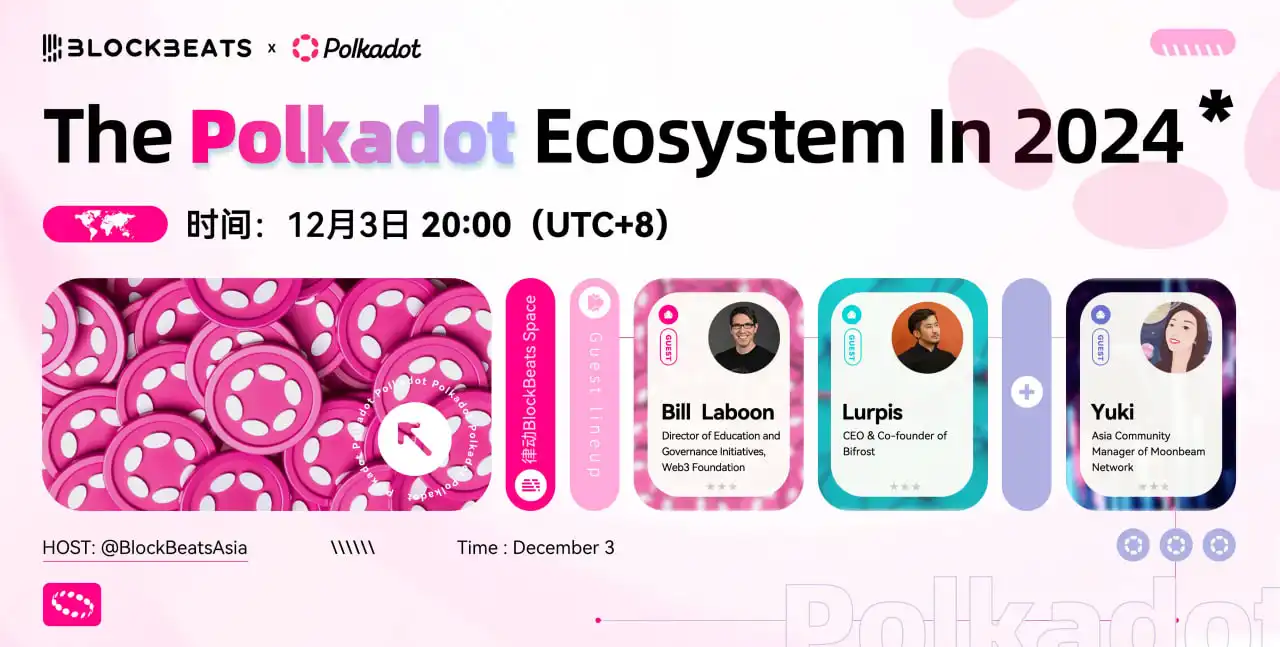
BlockBeats: Welcome everyone, please briefly introduce yourself and your project.
Bill Laboon: I'm Bill Laboon, Chair of Education and Governance at the Web3 Foundation. I started participating in the Polkadot project in 2018 and joined the Web3 Foundation in 2019, mainly working in the education field. I used to be a computer science professor, but as I learned more about blockchain, I jumped into this industry.
Yuki: Hello everyone, I'm Yuki from the Moonbeam Network, one of the early contributors. About the Moonbeam Network, many of you may be more familiar with the slot auction we did on Polkadot four years ago. The scene at that time may still be fresh in many people's memories. Initially, our vision on Polkadot was that Moonbeam Network would become the entry point for Solidity developers to enter the Polkadot ecosystem because Moonbeam Network brought Ethereum's development environment to the Polkadot ecosystem. But looking back now, Polkadot's development is very different from four years ago. Currently, Polkadot has put forward many new concepts and ideas, including the Plaza upgrade plan. Based on the current Assets Hub, it can not only support asset issuance but also be compatible with Rust and EVM smart contracts. For our parachain, it has also been upgraded along with the Polkadot ecosystem.
Lurpis: I'm Lurpis, a Bifrost Co-founder. I'm thrilled to be here with Bill and Yuki to discuss some recent developments in the Polkadot space. In the previous cycle, Polkadot seemed to be a very hot project in the Asian region, but during this bear market period, it has faced criticism from many in the community and has experienced some dramatic events. Therefore, we have been delving deep into some of the related technologies of Polkadot recently. Of course, we have also taken note of the various voices in the market. So, I would like to take this opportunity to discuss with everyone some of the latest developments.
BlockBeats: For the audience unfamiliar with the development of the Polkadot ecosystem, could you outline for us the key milestones of the Polkadot ecosystem in the past year?
Bill Laboon: I think there are two significant events on Polkadot. One is what is happening now, and the other is the plan for the future. First is the evolution towards Polkadot 2.0, which actually has three parts: asynchronous backing, a technology that increases throughput by a factor of ten and speeds it up by a factor of two. Polkadot 2.0 has already launched in March this year. In addition to the Polkadot Parachain auctions, ongoing Coretime and Elastic Expansion features are also in progress. These have been implemented on the Kusama network but are not yet on Polkadot, although they should be soon, allowing you to use multiple cores, meaning you can expand and contract your parachain.
So, the main focus this year has been on increasing throughput and Parachain auctions. Previously, you had to win an auction to launch a Parachain, but now anyone can. The second thing is scalability; we have made a lot of improvements in scalability. We just did a test on the Kusama network, reaching 87,000 transactions per second. Right now, we are working hard to improve Polkadot's scalability to make it easier for developers to build on top of it.
The second thing is actually setting out the future development plans for Polkadot. First is the Plaza upgrade plan, where you can write smart contracts without building a parachain and deploy them directly onto Polkadot. Looking ahead, our development direction is JAM, which is a more advanced version of Polkadot that allows for the creation of various services and a more user-friendly programming experience. But the major plan for this year should be the 'Plaza Upgrade,' expected to roll out around mid-next year. As for the 'JAM Plan,' it will take some more time.
Regarding Polkadot, I would like to talk about its level of decentralization, which has been continuously increasing. This is also a key belief of our Web3 Foundation. Our Nakamoto Coefficient is now at 131, which is basically the highest in the entire ecosystem. Of course, Open Gov is also crucial for decentralization, where all decisions are in the hands of DOT holders.
Over the past year, this system has indeed developed well. We have discovered what methods are effective and what are not. Open Gov has actually allowed people to learn from experience, and we now have a well-functioning system with a sustainable treasury. Recently, we adjusted the inflation rate, reduced inflation, increased the amount in the treasury, so the Polkadot ecosystem itself, the Polkadot chain itself can sustain itself without needing too much support from the Web3 Foundation and the community. It can continue to operate on its own through Open Gov and further decentralization. We are indeed working to make it a self-sustaining ecosystem and are making progress in that direction.
We have also faced many challenges, all stemming from our fully on-chain governance, where everything is controlled by DOT holders. From this, we have learned two important lessons. One is the importance of coordination, not management and command, but ensuring that everyone has open communication channels and can make reasonable plans in this decentralized ecosystem. This is the direction we are truly striving towards. We have many open channels, with two commonly used governance participation websites in the ecosystem being Polkassembly and SubSquare.
The second challenge is the budget. The amount of DOT available in the treasury is limited, and previously anyone could submit treasury proposals. While people can still submit treasury proposals, the community lacks good oversight on spending. Now, with the help of Alice and Bob, we have established treasury proposal and bounty standards, as well as considered budgeting and conducted some data analysis. Currently, our treasury is not running out of funds and can support the continued development of the ecosystem. We are stricter in terms of spending, ensuring that Polkadot spends money in meaningful ways, truly investing in product development. I believe the real challenge was the development of the OpenGov platform, but we have achieved it. We now have clear plans and budgets while not sacrificing decentralization. This is a crucial part of Polkadot's future sustainable development.
BlockBeats: Since the last cycle, Bifrost has been exploring the multi-chain development path but has always maintained a focus on and activity level within the Polkadot ecosystem. Could you share with us the progress Bifrost has made over the past year and the achievements in building within the Polkadot ecosystem? What opportunities does Polkadot 2.0's ecosystem present for Bifrost?
Lurpis: Earlier, we mentioned a lot about Polkadot 2.0, including technical developments, which is also why Bifrost is deeply involved in the Polkadot ecosystem. Bifrost specializes in whole-chain liquidity staking, which inevitably involves cross-chain technology. The solutions currently launched by Polkadot happen to align perfectly with our business needs.
Let's briefly introduce Bifrost. We provide whole-chain liquidity staking services, not only for Polkadot but also for various POS blockchains through cross-chain interoperability, essentially developing a parallel chain based on the Polkadot framework. In terms of TVL, we are the largest liquidity staking provider on Polkadot. Compared to applications developed on smart contracts, our advantage lies in cross-chain interoperability. In addition to Polkadot, we also provide liquidity staking for chains such as Moonbeam and Manta.
During this period, we often complain about some of the issues with Polkadot, with the most criticized being that many people do not know where Polkadot's applications are or how to use the Substrate framework to develop chains. In reality, Polkadot 1.0 gave everyone the biggest feeling of being able to easily create a chain, which many Ethereum Layer 2 solutions or OP Stacks can now also achieve. In addition to chain creation, Polkadot 2.0 can also deploy various applications. Taking Bifrost as an example, it can provide standardized multi-chain products and share liquidity. It offers a one-stop solution to the fragmented liquidity and governance issues of different blockchains.
Let's provide a few application examples. For instance, in the Polkadot ecosystem, combining meme coins, you can use vTokens and meme coins in Hydration to form an LP. Since LST is an interest-bearing asset, its price will continue to rise, meaning that participating in LP will also yield more returns. This is similar to restaking in the Ethereum ecosystem. Another example is from a cross-chain interoperability perspective, where you can use the interest from LST to invest in meme coins. Hydration is another DEX parallel chain on Polkadot where you can cross-chain vDOT to Hydration and then use Hydration's Yield DCA mechanism to use the rewards from your staked LST to purchase meme coins, essentially using your interest to participate in meme coin investments. These are relatively simple scenarios combining current applications.
Compared to smart contracts, a parachain has an additional advantage in providing cross-chain liquidity. Bifrost mainly uses Polkadot's XCM for cross-chain interoperability. If a cross-chain bridge is used, there will be liquidity constraints in the middle. For parachains, cross-chain interoperability using XCM has no liquidity constraints and lower cross-chain costs. For project teams, if a bridge requires liquidity to be locked, there must be incentive measures. If liquidity locking is not required, the project team can use the incentives for other DeFi sections, thereby bringing higher derivative yields to users. Overall, Polkadot has completed the construction of the infrastructure, but how to utilize this infrastructure to enable the application's landing still requires continuous exploration.
BlockBeats: Bifrost has been developing in the multi-chain field for a long time. Now everyone is working on multi-chains. So, what is the position of the Polkadot ecosystem? How to lead the market in the multi-chain ecosystem?
Lurpis: It is difficult to lead the market. From a technical point of view, it can only be said that Polkadot has already done the technology quite well. Polkadot 1.0 has already solved some of the problems that Ethereum 2.0 wants to solve, such as scalability and cross-chain interoperability issues. Of course, Ethereum is currently solving cross-chain interoperability issues, but there is still no good solution. Everyone has also discovered so many Rollups, and under the circumstance of relatively dispersed liquidity, it is still very difficult to land a different application. After all, it is necessary to be user-centric, to have users and funds coming in; this is the basic direction for the industry to move forward. Why does Polkadot 2.0 want to do JAM? It's not because Polkadot wants to create a new narrative, but because it has found the existing problems in Ethereum 2.0.
Previously, a KOL raised some difficulties with the current Rollup. Now Ethereum Rollup is walking into a deadlock that Polkadot has already overcome from a technical point of view, called cross-chain atomic interoperability. It is difficult for you to build truly composable applications based on these Rollups, which inevitably leads to the liquidity and user dispersion of Rollups. In fact, Polkadot's JAM solves this problem. JAM is not just creating chains; any program can be implemented on JAM. JAM is similar to Polkadot, such as a relay chain or spatial abstraction, in a final version.
In the previous cycle, Polkadot was very popular, but there were no large-scale applications for two main reasons: high slotting costs and incomplete infrastructure. After the auction of a slot, it took at least three months to develop and implement it. It was difficult to auction a slot and immediately have an application go online, so the market had a big expectation gap. In this cycle, except for meme coins attracting capital inflows, there has not been much progress; however, Polkadot is continually delivering various infrastructure. Based on this, developers can develop innovative applications based on this infrastructure. For example, in Hydration, using interest to participate in meme coins; on Ethereum, this is called Restaking, but on Polkadot, it is fully decentralized, completed through cross-chain interoperability, and the gas fees are very low. So, it is still application-oriented.
BlockBeats: The Moonwell issued on Moonbeam on the Base chain has been performing well in the past few months. In contrast, what do you think the Polkadot ecosystem needs to reignite liquidity and enthusiasm? What work has Moonbeam done in this regard over the past year? What will be the future focus?
Yuki: Just now, the two of you mentioned a lot about the development of Polkadot, and Moonbeam is also a follower. We have really implemented the new technologies proposed by Polkadot. For example, asynchronous backing. Currently, we have two networks, one is Moonriver, and the other is Moonbeam. We have completed upgrades for both of these networks. Previously, it took 12 seconds to produce a block. After asynchronous backing, it now only takes 6 seconds to produce a block, making the user experience on this chain more comfortable. This includes finality confirmation, and latency will also be greatly improved.
Recently, Polkadot has also introduced the Assets Hub, Plaza upgrade, and installed EVM-compatible smart contracts on the Assets Hub. For Moonbeam itself, we will also consider that initially we only considered Moonbeam as the entry point for Solidity developers to enter Polkadot because Substrate was incompatible with Solidity in the past. But Moonbeam can already achieve that your wallet account address format can directly support both Substrate's API and Ethereum's API. This is very good for the experience of developers and users. Now, we actually need to shift. After Polkadot takes on the early role of Moonbeam, where should our role be? Just as Lurpis said, for any public chain, however the technology is updated, we still ultimately target end users or developers using this chain.
The next challenge is how to attract more users and traffic. In fact, this also leverages the Polkadot ecosystem itself. The first is the aforementioned cross-chain interoperability. Moonbeam has successfully connected various parallel chains and has an APP initiated by a national foundation that can transform Bifrost's Token or transform DOT into a native token compatible with the ERC20 format. This uses Polkadot ecosystem's XCM technology, called native cross-chain interoperability. This technology can be compared to Cosmos's IBC. Over the past two years, Moonbeam has also developed this technology, and we will also use some of our AMMs in the ecosystem as liquidity exchange channels. Solely in the Polkadot ecosystem is, of course, not enough because we now find that there are too many chains. But more importantly, it's about how to help users quickly transform liquidity and increase their earning capabilities on different chains. So, this year, we are also researching different wallets, such as the Polkadot ecosystem's Nova Wallet. They recently launched a new product, a self-hosted wallet based on the Telegram Mini APP. Users can directly use the wallet to operate DOT/KSM on Telegram.
For Moonbeam itself, in addition to being connected to the Polkadot ecosystem, we are also actively exploring other ecosystem collaborations. In a recent community governance proposal we released, it was mentioned that we are exploring active validation services, also known as AVS, which is Eigenlayer's terminology. Moonbeam is actually considering whether we can become a hub for DeFi, providing richer liquidity and use cases for tokens that offer active validation services through restaking. After all, this is a missing piece in the current staking service provider landscape.
Backed by the advantages of being built on Polkadot Substrate, Moonbeam achieves performance that would take a long time to build in the Ethereum ecosystem. Moonbeam was quickly built using Substrate technology. This is also one of the directions Moonbeam is exploring.
BlockBeats: What supports the yield of the Polkadot ecosystem? How do you think the overall ecosystem's activity can be increased? How can the Polkadot ecosystem prosper with applications like Moonbeam?
Yuki: We can see that most DOT holders tend to stake their DOT, which ranks relatively high in terms of staking yield among many public chains. The current challenge is how to provide more liquidity for staked DOT. There are currently some solutions, such as vToken proposed by Bifrost, integrating vToken into various DeFi applications. Some of these solutions involve collaborations with Moonbeam's ecosystem, such as the AMM (StellaSwap), while others are deployed in Moonwell to provide users with yield. However, these solutions may still not fully meet user needs because the application scenarios are relatively limited, not as diversified as the EVM ecosystem, and cannot perform various lending loops, restaking, or leveraging operations. I believe Moonbeam can attract more DeFi protocols by improving network speed and empowering the Polkadot ecosystem.
Lurpis: When looking for Alpha within the ecosystem, you can analyze it from several aspects. First, you can pay attention to low-market-cap tokens on parachains. By observing the market cap and potential market space, you may discover Alpha opportunities. The second point is the cost and benefit for developers. It may feel like liquidity staking and restaking is already a fairly old narrative, but in reality, the concept of "liquidity staking" has existed for less than three years, yet it has grown to be the largest track in the DeFi TVL field. For developers, only when their protocol makes money, can they incentivize users. In simple terms, how much revenue can be earned from issuing a token.
The CoreTime launched by Polkadot has been live for about three months, with the cost of launching a parachain being less than 0.1% of the original slot auction cost. Building a chain on Polkadot costs approximately $230 per month, while the cheapest Ethereum Rollup costs $12,000 per month, which is 47 times more expensive than Polkadot. If the protocols developed do not earn enough to cover the costs, there will be no profit, making it impossible to provide sustained returns to customers. Even with various forms of staking, if there is no market demand, it will ultimately be retail investors who bear the burden. To achieve continuous returns, it is also essential to consider where developers build their applications. They need to keep costs low to generate revenue, which is key to providing sustained returns to users.
BlockBeats: Moonwell's development within the Base ecosystem seems promising. Will there be more interactions between Moonwell and Moonbeam in the future? Is there a possibility of diverting attention from Base to the Polkadot ecosystem?
Yuki: Before Moonwell decided to expand to the Base chain, they had already launched the WELL token. Moonbeam and Moonwell collaborated to deploy the governance token WELL onto the Base chain. In February of this year, Moonwell proposed an upgrade that leveraged the cross-chain interoperability protocol integrated with the Moonbeam ecosystem, known as the Wormhole Bridge Adapter. This upgrade allows the WELL token to participate in native voting and staking on the Base network.
This upgrade has made the transfer of the WELL token between Base and Moonbeam more seamless. The native token deployed on Moonwell used our token standard, but after the upgrade, it became the multi-chain XC20 standard, allowing it to freely move between Base and Moonbeam. The WELL token has already provided liquidity for multi-chains. Whether more tokens will develop in this way in the future depends on market demands.
Moonwell is an independent project initially deployed on the Moonbeam network and later expanded to multiple chains. The platform and applications support each other, with the platforms proposing requirements that we fulfill for their multi-chain expansion needs. This approach differs from early public chains that required applications to run only on their own chains. Multi-chain expansion has now become a trend, with Moonbeam also offering similar services and welcoming more applications to integrate and collaborate with us.
BlockBeats: Currently, the Asian market's attention is mostly focused on the sol and eth ecosystems. What do you think about how Polkadot should build its future in the Asian community? What opportunities are there for users?
Bill Laboon: We have always been very focused on the Asian community. China is the second-largest country in terms of funding amount and quantity for the Web3 Foundation after the United States. I think it's important for Asia to ensure that we have many Asian developers in the Polkadot ecosystem because the Web3 Foundation's belief has always been that users will follow developers. We have been working hard to provide more support to developers, attract more builders to develop, and involve more Asians to develop products that Asian users want. Through our grants program, by investing in new projects like Polkaport East, among others, we are working towards this goal. The Web3 Foundation will continue to attract more Asian developers to build in the Polkadot ecosystem.
Yuki: This is precisely the missing part in the Polkadot ecosystem. If you are a developer, the developer education in the Polkadot ecosystem is excellent. Every year, there is the PBA Program specifically for engineers, providing engineers with an intensive full-time development course. After completing the course, you can immediately apply the knowledge to your work. We can also see examples where some engineers, after completing the course, directly created a technical DAO or directly entered an ecosystem area as a core member. In addition, in the Chinese community of Polkadot, there are also some free educational courses, such as starting from scratch to learn Substrate and Solidity, teaching you how to develop a supply chain in a short time and how to add more performance to this public chain. Especially for Internet technicians and technicians transitioning from Web2 to Web3, they are very interested in this type of course.
After learning, Polkadot will immediately provide you with a practical opportunity. You can validate your ideas through hackathons to see if they can be accepted by the market. If there is a possibility of acceptance, the Polkadot ecosystem will provide you with an application link. Every year, the Web3 Foundation provides a lot of funding to participating projects, so project teams do not have to worry about not having early support.
Lurpis: If you are a developer, currently, if you develop a JAM client, you can participate in sharing a prize pool of 10 million DOT. There are already 32 teams participating. Participating in JAM development is also a good way to participate in the Polkadot ecosystem.
Space Link: https://x.com/i/spaces/1PlJQbLnMOyxE
You may also like

Token Cannot Compound, Where Is the Real Investment Opportunity?

February 6th Market Key Intelligence, How Much Did You Miss?

China's Central Bank and Eight Other Departments' Latest Regulatory Focus: Key Attention to RWA Tokenized Asset Risk
Foreword: Today, the People's Bank of China's website published the "Notice of the People's Bank of China, National Development and Reform Commission, Ministry of Industry and Information Technology, Ministry of Public Security, State Administration for Market Regulation, China Banking and Insurance Regulatory Commission, China Securities Regulatory Commission, State Administration of Foreign Exchange on Further Preventing and Dealing with Risks Related to Virtual Currency and Others (Yinfa [2026] No. 42)", the latest regulatory requirements from the eight departments including the central bank, which are basically consistent with the regulatory requirements of recent years. The main focus of the regulation is on speculative activities such as virtual currency trading, exchanges, ICOs, overseas platform services, and this time, regulatory oversight of RWA has been added, explicitly prohibiting RWA tokenization, stablecoins (especially those pegged to the RMB). The following is the full text:
To the people's governments of all provinces, autonomous regions, and municipalities directly under the Central Government, the Xinjiang Production and Construction Corps:
Recently, there have been speculative activities related to virtual currency and Real-World Assets (RWA) tokenization, disrupting the economic and financial order and jeopardizing the property security of the people. In order to further prevent and address the risks related to virtual currency and Real-World Assets tokenization, effectively safeguard national security and social stability, in accordance with the "Law of the People's Republic of China on the People's Bank of China," "Law of the People's Republic of China on Commercial Banks," "Securities Law of the People's Republic of China," "Law of the People's Republic of China on Securities Investment Funds," "Law of the People's Republic of China on Futures and Derivatives," "Cybersecurity Law of the People's Republic of China," "Regulations of the People's Republic of China on the Administration of Renminbi," "Regulations on Prevention and Disposal of Illegal Fundraising," "Regulations of the People's Republic of China on Foreign Exchange Administration," "Telecommunications Regulations of the People's Republic of China," and other provisions, after reaching consensus with the Cyberspace Administration of China, the Supreme People's Court, and the Supreme People's Procuratorate, and with the approval of the State Council, the relevant matters are notified as follows:
(I) Virtual currency does not possess the legal status equivalent to fiat currency. Virtual currencies such as Bitcoin, Ether, Tether, etc., have the main characteristics of being issued by non-monetary authorities, using encryption technology and distributed ledger or similar technology, existing in digital form, etc. They do not have legal tender status, should not and cannot be circulated and used as currency in the market.
The business activities related to virtual currency are classified as illegal financial activities. The exchange of fiat currency and virtual currency within the territory, exchange of virtual currencies, acting as a central counterparty in buying and selling virtual currencies, providing information intermediary and pricing services for virtual currency transactions, token issuance financing, and trading of virtual currency-related financial products, etc., fall under illegal financial activities, such as suspected illegal issuance of token vouchers, unauthorized public issuance of securities, illegal operation of securities and futures business, illegal fundraising, etc., are strictly prohibited across the board and resolutely banned in accordance with the law. Overseas entities and individuals are not allowed to provide virtual currency-related services to domestic entities in any form.
A stablecoin pegged to a fiat currency indirectly fulfills some functions of the fiat currency in circulation. Without the consent of relevant authorities in accordance with the law and regulations, any domestic or foreign entity or individual is not allowed to issue a RMB-pegged stablecoin overseas.
(II)Tokenization of Real-World Assets refers to the use of encryption technology and distributed ledger or similar technologies to transform ownership rights, income rights, etc., of assets into tokens (tokens) or other interests or bond certificates with token (token) characteristics, and carry out issuance and trading activities.
Engaging in the tokenization of real-world assets domestically, as well as providing related intermediary, information technology services, etc., which are suspected of illegal issuance of token vouchers, unauthorized public offering of securities, illegal operation of securities and futures business, illegal fundraising, and other illegal financial activities, shall be prohibited; except for relevant business activities carried out with the approval of the competent authorities in accordance with the law and regulations and relying on specific financial infrastructures. Overseas entities and individuals are not allowed to illegally provide services related to the tokenization of real-world assets to domestic entities in any form.
(III) Inter-agency Coordination. The People's Bank of China, together with the National Development and Reform Commission, the Ministry of Industry and Information Technology, the Ministry of Public Security, the State Administration for Market Regulation, the China Banking and Insurance Regulatory Commission, the China Securities Regulatory Commission, the State Administration of Foreign Exchange, and other departments, will improve the work mechanism, strengthen coordination with the Cyberspace Administration of China, the Supreme People's Court, and the Supreme People's Procuratorate, coordinate efforts, and overall guide regions to carry out risk prevention and disposal of virtual currency-related illegal financial activities.
The China Securities Regulatory Commission, together with the National Development and Reform Commission, the Ministry of Industry and Information Technology, the Ministry of Public Security, the People's Bank of China, the State Administration for Market Regulation, the China Banking and Insurance Regulatory Commission, the State Administration of Foreign Exchange, and other departments, will improve the work mechanism, strengthen coordination with the Cyberspace Administration of China, the Supreme People's Court, and the Supreme People's Procuratorate, coordinate efforts, and overall guide regions to carry out risk prevention and disposal of illegal financial activities related to the tokenization of real-world assets.
(IV) Strengthening Local Implementation. The people's governments at the provincial level are overall responsible for the prevention and disposal of risks related to virtual currencies and the tokenization of real-world assets in their respective administrative regions. The specific leading department is the local financial regulatory department, with participation from branches and dispatched institutions of the State Council's financial regulatory department, telecommunications regulators, public security, market supervision, and other departments, in coordination with cyberspace departments, courts, and procuratorates, to improve the normalization of the work mechanism, effectively connect with the relevant work mechanisms of central departments, form a cooperative and coordinated working pattern between central and local governments, effectively prevent and properly handle risks related to virtual currencies and the tokenization of real-world assets, and maintain economic and financial order and social stability.
(5) Enhanced Risk Monitoring. The People's Bank of China, China Securities Regulatory Commission, National Development and Reform Commission, Ministry of Industry and Information Technology, Ministry of Public Security, State Administration of Foreign Exchange, Cyberspace Administration of China, and other departments continue to improve monitoring techniques and system support, enhance cross-departmental data analysis and sharing, establish sound information sharing and cross-validation mechanisms, promptly grasp the risk situation of activities related to virtual currency and real-world asset tokenization. Local governments at all levels give full play to the role of local monitoring and early warning mechanisms. Local financial regulatory authorities, together with branches and agencies of the State Council's financial regulatory authorities, as well as departments of cyberspace and public security, ensure effective connection between online monitoring, offline investigation, and fund tracking, efficiently and accurately identify activities related to virtual currency and real-world asset tokenization, promptly share risk information, improve early warning information dissemination, verification, and rapid response mechanisms.
(6) Strengthened Oversight of Financial Institutions, Intermediaries, and Technology Service Providers. Financial institutions (including non-bank payment institutions) are prohibited from providing account opening, fund transfer, and clearing services for virtual currency-related business activities, issuing and selling financial products related to virtual currency, including virtual currency and related financial products in the scope of collateral, conducting insurance business related to virtual currency, or including virtual currency in the scope of insurance liability. Financial institutions (including non-bank payment institutions) are prohibited from providing custody, clearing, and settlement services for unauthorized real-world asset tokenization-related business and related financial products. Relevant intermediary institutions and information technology service providers are prohibited from providing intermediary, technical, or other services for unauthorized real-world asset tokenization-related businesses and related financial products.
(7) Enhanced Management of Internet Information Content and Access. Internet enterprises are prohibited from providing online business venues, commercial displays, marketing, advertising, or paid traffic diversion services for virtual currency and real-world asset tokenization-related business activities. Upon discovering clues of illegal activities, they should promptly report to relevant departments and provide technical support and assistance for related investigations and inquiries. Based on the clues transferred by the financial regulatory authorities, the cyberspace administration, telecommunications authorities, and public security departments should promptly close and deal with websites, mobile applications (including mini-programs), and public accounts engaged in virtual currency and real-world asset tokenization-related business activities in accordance with the law.
(8) Strengthened Entity Registration and Advertisement Management. Market supervision departments strengthen entity registration and management, and enterprise and individual business registrations must not contain terms such as "virtual currency," "virtual asset," "cryptocurrency," "crypto asset," "stablecoin," "real-world asset tokenization," or "RWA" in their names or business scopes. Market supervision departments, together with financial regulatory authorities, legally enhance the supervision of advertisements related to virtual currency and real-world asset tokenization, promptly investigating and handling relevant illegal advertisements.
(IX) Continued Rectification of Virtual Currency Mining Activities. The National Development and Reform Commission, together with relevant departments, strictly controls virtual currency mining activities, continuously promotes the rectification of virtual currency mining activities. The people's governments of various provinces take overall responsibility for the rectification of "mining" within their respective administrative regions. In accordance with the requirements of the National Development and Reform Commission and other departments in the "Notice on the Rectification of Virtual Currency Mining Activities" (NDRC Energy-saving Building [2021] No. 1283) and the provisions of the "Guidance Catalog for Industrial Structure Adjustment (2024 Edition)," a comprehensive review, investigation, and closure of existing virtual currency mining projects are conducted, new mining projects are strictly prohibited, and mining machine production enterprises are strictly prohibited from providing mining machine sales and other services within the country.
(X) Severe Crackdown on Related Illegal Financial Activities. Upon discovering clues to illegal financial activities related to virtual currency and the tokenization of real-world assets, local financial regulatory authorities, branches of the State Council's financial regulatory authorities, and other relevant departments promptly investigate, determine, and properly handle the issues in accordance with the law, and seriously hold the relevant entities and individuals legally responsible. Those suspected of crimes are transferred to the judicial authorities for processing according to the law.
(XI) Severe Crackdown on Related Illegal and Criminal Activities. The Ministry of Public Security, the People's Bank of China, the State Administration for Market Regulation, the China Banking and Insurance Regulatory Commission, the China Securities Regulatory Commission, as well as judicial and procuratorial organs, in accordance with their respective responsibilities, rigorously crack down on illegal and criminal activities related to virtual currency, the tokenization of real-world assets, such as fraud, money laundering, illegal business operations, pyramid schemes, illegal fundraising, and other illegal and criminal activities carried out under the guise of virtual currency, the tokenization of real-world assets, etc.
(XII) Strengthen Industry Self-discipline. Relevant industry associations should enhance membership management and policy advocacy, based on their own responsibilities, advocate and urge member units to resist illegal financial activities related to virtual currency and the tokenization of real-world assets. Member units that violate regulatory policies and industry self-discipline rules are to be disciplined in accordance with relevant self-regulatory management regulations. By leveraging various industry infrastructure, conduct risk monitoring related to virtual currency, the tokenization of real-world assets, and promptly transfer issue clues to relevant departments.
(XIII) Without the approval of relevant departments in accordance with the law and regulations, domestic entities and foreign entities controlled by them may not issue virtual currency overseas.
(XIV) Domestic entities engaging directly or indirectly in overseas external debt-based tokenization of real-world assets, or conducting asset securitization activities abroad based on domestic ownership rights, income rights, etc. (hereinafter referred to as domestic equity), should be strictly regulated in accordance with the principles of "same business, same risk, same rules." The National Development and Reform Commission, the China Securities Regulatory Commission, the State Administration of Foreign Exchange, and other relevant departments regulate it according to their respective responsibilities. For other forms of overseas real-world asset tokenization activities based on domestic equity by domestic entities, the China Securities Regulatory Commission, together with relevant departments, supervise according to their division of responsibilities. Without the consent and filing of relevant departments, no unit or individual may engage in the above-mentioned business.
(15) Overseas subsidiaries and branches of domestic financial institutions providing Real World Asset Tokenization-related services overseas shall do so legally and prudently. They shall have professional personnel and systems in place to effectively mitigate business risks, strictly implement customer onboarding, suitability management, anti-money laundering requirements, and incorporate them into the domestic financial institutions' compliance and risk management system. Intermediaries and information technology service providers offering Real World Asset Tokenization services abroad based on domestic equity or conducting Real World Asset Tokenization business in the form of overseas debt for domestic entities directly or indirectly venturing abroad must strictly comply with relevant laws and regulations. They should establish and improve relevant compliance and internal control systems in accordance with relevant normative requirements, strengthen business and risk control, and report the business developments to the relevant regulatory authorities for approval or filing.
(16) Strengthen organizational leadership and overall coordination. All departments and regions should attach great importance to the prevention of risks related to virtual currencies and Real World Asset Tokenization, strengthen organizational leadership, clarify work responsibilities, form a long-term effective working mechanism with centralized coordination, local implementation, and shared responsibilities, maintain high pressure, dynamically monitor risks, effectively prevent and mitigate risks in an orderly and efficient manner, legally protect the property security of the people, and make every effort to maintain economic and financial order and social stability.
(17) Widely carry out publicity and education. All departments, regions, and industry associations should make full use of various media and other communication channels to disseminate information through legal and policy interpretation, analysis of typical cases, and education on investment risks, etc. They should promote the illegality and harm of virtual currencies and Real World Asset Tokenization-related businesses and their manifestations, fully alert to potential risks and hidden dangers, and enhance public awareness and identification capabilities for risk prevention.
(18) Engaging in illegal financial activities related to virtual currencies and Real World Asset Tokenization in violation of this notice, as well as providing services for virtual currencies and Real World Asset Tokenization-related businesses, shall be punished in accordance with relevant regulations. If it constitutes a crime, criminal liability shall be pursued according to the law. For domestic entities and individuals who knowingly or should have known that overseas entities illegally provided virtual currency or Real World Asset Tokenization-related services to domestic entities and still assisted them, relevant responsibilities shall be pursued according to the law. If it constitutes a crime, criminal liability shall be pursued according to the law.
(19) If any unit or individual invests in virtual currencies, Real World Asset Tokens, and related financial products against public order and good customs, the relevant civil legal actions shall be invalid, and any resulting losses shall be borne by them. If there are suspicions of disrupting financial order and jeopardizing financial security, the relevant departments shall deal with them according to the law.
This notice shall enter into force upon the date of its issuance. The People's Bank of China and ten other departments' "Notice on Further Preventing and Dealing with the Risks of Virtual Currency Trading Speculation" (Yinfa [2021] No. 237) is hereby repealed.

Former Partner's Perspective on Multicoin: Kyle's Exit, But the Game He Left Behind Just Getting Started
Why Bitcoin Is Falling Now: The Real Reasons Behind BTC's Crash & WEEX's Smart Profit Playbook
Bitcoin's ongoing crash explained: Discover the 5 hidden triggers behind BTC's plunge & how WEEX's Auto Earn and Trade to Earn strategies help traders profit from crypto market volatility.

Wall Street's Hottest Trades See Exodus

Vitalik Discusses Ethereum Scaling Path, Circle Announces Partnership with Polymarket, What's the Overseas Crypto Community Talking About Today?

Believing in the Capital Markets - The Essence and Core Value of Cryptocurrency

Polymarket's 'Weatherman': Predict Temperature, Win Million-Dollar Payout

$15K+ Profits: The 4 AI Trading Secrets WEEX Hackathon Prelim Winners Used to Dominate Volatile Crypto Markets
How WEEX Hackathon's top AI trading strategies made $15K+ in crypto markets: 4 proven rules for ETH/BTC trading, market structure analysis, and risk management in volatile conditions.

A nearly 20% one-day plunge, how long has it been since you last saw a $60,000 Bitcoin?

Raoul Pal: I've seen every single panic, and they are never the end.

Key Market Information Discrepancy on February 6th - A Must-Read! | Alpha Morning Report

2026 Crypto Industry's First Snowfall
The Harsh Reality Behind the $26 Billion Crypto Liquidation: Liquidity Is Killing the Market
Why Is Gold, US Stocks, Bitcoin All Falling?

Key Market Intelligence for February 5th, how much did you miss out on?

Wintermute: By 2026, crypto had gradually become the settlement layer of the Internet economy
Token Cannot Compound, Where Is the Real Investment Opportunity?
February 6th Market Key Intelligence, How Much Did You Miss?
China's Central Bank and Eight Other Departments' Latest Regulatory Focus: Key Attention to RWA Tokenized Asset Risk
Foreword: Today, the People's Bank of China's website published the "Notice of the People's Bank of China, National Development and Reform Commission, Ministry of Industry and Information Technology, Ministry of Public Security, State Administration for Market Regulation, China Banking and Insurance Regulatory Commission, China Securities Regulatory Commission, State Administration of Foreign Exchange on Further Preventing and Dealing with Risks Related to Virtual Currency and Others (Yinfa [2026] No. 42)", the latest regulatory requirements from the eight departments including the central bank, which are basically consistent with the regulatory requirements of recent years. The main focus of the regulation is on speculative activities such as virtual currency trading, exchanges, ICOs, overseas platform services, and this time, regulatory oversight of RWA has been added, explicitly prohibiting RWA tokenization, stablecoins (especially those pegged to the RMB). The following is the full text:
To the people's governments of all provinces, autonomous regions, and municipalities directly under the Central Government, the Xinjiang Production and Construction Corps:
Recently, there have been speculative activities related to virtual currency and Real-World Assets (RWA) tokenization, disrupting the economic and financial order and jeopardizing the property security of the people. In order to further prevent and address the risks related to virtual currency and Real-World Assets tokenization, effectively safeguard national security and social stability, in accordance with the "Law of the People's Republic of China on the People's Bank of China," "Law of the People's Republic of China on Commercial Banks," "Securities Law of the People's Republic of China," "Law of the People's Republic of China on Securities Investment Funds," "Law of the People's Republic of China on Futures and Derivatives," "Cybersecurity Law of the People's Republic of China," "Regulations of the People's Republic of China on the Administration of Renminbi," "Regulations on Prevention and Disposal of Illegal Fundraising," "Regulations of the People's Republic of China on Foreign Exchange Administration," "Telecommunications Regulations of the People's Republic of China," and other provisions, after reaching consensus with the Cyberspace Administration of China, the Supreme People's Court, and the Supreme People's Procuratorate, and with the approval of the State Council, the relevant matters are notified as follows:
(I) Virtual currency does not possess the legal status equivalent to fiat currency. Virtual currencies such as Bitcoin, Ether, Tether, etc., have the main characteristics of being issued by non-monetary authorities, using encryption technology and distributed ledger or similar technology, existing in digital form, etc. They do not have legal tender status, should not and cannot be circulated and used as currency in the market.
The business activities related to virtual currency are classified as illegal financial activities. The exchange of fiat currency and virtual currency within the territory, exchange of virtual currencies, acting as a central counterparty in buying and selling virtual currencies, providing information intermediary and pricing services for virtual currency transactions, token issuance financing, and trading of virtual currency-related financial products, etc., fall under illegal financial activities, such as suspected illegal issuance of token vouchers, unauthorized public issuance of securities, illegal operation of securities and futures business, illegal fundraising, etc., are strictly prohibited across the board and resolutely banned in accordance with the law. Overseas entities and individuals are not allowed to provide virtual currency-related services to domestic entities in any form.
A stablecoin pegged to a fiat currency indirectly fulfills some functions of the fiat currency in circulation. Without the consent of relevant authorities in accordance with the law and regulations, any domestic or foreign entity or individual is not allowed to issue a RMB-pegged stablecoin overseas.
(II)Tokenization of Real-World Assets refers to the use of encryption technology and distributed ledger or similar technologies to transform ownership rights, income rights, etc., of assets into tokens (tokens) or other interests or bond certificates with token (token) characteristics, and carry out issuance and trading activities.
Engaging in the tokenization of real-world assets domestically, as well as providing related intermediary, information technology services, etc., which are suspected of illegal issuance of token vouchers, unauthorized public offering of securities, illegal operation of securities and futures business, illegal fundraising, and other illegal financial activities, shall be prohibited; except for relevant business activities carried out with the approval of the competent authorities in accordance with the law and regulations and relying on specific financial infrastructures. Overseas entities and individuals are not allowed to illegally provide services related to the tokenization of real-world assets to domestic entities in any form.
(III) Inter-agency Coordination. The People's Bank of China, together with the National Development and Reform Commission, the Ministry of Industry and Information Technology, the Ministry of Public Security, the State Administration for Market Regulation, the China Banking and Insurance Regulatory Commission, the China Securities Regulatory Commission, the State Administration of Foreign Exchange, and other departments, will improve the work mechanism, strengthen coordination with the Cyberspace Administration of China, the Supreme People's Court, and the Supreme People's Procuratorate, coordinate efforts, and overall guide regions to carry out risk prevention and disposal of virtual currency-related illegal financial activities.
The China Securities Regulatory Commission, together with the National Development and Reform Commission, the Ministry of Industry and Information Technology, the Ministry of Public Security, the People's Bank of China, the State Administration for Market Regulation, the China Banking and Insurance Regulatory Commission, the State Administration of Foreign Exchange, and other departments, will improve the work mechanism, strengthen coordination with the Cyberspace Administration of China, the Supreme People's Court, and the Supreme People's Procuratorate, coordinate efforts, and overall guide regions to carry out risk prevention and disposal of illegal financial activities related to the tokenization of real-world assets.
(IV) Strengthening Local Implementation. The people's governments at the provincial level are overall responsible for the prevention and disposal of risks related to virtual currencies and the tokenization of real-world assets in their respective administrative regions. The specific leading department is the local financial regulatory department, with participation from branches and dispatched institutions of the State Council's financial regulatory department, telecommunications regulators, public security, market supervision, and other departments, in coordination with cyberspace departments, courts, and procuratorates, to improve the normalization of the work mechanism, effectively connect with the relevant work mechanisms of central departments, form a cooperative and coordinated working pattern between central and local governments, effectively prevent and properly handle risks related to virtual currencies and the tokenization of real-world assets, and maintain economic and financial order and social stability.
(5) Enhanced Risk Monitoring. The People's Bank of China, China Securities Regulatory Commission, National Development and Reform Commission, Ministry of Industry and Information Technology, Ministry of Public Security, State Administration of Foreign Exchange, Cyberspace Administration of China, and other departments continue to improve monitoring techniques and system support, enhance cross-departmental data analysis and sharing, establish sound information sharing and cross-validation mechanisms, promptly grasp the risk situation of activities related to virtual currency and real-world asset tokenization. Local governments at all levels give full play to the role of local monitoring and early warning mechanisms. Local financial regulatory authorities, together with branches and agencies of the State Council's financial regulatory authorities, as well as departments of cyberspace and public security, ensure effective connection between online monitoring, offline investigation, and fund tracking, efficiently and accurately identify activities related to virtual currency and real-world asset tokenization, promptly share risk information, improve early warning information dissemination, verification, and rapid response mechanisms.
(6) Strengthened Oversight of Financial Institutions, Intermediaries, and Technology Service Providers. Financial institutions (including non-bank payment institutions) are prohibited from providing account opening, fund transfer, and clearing services for virtual currency-related business activities, issuing and selling financial products related to virtual currency, including virtual currency and related financial products in the scope of collateral, conducting insurance business related to virtual currency, or including virtual currency in the scope of insurance liability. Financial institutions (including non-bank payment institutions) are prohibited from providing custody, clearing, and settlement services for unauthorized real-world asset tokenization-related business and related financial products. Relevant intermediary institutions and information technology service providers are prohibited from providing intermediary, technical, or other services for unauthorized real-world asset tokenization-related businesses and related financial products.
(7) Enhanced Management of Internet Information Content and Access. Internet enterprises are prohibited from providing online business venues, commercial displays, marketing, advertising, or paid traffic diversion services for virtual currency and real-world asset tokenization-related business activities. Upon discovering clues of illegal activities, they should promptly report to relevant departments and provide technical support and assistance for related investigations and inquiries. Based on the clues transferred by the financial regulatory authorities, the cyberspace administration, telecommunications authorities, and public security departments should promptly close and deal with websites, mobile applications (including mini-programs), and public accounts engaged in virtual currency and real-world asset tokenization-related business activities in accordance with the law.
(8) Strengthened Entity Registration and Advertisement Management. Market supervision departments strengthen entity registration and management, and enterprise and individual business registrations must not contain terms such as "virtual currency," "virtual asset," "cryptocurrency," "crypto asset," "stablecoin," "real-world asset tokenization," or "RWA" in their names or business scopes. Market supervision departments, together with financial regulatory authorities, legally enhance the supervision of advertisements related to virtual currency and real-world asset tokenization, promptly investigating and handling relevant illegal advertisements.
(IX) Continued Rectification of Virtual Currency Mining Activities. The National Development and Reform Commission, together with relevant departments, strictly controls virtual currency mining activities, continuously promotes the rectification of virtual currency mining activities. The people's governments of various provinces take overall responsibility for the rectification of "mining" within their respective administrative regions. In accordance with the requirements of the National Development and Reform Commission and other departments in the "Notice on the Rectification of Virtual Currency Mining Activities" (NDRC Energy-saving Building [2021] No. 1283) and the provisions of the "Guidance Catalog for Industrial Structure Adjustment (2024 Edition)," a comprehensive review, investigation, and closure of existing virtual currency mining projects are conducted, new mining projects are strictly prohibited, and mining machine production enterprises are strictly prohibited from providing mining machine sales and other services within the country.
(X) Severe Crackdown on Related Illegal Financial Activities. Upon discovering clues to illegal financial activities related to virtual currency and the tokenization of real-world assets, local financial regulatory authorities, branches of the State Council's financial regulatory authorities, and other relevant departments promptly investigate, determine, and properly handle the issues in accordance with the law, and seriously hold the relevant entities and individuals legally responsible. Those suspected of crimes are transferred to the judicial authorities for processing according to the law.
(XI) Severe Crackdown on Related Illegal and Criminal Activities. The Ministry of Public Security, the People's Bank of China, the State Administration for Market Regulation, the China Banking and Insurance Regulatory Commission, the China Securities Regulatory Commission, as well as judicial and procuratorial organs, in accordance with their respective responsibilities, rigorously crack down on illegal and criminal activities related to virtual currency, the tokenization of real-world assets, such as fraud, money laundering, illegal business operations, pyramid schemes, illegal fundraising, and other illegal and criminal activities carried out under the guise of virtual currency, the tokenization of real-world assets, etc.
(XII) Strengthen Industry Self-discipline. Relevant industry associations should enhance membership management and policy advocacy, based on their own responsibilities, advocate and urge member units to resist illegal financial activities related to virtual currency and the tokenization of real-world assets. Member units that violate regulatory policies and industry self-discipline rules are to be disciplined in accordance with relevant self-regulatory management regulations. By leveraging various industry infrastructure, conduct risk monitoring related to virtual currency, the tokenization of real-world assets, and promptly transfer issue clues to relevant departments.
(XIII) Without the approval of relevant departments in accordance with the law and regulations, domestic entities and foreign entities controlled by them may not issue virtual currency overseas.
(XIV) Domestic entities engaging directly or indirectly in overseas external debt-based tokenization of real-world assets, or conducting asset securitization activities abroad based on domestic ownership rights, income rights, etc. (hereinafter referred to as domestic equity), should be strictly regulated in accordance with the principles of "same business, same risk, same rules." The National Development and Reform Commission, the China Securities Regulatory Commission, the State Administration of Foreign Exchange, and other relevant departments regulate it according to their respective responsibilities. For other forms of overseas real-world asset tokenization activities based on domestic equity by domestic entities, the China Securities Regulatory Commission, together with relevant departments, supervise according to their division of responsibilities. Without the consent and filing of relevant departments, no unit or individual may engage in the above-mentioned business.
(15) Overseas subsidiaries and branches of domestic financial institutions providing Real World Asset Tokenization-related services overseas shall do so legally and prudently. They shall have professional personnel and systems in place to effectively mitigate business risks, strictly implement customer onboarding, suitability management, anti-money laundering requirements, and incorporate them into the domestic financial institutions' compliance and risk management system. Intermediaries and information technology service providers offering Real World Asset Tokenization services abroad based on domestic equity or conducting Real World Asset Tokenization business in the form of overseas debt for domestic entities directly or indirectly venturing abroad must strictly comply with relevant laws and regulations. They should establish and improve relevant compliance and internal control systems in accordance with relevant normative requirements, strengthen business and risk control, and report the business developments to the relevant regulatory authorities for approval or filing.
(16) Strengthen organizational leadership and overall coordination. All departments and regions should attach great importance to the prevention of risks related to virtual currencies and Real World Asset Tokenization, strengthen organizational leadership, clarify work responsibilities, form a long-term effective working mechanism with centralized coordination, local implementation, and shared responsibilities, maintain high pressure, dynamically monitor risks, effectively prevent and mitigate risks in an orderly and efficient manner, legally protect the property security of the people, and make every effort to maintain economic and financial order and social stability.
(17) Widely carry out publicity and education. All departments, regions, and industry associations should make full use of various media and other communication channels to disseminate information through legal and policy interpretation, analysis of typical cases, and education on investment risks, etc. They should promote the illegality and harm of virtual currencies and Real World Asset Tokenization-related businesses and their manifestations, fully alert to potential risks and hidden dangers, and enhance public awareness and identification capabilities for risk prevention.
(18) Engaging in illegal financial activities related to virtual currencies and Real World Asset Tokenization in violation of this notice, as well as providing services for virtual currencies and Real World Asset Tokenization-related businesses, shall be punished in accordance with relevant regulations. If it constitutes a crime, criminal liability shall be pursued according to the law. For domestic entities and individuals who knowingly or should have known that overseas entities illegally provided virtual currency or Real World Asset Tokenization-related services to domestic entities and still assisted them, relevant responsibilities shall be pursued according to the law. If it constitutes a crime, criminal liability shall be pursued according to the law.
(19) If any unit or individual invests in virtual currencies, Real World Asset Tokens, and related financial products against public order and good customs, the relevant civil legal actions shall be invalid, and any resulting losses shall be borne by them. If there are suspicions of disrupting financial order and jeopardizing financial security, the relevant departments shall deal with them according to the law.
This notice shall enter into force upon the date of its issuance. The People's Bank of China and ten other departments' "Notice on Further Preventing and Dealing with the Risks of Virtual Currency Trading Speculation" (Yinfa [2021] No. 237) is hereby repealed.
Former Partner's Perspective on Multicoin: Kyle's Exit, But the Game He Left Behind Just Getting Started
Why Bitcoin Is Falling Now: The Real Reasons Behind BTC's Crash & WEEX's Smart Profit Playbook
Bitcoin's ongoing crash explained: Discover the 5 hidden triggers behind BTC's plunge & how WEEX's Auto Earn and Trade to Earn strategies help traders profit from crypto market volatility.


 App
App