

WSJ: $500 Million Investment in WLFI Reveals "Spy Chief" and Trump Family's Money-for-Power Deal
Original Title: "Spy Sheikh" Bought Secret Stake in Trump Company
Original Authors: Sam Kessler, Rebecca Ballhaus, Eliot Brown, Angus Berwick, The Wall Street Journal
Original Translation: Luffy, Foresight News
According to company documents and people familiar with the matter, four days before Donald Trump's presidential inauguration last year, a deputy of an Abu Dhabi royal purchased a secret stake in the Trump family's startup cryptocurrency business for $500 million, representing 49% ownership. The buyer made an initial payment, with $187 million directly transferred to a Trump family entity.
The transaction with World Liberty Financial had not been previously reported and was signed by the president's son, Eric Trump. Documents show that at least an additional $31 million will flow to family-related entities of the company's co-founder, Steve Witkoff, who was appointed as the U.S. Middle East envoy just weeks ago.
Sources say the hidden benefactor behind this investment is Sheikh Tahnoon bin Zayed Al Nahyan, an Abu Dhabi royal who has been lobbying the U.S. for access to tightly controlled artificial intelligence chips. Tahnoon is sometimes referred to as the "Spy Chief" and is the brother of the UAE's president, the country's national security adviser, and the head of the oil-rich nation's largest sovereign wealth fund. He oversees a business empire valued at over $1.3 trillion, supported by personal wealth and state funds, with operations spanning sectors from aquaculture and AI to surveillance technology, making him one of the world's most influential individual investors.
This transaction is unprecedented in U.S. political history: a foreign government official acquiring a significant stake in a soon-to-be U.S. president's company.
During the Biden administration, concerns over sensitive technology potentially flowing to China largely hindered Tahnoon's efforts to acquire AI hardware. Of particular concern to U.S. intelligence officials and lawmakers is Tahnoon's AI company, G42, which has close ties to sanctioned tech giants like Huawei and other Chinese firms, triggering widespread alarms. Despite G42 claiming it severed ties with China by the end of 2023, American worries persist.
The Trump victory reopened the door for Tahnoon. Sources say that in the months that followed, Tahnoon met with Trump, Witkoff, and other US officials multiple times, including during a March visit to the White House, where the Sheikh expressed a keen interest in collaborating with the US in AI and other fields.
Two months after the March meeting, the Trump administration committed to providing this Gulf nation with approximately 500,000 state-of-the-art AI chips annually, enough to build one of the world's largest AI data center clusters. The framework agreement, as reported earlier by The Wall Street Journal, stipulates that about one-fifth of the chips will flow to G42.
The agreement is widely seen as a significant victory for the UAE ruling family, breaking through longstanding US national security concerns to allow the country to compete on the global stage in AI. Supporters of the agreement praise it for attracting massive investment to the US and helping US technology set global standards.
What was previously unknown to the public is that Tahnoon's envoy signed an agreement in January of that year to acquire a 49% stake in World Liberty Financial.
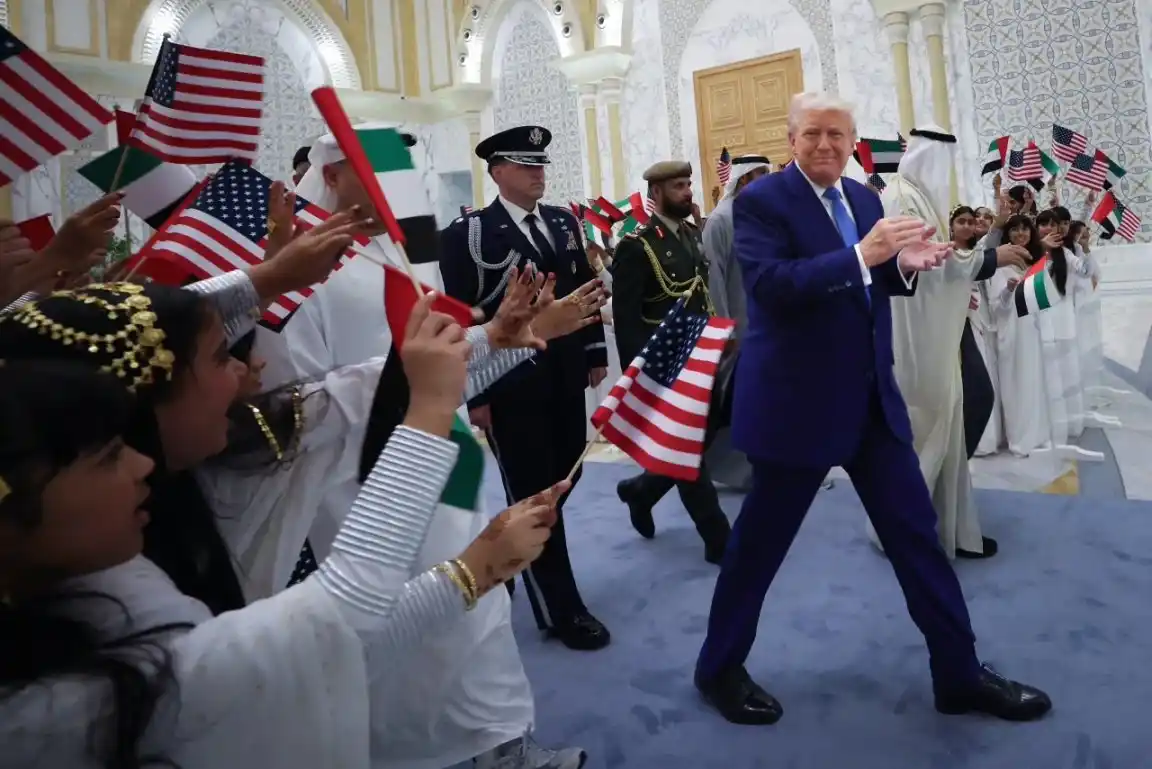
Trump visits Abu Dhabi in May of last year
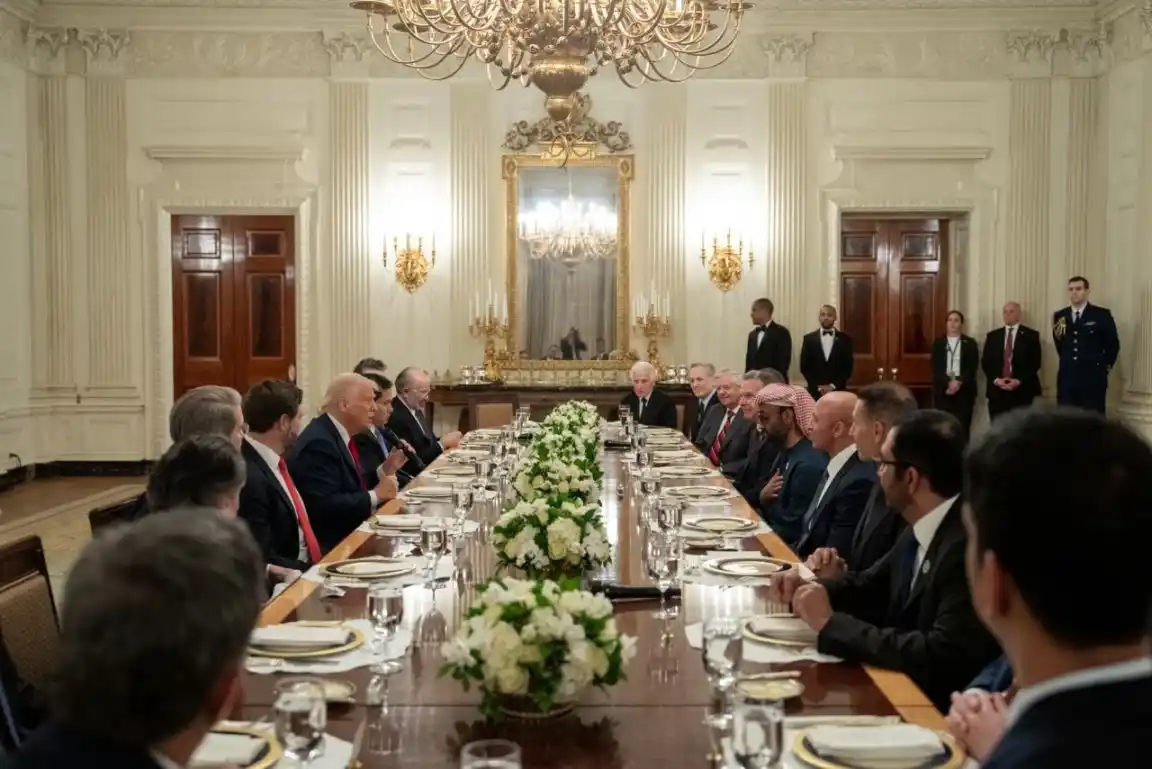
Tahnoon meets Trump and other US officials at the White House in March of last year
$500 Million Transaction Details
Documents show that of the initial $250 million payment made by Tahnoon-backed company Aryam Investment 1, $187 million was transferred directly to Trump family entities DT Marks DEFI LLC and DT Marks SC LLC. In addition to funds going to Witkoff family entities, $31 million was transferred to entities associated with co-founders Zak Folkman and Chase Herro. The Wall Street Journal has yet to determine the specific allocation of the remaining $250 million investment Aryam is supposed to make by July 15, 2025.
The agreement made Aryam the largest shareholder of World Liberty Financial and the only known external investor outside of the company's founders. The documents show that the transaction secured two board seats for Aryam on the five-person board of World Liberty Financial, with the two appointed Aryam executives also serving as executives at Tahnoon's G42 at the time; board members at that time included Eric Trump and Zach Witkoff (son of Steve Witkoff).
After Trump's victory, his real estate company has been seeking partnerships with foreign businesses, and the President himself has received gifts from foreign governments, including a $400 million luxury jet gifted by Qatar. However, the World Liberty Financial deal is the only known case of a foreign government official purchasing a large stake in one of Trump's companies after his election.
Information disclosed on the World Liberty Financial website shows that the Trump family's ownership stake has decreased from 75% last year to 38%, indicating an external party purchased shares, but the company has never disclosed the identity of the buyer.
Weeks before the US-UAE chip deal was announced in May of last year, World Liberty Financial CEO Zach Witkoff announced that Tahnoon's investment firm MGX would use World Liberty Financial's stablecoin to complete a $2 billion investment in the cryptocurrency exchange Binance. An executive from G42, who also sits on the board of MGX jointly owned by G42, joined the World Liberty Financial board at that time.
Zach Witkoff promoted MGX's stablecoin collaboration as an endorsement of World Liberty Financial's technology, without disclosing that MGX and World Liberty Financial are led by the same group of people.
World Liberty Financial spokesperson David Wachsman commented on the Aryam investment, saying, "We made this deal because we believe it is in the best interest of the company's continued growth. The notion that a US private company should adhere to special standards in fundraising that other similar entities are not subject to is both absurd and un-American."
He stated that neither President Trump nor Steve Witkoff were involved in this transaction, and they have not been involved in World Liberty Financial affairs since taking office, with Witkoff never holding an operational role at the company. He added that this deal does not provide any party with a channel to influence government decisions or policies, "We adhere to the same regulations as any other company in the industry."
A source familiar with Tahnoon's investment dealings stated that Tahnoon and his team conducted "months of due diligence" on World Liberty Financial's plans before investing. Following this evaluation, he and "several co-investors" completed the investment in the company, noting that G42 funds were not used in this investment. "At no point during the due diligence or thereafter was there any discussion with President Trump about this investment." The source described Tahnoon as a "significant investor" in the cryptocurrency space.
White House spokesperson Anna Kelly said, "President Trump acts solely in the best interest of the American public." She stated that the president's assets are held in a trust managed by his children, with "no conflicts of interest," and described Witkoff's commitment to "advancing President Trump's global peace goals."
White House legal advisor David Warrington stated, "The President has not been involved in any business transactions that could involve his constitutional duties."
He said that Witkoff strictly adheres to government ethics rules, "has never and will not participate in any official matters that could affect his financial interests," and added that Witkoff has "divested his related interests in World Liberty Financial."
A source close to Witkoff said that the envoy was not involved in AI chip negotiations related to G42, but was briefed on the discussions.
A Trump Organization spokesperson stated that the company "places a high value on ethical obligations, staunchly guards against conflicts of interest," and complies with all applicable laws.
"Chief's" AI Chip Offensive
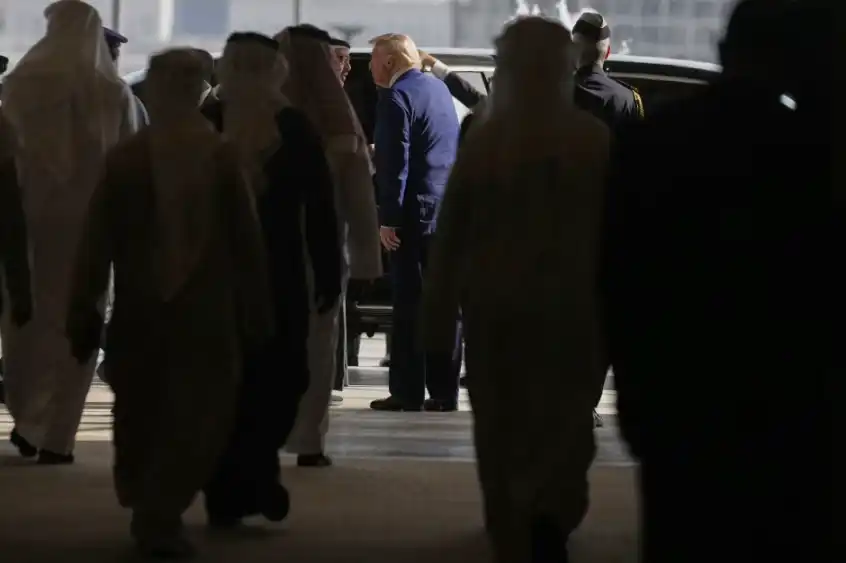
Trump posed with UAE President Mohammed during his visit to the UAE in May last year
After Trump's victory, the UAE hoped for a more cooperative partner in the United States.
For Tahnoon, obtaining American chips was a top priority. Commissioned by his elder brother, he led efforts to position the UAE as a global leader in AI. During the Biden administration, amid concerns that chips could flow to China, the U.S. only allowed a limited number of chips to be exported to the country. Despite G42's claim to have severed ties with China by the end of 2023, UAE entities, including other companies under Tahnoon's commercial empire, maintain close ties with China.
Tahnoon hoped to secure approval for a significant additional number of chips to establish one of the world's largest AI data center clusters, requiring power equivalent to that of two Hoover Dams. Tahnoon and his deputy planned to lobby intensely to garner support from the new Trump administration.
Tahnoon had already engaged in commercial dealings with the Trump family through Trump's son-in-law Jared Kushner. In 2024, Kushner's investment firm raised $1.5 billion from a company supported by Tahnoon as well as Qatar.
Shortly after his reelection, Trump appointed his long-time friend and golfing buddy Steve Witkoff as the Middle East envoy. Witkoff wasted no time and informed Biden administration officials of his plans to reach out to contacts in the Middle East and to visit the UAE, Qatar, Saudi Arabia, and Israel before taking office.
The early December 2024 trip to the UAE had a dual purpose of diplomacy and cryptocurrency. Witkoff, who had helped found World Liberty Financial in September, attended a cryptocurrency conference in Abu Dhabi, where he mingled with crypto heavyweights and Eric Trump in a VIP room. Eric Trump declared to the Emirati audience in his keynote speech, "Our family loves you."
According to The Wall Street Journal, Witkoff also met with Tahnoon as part of a series of talks in the region, discussing issues including the Gaza ceasefire.
About a week after Witkoff's trip, two entities were registered in Delaware and Abu Dhabi on consecutive days, without disclosing any ownership information, both sharing the name Aryam Investment 1.
Records reviewed by The Wall Street Journal showed that the Delaware-based Aryam entity was managed by an executive from G42, a company under Tahnoon; the Abu Dhabi entity shared an office address with several other companies under the Sheikh's business empire.
Several weeks later, on January 16, 2025, a representative from Aryam signed a $500 million deal with Trump and Witkoff's World Liberty Financial.
Interest Network Behind the Deal
At the time of the investment, World Liberty Financial had no products and had only raised $82 million through the issuance of a token called WLFI. Documents revealed that Aryam's investment did not grant it rights to future WLFI token sales, effectively excluding the Tahnoon-backed entity from the company's sole revenue stream at the time.
The agreement for Aryam to acquire a stake in World Liberty Financial was signed by G42's Chief Legal Officer and Tahnoon's key advisor Martin Edelman, along with G42's CEO Peng Xiao. The deal also involved Tahnoon's personal investment firm Royal Group, with Edelman serving as an advisor to that company simultaneously.
Edelman and Xiao joined the World Liberty Financial board, but the company's website did not list them on the team page.
The duo played a key role in lobbying the Trump administration to secure chips in the UAE.
G42's Crypto and Blockchain Head Fiacc Larkin joined World Liberty Financial as Chief Strategic Advisor in January 2025. His LinkedIn profile indicates that he also serves as an advisor to the Abu Dhabi Department of Economic Development, a government entity.
For years, G42 has been closely watched by Biden administration officials and Republican lawmakers. In 2024, Republican lawmakers requested an investigation into the risk of China acquiring sensitive U.S. technology through the company.
Peng Xiao, born in China, attended university in Washington, D.C., became a U.S. citizen, renounced it, and later took on Emirati citizenship. During the Biden administration, Peng Xiao himself came under scrutiny.
In 2024, a Republican committee chair in a request for investigation to the Department of Commerce stated that documents revealed a "vast network" behind Peng Xiao, involving Emirati and Chinese entities.
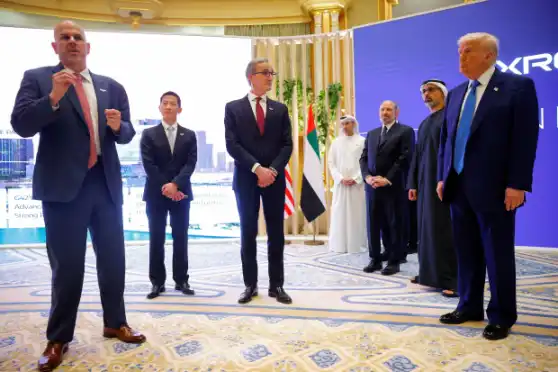
Trump met with Mohammed during his visit last May. Peng Xiao, CEO of Tahnoon's AI company G42, was present (second from the left)
In a statement that year, G42 denied the allegations in the letter, stating that the company had ceased cooperation with Chinese entities.
Edelman is a prominent New York real estate lawyer who has cultivated connections in the UAE for decades. He advises the UAE royal family and also serves on the boards of several Tahnoon-affiliated companies, including G42 and MGX. He is a longtime friend of Witkoff and publicly praised him after the election.
Company documents reviewed by The Wall Street Journal show that the stock acquisition deal brought enormous profits to the founders of World Liberty Financial, with the Trump family, Witkoff family, Folkman, and Herro-related entities quickly reaping financial rewards. Trump's disclosure filings indicate that as of the end of 2024, he personally held 70% of the shares in DT Marks DEFI, with the remaining 30% held by other family members; he did not disclose the ownership structure of DT Marks SC.
Ethical and Legal Controversies
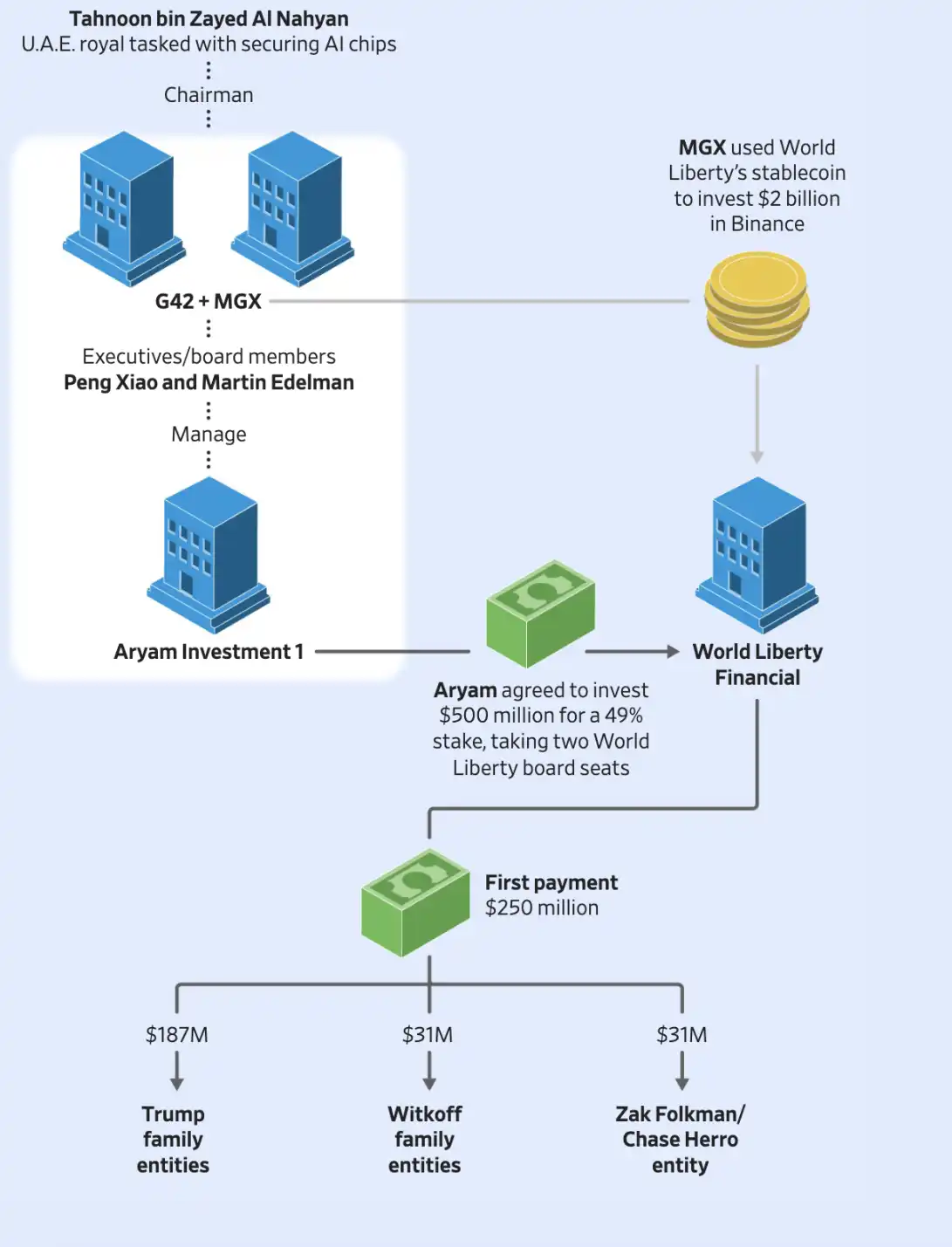
Analysis of the Investment Transaction Details
Donald Trump has long been criticized for maintaining control of his private business empire and receiving foreign profits during his term. During his first term, Democratic lawmakers sued Trump, accusing him of profiting from foreign government patronage of his businesses in violation of the Constitution's Emoluments Clause. Trump called it political persecution, while the Department of Justice argued that Trump's profit-sharing did not constitute emoluments, and the Supreme Court ultimately refused to hear the case.
During his second term, Trump's real estate holding company, the Trump Organization, stated that it would not enter into new deals with foreign governments during his presidency but did not restrict new deals with foreign private businesses, marking a departure from his first term. The company stated that it would donate profits from identifiable foreign government officials at its hotels and other businesses to the U.S. Treasury. World Liberty Financial did not make such a commitment.
Legal experts have suggested that the transaction with Aryam may violate the Emoluments Clause, especially considering the close timing between the UAE Chip Deal and the transaction with World Liberty Financial, creating a significant conflict of interest.
Kathleen Clark, a law professor at the University of Washington and former ethics lawyer for the District of Columbia government, stated that the clause was meant to prevent any government official from being "bought off" by a foreign government. "This appears to be a clear violation of the Foreign Emoluments Clause and, more significantly, it looks like a bribe."
She suggested that this transaction "should be a five-alarm warning to the federal government being sold out."
Ty Cobb, who served as a senior White House legal advisor during Trump's first term, claimed that Trump's conflicts of interest far exceeded those of any previous administration, stating, "It's like having a B-52 bomber overhead and you're complaining about kayaking." "As an ethics lawyer, my advice would be crystal clear: Do not engage in commercial dealings with the families of foreign heads of state. It tarnishes American foreign policy."
A White House official stated that World Liberty Financial's business was unrelated to Trump, so any compensation-related allegations were "false and irrelevant." White House Counsel Warrington stated that Trump "has carried out his constitutional duties ethically."
From Chip Deal to Binance Pardon
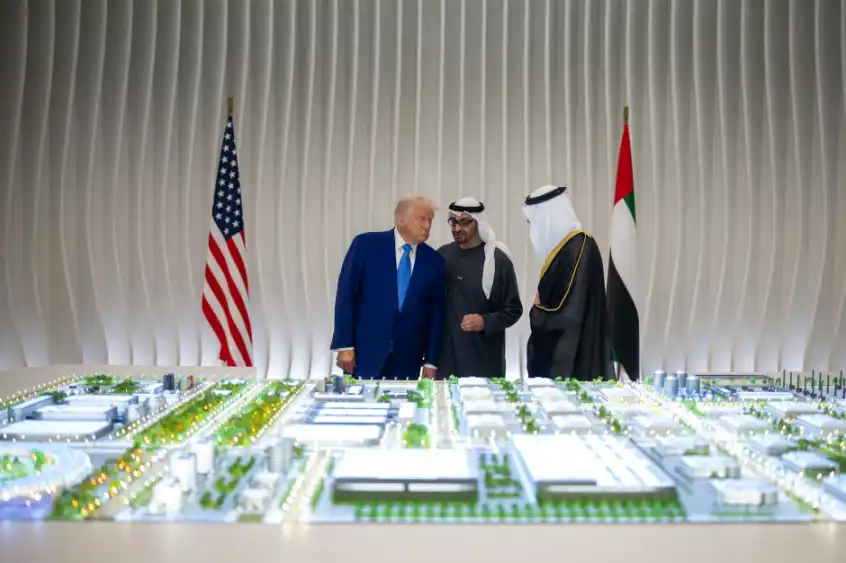
Trump and Mohammed visited a model of an artificial intelligence data center project during their visit in May last year
After investing in World Liberty Financial, Tahnoon is pushing for the accelerated development of an AI chip.
The sheikh hosted global tech and finance CEOs at the Abu Dhabi royal estate and often posted meeting photos on Instagram, many of which took place on a set of white sofas. He prepared to pledge a significant amount of money to the U.S. and emphasized the UAE's alignment with the U.S. in the AI field.
On Trump's first day in office (five days after Aryam signed an agreement with World Liberty Financial), the President announced at the White House that OpenAI and SoftBank plan to build a $500 billion AI data center project, with Tahnoon's MGX being two of the designated investors. The project has not progressed to date.
Last spring, Trump administration officials began discussing a chip agreement framework with the UAE. Some officials did not see a national security risk, but others still held concerns from the previous administration, believing the technology could ultimately flow to China. Insiders said they discussed schemes to restrict chip control in the agreement, one of which was to exclude UAE companies like G42 from direct acquisition channels, requiring the technology to be held by U.S. partners like Microsoft, OpenAI, etc.
In March, Tahnoon led a delegation to Washington, planning to accelerate U.S. government reviews of UAE investments in the U.S. in addition to the chip agreement. He met with Trump in the Oval Office and pledged that the UAE would invest $1.4 trillion in the U.S. over ten years. An insider said this commitment excited the President, although government officials found it challenging to understand the specifics of the commitment.
On March 18, Trump hosted a dinner for Tahnoon and his delegation at the White House, attended by the Vice President, Secretary of State, Commerce Secretary, Treasury Secretary, and other cabinet members. Tahnoon sat next to Witkoff, with Edelman at the end of the table. Trump later posted photos on Truth Social promoting the "bond of friendship" between the two countries, stating that they discussed strengthening cooperation in the economic and tech sectors.
Former national security officials expressed shock at the level of reception Tahnoon received. During the Biden administration, visiting foreign officials typically only met with equivalent U.S. officials, not the President and six cabinet members.
Meanwhile, Tahnoon's ties with World Liberty Financial are growing stronger. In May, Zach Witkoff announced at a cryptocurrency conference in Dubai that the sheikh's investment company MGX would use World Liberty Financial's USD1 stablecoin to complete a $2 billion investment in Binance, the largest single investment in a cryptocurrency company's history. Zach Witkoff smiled, thanking MGX for "their trust in us."
This move has propelled USD1 into the ranks of the world's largest stablecoins, enhancing its financial credibility and bringing a $2 billion cash reserve to World Liberty Financial. The company will use this fund as a reserve to keep the stablecoin pegged 1:1 to the dollar, and will invest the fund in U.S. Treasury bonds to earn interest, potentially generating around $80 million in profit if held for one year.
MGX told The Wall Street Journal last year that it had evaluated stablecoins on multiple platforms and selected USD1 after considering factors such as "business applicability." A spokesperson for World Liberty Financial called USD1 a "higher-quality product."
Both companies have never disclosed the fact that MGX and World Liberty Financial share management.
In fact, Aryam's transaction laid the foundation for the launch of USD1. This investment was split into two newly formed World Liberty Financial entities, with one responsible for operating the new stablecoin product and the other managing the rest of the company's operations.
A source close to the company said G42's Larkin is in charge of the USD1 project at World Liberty Financial.
Tahnoon's $2 billion investment through MGX in Binance implies an economic interest in pushing for Binance founder CZ to receive a pardon from Trump. This move could pave the way for Binance to re-enter the U.S. market. In 2023, Binance and CZ pleaded guilty to violating anti-money laundering rules and were banned from operating in the U.S.
CZ currently resides in Abu Dhabi, having obtained UAE citizenship several years ago. He has close ties to Tahnoon and has established a strong connection with the UAE royal family.
Insiders said individuals close to the royal family lobbied the Trump administration to pardon CZ, stating that this would help the world's largest cryptocurrency exchange platform re-enter the U.S. Pardoning CZ would also open the door for UAE authorities to issue a comprehensive regulatory license to Binance, completing Binance's plan to establish Abu Dhabi as its new global headquarters and boost the capital's global financial ambitions.
Binance itself is also seeking to re-enter the U.S. through the pardon. The Wall Street Journal previously reported that the company has taken several measures to promote the development of World Liberty Financial's business. CZ denied any business relationship with Trump's cryptocurrency company, while Binance stated that it did not control the stablecoin chosen by MGX, with "limited involvement" in World Liberty Financial's related products. World Liberty Financial denied playing any role in the pardon issue, with its lawyers stating that its dealings with Binance were routine operations. A source close to Steve Witkoff said he was not involved in the CZ pardon matter.
CZ's lawyer Teresa Goody Guillén stated that the pardon of her client did not bring Binance into the U.S. market, as the UAE has been actively attracting cryptocurrency companies. She described the negative interpretation of CZ's pardon as "an unconstitutional usurpation of the presidential pardon power."
On May 8 of last year, the U.S. Treasury Department announced the launch of a fast-track pilot program for foreign investors, which was precisely the investment review acceleration process advocated by the UAE.
During Trump's visit to Abu Dhabi that month, it was announced that the two countries had reached "a very significant agreement" regarding the UAE's purchase of American AI chips. Months later, after further negotiations, the Trump administration approved the sale of 35,000 chips to G42, fewer than the UAE had expected.
During a May demonstration at the royal palace, Trump carefully examined a bright 3D model of the large AI data center project being developed by G42, with Steve Witkoff and Tahnoon looking on. Trump repeatedly mentioned Tahnoon in local meetings, telling UAE President Mohammed that his "good brother" had recently visited Washington; Tahnoon then posted a photo with Trump and Witkoff on Instagram.
Trump predicted that the relationship between the two countries "will only get closer and better." He told Mohammed, "Our relationship is so good right now; it's as good as it can be."
In September, under an agreement negotiated by the Trump administration, MGX became one of the few selected investors to operate TikTok's U.S. business.
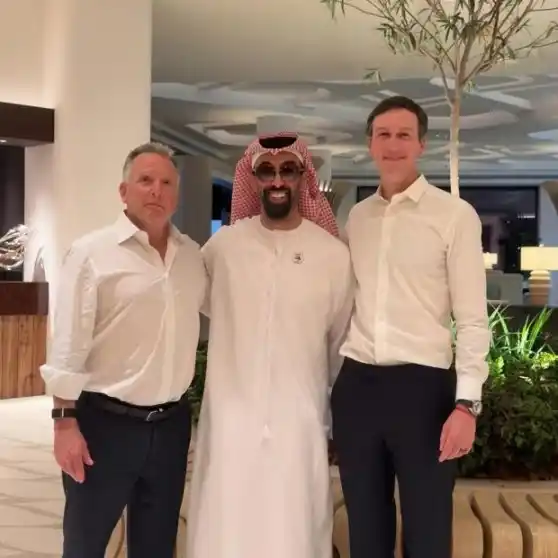
On October 22 of last year, Steve Witkoff, Jared Kushner, and Tahnoon posted a photo on social media.
The following month, Trump pardoned CZ, sparking outrage from Democratic lawmakers who accused him of selling pardons to the highest bidder.
On October 22, the White House confirmed that the day before Trump signed the pardon, a White House official said that Witkoff and Kushner returned to Abu Dhabi to discuss Gaza, Israel, and Trump's peace commission plans. The individual they met with was Tahnoon.
You may also like

Token Cannot Compound, Where Is the Real Investment Opportunity?

February 6th Market Key Intelligence, How Much Did You Miss?

China's Central Bank and Eight Other Departments' Latest Regulatory Focus: Key Attention to RWA Tokenized Asset Risk
Foreword: Today, the People's Bank of China's website published the "Notice of the People's Bank of China, National Development and Reform Commission, Ministry of Industry and Information Technology, Ministry of Public Security, State Administration for Market Regulation, China Banking and Insurance Regulatory Commission, China Securities Regulatory Commission, State Administration of Foreign Exchange on Further Preventing and Dealing with Risks Related to Virtual Currency and Others (Yinfa [2026] No. 42)", the latest regulatory requirements from the eight departments including the central bank, which are basically consistent with the regulatory requirements of recent years. The main focus of the regulation is on speculative activities such as virtual currency trading, exchanges, ICOs, overseas platform services, and this time, regulatory oversight of RWA has been added, explicitly prohibiting RWA tokenization, stablecoins (especially those pegged to the RMB). The following is the full text:
To the people's governments of all provinces, autonomous regions, and municipalities directly under the Central Government, the Xinjiang Production and Construction Corps:
Recently, there have been speculative activities related to virtual currency and Real-World Assets (RWA) tokenization, disrupting the economic and financial order and jeopardizing the property security of the people. In order to further prevent and address the risks related to virtual currency and Real-World Assets tokenization, effectively safeguard national security and social stability, in accordance with the "Law of the People's Republic of China on the People's Bank of China," "Law of the People's Republic of China on Commercial Banks," "Securities Law of the People's Republic of China," "Law of the People's Republic of China on Securities Investment Funds," "Law of the People's Republic of China on Futures and Derivatives," "Cybersecurity Law of the People's Republic of China," "Regulations of the People's Republic of China on the Administration of Renminbi," "Regulations on Prevention and Disposal of Illegal Fundraising," "Regulations of the People's Republic of China on Foreign Exchange Administration," "Telecommunications Regulations of the People's Republic of China," and other provisions, after reaching consensus with the Cyberspace Administration of China, the Supreme People's Court, and the Supreme People's Procuratorate, and with the approval of the State Council, the relevant matters are notified as follows:
(I) Virtual currency does not possess the legal status equivalent to fiat currency. Virtual currencies such as Bitcoin, Ether, Tether, etc., have the main characteristics of being issued by non-monetary authorities, using encryption technology and distributed ledger or similar technology, existing in digital form, etc. They do not have legal tender status, should not and cannot be circulated and used as currency in the market.
The business activities related to virtual currency are classified as illegal financial activities. The exchange of fiat currency and virtual currency within the territory, exchange of virtual currencies, acting as a central counterparty in buying and selling virtual currencies, providing information intermediary and pricing services for virtual currency transactions, token issuance financing, and trading of virtual currency-related financial products, etc., fall under illegal financial activities, such as suspected illegal issuance of token vouchers, unauthorized public issuance of securities, illegal operation of securities and futures business, illegal fundraising, etc., are strictly prohibited across the board and resolutely banned in accordance with the law. Overseas entities and individuals are not allowed to provide virtual currency-related services to domestic entities in any form.
A stablecoin pegged to a fiat currency indirectly fulfills some functions of the fiat currency in circulation. Without the consent of relevant authorities in accordance with the law and regulations, any domestic or foreign entity or individual is not allowed to issue a RMB-pegged stablecoin overseas.
(II)Tokenization of Real-World Assets refers to the use of encryption technology and distributed ledger or similar technologies to transform ownership rights, income rights, etc., of assets into tokens (tokens) or other interests or bond certificates with token (token) characteristics, and carry out issuance and trading activities.
Engaging in the tokenization of real-world assets domestically, as well as providing related intermediary, information technology services, etc., which are suspected of illegal issuance of token vouchers, unauthorized public offering of securities, illegal operation of securities and futures business, illegal fundraising, and other illegal financial activities, shall be prohibited; except for relevant business activities carried out with the approval of the competent authorities in accordance with the law and regulations and relying on specific financial infrastructures. Overseas entities and individuals are not allowed to illegally provide services related to the tokenization of real-world assets to domestic entities in any form.
(III) Inter-agency Coordination. The People's Bank of China, together with the National Development and Reform Commission, the Ministry of Industry and Information Technology, the Ministry of Public Security, the State Administration for Market Regulation, the China Banking and Insurance Regulatory Commission, the China Securities Regulatory Commission, the State Administration of Foreign Exchange, and other departments, will improve the work mechanism, strengthen coordination with the Cyberspace Administration of China, the Supreme People's Court, and the Supreme People's Procuratorate, coordinate efforts, and overall guide regions to carry out risk prevention and disposal of virtual currency-related illegal financial activities.
The China Securities Regulatory Commission, together with the National Development and Reform Commission, the Ministry of Industry and Information Technology, the Ministry of Public Security, the People's Bank of China, the State Administration for Market Regulation, the China Banking and Insurance Regulatory Commission, the State Administration of Foreign Exchange, and other departments, will improve the work mechanism, strengthen coordination with the Cyberspace Administration of China, the Supreme People's Court, and the Supreme People's Procuratorate, coordinate efforts, and overall guide regions to carry out risk prevention and disposal of illegal financial activities related to the tokenization of real-world assets.
(IV) Strengthening Local Implementation. The people's governments at the provincial level are overall responsible for the prevention and disposal of risks related to virtual currencies and the tokenization of real-world assets in their respective administrative regions. The specific leading department is the local financial regulatory department, with participation from branches and dispatched institutions of the State Council's financial regulatory department, telecommunications regulators, public security, market supervision, and other departments, in coordination with cyberspace departments, courts, and procuratorates, to improve the normalization of the work mechanism, effectively connect with the relevant work mechanisms of central departments, form a cooperative and coordinated working pattern between central and local governments, effectively prevent and properly handle risks related to virtual currencies and the tokenization of real-world assets, and maintain economic and financial order and social stability.
(5) Enhanced Risk Monitoring. The People's Bank of China, China Securities Regulatory Commission, National Development and Reform Commission, Ministry of Industry and Information Technology, Ministry of Public Security, State Administration of Foreign Exchange, Cyberspace Administration of China, and other departments continue to improve monitoring techniques and system support, enhance cross-departmental data analysis and sharing, establish sound information sharing and cross-validation mechanisms, promptly grasp the risk situation of activities related to virtual currency and real-world asset tokenization. Local governments at all levels give full play to the role of local monitoring and early warning mechanisms. Local financial regulatory authorities, together with branches and agencies of the State Council's financial regulatory authorities, as well as departments of cyberspace and public security, ensure effective connection between online monitoring, offline investigation, and fund tracking, efficiently and accurately identify activities related to virtual currency and real-world asset tokenization, promptly share risk information, improve early warning information dissemination, verification, and rapid response mechanisms.
(6) Strengthened Oversight of Financial Institutions, Intermediaries, and Technology Service Providers. Financial institutions (including non-bank payment institutions) are prohibited from providing account opening, fund transfer, and clearing services for virtual currency-related business activities, issuing and selling financial products related to virtual currency, including virtual currency and related financial products in the scope of collateral, conducting insurance business related to virtual currency, or including virtual currency in the scope of insurance liability. Financial institutions (including non-bank payment institutions) are prohibited from providing custody, clearing, and settlement services for unauthorized real-world asset tokenization-related business and related financial products. Relevant intermediary institutions and information technology service providers are prohibited from providing intermediary, technical, or other services for unauthorized real-world asset tokenization-related businesses and related financial products.
(7) Enhanced Management of Internet Information Content and Access. Internet enterprises are prohibited from providing online business venues, commercial displays, marketing, advertising, or paid traffic diversion services for virtual currency and real-world asset tokenization-related business activities. Upon discovering clues of illegal activities, they should promptly report to relevant departments and provide technical support and assistance for related investigations and inquiries. Based on the clues transferred by the financial regulatory authorities, the cyberspace administration, telecommunications authorities, and public security departments should promptly close and deal with websites, mobile applications (including mini-programs), and public accounts engaged in virtual currency and real-world asset tokenization-related business activities in accordance with the law.
(8) Strengthened Entity Registration and Advertisement Management. Market supervision departments strengthen entity registration and management, and enterprise and individual business registrations must not contain terms such as "virtual currency," "virtual asset," "cryptocurrency," "crypto asset," "stablecoin," "real-world asset tokenization," or "RWA" in their names or business scopes. Market supervision departments, together with financial regulatory authorities, legally enhance the supervision of advertisements related to virtual currency and real-world asset tokenization, promptly investigating and handling relevant illegal advertisements.
(IX) Continued Rectification of Virtual Currency Mining Activities. The National Development and Reform Commission, together with relevant departments, strictly controls virtual currency mining activities, continuously promotes the rectification of virtual currency mining activities. The people's governments of various provinces take overall responsibility for the rectification of "mining" within their respective administrative regions. In accordance with the requirements of the National Development and Reform Commission and other departments in the "Notice on the Rectification of Virtual Currency Mining Activities" (NDRC Energy-saving Building [2021] No. 1283) and the provisions of the "Guidance Catalog for Industrial Structure Adjustment (2024 Edition)," a comprehensive review, investigation, and closure of existing virtual currency mining projects are conducted, new mining projects are strictly prohibited, and mining machine production enterprises are strictly prohibited from providing mining machine sales and other services within the country.
(X) Severe Crackdown on Related Illegal Financial Activities. Upon discovering clues to illegal financial activities related to virtual currency and the tokenization of real-world assets, local financial regulatory authorities, branches of the State Council's financial regulatory authorities, and other relevant departments promptly investigate, determine, and properly handle the issues in accordance with the law, and seriously hold the relevant entities and individuals legally responsible. Those suspected of crimes are transferred to the judicial authorities for processing according to the law.
(XI) Severe Crackdown on Related Illegal and Criminal Activities. The Ministry of Public Security, the People's Bank of China, the State Administration for Market Regulation, the China Banking and Insurance Regulatory Commission, the China Securities Regulatory Commission, as well as judicial and procuratorial organs, in accordance with their respective responsibilities, rigorously crack down on illegal and criminal activities related to virtual currency, the tokenization of real-world assets, such as fraud, money laundering, illegal business operations, pyramid schemes, illegal fundraising, and other illegal and criminal activities carried out under the guise of virtual currency, the tokenization of real-world assets, etc.
(XII) Strengthen Industry Self-discipline. Relevant industry associations should enhance membership management and policy advocacy, based on their own responsibilities, advocate and urge member units to resist illegal financial activities related to virtual currency and the tokenization of real-world assets. Member units that violate regulatory policies and industry self-discipline rules are to be disciplined in accordance with relevant self-regulatory management regulations. By leveraging various industry infrastructure, conduct risk monitoring related to virtual currency, the tokenization of real-world assets, and promptly transfer issue clues to relevant departments.
(XIII) Without the approval of relevant departments in accordance with the law and regulations, domestic entities and foreign entities controlled by them may not issue virtual currency overseas.
(XIV) Domestic entities engaging directly or indirectly in overseas external debt-based tokenization of real-world assets, or conducting asset securitization activities abroad based on domestic ownership rights, income rights, etc. (hereinafter referred to as domestic equity), should be strictly regulated in accordance with the principles of "same business, same risk, same rules." The National Development and Reform Commission, the China Securities Regulatory Commission, the State Administration of Foreign Exchange, and other relevant departments regulate it according to their respective responsibilities. For other forms of overseas real-world asset tokenization activities based on domestic equity by domestic entities, the China Securities Regulatory Commission, together with relevant departments, supervise according to their division of responsibilities. Without the consent and filing of relevant departments, no unit or individual may engage in the above-mentioned business.
(15) Overseas subsidiaries and branches of domestic financial institutions providing Real World Asset Tokenization-related services overseas shall do so legally and prudently. They shall have professional personnel and systems in place to effectively mitigate business risks, strictly implement customer onboarding, suitability management, anti-money laundering requirements, and incorporate them into the domestic financial institutions' compliance and risk management system. Intermediaries and information technology service providers offering Real World Asset Tokenization services abroad based on domestic equity or conducting Real World Asset Tokenization business in the form of overseas debt for domestic entities directly or indirectly venturing abroad must strictly comply with relevant laws and regulations. They should establish and improve relevant compliance and internal control systems in accordance with relevant normative requirements, strengthen business and risk control, and report the business developments to the relevant regulatory authorities for approval or filing.
(16) Strengthen organizational leadership and overall coordination. All departments and regions should attach great importance to the prevention of risks related to virtual currencies and Real World Asset Tokenization, strengthen organizational leadership, clarify work responsibilities, form a long-term effective working mechanism with centralized coordination, local implementation, and shared responsibilities, maintain high pressure, dynamically monitor risks, effectively prevent and mitigate risks in an orderly and efficient manner, legally protect the property security of the people, and make every effort to maintain economic and financial order and social stability.
(17) Widely carry out publicity and education. All departments, regions, and industry associations should make full use of various media and other communication channels to disseminate information through legal and policy interpretation, analysis of typical cases, and education on investment risks, etc. They should promote the illegality and harm of virtual currencies and Real World Asset Tokenization-related businesses and their manifestations, fully alert to potential risks and hidden dangers, and enhance public awareness and identification capabilities for risk prevention.
(18) Engaging in illegal financial activities related to virtual currencies and Real World Asset Tokenization in violation of this notice, as well as providing services for virtual currencies and Real World Asset Tokenization-related businesses, shall be punished in accordance with relevant regulations. If it constitutes a crime, criminal liability shall be pursued according to the law. For domestic entities and individuals who knowingly or should have known that overseas entities illegally provided virtual currency or Real World Asset Tokenization-related services to domestic entities and still assisted them, relevant responsibilities shall be pursued according to the law. If it constitutes a crime, criminal liability shall be pursued according to the law.
(19) If any unit or individual invests in virtual currencies, Real World Asset Tokens, and related financial products against public order and good customs, the relevant civil legal actions shall be invalid, and any resulting losses shall be borne by them. If there are suspicions of disrupting financial order and jeopardizing financial security, the relevant departments shall deal with them according to the law.
This notice shall enter into force upon the date of its issuance. The People's Bank of China and ten other departments' "Notice on Further Preventing and Dealing with the Risks of Virtual Currency Trading Speculation" (Yinfa [2021] No. 237) is hereby repealed.

Former Partner's Perspective on Multicoin: Kyle's Exit, But the Game He Left Behind Just Getting Started
Why Bitcoin Is Falling Now: The Real Reasons Behind BTC's Crash & WEEX's Smart Profit Playbook
Bitcoin's ongoing crash explained: Discover the 5 hidden triggers behind BTC's plunge & how WEEX's Auto Earn and Trade to Earn strategies help traders profit from crypto market volatility.

Wall Street's Hottest Trades See Exodus

Vitalik Discusses Ethereum Scaling Path, Circle Announces Partnership with Polymarket, What's the Overseas Crypto Community Talking About Today?

Believing in the Capital Markets - The Essence and Core Value of Cryptocurrency

Polymarket's 'Weatherman': Predict Temperature, Win Million-Dollar Payout
$15K+ Profits: The 4 AI Trading Secrets WEEX Hackathon Prelim Winners Used to Dominate Volatile Crypto Markets
How WEEX Hackathon's top AI trading strategies made $15K+ in crypto markets: 4 proven rules for ETH/BTC trading, market structure analysis, and risk management in volatile conditions.

A nearly 20% one-day plunge, how long has it been since you last saw a $60,000 Bitcoin?

Raoul Pal: I've seen every single panic, and they are never the end.

Key Market Information Discrepancy on February 6th - A Must-Read! | Alpha Morning Report

2026 Crypto Industry's First Snowfall

The Harsh Reality Behind the $26 Billion Crypto Liquidation: Liquidity Is Killing the Market

Why Is Gold, US Stocks, Bitcoin All Falling?

Key Market Intelligence for February 5th, how much did you miss out on?

Wintermute: By 2026, crypto had gradually become the settlement layer of the Internet economy
Token Cannot Compound, Where Is the Real Investment Opportunity?
February 6th Market Key Intelligence, How Much Did You Miss?
China's Central Bank and Eight Other Departments' Latest Regulatory Focus: Key Attention to RWA Tokenized Asset Risk
Foreword: Today, the People's Bank of China's website published the "Notice of the People's Bank of China, National Development and Reform Commission, Ministry of Industry and Information Technology, Ministry of Public Security, State Administration for Market Regulation, China Banking and Insurance Regulatory Commission, China Securities Regulatory Commission, State Administration of Foreign Exchange on Further Preventing and Dealing with Risks Related to Virtual Currency and Others (Yinfa [2026] No. 42)", the latest regulatory requirements from the eight departments including the central bank, which are basically consistent with the regulatory requirements of recent years. The main focus of the regulation is on speculative activities such as virtual currency trading, exchanges, ICOs, overseas platform services, and this time, regulatory oversight of RWA has been added, explicitly prohibiting RWA tokenization, stablecoins (especially those pegged to the RMB). The following is the full text:
To the people's governments of all provinces, autonomous regions, and municipalities directly under the Central Government, the Xinjiang Production and Construction Corps:
Recently, there have been speculative activities related to virtual currency and Real-World Assets (RWA) tokenization, disrupting the economic and financial order and jeopardizing the property security of the people. In order to further prevent and address the risks related to virtual currency and Real-World Assets tokenization, effectively safeguard national security and social stability, in accordance with the "Law of the People's Republic of China on the People's Bank of China," "Law of the People's Republic of China on Commercial Banks," "Securities Law of the People's Republic of China," "Law of the People's Republic of China on Securities Investment Funds," "Law of the People's Republic of China on Futures and Derivatives," "Cybersecurity Law of the People's Republic of China," "Regulations of the People's Republic of China on the Administration of Renminbi," "Regulations on Prevention and Disposal of Illegal Fundraising," "Regulations of the People's Republic of China on Foreign Exchange Administration," "Telecommunications Regulations of the People's Republic of China," and other provisions, after reaching consensus with the Cyberspace Administration of China, the Supreme People's Court, and the Supreme People's Procuratorate, and with the approval of the State Council, the relevant matters are notified as follows:
(I) Virtual currency does not possess the legal status equivalent to fiat currency. Virtual currencies such as Bitcoin, Ether, Tether, etc., have the main characteristics of being issued by non-monetary authorities, using encryption technology and distributed ledger or similar technology, existing in digital form, etc. They do not have legal tender status, should not and cannot be circulated and used as currency in the market.
The business activities related to virtual currency are classified as illegal financial activities. The exchange of fiat currency and virtual currency within the territory, exchange of virtual currencies, acting as a central counterparty in buying and selling virtual currencies, providing information intermediary and pricing services for virtual currency transactions, token issuance financing, and trading of virtual currency-related financial products, etc., fall under illegal financial activities, such as suspected illegal issuance of token vouchers, unauthorized public issuance of securities, illegal operation of securities and futures business, illegal fundraising, etc., are strictly prohibited across the board and resolutely banned in accordance with the law. Overseas entities and individuals are not allowed to provide virtual currency-related services to domestic entities in any form.
A stablecoin pegged to a fiat currency indirectly fulfills some functions of the fiat currency in circulation. Without the consent of relevant authorities in accordance with the law and regulations, any domestic or foreign entity or individual is not allowed to issue a RMB-pegged stablecoin overseas.
(II)Tokenization of Real-World Assets refers to the use of encryption technology and distributed ledger or similar technologies to transform ownership rights, income rights, etc., of assets into tokens (tokens) or other interests or bond certificates with token (token) characteristics, and carry out issuance and trading activities.
Engaging in the tokenization of real-world assets domestically, as well as providing related intermediary, information technology services, etc., which are suspected of illegal issuance of token vouchers, unauthorized public offering of securities, illegal operation of securities and futures business, illegal fundraising, and other illegal financial activities, shall be prohibited; except for relevant business activities carried out with the approval of the competent authorities in accordance with the law and regulations and relying on specific financial infrastructures. Overseas entities and individuals are not allowed to illegally provide services related to the tokenization of real-world assets to domestic entities in any form.
(III) Inter-agency Coordination. The People's Bank of China, together with the National Development and Reform Commission, the Ministry of Industry and Information Technology, the Ministry of Public Security, the State Administration for Market Regulation, the China Banking and Insurance Regulatory Commission, the China Securities Regulatory Commission, the State Administration of Foreign Exchange, and other departments, will improve the work mechanism, strengthen coordination with the Cyberspace Administration of China, the Supreme People's Court, and the Supreme People's Procuratorate, coordinate efforts, and overall guide regions to carry out risk prevention and disposal of virtual currency-related illegal financial activities.
The China Securities Regulatory Commission, together with the National Development and Reform Commission, the Ministry of Industry and Information Technology, the Ministry of Public Security, the People's Bank of China, the State Administration for Market Regulation, the China Banking and Insurance Regulatory Commission, the State Administration of Foreign Exchange, and other departments, will improve the work mechanism, strengthen coordination with the Cyberspace Administration of China, the Supreme People's Court, and the Supreme People's Procuratorate, coordinate efforts, and overall guide regions to carry out risk prevention and disposal of illegal financial activities related to the tokenization of real-world assets.
(IV) Strengthening Local Implementation. The people's governments at the provincial level are overall responsible for the prevention and disposal of risks related to virtual currencies and the tokenization of real-world assets in their respective administrative regions. The specific leading department is the local financial regulatory department, with participation from branches and dispatched institutions of the State Council's financial regulatory department, telecommunications regulators, public security, market supervision, and other departments, in coordination with cyberspace departments, courts, and procuratorates, to improve the normalization of the work mechanism, effectively connect with the relevant work mechanisms of central departments, form a cooperative and coordinated working pattern between central and local governments, effectively prevent and properly handle risks related to virtual currencies and the tokenization of real-world assets, and maintain economic and financial order and social stability.
(5) Enhanced Risk Monitoring. The People's Bank of China, China Securities Regulatory Commission, National Development and Reform Commission, Ministry of Industry and Information Technology, Ministry of Public Security, State Administration of Foreign Exchange, Cyberspace Administration of China, and other departments continue to improve monitoring techniques and system support, enhance cross-departmental data analysis and sharing, establish sound information sharing and cross-validation mechanisms, promptly grasp the risk situation of activities related to virtual currency and real-world asset tokenization. Local governments at all levels give full play to the role of local monitoring and early warning mechanisms. Local financial regulatory authorities, together with branches and agencies of the State Council's financial regulatory authorities, as well as departments of cyberspace and public security, ensure effective connection between online monitoring, offline investigation, and fund tracking, efficiently and accurately identify activities related to virtual currency and real-world asset tokenization, promptly share risk information, improve early warning information dissemination, verification, and rapid response mechanisms.
(6) Strengthened Oversight of Financial Institutions, Intermediaries, and Technology Service Providers. Financial institutions (including non-bank payment institutions) are prohibited from providing account opening, fund transfer, and clearing services for virtual currency-related business activities, issuing and selling financial products related to virtual currency, including virtual currency and related financial products in the scope of collateral, conducting insurance business related to virtual currency, or including virtual currency in the scope of insurance liability. Financial institutions (including non-bank payment institutions) are prohibited from providing custody, clearing, and settlement services for unauthorized real-world asset tokenization-related business and related financial products. Relevant intermediary institutions and information technology service providers are prohibited from providing intermediary, technical, or other services for unauthorized real-world asset tokenization-related businesses and related financial products.
(7) Enhanced Management of Internet Information Content and Access. Internet enterprises are prohibited from providing online business venues, commercial displays, marketing, advertising, or paid traffic diversion services for virtual currency and real-world asset tokenization-related business activities. Upon discovering clues of illegal activities, they should promptly report to relevant departments and provide technical support and assistance for related investigations and inquiries. Based on the clues transferred by the financial regulatory authorities, the cyberspace administration, telecommunications authorities, and public security departments should promptly close and deal with websites, mobile applications (including mini-programs), and public accounts engaged in virtual currency and real-world asset tokenization-related business activities in accordance with the law.
(8) Strengthened Entity Registration and Advertisement Management. Market supervision departments strengthen entity registration and management, and enterprise and individual business registrations must not contain terms such as "virtual currency," "virtual asset," "cryptocurrency," "crypto asset," "stablecoin," "real-world asset tokenization," or "RWA" in their names or business scopes. Market supervision departments, together with financial regulatory authorities, legally enhance the supervision of advertisements related to virtual currency and real-world asset tokenization, promptly investigating and handling relevant illegal advertisements.
(IX) Continued Rectification of Virtual Currency Mining Activities. The National Development and Reform Commission, together with relevant departments, strictly controls virtual currency mining activities, continuously promotes the rectification of virtual currency mining activities. The people's governments of various provinces take overall responsibility for the rectification of "mining" within their respective administrative regions. In accordance with the requirements of the National Development and Reform Commission and other departments in the "Notice on the Rectification of Virtual Currency Mining Activities" (NDRC Energy-saving Building [2021] No. 1283) and the provisions of the "Guidance Catalog for Industrial Structure Adjustment (2024 Edition)," a comprehensive review, investigation, and closure of existing virtual currency mining projects are conducted, new mining projects are strictly prohibited, and mining machine production enterprises are strictly prohibited from providing mining machine sales and other services within the country.
(X) Severe Crackdown on Related Illegal Financial Activities. Upon discovering clues to illegal financial activities related to virtual currency and the tokenization of real-world assets, local financial regulatory authorities, branches of the State Council's financial regulatory authorities, and other relevant departments promptly investigate, determine, and properly handle the issues in accordance with the law, and seriously hold the relevant entities and individuals legally responsible. Those suspected of crimes are transferred to the judicial authorities for processing according to the law.
(XI) Severe Crackdown on Related Illegal and Criminal Activities. The Ministry of Public Security, the People's Bank of China, the State Administration for Market Regulation, the China Banking and Insurance Regulatory Commission, the China Securities Regulatory Commission, as well as judicial and procuratorial organs, in accordance with their respective responsibilities, rigorously crack down on illegal and criminal activities related to virtual currency, the tokenization of real-world assets, such as fraud, money laundering, illegal business operations, pyramid schemes, illegal fundraising, and other illegal and criminal activities carried out under the guise of virtual currency, the tokenization of real-world assets, etc.
(XII) Strengthen Industry Self-discipline. Relevant industry associations should enhance membership management and policy advocacy, based on their own responsibilities, advocate and urge member units to resist illegal financial activities related to virtual currency and the tokenization of real-world assets. Member units that violate regulatory policies and industry self-discipline rules are to be disciplined in accordance with relevant self-regulatory management regulations. By leveraging various industry infrastructure, conduct risk monitoring related to virtual currency, the tokenization of real-world assets, and promptly transfer issue clues to relevant departments.
(XIII) Without the approval of relevant departments in accordance with the law and regulations, domestic entities and foreign entities controlled by them may not issue virtual currency overseas.
(XIV) Domestic entities engaging directly or indirectly in overseas external debt-based tokenization of real-world assets, or conducting asset securitization activities abroad based on domestic ownership rights, income rights, etc. (hereinafter referred to as domestic equity), should be strictly regulated in accordance with the principles of "same business, same risk, same rules." The National Development and Reform Commission, the China Securities Regulatory Commission, the State Administration of Foreign Exchange, and other relevant departments regulate it according to their respective responsibilities. For other forms of overseas real-world asset tokenization activities based on domestic equity by domestic entities, the China Securities Regulatory Commission, together with relevant departments, supervise according to their division of responsibilities. Without the consent and filing of relevant departments, no unit or individual may engage in the above-mentioned business.
(15) Overseas subsidiaries and branches of domestic financial institutions providing Real World Asset Tokenization-related services overseas shall do so legally and prudently. They shall have professional personnel and systems in place to effectively mitigate business risks, strictly implement customer onboarding, suitability management, anti-money laundering requirements, and incorporate them into the domestic financial institutions' compliance and risk management system. Intermediaries and information technology service providers offering Real World Asset Tokenization services abroad based on domestic equity or conducting Real World Asset Tokenization business in the form of overseas debt for domestic entities directly or indirectly venturing abroad must strictly comply with relevant laws and regulations. They should establish and improve relevant compliance and internal control systems in accordance with relevant normative requirements, strengthen business and risk control, and report the business developments to the relevant regulatory authorities for approval or filing.
(16) Strengthen organizational leadership and overall coordination. All departments and regions should attach great importance to the prevention of risks related to virtual currencies and Real World Asset Tokenization, strengthen organizational leadership, clarify work responsibilities, form a long-term effective working mechanism with centralized coordination, local implementation, and shared responsibilities, maintain high pressure, dynamically monitor risks, effectively prevent and mitigate risks in an orderly and efficient manner, legally protect the property security of the people, and make every effort to maintain economic and financial order and social stability.
(17) Widely carry out publicity and education. All departments, regions, and industry associations should make full use of various media and other communication channels to disseminate information through legal and policy interpretation, analysis of typical cases, and education on investment risks, etc. They should promote the illegality and harm of virtual currencies and Real World Asset Tokenization-related businesses and their manifestations, fully alert to potential risks and hidden dangers, and enhance public awareness and identification capabilities for risk prevention.
(18) Engaging in illegal financial activities related to virtual currencies and Real World Asset Tokenization in violation of this notice, as well as providing services for virtual currencies and Real World Asset Tokenization-related businesses, shall be punished in accordance with relevant regulations. If it constitutes a crime, criminal liability shall be pursued according to the law. For domestic entities and individuals who knowingly or should have known that overseas entities illegally provided virtual currency or Real World Asset Tokenization-related services to domestic entities and still assisted them, relevant responsibilities shall be pursued according to the law. If it constitutes a crime, criminal liability shall be pursued according to the law.
(19) If any unit or individual invests in virtual currencies, Real World Asset Tokens, and related financial products against public order and good customs, the relevant civil legal actions shall be invalid, and any resulting losses shall be borne by them. If there are suspicions of disrupting financial order and jeopardizing financial security, the relevant departments shall deal with them according to the law.
This notice shall enter into force upon the date of its issuance. The People's Bank of China and ten other departments' "Notice on Further Preventing and Dealing with the Risks of Virtual Currency Trading Speculation" (Yinfa [2021] No. 237) is hereby repealed.
Former Partner's Perspective on Multicoin: Kyle's Exit, But the Game He Left Behind Just Getting Started
Why Bitcoin Is Falling Now: The Real Reasons Behind BTC's Crash & WEEX's Smart Profit Playbook
Bitcoin's ongoing crash explained: Discover the 5 hidden triggers behind BTC's plunge & how WEEX's Auto Earn and Trade to Earn strategies help traders profit from crypto market volatility.












