
- Buy Crypto
- Markets
 Futures
- Spot
- Copy Trade
- Earn
- More
With Its Shared Security Model, Liquid Security Will Fuel Endless Blockchain Innovation
By: cryptosheadlines|2025/05/07 22:30:04
0
Share
Airdrop Is Live CaryptosHeadlines Media Has Launched Its Native Token CHT. Airdrop Is Live For Everyone, Claim Instant 5000 CHT Tokens Worth Of $50 USDT. Join the Airdrop at the official website, CryptosHeadlinesToken.com Liquid security in crypto is all the rage, enabling crypto investors to boost the security of the wider decentralized finance economy by expanding the capital efficiency of staked assets. With restaking, investors can redeploy crypto that has already been staked to secure proof-of-stake blockchains and use that collateral to provide security for a second layer of blockchain-based decentralized applications. The idea builds upon the concept of traditional staking, where users lock up crypto in smart contracts to support blockchain network operations. By staking crypto, users participate in validating transactions, helping to secure the distributed ledger, and ensuring the network operates without problems. Generally, users will need to commit to locking up their tokens for a specified period, during which they cannot be withdrawn. It’s a big commitment, but it’s rewarding, as investors will be repaid with regular rewards. Liquid security goes further, enabling stakers to retain the liquidity of their staked assets and redeploy them to additional dApps and services and boost their security in return for expanded rewards. It’s an attractive proposition, explaining why more than $15.8 billion worth of crypto assets have already been restaked. Securing Blockchain ProtocolsThe dApps and services secured through liquid security are known as Actively Validated Services on Ethereum. They leverage protocols such as EigenLayer, which provides the necessary architecture for investors to restake the “liquid staking tokens” or LSTs they receive in return for their original staked assets. LSTs are a kind of receipt token that allows the staker to retain liquidity even after they’ve locked up their original assets. They are designed to improve capital efficiency. Ethereum, with $9.9 billion in liquid security restaked total value locked, isn’t the only network with a restaking ecosystem. On Bitcoin, protocols like SatLayer make it possible for users to restake Bitcoin on bitcoin-validated-services that leverage the underlying security of the Bitcoin blockchain. SatLayer and others have enabled more than $5.5 billion in liquid security TVL on Bitcoin. Liquid security is also possible on networks such as Solana, via the Picasso protocol, and Near Protocol through Octopus 2.0. Actively Validated Services and Bitcoin Validated Services follow the same principle, providing security for dApps and services such as data oracles, which provide reliable price feeds to DeFi applications, data availability layers, which are used by developers to store and verify blockchain data, and cross-chain bridges, which help to facilitate transfers of digital assets across networks. Both AVSs and BVSs utilize on-chain and off-chain enforcement mechanisms to ensure that validators behave honestly. The on-chain mechanisms use smart contracts that outline the slashing terms, enabling dishonest validators to be penalized. Meanwhile, the off-chain mechanisms handle the execution, ensuring dApps run as they should. Slashing is crucial because it allows restaking protocols to take away the restaked collateral put up by validators in the event they try to cheat, acting as a strong deterrent for malicious behavior. If a validator is slashed, the restakers who deployed their funds to that validator will also be penalized. It ensures everyone has skin in the game and incentivizes every player to keep tabs on the validator’s behavior. Accelerating Blockchain innovation From the network’s perspective, restaking fuels innovation because it makes it easier for various dApps and protocols to bootstrap the security they need to attract more users and capital. Before the arrival of EigenLayer and AVSs, new protocols faced an uphill struggle to create their consensus mechanisms and networks of validators and attract the necessary capital to secure themselves. This was a huge barrier to innovation because it meant that every new protocol would need to devote significant resources to build their independent consensus mechanisms, deterring many developers from turning their ideas into real-world dApps. With restaking, new projects no longer need to worry about security. They can instead just set up an AVS or BVS, and they’ll inherit the robust security of the Ethereum or Bitcoin blockchains, gaining access to an established validator set. By leveraging a BVS on SatLayer, for example, a new project can also benefit from more elastic security that scales up or down according to user demand. If a project grows its user base, it will need greater security to reassure those users, which it can get by enhancing its BVS incentives for restakers to attract more restaked capital. With the growth of BVSs, it’s likely to open the floodgates for smaller projects to build on Bitcoin, where they can tap into the most secure blockchain in the business, secured by billions of dollars in capital. SatLayer says that one effect of restaking is that it extends Bitcoin’s unique security model to the entire ecosystem of dApps building on the Bitcoin blockchain. It creates a more robust economy through a kind of “ripple effect”, where interconnected protocols and platforms all share the same crypto-economic security. With this model, there should be fewer vulnerabilities and risks for users within the broader Bitcoin ecosystem. For instance, a Bitcoin DeFi protocol such as Solv Protocol is connected to various other dApps and services, such as network bridges and data availability layers. A vulnerability in one of those interconnected protocols could impact its users, hence, the shared security model provides significant advantages. Dapps Secured By RestakingThe Ethereum restaking ecosystem is the most mature because that’s where the concept was first pioneered by EigenLayer. Already, there are a number of AVSs operating in Ethereum, with examples including EigenDA, which is a high-throughput and low-cost data availability service that caters to Ethereum Layer-2 networks, enabling greater scale. Others include Hyperlane, a modular cross-chain interoperability protocol that enables smooth asset transfers across Ethereum, Cosmos, and other blockchains. Also, Espresso, which is a decentralized sequencing marketplace for L2 rollups, provides rapid finality for off-chain transactions. Bitcoin’s restaking ecosystem is much newer, and at present, there aren’t any BVSs up and running, but SatLayer is inviting developers to sign up and learn about how they can create a BVS dApp on its protocol. It’s expecting great demand, as the nascent Bitcoin DeFi ecosystem urgently needs more services to support its rapid growth. The intention is to nurture a more collaborative environment on Bitcoin, where various protocols will be able to communicate and share resources in a highly secure way. In this way, it aims to channel the network effects of restaking and dramatically expand the nascent but fast-growing DeFi ecosystem on Bitcoin, which has the potential to vastly exceed the size of Ethereum-based DeFi. Final ThoughtsBefore restaking emerged, blockchain ecosystems were much less secure, with every new project forced to create its consensus mechanism and attract enough capital to provide the security its users required. Because of this, protocols would have to compete with each other for a limited capital resource, which had the effect of weakening security across the entire network. Restaking dramatically boosts capital efficiency and puts an end to this competition. Instead of trying to outcompete each other, protocols can now share the security foundation of the ecosystem they build on, making the entire blockchain ecosystem safer for users. By incentivizing adoption with the prospect of more enticing rewards, restaking promises to fuel a new chapter of more collaborative blockchain innovation.shareSource link
You may also like

Particle Founder: The entrepreneurial insights I have gained the most from in the past year
Stop lean startup, stop lightning entrepreneurship, and think carefully about what your product aspirations are.

Huang Renxun's latest podcast transcript: The future of Nvidia, the development of embodied intelligence and agents, the explosion of inference demand, and the public relations crisis of artificial intelligence
The competition in the future is not just about whose model is larger or whose computing power is stronger, but also about who understands the industry better, who can embed AI more deeply into real processes, and who can organize these capabilities into a runnable and scalable system.

OKX Ventures Research Report: AI Agent Economic Infrastructure Research Report (Part 1)
The existing infrastructure is hostile to the Agent economy. Agents can think and act independently at the "capability level," but at the "economic level," they are still locked into infrastructure designed for humans.

The migration of settlement rights: B18 and the institutional starting point of on-chain banks
In the traditional system, banks decide the settlement; in the on-chain system, code begins to take over this responsibility.

From Tencent and Circle: Looking at the Simple and Difficult Questions of Investment
The AI narrative continues to ferment, but the recent performance of related stocks varies, with some in the midst of summer and others as if in winter.

The second half of stablecoins no longer belongs to the crypto circle
What Coinbase doesn't want, Mastercard is eager to buy.

Cursor "Shell" Kimi Controversy Reversed: From Copyright Infringement Allegations to Authorized Collaboration, China's Open Source Model Once Again Becomes a Global AI Foundation
Cursor was accused of being based on Kimi K2.5, which sparked controversy, and was later confirmed to be compliant through Fireworks AI due diligence.

The Real Reason Tokens Don't Sell: 90% of Crypto Projects Overlook Investor Relations
Provide an Investor Relations Best Practices Guide for Crypto Projects.

Is the income of pump.fun real, earning a million dollars a day despite the market downturn?
If it can really earn this much, what is the reason for the low price of $PUMP?

The real reason why tokens are not selling: 90% of crypto projects neglect investor relations
Investor Relations Practice Guide for Cryptocurrency Projects.

Who is the true winner of the "Tokenization" narrative?
Virtually everyone benefits, but the reason for the benefit, the timing, and the underlying logic are completely different.

Moss: The Era of AI-Traded by Anyone | Project Introduction
AI Trading Agent is rapidly growing its infrastructure.

Chip Smuggling Case Exposes Regulatory Loophole | Rewire News Evening Update
AI chips have become a strategic asset more sensitive than missiles

How a Structured AI Crypto Trading Bot Won at the WEEX Hackathon
Ritmex demonstrates how disciplined risk control and structured signals can make an AI crypto trading bot more stable and reliable on WEEX, highlighting the importance of combining execution discipline with scalable AI trading systems.

Old Indicator Fails, Three Major New Signals Emerge: BTC True Bottom May Still Be Below $60K
When the grocery shopping auntie on the subway, or Tony the hairdresser, start asking you about BTC, crypto, and cryptocurrency investments, selling immediately will be the only best option.

Meeting OpenClaw Founder at a Hackathon: What Else Can Lobsters Do?
Imperial College London MetaGame: AI Agent × Web3 Landing Three Major Directions.
Huang Renxun's Latest Podcast Transcript: NVIDIA's Future, Embodied Intelligence and Agent Development, Soaring Demand for Inferencing, and AI's PR Crisis
The future of competition is not only about whose model is bigger, whose computing power is stronger, but also about who understands the industry better, who can more deeply integrate AI into real processes, and who can organize these capabilities into a set of executable, scalable systems
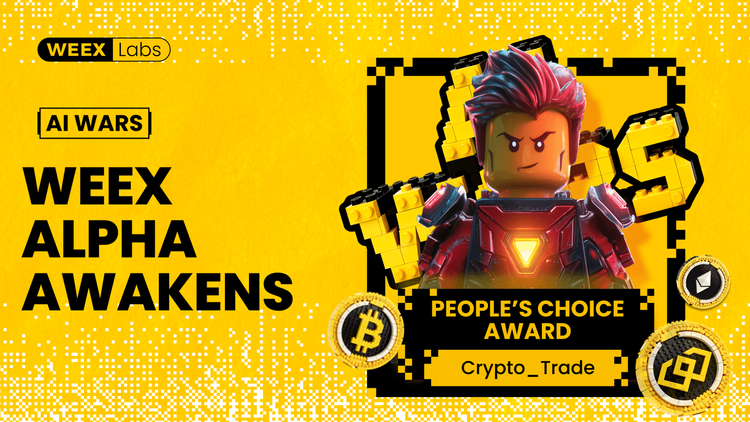
How a Structured AI Crypto Trading Bot Won at the WEEX Hackathon
Crypto_Trade shows how structured inputs and controlled adaptability can build a more stable and reliable AI crypto trading bot within the WEEX AI Trading Hackathon, highlighting a practical path toward scalable AI trading systems.
Particle Founder: The entrepreneurial insights I have gained the most from in the past year
Stop lean startup, stop lightning entrepreneurship, and think carefully about what your product aspirations are.
Huang Renxun's latest podcast transcript: The future of Nvidia, the development of embodied intelligence and agents, the explosion of inference demand, and the public relations crisis of artificial intelligence
The competition in the future is not just about whose model is larger or whose computing power is stronger, but also about who understands the industry better, who can embed AI more deeply into real processes, and who can organize these capabilities into a runnable and scalable system.
OKX Ventures Research Report: AI Agent Economic Infrastructure Research Report (Part 1)
The existing infrastructure is hostile to the Agent economy. Agents can think and act independently at the "capability level," but at the "economic level," they are still locked into infrastructure designed for humans.
The migration of settlement rights: B18 and the institutional starting point of on-chain banks
In the traditional system, banks decide the settlement; in the on-chain system, code begins to take over this responsibility.
From Tencent and Circle: Looking at the Simple and Difficult Questions of Investment
The AI narrative continues to ferment, but the recent performance of related stocks varies, with some in the midst of summer and others as if in winter.
The second half of stablecoins no longer belongs to the crypto circle
What Coinbase doesn't want, Mastercard is eager to buy.


 App
App