
 Buy Crypto
- Markets
 Futures
- Spot
- Copy Trade
- Earn
- More
Why Is the Money Not Here in Bitcoin?

Original Article Title: Crypto Exodus: Why Capital Is Leaving Bitcoin
Original Article Author: @PillageCapital
Translation: Peggy, BlockBeats
Editor's Note: If the first decade of Bitcoin resolved the "right to exist," the next decade will resolve the "ownership of value."
In the early days of the crypto world, Bitcoin represented rebellion and freedom, delivering a comprehensive blow to the rigid financial system. However, as the rebels won the battle, a new era quietly emerged: regulation began to embrace innovation, capital migrated to more efficient paths, stablecoins and tokenization of real-world assets rapidly expanded, and the mythos of Bitcoin faded away.
This article, from Bitcoin's historical mission and the breakdown of network effects to the rise of stablecoins, regulation, and tokenization of real-world assets, incisively points out the new turning point in the crypto industry.
Below is the original text:
Bitcoin was never the future of money. It was a battering ram in the regulatory war. Now, as this war nears its end, the capital that once propelled it is quietly exiting.
For the past 17 years, we have convinced ourselves that the "magic internet money" was the ultimate form of finance. This is not the case. Bitcoin is a regulatory battering ram, a single-function siege engine designed to destroy a particular high wall—the nation's absolute intolerance of "digital bearer assets."
This mission is now largely accomplished.
The tokenization of U.S. stocks has begun; gold tokenization is also legal and growing; the market capitalization of the U.S. dollar tokenization (stablecoins) has reached billions of dollars.
In times of war, a battering ram is invaluable; in peacetime, it is merely a heavy and expensive relic.
As financial infrastructure is upgraded and legitimized, the narrative of "Gold 2.0" is collapsing, reverting to what we truly desired in the 1990s: tokenized representations of real assets.
I. Prehistoric Era: E-gold
To understand why Bitcoin is becoming obsolete, one must first understand why it was created. It was not a "flawless birth" but rather the product of a series of digital currency experiments that were destroyed in the same way.
In 1996, E-gold was launched. By the mid-2000s, it had around 5 million accounts and processed transactions worth billions of dollars.
It proved one thing: the world does indeed need digital asset holdings backed by real value.
Then, the state stepped in and destroyed it. In December 2005, the FBI raided E-gold. In July 2008, the founder pleaded guilty.
The message conveyed couldn't be clearer: a centralized digital gold currency was too easy to destroy—a knock on a door, a server shutdown, a single prosecution, and it was all over.
Three months later, in October 2008, Satoshi Nakamoto released the Bitcoin whitepaper.
Prior to this, he had been contemplating these issues for years. In his own writing, he said the fundamental flaw of traditional currency and early digital currencies was their excessive reliance on central banks and commercial banks. Experiments like E-gold also demonstrated how simple it was to attack these "trust nodes."
Satoshi Nakamoto had just witnessed a true digital currency innovation being decapitated.
If you wanted a digital asset holding to survive, you couldn't allow it to be destroyed with just a "knock on some door."
Bitcoin was engineered for this—it was designed to remove those attack vectors that destroyed E-gold.
It wasn't created for efficiency but for "survival."
II. War: A Necessary Illusion
In the early days, introducing a newcomer to the world of Bitcoin was almost like performing magic. We would have them download a wallet on their phone. When the first coin arrived, you could see that moment on their face—they had just opened a financial account, instantly received value, without permission, without forms, without regulation.
It was a slap in the face. The traditional banking system seemed so antiquated at that moment, and you suddenly realized that you had been under a subtle oppression without even realizing it.
At the Money 20/20 conference in Las Vegas, a speaker projected a QR code onto a huge screen, running a Bitcoin raffle live. The audience sent coins to it, and the grand prize was generated on the spot. A traditional finance professional next to me leaned in and said that guy probably violated fifteen laws at once. He might have been right. But no one cared—that was the point.
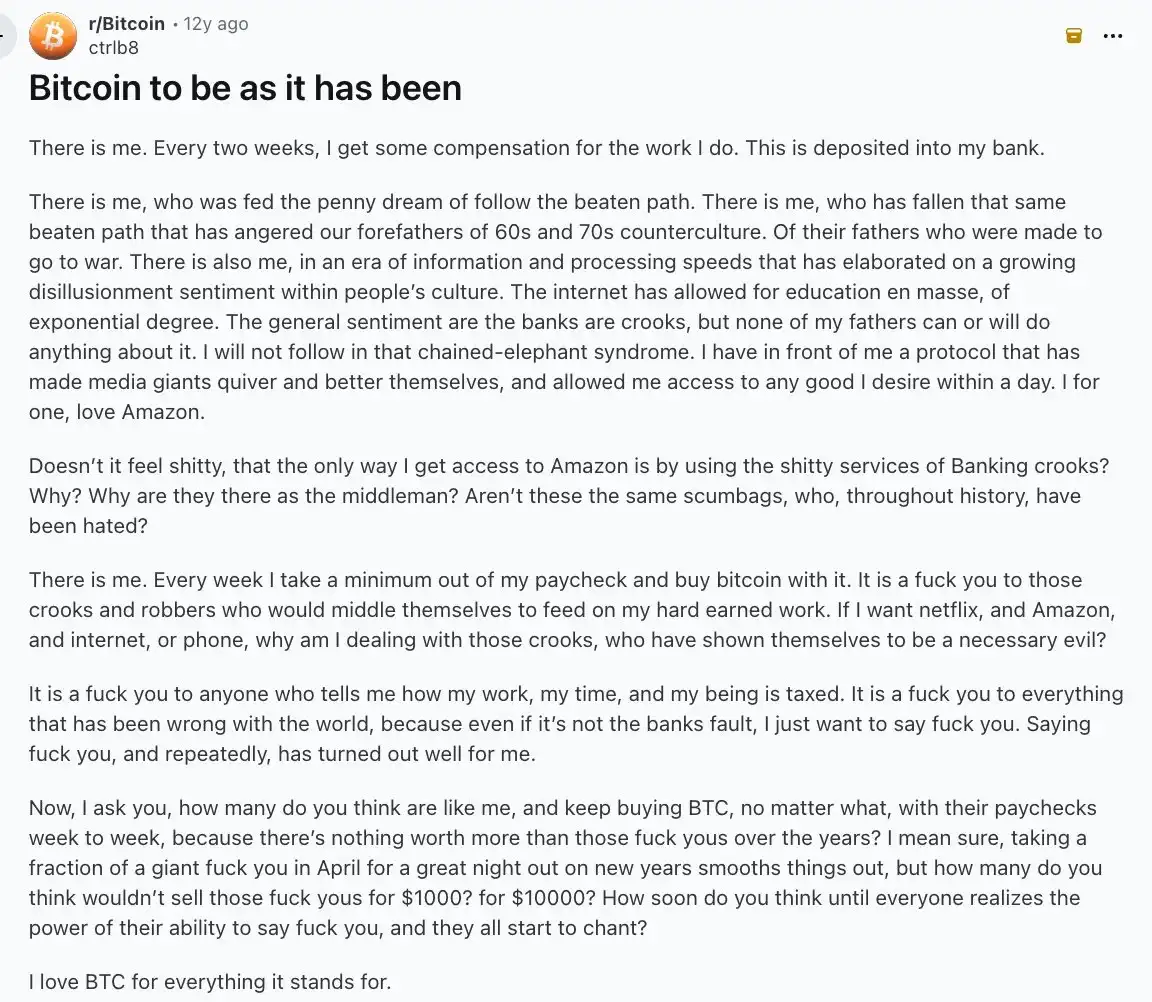
This was not just finance; this was rebellion. A post on the early Reddit Bitcoin board once hit the top spot, perfectly capturing the mood at the time: buy Bitcoin because "it's a big F U to those blood-sucking parasites and thieves who live off the sweat of my brow."
This "self-bootstrapping" mechanism is almost perfect. As long as you fight for this cause, post, promote, argue, and onboard new people, you are directly increasing the value of the coins in your own wallet and in the wallets of your friends. Rebellion will reward you.
Because this network cannot be shut down, it continues to expand after every crackdown, after every negative report. Over time, everyone starts to see this "magic internet money" as the real deal, not just a stopgap measure.
This collective delusion is so powerful that the system itself begins to join the game. BlackRock starts applying for an ETF; the U.S. president discusses whether Bitcoin should be treated as a reserve asset; pension funds and university endowments take on exposure; Michael Saylor convinces convertible bond investors and shareholders to fund the purchase of billions of dollars' worth of enterprise Bitcoin; Bitcoin mining scales up, with overall power consumption reaching the level of a mid-sized country.
Ultimately, when over half of campaign funds come from the crypto industry, the call for "legalized infrastructure" is finally heard. Ironically, it couldn't be simpler: the government's past strong crackdown on banks and payment institutions ended up creating a $30 trillion juggernaut, forcing them to concede.
III. Downfall: When Victory Ends Trade
Channel Upgrades, Monopoly Broken
Bitcoin's advantage has never been just censorship resistance. Its true advantage is its monopoly status.
For many years, if you wanted a "holdable, transferable tokenized value," Bitcoin was the only choice. Bank accounts were closed, fintech companies were scared into inaction by regulation. If you wanted to enjoy the benefits of "instant, programmable money," you had to accept the entire Bitcoin package.
So we accepted it. We supported it, embraced it, because there was no alternative.
But that era has ended.
As soon as there is more than one available "value channel," things immediately look different—just look at the Tether migration path. USDT was initially issued on the Bitcoin chain; later, Ethereum became cheaper, more user-friendly, and most of the circulating supply moved to Ethereum. When Ethereum gas fees got out of control, retail and emerging markets pushed demand towards Tron. The dollars are still the same dollars, the issuer is still the same, just a different "pipe."
Stablecoins have no loyalty to any chain. They see the blockchain as plumbing that can be replaced at any time. What truly matters is the asset and the issuer; the chain itself is just a combination of fee structure, stability, and connectivity to the overall system. In this sense, those who used to shout "Blockchain, not Bitcoin" back then actually ended up winning.

In the early days, images of horse carriages were widely circulated to mock the banks' reports on blockchain technology.
Once you understand this, you will see Bitcoin's position in a completely different light. When there's only one available "rail," all value is forced to flow on that rail, making it easy to blur the lines between the "value of the asset itself" and the "value of the rail." But when there are multiple available rails, value naturally flows to the cheaper and better-connected one.
We are now in such an era.
Today, most people outside the U.S. can hold tokenized US stocks. Perpetual contracts, once a "killer app" in the crypto industry, are now being directly replicated by local institutions like CME. Banks are starting to support USDT deposits and withdrawals. Coinbase is gradually becoming an account that combines banking and brokerage services: you can wire transfer, write checks, buy U.S. stocks, and crypto assets. The network effect that once safeguarded Bitcoin's monopoly position is dissolving into a nondiscriminatory underlying pipeline.
Once the monopoly is gone, Bitcoin is no longer the sole path to achieving these financial effects. It becomes one of many products, competing with products that are closer to the end user, more compliant, and of higher quality.
Technical Reality Check
In the era of the "war," we overlooked a simple fact: Bitcoin is a lousy payment system.
We still need to scan QR codes, copy and paste an unreadable string to make transfers. There are no unified usernames. Cross-chain and cross-layer transfers are like a checkpoint game. If you mix up addresses, you burn the money forever.
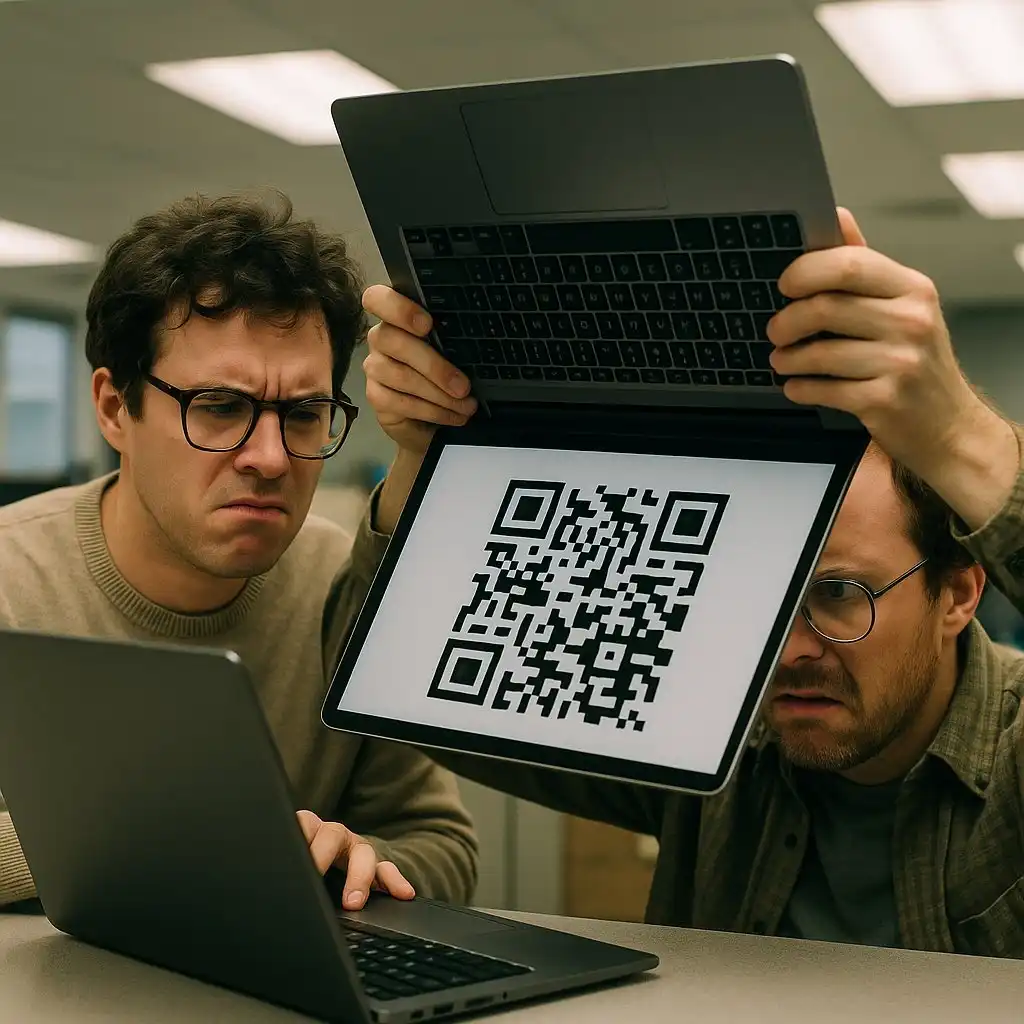
The Money of the Future World
By 2017, the cost of a Bitcoin transaction had soared to nearly $100. A Bitcoin café in Prague had to start accepting Litecoin to stay in business. I once had dinner in Las Vegas, and everyone tried to pay the bill with Bitcoin, causing chaos for thirty minutes, with mobile wallets freezing, transactions getting stuck, and everything being a mess.
Even today, various wallets still fail miserably in their basic functions: balances not displaying, transactions pending, wrong addresses entered, funds disappearing into thin air. In the early days, almost everyone who was introduced to cryptocurrency managed to lose their coins. I myself once lost over a thousand bitcoins—something quite common in the crypto world.
Pure on-chain finance is terrifying when used at scale. People click "sign" in their browser, faced with a block of unreadable code, with no idea what they are authorizing. Even mature institutions like Bybit can be easily hacked, with hackers walking away with billions of dollars and no viable recourse.
We tell ourselves that these user experience issues are just "growing pains."
Ten years later, the reality proves that what truly improves user experience is not some elegant protocol, but centralized custodians. They provide people with passwords, recovery options, and fiat gateways.
The ironic technological conclusion is this: Bitcoin never learned how to achieve usability without rebuilding the very intermediaries it sought to overthrow.
Transactions are no longer worth the risk
After other assets have undergone upgrades, Bitcoin's remaining advantage is merely its "asset's transactionability"—a feature that is now failing.
Look at the return over a full four-year cycle. The performance of the Nasdaq has already surpassed that of Bitcoin.
You endure existential regulatory risks, endure harsh pullbacks, experience countless hacks and exchange collapses, only to find that the final return is less than that of a regular tech index. The risk premium has vanished.
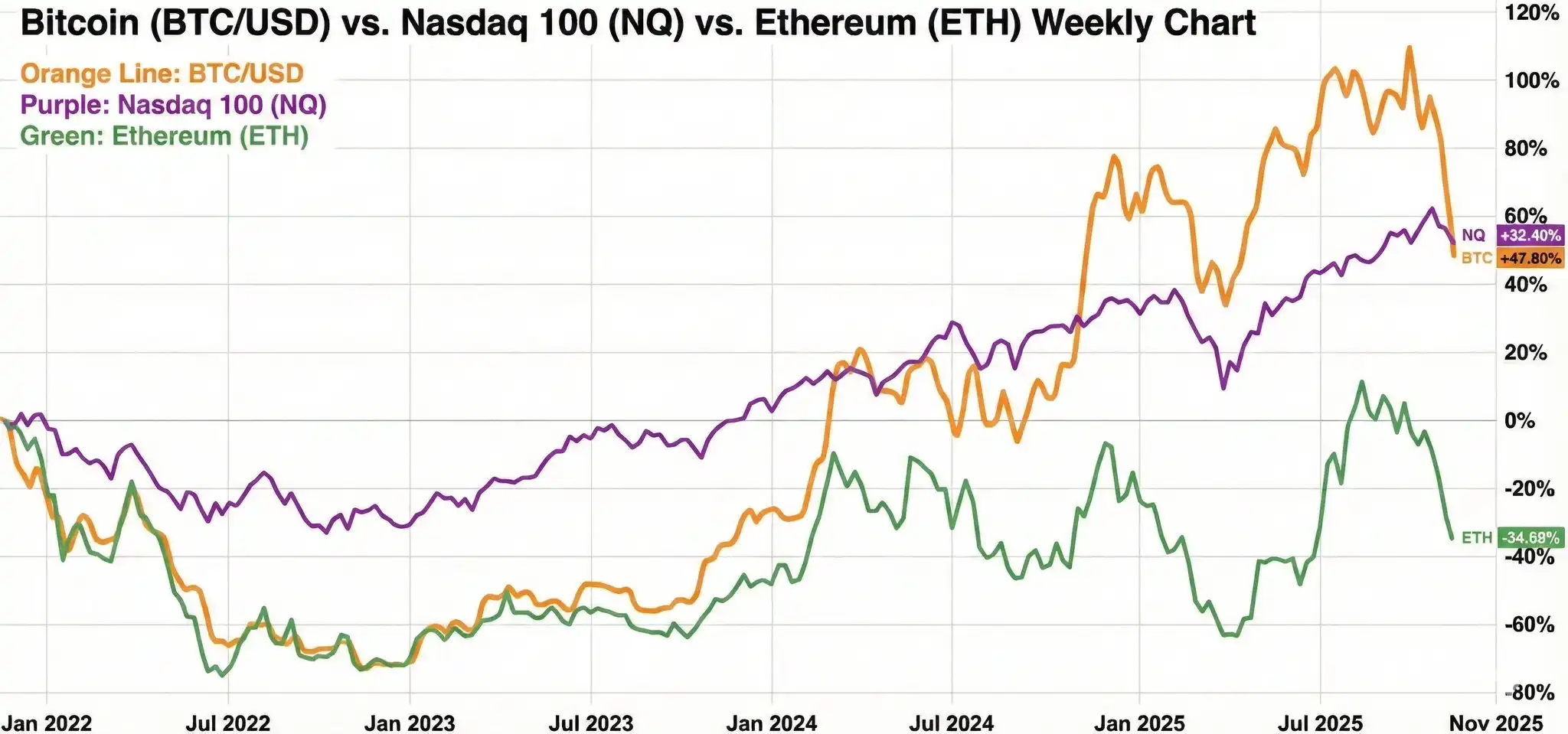
Ethereum is performing even worse.
In theory, as a "high-risk, high-return layer," it should offer you higher returns; but in reality, it's more like a continuous tax, while the boring index line steadily rises.
Part of the reason is structural.
A large portion of early holders have all their net worth in crypto, and today they are older, have families, and real expenses, naturally wishing to lower their risk. To maintain a "normal wealthy life," they sell coins every month. With these sales spread among thousands of holders, this amounts to monthly "life sell pressure" of billions of dollars.
On the other hand, new sources of funds are entirely different. ETF buyers, wealth management clients mostly make only 1%-2% allocations as part of their "going through the motions." This money is stable but not aggressive. These mild inflows must simultaneously offset the continuous sell-offs from early OGs, exchange fees, miner issuances, and an endless string of scams and security incidents just to barely prevent price declines.
The era of "earning massive Alpha to bear regulatory scrutiny" is over.
Builders Smell the Stagnation
Builders are not fools. They are highly sensitive and can smell the beginning of technical loss of edge.
Developer activity has dropped back to 2017 levels.

Weekly Developer Submissions Across Ecosystems
Meanwhile, the codebase has effectively "frozen." Distributed systems are inherently hard to change. The ambitious engineers who once saw crypto at the tech frontier have gradually shifted to more exciting fields such as robotics, aerospace, AI, rather than continuing to push digits around here.
When "transactions are no longer economical, user experience is worse, talent is leaving," the future direction is actually quite clear.
IV. Resilience is More Important Than "Pure Decentralization"
The "decentralization worship" tells a simple story: code is law; money is uninspectable; no one can stop or reverse a transaction.
But most people don't actually want that world. They want a track that works and someone to fix it when it breaks.
This is most evident in Tether's approach. For example:
When funds are stolen by North Korean hackers, Tether freezes those balances.
When someone mistakenly sends a large amount of USDT to a contract or burn address, as long as they can sign from the originating wallet, pass KYC, pay fees, Tether will blacklist those stuck tokens and issue new minted tokens to the correct address.
The process is cumbersome, involves paperwork, and waiting, but it's an actionable remediation mechanism. It is a "human layer" that can acknowledge mistakes and rectify them.
It's certainly counterparty risk, but it's precisely the counterparty risk people are willing to take: if you lose money due to a tech glitch or hack, there's still a chance of recovery.
In the on-chain Bitcoin world, that chance is zero.
If you put the wrong address, sign a wrong transaction, it's a permanent loss. No appeals, no customer service, no second chances.
Our entire legal system is built on a completely opposite intuition: Courts can appeal decisions; judges can overturn rulings; governors and presidents can pardon
The existence of the bankruptcy system is to prevent a "lifetime being ruined by a single mistake"
We hope to live in a world where obvious mistakes can be corrected.
Nobody really wants a system where a bug like the Parity multisig vulnerability permanently freezes $150 million of DOT funds, and everyone can only shrug and say, "Code is law."
Today, our trust in issuers is also much higher than in earlier years.
In the past, "regulation" meant that crypto companies could lose their bank accounts at any time because banks were afraid of regulatory agencies revoking their licenses.
In more recent years, we even watched as entire "crypto-friendly" banks were knocked down like dominoes over a single weekend.
At that time, the state seemed more like an executioner than a judge.
However, today, the same regulatory framework has become a safety net: it demands disclosure; it encloses issuers in auditable structures; it gives politicians and courts the means to handle public theft
With "cryptocurrency" and "political power" deeply intertwined, regulatory agencies can no longer easily destroy the entire industry; they must choose to "tame" it.
In such a world, assuming the risks of issuers and regulators is actually much more rational than assuming the risk of "losing everything with a lost mnemonic phrase."
Nobody really wants a completely unregulated financial system.
Ten years ago, it was a fractured regulatory system that made "unregulated chaos" look like a better alternative.
But as the regulatory track continues to upgrade and add features, this comparison has flipped.
The true preference is now very clear: people want both a strong track and referees on the field.
V. From "Magic Internet Money" to "Tokenization of Real Assets"
Bitcoin accomplished its mission.
It was the battering ram that smashed the wall that had previously caused the demise of projects like E-gold and similar ones. It made "permanently prohibiting asset tokenization" politically and socially infeasible.
But victory brings about a paradox: when the system ultimately decides to upgrade, the value of the battering ram itself will rapidly collapse.
The crypto world still has roles to play. But we no longer need a $30 trillion "Rebel Alliance." Teams like Hyperliquid only need 11 people to rapidly prototype new features, forcing regulators to respond.
Once a mechanism runs smoothly in the "sandbox," traditional finance will replicate it within a regulatory framework.
Mainstream trading logic is also no longer about: putting the bulk of your net worth on "magic internet money" for a decade, then praying for it to moon. That only made sense in an age of "broken orbits, immense upside potential."
"Magic internet money" itself is a strange compromise: a perfect orbit carrying an asset supported only by a narrative.
Next, we will discuss: what happens when the same orbit carries truly scarce assets from the real world.
Capital has already started adjusting.
Even the crypto world's "unofficial central bank" is shifting towards Tether, with gold on its balance sheet surpassing Bitcoin. Tokenized gold and other real-world assets are rapidly growing.
The era of "magic internet money" is ending. The era of "real asset tokenization" is beginning.
Now that the door is open, we no longer need to worship that battering ram but should instead focus on the assets and transactions that are truly important once we step through that door.
You may also like

TAO is Elon Musk, who invested in OpenAI, and Subnet is Sam Altman

The era of "mass coin distribution" on public chains comes to an end

Soaring 50 times, with an FDV exceeding 10 billion USD, why RaveDAO?

1 billion DOTs were minted out of thin air, but the hacker only made 230,000 dollars

After the blockade of the Strait of Hormuz, when will the war end?

Before using Musk's "Western WeChat" X Chat, you need to understand these three questions
The X Chat will be available for download on the App Store this Friday. The media has already covered the feature list, including self-destructing messages, screenshot prevention, 481-person group chats, Grok integration, and registration without a phone number, positioning it as the "Western WeChat." However, there are three questions that have hardly been addressed in any reports.
There is a sentence on X's official help page that is still hanging there: "If malicious insiders or X itself cause encrypted conversations to be exposed through legal processes, both the sender and receiver will be completely unaware."
No. The difference lies in where the keys are stored.
In Signal's end-to-end encryption, the keys never leave your device. X, the court, or any external party does not hold your keys. Signal's servers have nothing to decrypt your messages; even if they were subpoenaed, they could only provide registration timestamps and last connection times, as evidenced by past subpoena records.
X Chat uses the Juicebox protocol. This solution divides the key into three parts, each stored on three servers operated by X. When recovering the key with a PIN code, the system retrieves these three shards from X's servers and recombines them. No matter how complex the PIN code is, X is the actual custodian of the key, not the user.
This is the technical background of the "help page sentence": because the key is on X's servers, X has the ability to respond to legal processes without the user's knowledge. Signal does not have this capability, not because of policy, but because it simply does not have the key.
The following illustration compares the security mechanisms of Signal, WhatsApp, Telegram, and X Chat along six dimensions. X Chat is the only one of the four where the platform holds the key and the only one without Forward Secrecy.
The significance of Forward Secrecy is that even if a key is compromised at a certain point in time, historical messages cannot be decrypted because each message has a unique key. Signal's Double Ratchet protocol automatically updates the key after each message, a mechanism lacking in X Chat.
After analyzing the X Chat architecture in June 2025, Johns Hopkins University cryptology professor Matthew Green commented, "If we judge XChat as an end-to-end encryption scheme, this seems like a pretty game-over type of vulnerability." He later added, "I would not trust this any more than I trust current unencrypted DMs."
From a September 2025 TechCrunch report to being live in April 2026, this architecture saw no changes.
In a February 9, 2026 tweet, Musk pledged to undergo rigorous security tests of X Chat before its launch on X Chat and to open source all the code.
As of the April 17 launch date, no independent third-party audit has been completed, there is no official code repository on GitHub, the App Store's privacy label reveals X Chat collects five or more categories of data including location, contact info, and search history, directly contradicting the marketing claim of "No Ads, No Trackers."
Not continuous monitoring, but a clear access point.
For every message on X Chat, users can long-press and select "Ask Grok." When this button is clicked, the message is delivered to Grok in plaintext, transitioning from encrypted to unencrypted at this stage.
This design is not a vulnerability but a feature. However, X Chat's privacy policy does not state whether this plaintext data will be used for Grok's model training or if Grok will store this conversation content. By actively clicking "Ask Grok," users are voluntarily removing the encryption protection of that message.
There is also a structural issue: How quickly will this button shift from an "optional feature" to a "default habit"? The higher the quality of Grok's replies, the more frequently users will rely on it, leading to an increase in the proportion of messages flowing out of encryption protection. The actual encryption strength of X Chat, in the long run, depends not only on the design of the Juicebox protocol but also on the frequency of user clicks on "Ask Grok."
X Chat's initial release only supports iOS, with the Android version simply stating "coming soon" without a timeline.
In the global smartphone market, Android holds about 73%, while iOS holds about 27% (IDC/Statista, 2025). Of WhatsApp's 3.14 billion monthly active users, 73% are on Android (according to Demand Sage). In India, WhatsApp covers 854 million users, with over 95% Android penetration. In Brazil, there are 148 million users, with 81% on Android, and in Indonesia, there are 112 million users, with 87% on Android.
WhatsApp's dominance in the global communication market is built on Android. Signal, with a monthly active user base of around 85 million, also relies mainly on privacy-conscious users in Android-dominant countries.
X Chat circumvented this battlefield, with two possible interpretations. One is technical debt; X Chat is built with Rust, and achieving cross-platform support is not easy, so prioritizing iOS may be an engineering constraint. The other is a strategic choice; with iOS holding a market share of nearly 55% in the U.S., X's core user base being in the U.S., prioritizing iOS means focusing on their core user base rather than engaging in direct competition with Android-dominated emerging markets and WhatsApp.
These two interpretations are not mutually exclusive, leading to the same result: X Chat's debut saw it willingly forfeit 73% of the global smartphone user base.
This matter has been described by some: X Chat, along with X Money and Grok, forms a trifecta creating a closed-loop data system parallel to the existing infrastructure, similar in concept to the WeChat ecosystem. This assessment is not new, but with X Chat's launch, it's worth revisiting the schematic.
X Chat generates communication metadata, including information on who is talking to whom, for how long, and how frequently. This data flows into X's identity system. Part of the message content goes through the Ask Grok feature and enters Grok's processing chain. Financial transactions are handled by X Money: external public testing was completed in March, opening to the public in April, enabling fiat peer-to-peer transfers via Visa Direct. A senior Fireblocks executive confirmed plans for cryptocurrency payments to go live by the end of the year, holding money transmitter licenses in over 40 U.S. states currently.
Every WeChat feature operates within China's regulatory framework. Musk's system operates within Western regulatory frameworks, but he also serves as the head of the Department of Government Efficiency (DOGE). This is not a WeChat replica; it is a reenactment of the same logic under different political conditions.
The difference is that WeChat has never explicitly claimed to be "end-to-end encrypted" on its main interface, whereas X Chat does. "End-to-end encryption" in user perception means that no one, not even the platform, can see your messages. X Chat's architectural design does not meet this user expectation, but it uses this term.
X Chat consolidates the three data lines of "who this person is, who they are talking to, and where their money comes from and goes to" in one company's hands.
The help page sentence has never been just technical instructions.
Parse Noise's newly launched Beta version, how to "on-chain" this heat?

Is Lobster a Thing of the Past? Unpacking the Hermes Agent Tools that Supercharge Your Throughput to 100x

Declare War on AI? The Doomsday Narrative Behind Ultraman's Residence in Flames
Crypto VCs Are Dead? The Market Extinction Cycle Has Begun
Claude's Journey to Foolishness in Diagrams: The Cost of Thriftiness, or How API Bill Increased 100-Fold

Edge Land Regress: A Rehash Around Maritime Power, Energy, and the Dollar
Arthur Hayes Latest Interview: How Should Retail Investors Navigate the Iran Conflict?
Just now, Sam Altman was attacked again, this time by gunfire

Straits Blockade, Stablecoin Recap | Rewire News Morning Edition

From High Expectations to Controversial Turnaround, Genius Airdrop Triggers Community Backlash
The Xiaomi electric vehicle factory in Beijing's Daxing district has become the new Jerusalem for the American elite

Lean Harness, Fat Skill: The Real Source of 100x AI Productivity
TAO is Elon Musk, who invested in OpenAI, and Subnet is Sam Altman
The era of "mass coin distribution" on public chains comes to an end
Soaring 50 times, with an FDV exceeding 10 billion USD, why RaveDAO?
1 billion DOTs were minted out of thin air, but the hacker only made 230,000 dollars
After the blockade of the Strait of Hormuz, when will the war end?
Before using Musk's "Western WeChat" X Chat, you need to understand these three questions
The X Chat will be available for download on the App Store this Friday. The media has already covered the feature list, including self-destructing messages, screenshot prevention, 481-person group chats, Grok integration, and registration without a phone number, positioning it as the "Western WeChat." However, there are three questions that have hardly been addressed in any reports.
There is a sentence on X's official help page that is still hanging there: "If malicious insiders or X itself cause encrypted conversations to be exposed through legal processes, both the sender and receiver will be completely unaware."
No. The difference lies in where the keys are stored.
In Signal's end-to-end encryption, the keys never leave your device. X, the court, or any external party does not hold your keys. Signal's servers have nothing to decrypt your messages; even if they were subpoenaed, they could only provide registration timestamps and last connection times, as evidenced by past subpoena records.
X Chat uses the Juicebox protocol. This solution divides the key into three parts, each stored on three servers operated by X. When recovering the key with a PIN code, the system retrieves these three shards from X's servers and recombines them. No matter how complex the PIN code is, X is the actual custodian of the key, not the user.
This is the technical background of the "help page sentence": because the key is on X's servers, X has the ability to respond to legal processes without the user's knowledge. Signal does not have this capability, not because of policy, but because it simply does not have the key.
The following illustration compares the security mechanisms of Signal, WhatsApp, Telegram, and X Chat along six dimensions. X Chat is the only one of the four where the platform holds the key and the only one without Forward Secrecy.
The significance of Forward Secrecy is that even if a key is compromised at a certain point in time, historical messages cannot be decrypted because each message has a unique key. Signal's Double Ratchet protocol automatically updates the key after each message, a mechanism lacking in X Chat.
After analyzing the X Chat architecture in June 2025, Johns Hopkins University cryptology professor Matthew Green commented, "If we judge XChat as an end-to-end encryption scheme, this seems like a pretty game-over type of vulnerability." He later added, "I would not trust this any more than I trust current unencrypted DMs."
From a September 2025 TechCrunch report to being live in April 2026, this architecture saw no changes.
In a February 9, 2026 tweet, Musk pledged to undergo rigorous security tests of X Chat before its launch on X Chat and to open source all the code.
As of the April 17 launch date, no independent third-party audit has been completed, there is no official code repository on GitHub, the App Store's privacy label reveals X Chat collects five or more categories of data including location, contact info, and search history, directly contradicting the marketing claim of "No Ads, No Trackers."
Not continuous monitoring, but a clear access point.
For every message on X Chat, users can long-press and select "Ask Grok." When this button is clicked, the message is delivered to Grok in plaintext, transitioning from encrypted to unencrypted at this stage.
This design is not a vulnerability but a feature. However, X Chat's privacy policy does not state whether this plaintext data will be used for Grok's model training or if Grok will store this conversation content. By actively clicking "Ask Grok," users are voluntarily removing the encryption protection of that message.
There is also a structural issue: How quickly will this button shift from an "optional feature" to a "default habit"? The higher the quality of Grok's replies, the more frequently users will rely on it, leading to an increase in the proportion of messages flowing out of encryption protection. The actual encryption strength of X Chat, in the long run, depends not only on the design of the Juicebox protocol but also on the frequency of user clicks on "Ask Grok."
X Chat's initial release only supports iOS, with the Android version simply stating "coming soon" without a timeline.
In the global smartphone market, Android holds about 73%, while iOS holds about 27% (IDC/Statista, 2025). Of WhatsApp's 3.14 billion monthly active users, 73% are on Android (according to Demand Sage). In India, WhatsApp covers 854 million users, with over 95% Android penetration. In Brazil, there are 148 million users, with 81% on Android, and in Indonesia, there are 112 million users, with 87% on Android.
WhatsApp's dominance in the global communication market is built on Android. Signal, with a monthly active user base of around 85 million, also relies mainly on privacy-conscious users in Android-dominant countries.
X Chat circumvented this battlefield, with two possible interpretations. One is technical debt; X Chat is built with Rust, and achieving cross-platform support is not easy, so prioritizing iOS may be an engineering constraint. The other is a strategic choice; with iOS holding a market share of nearly 55% in the U.S., X's core user base being in the U.S., prioritizing iOS means focusing on their core user base rather than engaging in direct competition with Android-dominated emerging markets and WhatsApp.
These two interpretations are not mutually exclusive, leading to the same result: X Chat's debut saw it willingly forfeit 73% of the global smartphone user base.
This matter has been described by some: X Chat, along with X Money and Grok, forms a trifecta creating a closed-loop data system parallel to the existing infrastructure, similar in concept to the WeChat ecosystem. This assessment is not new, but with X Chat's launch, it's worth revisiting the schematic.
X Chat generates communication metadata, including information on who is talking to whom, for how long, and how frequently. This data flows into X's identity system. Part of the message content goes through the Ask Grok feature and enters Grok's processing chain. Financial transactions are handled by X Money: external public testing was completed in March, opening to the public in April, enabling fiat peer-to-peer transfers via Visa Direct. A senior Fireblocks executive confirmed plans for cryptocurrency payments to go live by the end of the year, holding money transmitter licenses in over 40 U.S. states currently.
Every WeChat feature operates within China's regulatory framework. Musk's system operates within Western regulatory frameworks, but he also serves as the head of the Department of Government Efficiency (DOGE). This is not a WeChat replica; it is a reenactment of the same logic under different political conditions.
The difference is that WeChat has never explicitly claimed to be "end-to-end encrypted" on its main interface, whereas X Chat does. "End-to-end encryption" in user perception means that no one, not even the platform, can see your messages. X Chat's architectural design does not meet this user expectation, but it uses this term.
X Chat consolidates the three data lines of "who this person is, who they are talking to, and where their money comes from and goes to" in one company's hands.
The help page sentence has never been just technical instructions.


 App
App