
 Buy Crypto
- Markets
 Futures
- Spot
- Copy Trade
- Earn
- More
What is the Undissolved DOGE Still Up To?

Reuters reported that the "U.S. Government Efficiency Department DOGE Dissolved" news was actually fake news.
According to Reuters' report on November 23, the person who publicly confirmed this news was a senior official in the Trump administration, the director of the U.S. Office of Personnel Management (USOPM), Scott Kupor. This news quickly caused a stir. In Reuters' description, DOGE's gradual decline today sharply contrasts with the government's full-scale promotion of its effectiveness in recent months: Trump and his advisors, cabinet members early on campaigned for it on social media, and Musk even once wielded a chainsaw to advocate for reducing government positions.
However, a dramatic scene quickly unfolded as this seemingly explosive report soon sparked controversy and various clarifications.
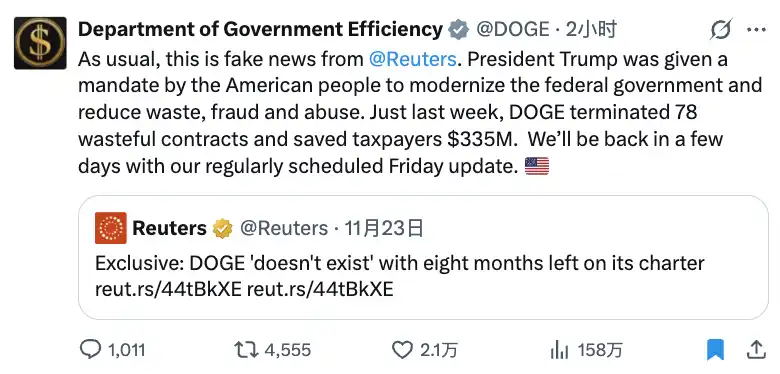
DOGE tweeted that this is fake news
After the publication of the report, Scott Kupor, who was supposed to have confirmed the news in the article, quickly took to social media to object to Reuters, stating that Reuters "cleverly edited" his full comments to create a sensational headline.
He clarified in a tweet: "DOGE's principles still exist and operate well: decentralization, elimination of fraud, waste, and abuse, reshaping the federal workforce, making efficiency a top priority, etc. DOGE has catalyzed these changes." He further stated, "The fact is: DOGE may not have achieved centralized leadership under @USDS. But DOGE's principles still exist and are effective."
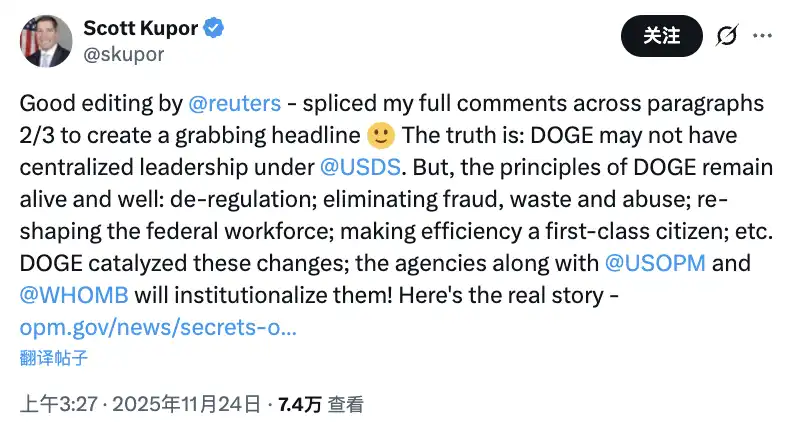
Reuters' "Fake News," Those Wishing for DOGE's Dissolution Never Relent
As a globally renowned news agency, Reuters' clients are spread all over the world and should theoretically maintain a relatively neutral stance. However, in the United States, conservative readers generally believe Reuters leans left. Was this breaking news about DOGE's dissolution an objective statement of fact, or did it carry some kind of bias? The outside world has been discussing this issue.
From various indications, this report may reflect several aspects: one, the establishment and traditional media are truly unhappy with DOGE as a disruptor and want to weaken its influence by portraying its "dissolution"; two, the Washington political circle has always been averse to Musk and DOGE, and they are seizing the media's voice to declare its failure.
This kind of speculation from the public is not groundless.
From the day of its inception, DOGE was destined to make enemies on all sides. The existence of this institution itself is a challenge to the Washington power structure, touching the interests of too many people, and therefore has faced fierce opposition from multiple fronts.
Protesters once gathered outside the Office of Personnel Management, claiming that Musk was illegally in control of government infrastructure and expressing concerns that this unelected foreign-born individual might be able to steal sensitive information stored in federal servers. Including federal employees, retirees, and others who were shocked and outraged by Musk and DOGE's actions, a rally was organized in front of the Treasury Department. 21 members of the United States Digital Service (USDS) collectively resigned. These internal rebellions show that DOGE's radical approach has sparked strong resistance among government employees.
Multiple opinion polls have shown that the majority of Americans oppose DOGE's infiltration of the government and the power Musk has gained. Musk once said at a cabinet meeting that his government efficiency team was receiving death threats every day.
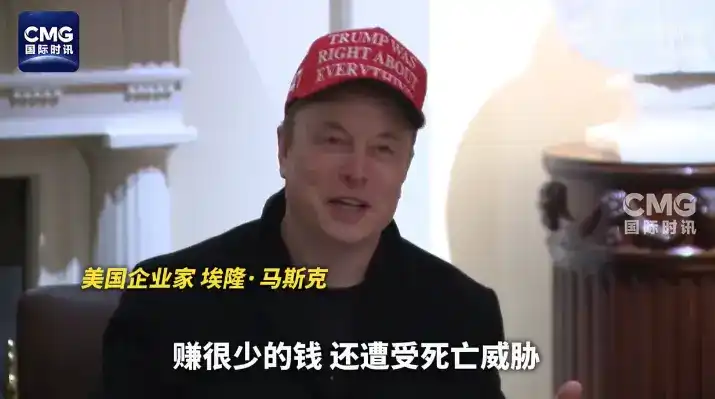
Despite Musk's public falling-out with Trump in May and his departure from Washington, officials from the Trump administration never publicly stated that he was gone for good. However, signals of DOGE's demise have been a subject of discussion and speculation.
For example, this time, the "Whistleblower" Scott Kupor, although there is no direct evidence of him having a public conflict with Musk or DOGE, Scott Kupor has publicly stated that he does not agree with DOGE's approach.
Who is the "Whistleblower" Scott Kupor?
The name Scott Kupor may be unfamiliar to many, but he was previously a managing partner at the Silicon Valley-based prominent venture capital firm Andreessen Horowitz (a16z). On July 14, 2025, Scott Kupor was sworn in as the director of the U.S. Office of Personnel Management.
After taking office, Kupor introduced modern recruitment reforms, such as changing the traditional "pick one out of three candidates" to "select from a larger talent pool," aiming to hire from a more extensive talent pool. He also emphasized that the OPM needed to become more efficient, more transparent, and actively bring in tech talent (especially AI-related) into the federal government.
In an interview with the media, Kupor explicitly stated, "OPM is its own agency." He added that if DOGE's goals align with his own, he is willing to cooperate, but he will never completely follow DOGE's orders. In other words, he wants to institutionalize efficiency reforms but will not fully embrace Musk's aggressive approach.
Past reports also show a difference in opinion between Kupor and DOGE. According to the Financial Times, he has criticized the control mechanisms strongly pushed by Musk, such as requiring employees to submit "weekly progress reports." The Washington Post also stated that he found Musk's "5 things weekly report system" to be inefficient. Regarding Musk's initially proposed super aggressive cost-cutting goals, he also expressed doubts: "We can't just cut discretionary spending to zero and magically save two trillion dollars."
This gradual reform approach contrasts sharply with Musk's aggressive layoff method. Kupor may believe that driving reform through traditional institutions like OPM is more prudent and sustainable than relying on Musk as an "external consultant." Despite criticisms, he also believes that DOGE has played a key catalyzing role.
According to Kupor's own statement, along with Reuters' disclosure, OPM has now taken over much of DOGE's cost-cutting and employee reduction work. From a bureaucratic perspective, OPM, as the federal government's human resources department, should have been doing this work originally. Kupor's stance may reflect an adjustment strategy within the Trump administration: no longer needing an independently led, highly controversial agency by Musk, but rather integrating reform functions into regular government departments. This approach allows for continued reform progress while reducing external pressure.
What Has DOGE Accomplished?
Last October, at a Trump campaign rally in Madison Square Garden, Musk stated he believed DOGE could cut "at least" 2 trillion dollars in federal spending, a figure higher than the 2023 discretionary spending budget.
At the first cabinet meeting in February this year, Musk still optimistically believed a reduction of 1 trillion dollars was possible — 15% of the budget.
However, as time passed, this target repeatedly shrank. In April 2025, Musk stated that 1.5 trillion dollars had already been cut, but this figure was questioned by fact-checkers. Blake Moore, chair of the House DOGE core group, mentioned on June 5 that Republican members always knew this was a "gross exaggeration."
According to its website, DOGE has terminated 13,440 contracts, 15,887 appropriations, and 264 leases — these estimated numbers fluctuated significantly over its 10-month existence. DOGE pledged to save one trillion dollars for American taxpayers, but even based on their own records, they have far from met this goal.
As of the time of writing, the DOGE website claims that the department has achieved $214 billion in savings through "asset sales, contract/lease cancellations and renegotiation, fraud and improper payment removal, appropriation cancellations, interest savings, project changes, regulatory savings, and workforce reductions," equivalent to $1,329.19 per taxpayer.
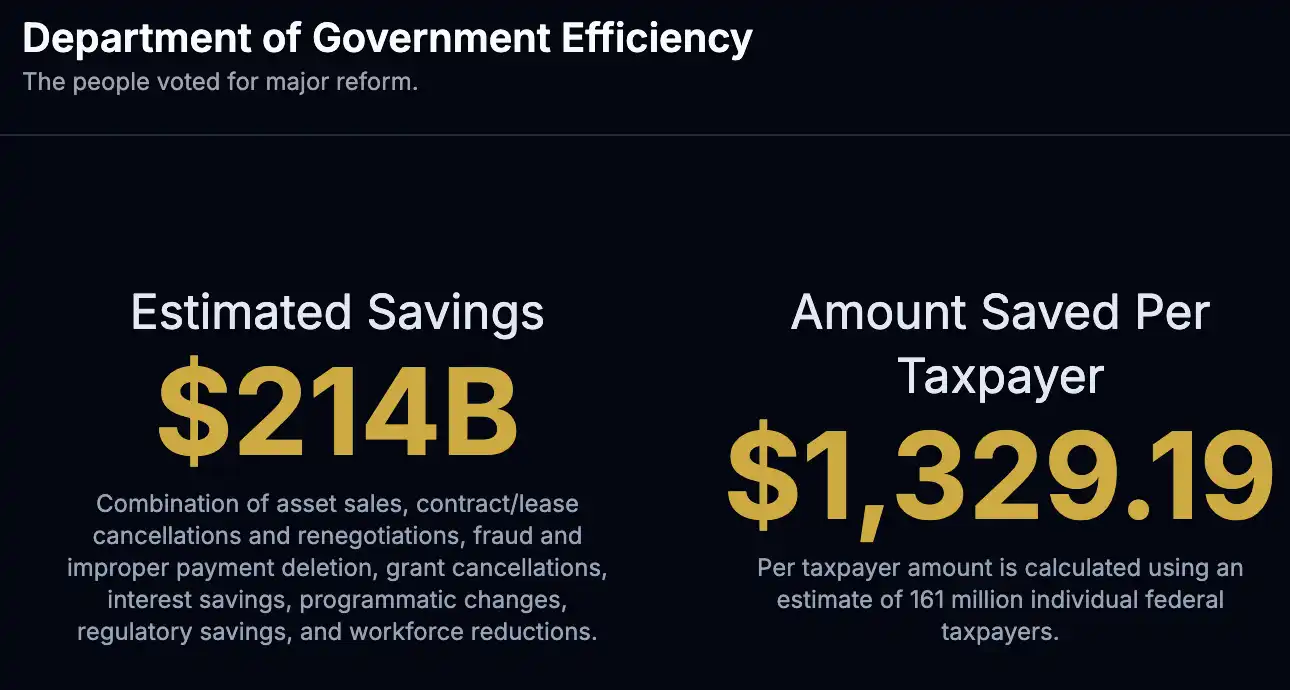
This figure falls far short of the initial promised $1 trillion target, achieving only about 21%. Due to the agency not publicly disclosing detailed work breakdowns, external financial experts have been unable to verify the veracity of this claim. As of the end of the fiscal year in October, The New York Times reported that budget experts and the Congressional Appropriations Committee still did not know how much funding had been cut or where the unused funds had gone.
In a recent tweet, DOGE stated that in the past 9 days, they terminated or reduced 78 wasteful contracts worth $19 billion, saving $3.35 billion.
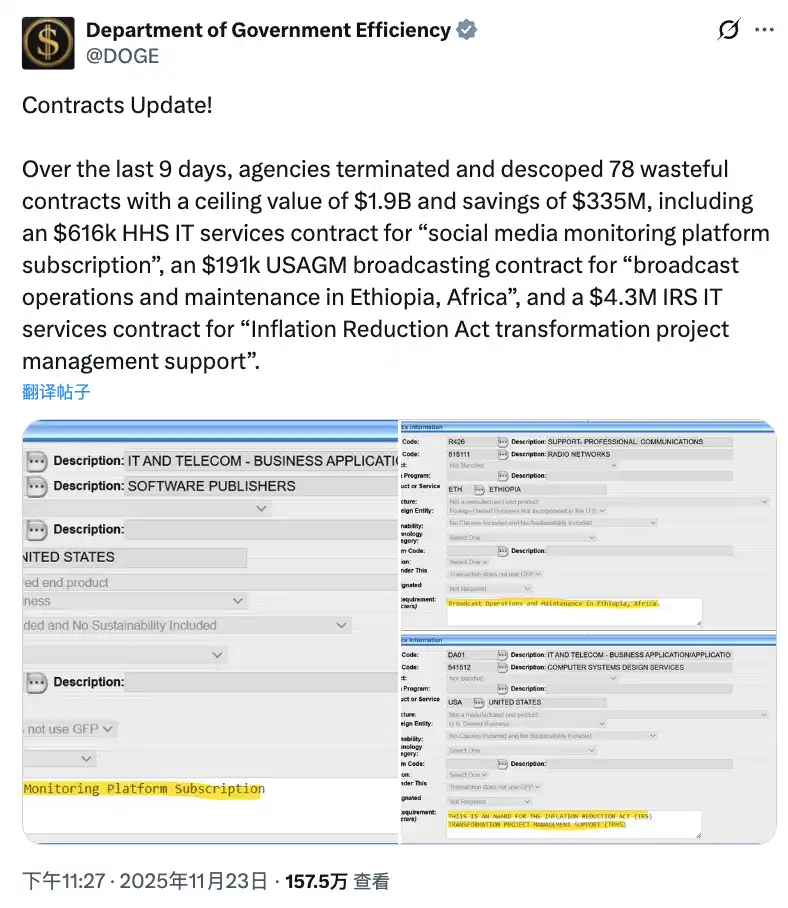
This includes a $616,000 HHS IT services contract for a "Social Media Monitoring Platform Subscription"; a $191,000 USAGM broadcasting contract for "Broadcast Operations and Maintenance in Africa Ethiopia"; and a $4.3 million IRS IT services contract for "Inflation Reduction Act Transformation Project Management Support."
Prior to this, DOGE's "achievements" were mainly focused on personnel reductions and agency paralysis.
DOGE first began its federal agency reduction efforts by eliminating all employees engaged in diversity, equity, and inclusion work from all federal agencies, who were placed on administrative leave.
Subsequently, DOGE announced a voluntary "deferred retirement" program, also known as "Fork in the Road," offering federal employees the option to resign and continue to receive pay until the end of September – nearly 75,000 federal employees accepted this proposal in February. Read more: "Cutting Hundreds of Millions More in Contracts, Musk's D.O.G.E. Finds What Bizarre Government Departments?"
The second Trump administration announced about 300,000 U.S. federal job cuts, almost entirely attributed to DOGE. As of July 14, 2025, CNN traced at least 128,709 workers who were laid off or targeted for layoffs. By May 12, The New York Times tracked over 58,500 confirmed reductions, over 76,000 buyouts, and over 149,000 other planned reductions; the total cuts accounted for 12% of the 2.4 million civilian federal workforce.
In a blog post released on Friday regarding the Federal Employee Plan, Kupor stated that the government has hired approximately 68,000 people this year, while 317,000 employees have left the government—exceeding Trump's goal of cutting four employees for every one hired.
Breaking it down by department: the Department of Education will cut almost 50% of its staff. Over 1,300 positions will be eliminated through RIF, with around 600 people accepting either the "Fork" deferred resignation offer or the department's VSIP offer. The Department of Veterans Affairs aims to "return to our final strength of 399,957 employees in 2019," which will reduce approximately 80,000 employees. The Department of Health and Human Services announced significant cuts, stating its intention to cut 20,000 positions (25% of the agency), of which half they plan to achieve through early retirement, buyouts, and attrition.
DOGE remains a driving force behind many personnel cuts in the federal government this year. Government agencies make up the majority of these layoffs, with 62,530 federal employees being dismissed in the first two months of 2025. This represents a staggering 41,311% increase compared to the same period in 2024.
No wonder the fake news about DOGE "dissolution" emerged, as many wanted to see this disruptive agency in Washington disappear.
And now, perhaps the story of DOGE is not truly over yet.
You may also like

TAO is Elon Musk, who invested in OpenAI, and Subnet is Sam Altman

The era of "mass coin distribution" on public chains comes to an end

Soaring 50 times, with an FDV exceeding 10 billion USD, why RaveDAO?

1 billion DOTs were minted out of thin air, but the hacker only made 230,000 dollars

After the blockade of the Strait of Hormuz, when will the war end?

Before using Musk's "Western WeChat" X Chat, you need to understand these three questions
The X Chat will be available for download on the App Store this Friday. The media has already covered the feature list, including self-destructing messages, screenshot prevention, 481-person group chats, Grok integration, and registration without a phone number, positioning it as the "Western WeChat." However, there are three questions that have hardly been addressed in any reports.
There is a sentence on X's official help page that is still hanging there: "If malicious insiders or X itself cause encrypted conversations to be exposed through legal processes, both the sender and receiver will be completely unaware."
No. The difference lies in where the keys are stored.
In Signal's end-to-end encryption, the keys never leave your device. X, the court, or any external party does not hold your keys. Signal's servers have nothing to decrypt your messages; even if they were subpoenaed, they could only provide registration timestamps and last connection times, as evidenced by past subpoena records.
X Chat uses the Juicebox protocol. This solution divides the key into three parts, each stored on three servers operated by X. When recovering the key with a PIN code, the system retrieves these three shards from X's servers and recombines them. No matter how complex the PIN code is, X is the actual custodian of the key, not the user.
This is the technical background of the "help page sentence": because the key is on X's servers, X has the ability to respond to legal processes without the user's knowledge. Signal does not have this capability, not because of policy, but because it simply does not have the key.
The following illustration compares the security mechanisms of Signal, WhatsApp, Telegram, and X Chat along six dimensions. X Chat is the only one of the four where the platform holds the key and the only one without Forward Secrecy.
The significance of Forward Secrecy is that even if a key is compromised at a certain point in time, historical messages cannot be decrypted because each message has a unique key. Signal's Double Ratchet protocol automatically updates the key after each message, a mechanism lacking in X Chat.
After analyzing the X Chat architecture in June 2025, Johns Hopkins University cryptology professor Matthew Green commented, "If we judge XChat as an end-to-end encryption scheme, this seems like a pretty game-over type of vulnerability." He later added, "I would not trust this any more than I trust current unencrypted DMs."
From a September 2025 TechCrunch report to being live in April 2026, this architecture saw no changes.
In a February 9, 2026 tweet, Musk pledged to undergo rigorous security tests of X Chat before its launch on X Chat and to open source all the code.
As of the April 17 launch date, no independent third-party audit has been completed, there is no official code repository on GitHub, the App Store's privacy label reveals X Chat collects five or more categories of data including location, contact info, and search history, directly contradicting the marketing claim of "No Ads, No Trackers."
Not continuous monitoring, but a clear access point.
For every message on X Chat, users can long-press and select "Ask Grok." When this button is clicked, the message is delivered to Grok in plaintext, transitioning from encrypted to unencrypted at this stage.
This design is not a vulnerability but a feature. However, X Chat's privacy policy does not state whether this plaintext data will be used for Grok's model training or if Grok will store this conversation content. By actively clicking "Ask Grok," users are voluntarily removing the encryption protection of that message.
There is also a structural issue: How quickly will this button shift from an "optional feature" to a "default habit"? The higher the quality of Grok's replies, the more frequently users will rely on it, leading to an increase in the proportion of messages flowing out of encryption protection. The actual encryption strength of X Chat, in the long run, depends not only on the design of the Juicebox protocol but also on the frequency of user clicks on "Ask Grok."
X Chat's initial release only supports iOS, with the Android version simply stating "coming soon" without a timeline.
In the global smartphone market, Android holds about 73%, while iOS holds about 27% (IDC/Statista, 2025). Of WhatsApp's 3.14 billion monthly active users, 73% are on Android (according to Demand Sage). In India, WhatsApp covers 854 million users, with over 95% Android penetration. In Brazil, there are 148 million users, with 81% on Android, and in Indonesia, there are 112 million users, with 87% on Android.
WhatsApp's dominance in the global communication market is built on Android. Signal, with a monthly active user base of around 85 million, also relies mainly on privacy-conscious users in Android-dominant countries.
X Chat circumvented this battlefield, with two possible interpretations. One is technical debt; X Chat is built with Rust, and achieving cross-platform support is not easy, so prioritizing iOS may be an engineering constraint. The other is a strategic choice; with iOS holding a market share of nearly 55% in the U.S., X's core user base being in the U.S., prioritizing iOS means focusing on their core user base rather than engaging in direct competition with Android-dominated emerging markets and WhatsApp.
These two interpretations are not mutually exclusive, leading to the same result: X Chat's debut saw it willingly forfeit 73% of the global smartphone user base.
This matter has been described by some: X Chat, along with X Money and Grok, forms a trifecta creating a closed-loop data system parallel to the existing infrastructure, similar in concept to the WeChat ecosystem. This assessment is not new, but with X Chat's launch, it's worth revisiting the schematic.
X Chat generates communication metadata, including information on who is talking to whom, for how long, and how frequently. This data flows into X's identity system. Part of the message content goes through the Ask Grok feature and enters Grok's processing chain. Financial transactions are handled by X Money: external public testing was completed in March, opening to the public in April, enabling fiat peer-to-peer transfers via Visa Direct. A senior Fireblocks executive confirmed plans for cryptocurrency payments to go live by the end of the year, holding money transmitter licenses in over 40 U.S. states currently.
Every WeChat feature operates within China's regulatory framework. Musk's system operates within Western regulatory frameworks, but he also serves as the head of the Department of Government Efficiency (DOGE). This is not a WeChat replica; it is a reenactment of the same logic under different political conditions.
The difference is that WeChat has never explicitly claimed to be "end-to-end encrypted" on its main interface, whereas X Chat does. "End-to-end encryption" in user perception means that no one, not even the platform, can see your messages. X Chat's architectural design does not meet this user expectation, but it uses this term.
X Chat consolidates the three data lines of "who this person is, who they are talking to, and where their money comes from and goes to" in one company's hands.
The help page sentence has never been just technical instructions.
Parse Noise's newly launched Beta version, how to "on-chain" this heat?

Is Lobster a Thing of the Past? Unpacking the Hermes Agent Tools that Supercharge Your Throughput to 100x

Declare War on AI? The Doomsday Narrative Behind Ultraman's Residence in Flames
Crypto VCs Are Dead? The Market Extinction Cycle Has Begun
Claude's Journey to Foolishness in Diagrams: The Cost of Thriftiness, or How API Bill Increased 100-Fold

Edge Land Regress: A Rehash Around Maritime Power, Energy, and the Dollar
Arthur Hayes Latest Interview: How Should Retail Investors Navigate the Iran Conflict?
Just now, Sam Altman was attacked again, this time by gunfire

Straits Blockade, Stablecoin Recap | Rewire News Morning Edition

From High Expectations to Controversial Turnaround, Genius Airdrop Triggers Community Backlash
The Xiaomi electric vehicle factory in Beijing's Daxing district has become the new Jerusalem for the American elite

Lean Harness, Fat Skill: The Real Source of 100x AI Productivity
TAO is Elon Musk, who invested in OpenAI, and Subnet is Sam Altman
The era of "mass coin distribution" on public chains comes to an end
Soaring 50 times, with an FDV exceeding 10 billion USD, why RaveDAO?
1 billion DOTs were minted out of thin air, but the hacker only made 230,000 dollars
After the blockade of the Strait of Hormuz, when will the war end?
Before using Musk's "Western WeChat" X Chat, you need to understand these three questions
The X Chat will be available for download on the App Store this Friday. The media has already covered the feature list, including self-destructing messages, screenshot prevention, 481-person group chats, Grok integration, and registration without a phone number, positioning it as the "Western WeChat." However, there are three questions that have hardly been addressed in any reports.
There is a sentence on X's official help page that is still hanging there: "If malicious insiders or X itself cause encrypted conversations to be exposed through legal processes, both the sender and receiver will be completely unaware."
No. The difference lies in where the keys are stored.
In Signal's end-to-end encryption, the keys never leave your device. X, the court, or any external party does not hold your keys. Signal's servers have nothing to decrypt your messages; even if they were subpoenaed, they could only provide registration timestamps and last connection times, as evidenced by past subpoena records.
X Chat uses the Juicebox protocol. This solution divides the key into three parts, each stored on three servers operated by X. When recovering the key with a PIN code, the system retrieves these three shards from X's servers and recombines them. No matter how complex the PIN code is, X is the actual custodian of the key, not the user.
This is the technical background of the "help page sentence": because the key is on X's servers, X has the ability to respond to legal processes without the user's knowledge. Signal does not have this capability, not because of policy, but because it simply does not have the key.
The following illustration compares the security mechanisms of Signal, WhatsApp, Telegram, and X Chat along six dimensions. X Chat is the only one of the four where the platform holds the key and the only one without Forward Secrecy.
The significance of Forward Secrecy is that even if a key is compromised at a certain point in time, historical messages cannot be decrypted because each message has a unique key. Signal's Double Ratchet protocol automatically updates the key after each message, a mechanism lacking in X Chat.
After analyzing the X Chat architecture in June 2025, Johns Hopkins University cryptology professor Matthew Green commented, "If we judge XChat as an end-to-end encryption scheme, this seems like a pretty game-over type of vulnerability." He later added, "I would not trust this any more than I trust current unencrypted DMs."
From a September 2025 TechCrunch report to being live in April 2026, this architecture saw no changes.
In a February 9, 2026 tweet, Musk pledged to undergo rigorous security tests of X Chat before its launch on X Chat and to open source all the code.
As of the April 17 launch date, no independent third-party audit has been completed, there is no official code repository on GitHub, the App Store's privacy label reveals X Chat collects five or more categories of data including location, contact info, and search history, directly contradicting the marketing claim of "No Ads, No Trackers."
Not continuous monitoring, but a clear access point.
For every message on X Chat, users can long-press and select "Ask Grok." When this button is clicked, the message is delivered to Grok in plaintext, transitioning from encrypted to unencrypted at this stage.
This design is not a vulnerability but a feature. However, X Chat's privacy policy does not state whether this plaintext data will be used for Grok's model training or if Grok will store this conversation content. By actively clicking "Ask Grok," users are voluntarily removing the encryption protection of that message.
There is also a structural issue: How quickly will this button shift from an "optional feature" to a "default habit"? The higher the quality of Grok's replies, the more frequently users will rely on it, leading to an increase in the proportion of messages flowing out of encryption protection. The actual encryption strength of X Chat, in the long run, depends not only on the design of the Juicebox protocol but also on the frequency of user clicks on "Ask Grok."
X Chat's initial release only supports iOS, with the Android version simply stating "coming soon" without a timeline.
In the global smartphone market, Android holds about 73%, while iOS holds about 27% (IDC/Statista, 2025). Of WhatsApp's 3.14 billion monthly active users, 73% are on Android (according to Demand Sage). In India, WhatsApp covers 854 million users, with over 95% Android penetration. In Brazil, there are 148 million users, with 81% on Android, and in Indonesia, there are 112 million users, with 87% on Android.
WhatsApp's dominance in the global communication market is built on Android. Signal, with a monthly active user base of around 85 million, also relies mainly on privacy-conscious users in Android-dominant countries.
X Chat circumvented this battlefield, with two possible interpretations. One is technical debt; X Chat is built with Rust, and achieving cross-platform support is not easy, so prioritizing iOS may be an engineering constraint. The other is a strategic choice; with iOS holding a market share of nearly 55% in the U.S., X's core user base being in the U.S., prioritizing iOS means focusing on their core user base rather than engaging in direct competition with Android-dominated emerging markets and WhatsApp.
These two interpretations are not mutually exclusive, leading to the same result: X Chat's debut saw it willingly forfeit 73% of the global smartphone user base.
This matter has been described by some: X Chat, along with X Money and Grok, forms a trifecta creating a closed-loop data system parallel to the existing infrastructure, similar in concept to the WeChat ecosystem. This assessment is not new, but with X Chat's launch, it's worth revisiting the schematic.
X Chat generates communication metadata, including information on who is talking to whom, for how long, and how frequently. This data flows into X's identity system. Part of the message content goes through the Ask Grok feature and enters Grok's processing chain. Financial transactions are handled by X Money: external public testing was completed in March, opening to the public in April, enabling fiat peer-to-peer transfers via Visa Direct. A senior Fireblocks executive confirmed plans for cryptocurrency payments to go live by the end of the year, holding money transmitter licenses in over 40 U.S. states currently.
Every WeChat feature operates within China's regulatory framework. Musk's system operates within Western regulatory frameworks, but he also serves as the head of the Department of Government Efficiency (DOGE). This is not a WeChat replica; it is a reenactment of the same logic under different political conditions.
The difference is that WeChat has never explicitly claimed to be "end-to-end encrypted" on its main interface, whereas X Chat does. "End-to-end encryption" in user perception means that no one, not even the platform, can see your messages. X Chat's architectural design does not meet this user expectation, but it uses this term.
X Chat consolidates the three data lines of "who this person is, who they are talking to, and where their money comes from and goes to" in one company's hands.
The help page sentence has never been just technical instructions.


 App
App