

What Can the Cryptocurrency Market Trade One Year Later?

By: blockbeats|2026/02/02 23:00:00
0
Share
copy
Original Title: "What Can the Crypto Market Trade One Year Later?"
Original Author: Mandy Azuma, Odaily Planet Daily

This weekend, amid internal and external troubles, the crypto market experienced another bloodbath. BTC is currently hesitating around its Strategy holding cost price of $76,000, while altcoins are contemplating self-harm just by looking at the price.

Behind the current turmoil, after recent discussions with projects, funds, and exchanges, a recurring question keeps popping up in my mind: What will the crypto market be trading one year from now?

And the more fundamental question behind it is: If the primary market no longer produces the "future secondary," then what will the secondary market be trading one year from now? What changes will occur in the trading platforms?

Although the death of altcoins has long been a topic of discussion, the market has not lacked projects in the past year. Projects are still lining up for TGEs every day. As media professionals, we are still actively engaging with project teams for marketing and promotion.

(Please note, in this context, when we mention "projects," we are mostly referring to the narrow definition of "project teams." In simplest terms, these are projects aiming to compete with Ethereum and its ecosystem—foundational infrastructure and various decentralized applications. These are "token issuance projects," which are the cornerstone of what our industry calls native innovation and entrepreneurship. Therefore, platforms emerging from industries such as Meme and traditional sectors entering the crypto space are temporarily set aside for discussion.)

If we push the timeline back a bit, we'll find a fact that we have all been avoiding discussing: these projects preparing for TGE are all "existing old projects." Most of them raised funds 1–3 years ago and are only now reaching the token issuance stage, even under internal and external pressures, they are compelled to take this token issuance step.

This seems to be a kind of "industry destocking," or to put it more bluntly, queuing up to complete the life cycle, issuing tokens to provide an account to the team and investors, and then lying down quietly awaiting death, or spending the funds in the account hoping for a miracle.

The Primary Market Is Dead

For those of us who entered the industry during the ICO era or even earlier, experienced several bull-bear transitions, and witnessed the industry's dividends empowering countless individuals, subconsciously, we always feel that as long as time is sufficient, new cycles, new projects, new narratives, and new TGEs will always emerge.

However, the reality is that we are already far from the comfort zone.

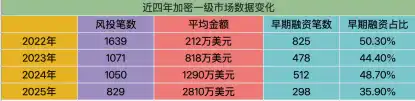
Looking at the data directly, within the most recent four-year cycle (2022-2025), excluding special primary market activities such as mergers and acquisitions, IPOs, and public offerings, the number of financing transactions in the crypto industry has shown a significant downward trend (1639 ➡️ 1071 ➡️ 1050 ➡️ 829).
What Can the Cryptocurrency Market Trade One Year Later?

The reality is even bleaker than the data, as the primary market has not only seen a decrease in overall funding amount but also a structural collapse.

Over the past four years, the early-stage rounds representing the industry's fresh blood (including angel, pre-seed, and seed rounds) have experienced a significant decline in the number of deals (825 ➡️ 298 over four years, a decrease of 63.9%), showing a larger drop compared to the overall funding amount (a decrease of 49.4%). The primary market's ability to provide funding to the industry has been shrinking.

Sectors with a rising number of deals include financial services, trading platforms, asset management, payments, AI, and other applied encryption technologies. However, these have limited practical implications since the vast majority will not issue their own tokens. In contrast, native "projects" in L1, L2, DeFi, social, and similar areas have seen a more significant decline in funding.
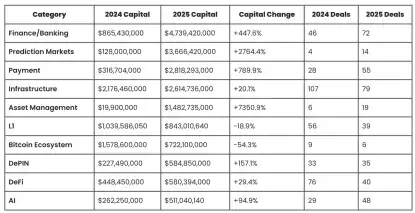
Odaily Note: Chart sourced from Crypto Fundraising

One easily misinterpreted data point is the substantial reduction in the number of deals, coupled with an increase in the average deal size. This is primarily due to the "mega-deals" capturing a significant amount of funds from the traditional finance side, greatly inflating the average. Additionally, mainstream VCs tend to double down on a small number of "super projects," such as Polymarket's multi-billion-dollar rounds.

From the perspective of crypto capital, this imbalance is even more pronounced.

Recently, a friend outside the industry asked me about a well-known long-established crypto fund that was fundraising. After reviewing their Deck, he was puzzled why their returns were "so poor." The table below shows the actual data from the Deck; I won't mention the fund's name but have only extracted their fund performance data from 2014 to 2022.
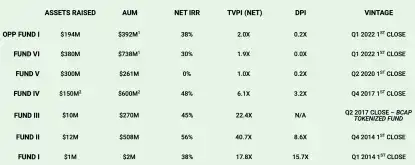
It is clear to see that between 2017 and 2022, there has been a significant change in this fund's IRR and DPI — the former representing the fund's annualized return level, more reflective of the "on-paper money-making ability," while the latter represents the cash multiple already returned to LPs.

Looking at different vintage years, this set of funds' returns demonstrate a very clear "cyclical discontinuity": funds established from 2014 to 2017 (Fund I, Fund II, Fund III, Fund IV) have shown a significant lead in overall returns, with TVPI generally ranging from 6x to 40x, Net IRR staying between 38% and 56%, and also having achieved high DPI, indicating that these funds not only have high paper returns but have also undergone significant cash-outs, benefiting from the early days of crypto infrastructure and the period when leading protocols went from 0 to 1.

For funds established after 2020 (Fund V, Fund VI, and the 2022 Opportunity Fund), there has been a clear downgrade, with TVPI mostly concentrated in the 1.0x–2.0x range. DPI is close to zero or very low, indicating that returns mostly remain at the unrealized level and cannot be converted into real exit gains. This reflects that in a context of valuation inflation, increased competition, and declining project quality supply, the primary market cannot replicate the excess return structure previously driven by the "new narrative + new asset supply."

The real story behind the data is that after the DeFi Summer hype in 2019, the primary market valuations of crypto-native protocols were inflated. However, these projects faced a weak narrative, industry tightening, exchanges controlling liquidity tied to temporary Term modifications, and other conditions when they actually launched their tokens two years later. They generally performed poorly, with some even experiencing a market cap inversion, making investors the weaker party and fund exits challenging.

Nevertheless, these fund misalignments can still create a semblance of false prosperity in the industry, until some giant star funds raised funds nearly two years later, revealing the grim reality of the actual data.

The fund I cited currently manages nearly $3 billion, which further illustrates its role as a mirror reflecting the industry cycle—whether it is doing well is no longer a matter of individual project selection; the trend has passed.

While traditional funds are currently struggling to raise funds, some can still survive, lie flat, collect management fees, or transition to investing in AI. Many other funds have already closed or shifted to the secondary market.

For example, in the Chinese market, the "Ethereum Milk King," Boss Yilihua, who was once a representative figure in the primary market not long ago, with an average annual investment in over a hundred projects.

Shanzhai's Substitute Is Never Meme

When we talk about the exhaustion of crypto-native projects, one exception is the Meme explosion.

For the past two years, there has been a repeated phrase in the industry: Shanzhai's substitute is Meme.

But looking back now, this conclusion has actually been proven wrong.

During the early stages of the Meme wave, we played Meme in a "mainstream Shanzhai" way—filtering out so-called fundamentals, community quality, and narrative rationality from a large number of Meme projects, trying to find the project that can survive long-term, continuously refresh itself, eventually grow into Doge, or even the "next Bitcoin."

However, today, if someone tells you to "hold onto Meme" in this manner, you would surely think their brain is fried.

The current Meme is an instant monetization mechanism of popularity: it is a game of attention and liquidity, a product of the batch production by Dev and AI tools,

it is an asset form with an extremely short lifecycle but continuous supply.

Its goal is no longer "survival," but to be seen, to be traded, to be used.

We also have several long-term profitable Meme traders in our team; obviously, what they focus on is not the future of the project but the rhythm, diffusion speed, emotional structure, and liquidity path.

Some say Meme is no longer playable now, but in my opinion, after Trump's "final cut," it has precisely matured as a new asset form.

Meme was never meant to be an alternative to "long-term assets," but rather a return to the attention economy and liquidity game itself, becoming purer, more brutal, and less suitable for most ordinary traders.

Seeking Solutions Outward

Asset Tokenization

So, as Meme becomes more specialized, Bitcoin becomes more institutionalized, altcoins languish, new projects are about to rupture, what can those of us who like to engage in value research, comparative analysis judgment, with speculative attributes but not purely high-frequency gambling probability, and wish for sustainable development, play?

This issue is not only relevant to retail investors.

It also stands before exchanges, market makers, and platforms—after all, the market cannot always rely on higher leverage, more aggressive contract products to sustain activity.

In fact, as the entire inherent logic begins to overturn, the industry has long been seeking external solutions.

The direction we are all discussing is to repackage traditional financial assets as on-chain tradable assets.

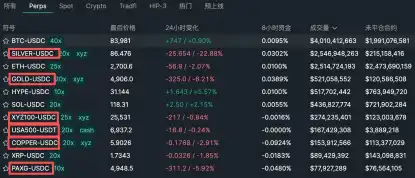
Stock tokenization, precious metal assets are becoming a top priority for trading platforms. From various centralized exchanges to the decentralized platform Hyperliquid, they have all seen this path as a key breakthrough, with the market offering positive feedback—last week, during the craziest days of the precious metals market, silver trading volume on Hyperliquid exceeded $1 billion in a single day, with coin stocks, indices, precious metals, and other assets briefly occupying the top ten in trading volume, boosting HYPE by 50% in the "all-asset trading" narrative surge.
Indeed, some of the current slogans, such as "providing traditional investors with a new choice, low threshold," are premature and not realistic.

However, from a crypto-native perspective, it may address internal issues: the supply and narrative of native assets have slowed down. After the old coins languish and new coins are in short supply, what new trading reasons can crypto trading platforms provide to the market?

Tokenized assets are easy for us to get started with. In the past, we studied: public chain ecosystems, protocol revenue, token models, unlocking schedules, and narrative space.

Now, the focus of our research is shifting to: macro data, financial reports, interest rate expectations, industry cycles, and policy variables. Of course, we have been studying many parts of these for a long time.

Essentially, this is a migration of speculative logic, not just a simple category extension.

Launching gold tokens and silver tokens is not just adding a few more currencies. What they are truly trying to introduce is a new trading narrative—bringing the volatility and rhythm that originally belonged to the traditional financial market into the crypto trading system.

Prediction Markets

In addition to bringing "external assets" onto the chain, another direction is to bring "external uncertainty" onto the chain—prediction markets.

According to Dune Analytics, despite the cryptocurrency market experiencing a crash last weekend, prediction market trading remains active, with weekly transaction volume hitting a new all-time high of 26.39 million transactions. Polymarket, with a transaction volume of 13.34 million, ranked first, followed closely by Kalshi with 11.88 million transactions.
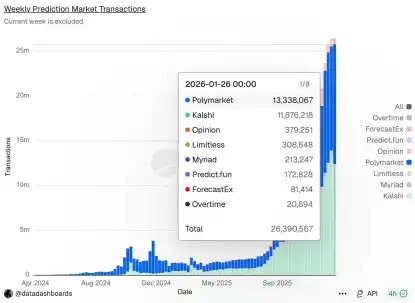
Regarding the development prospects and scale expectations of prediction markets, we will not elaborate on them in this article. Odaily has recently been writing more than two analysis articles on prediction markets every day... You can search and use them on your own.

I want to discuss from the perspective of a coin circle user why we participate in prediction markets. Is it because we are all gambling addicts?

Of course, it is.

In fact, for a long time, meme traders were fundamentally not gambling on technology but on events: whether or not a coin will be listed, whether there will be a partnership announcement, whether a coin will be issued, whether a new feature will be launched, whether there are compliance-related advantages, and whether the next narrative can be hitched onto.

Price is just the outcome; events are the starting point.

And the prediction market has, for the first time, broken this matter down from an "implicit variable in the price curve" into an object that can be directly traded.

You no longer need to indirectly bet on whether an outcome will occur by buying a token; instead, you can directly bet on the outcome itself.

More importantly, prediction markets are adapting to the current environment of "new project shutdowns" and narrative scarcity.

As the tradable universe of assets shrinks, market attention is increasingly focused on macro trends, regulation, politics, whale behavior, and major industry milestones.

In other words, while the tradable "targets" are diminishing, the tradable "events" have not decreased; in fact, they have increased.

That is also why, over the past two years, the liquidity that has truly emerged in prediction markets has almost entirely come from non-crypto-native events.

Essentially, it is introducing the uncertainty of the external world into the crypto trading system. From a trading experience perspective, it is also more user-friendly for traditional crypto traders:

The core issue is extremely simplified to one question—is this outcome going to happen? And, if so, is the current probability expensive or cheap?

Unlike Memes, the barrier to entry for prediction markets lies not in execution speed but in information assessment and structural understanding.

With that said, do you feel like you could give it a try too?

Conclusion

Perhaps the so-called crypto world will ultimately disappear in the near future, but before it does, we are still trying our best. As the era of "new coin-driven trading" gradually fades, the market always needs a new speculative vehicle that is new, has a low entry barrier, is narrative-driven, and can be sustainable.

Or, in other words, the market will not disappear; it will only migrate. When the first level no longer produces the future, what can truly be traded at the second level are these two things—the uncertainty of the external world and the tradable narrative that can be repeatedly reconstructed.

Perhaps what we can do is to adapt early to another transition of speculative paradigms.

Original Article Link

You may also like

Token Cannot Compound, Where Is the Real Investment Opportunity?

The next chapter in the crypto industry will undoubtedly be written by Crypto-empowered Stocks.

February 6th Market Key Intelligence, How Much Did You Miss?

1. On-chain Flows: $508.2M USD inflow to Ethereum today; $390.8M USD outflow from Arbitrum 2. Biggest Gainers/Losers: $HBTC, $AIO 3. Top News: Current Bitcoin weekly RSI oversold signal comparable to June 2022

China's Central Bank and Eight Other Departments' Latest Regulatory Focus: Key Attention to RWA Tokenized Asset Risk


Foreword: Today, the People's Bank of China's website published the "Notice of the People's Bank of China, National Development and Reform Commission, Ministry of Industry and Information Technology, Ministry of Public Security, State Administration for Market Regulation, China Banking and Insurance Regulatory Commission, China Securities Regulatory Commission, State Administration of Foreign Exchange on Further Preventing and Dealing with Risks Related to Virtual Currency and Others (Yinfa [2026] No. 42)", the latest regulatory requirements from the eight departments including the central bank, which are basically consistent with the regulatory requirements of recent years. The main focus of the regulation is on speculative activities such as virtual currency trading, exchanges, ICOs, overseas platform services, and this time, regulatory oversight of RWA has been added, explicitly prohibiting RWA tokenization, stablecoins (especially those pegged to the RMB). The following is the full text:


To the people's governments of all provinces, autonomous regions, and municipalities directly under the Central Government, the Xinjiang Production and Construction Corps:


  Recently, there have been speculative activities related to virtual currency and Real-World Assets (RWA) tokenization, disrupting the economic and financial order and jeopardizing the property security of the people. In order to further prevent and address the risks related to virtual currency and Real-World Assets tokenization, effectively safeguard national security and social stability, in accordance with the "Law of the People's Republic of China on the People's Bank of China," "Law of the People's Republic of China on Commercial Banks," "Securities Law of the People's Republic of China," "Law of the People's Republic of China on Securities Investment Funds," "Law of the People's Republic of China on Futures and Derivatives," "Cybersecurity Law of the People's Republic of China," "Regulations of the People's Republic of China on the Administration of Renminbi," "Regulations on Prevention and Disposal of Illegal Fundraising," "Regulations of the People's Republic of China on Foreign Exchange Administration," "Telecommunications Regulations of the People's Republic of China," and other provisions, after reaching consensus with the Cyberspace Administration of China, the Supreme People's Court, and the Supreme People's Procuratorate, and with the approval of the State Council, the relevant matters are notified as follows:


  I. Clarify the essential attributes of virtual currency, Real-World Assets tokenization, and related business activities


  (I) Virtual currency does not possess the legal status equivalent to fiat currency. Virtual currencies such as Bitcoin, Ether, Tether, etc., have the main characteristics of being issued by non-monetary authorities, using encryption technology and distributed ledger or similar technology, existing in digital form, etc. They do not have legal tender status, should not and cannot be circulated and used as currency in the market.


  The business activities related to virtual currency are classified as illegal financial activities. The exchange of fiat currency and virtual currency within the territory, exchange of virtual currencies, acting as a central counterparty in buying and selling virtual currencies, providing information intermediary and pricing services for virtual currency transactions, token issuance financing, and trading of virtual currency-related financial products, etc., fall under illegal financial activities, such as suspected illegal issuance of token vouchers, unauthorized public issuance of securities, illegal operation of securities and futures business, illegal fundraising, etc., are strictly prohibited across the board and resolutely banned in accordance with the law. Overseas entities and individuals are not allowed to provide virtual currency-related services to domestic entities in any form.


  A stablecoin pegged to a fiat currency indirectly fulfills some functions of the fiat currency in circulation. Without the consent of relevant authorities in accordance with the law and regulations, any domestic or foreign entity or individual is not allowed to issue a RMB-pegged stablecoin overseas.


(II)Tokenization of Real-World Assets refers to the use of encryption technology and distributed ledger or similar technologies to transform ownership rights, income rights, etc., of assets into tokens (tokens) or other interests or bond certificates with token (token) characteristics, and carry out issuance and trading activities.


  Engaging in the tokenization of real-world assets domestically, as well as providing related intermediary, information technology services, etc., which are suspected of illegal issuance of token vouchers, unauthorized public offering of securities, illegal operation of securities and futures business, illegal fundraising, and other illegal financial activities, shall be prohibited; except for relevant business activities carried out with the approval of the competent authorities in accordance with the law and regulations and relying on specific financial infrastructures. Overseas entities and individuals are not allowed to illegally provide services related to the tokenization of real-world assets to domestic entities in any form.


  II. Sound Work Mechanism


  (III) Inter-agency Coordination. The People's Bank of China, together with the National Development and Reform Commission, the Ministry of Industry and Information Technology, the Ministry of Public Security, the State Administration for Market Regulation, the China Banking and Insurance Regulatory Commission, the China Securities Regulatory Commission, the State Administration of Foreign Exchange, and other departments, will improve the work mechanism, strengthen coordination with the Cyberspace Administration of China, the Supreme People's Court, and the Supreme People's Procuratorate, coordinate efforts, and overall guide regions to carry out risk prevention and disposal of virtual currency-related illegal financial activities.


  The China Securities Regulatory Commission, together with the National Development and Reform Commission, the Ministry of Industry and Information Technology, the Ministry of Public Security, the People's Bank of China, the State Administration for Market Regulation, the China Banking and Insurance Regulatory Commission, the State Administration of Foreign Exchange, and other departments, will improve the work mechanism, strengthen coordination with the Cyberspace Administration of China, the Supreme People's Court, and the Supreme People's Procuratorate, coordinate efforts, and overall guide regions to carry out risk prevention and disposal of illegal financial activities related to the tokenization of real-world assets.


  (IV) Strengthening Local Implementation. The people's governments at the provincial level are overall responsible for the prevention and disposal of risks related to virtual currencies and the tokenization of real-world assets in their respective administrative regions. The specific leading department is the local financial regulatory department, with participation from branches and dispatched institutions of the State Council's financial regulatory department, telecommunications regulators, public security, market supervision, and other departments, in coordination with cyberspace departments, courts, and procuratorates, to improve the normalization of the work mechanism, effectively connect with the relevant work mechanisms of central departments, form a cooperative and coordinated working pattern between central and local governments, effectively prevent and properly handle risks related to virtual currencies and the tokenization of real-world assets, and maintain economic and financial order and social stability.


  III. Strengthened Risk Monitoring, Prevention, and Disposal


  (5) Enhanced Risk Monitoring. The People's Bank of China, China Securities Regulatory Commission, National Development and Reform Commission, Ministry of Industry and Information Technology, Ministry of Public Security, State Administration of Foreign Exchange, Cyberspace Administration of China, and other departments continue to improve monitoring techniques and system support, enhance cross-departmental data analysis and sharing, establish sound information sharing and cross-validation mechanisms, promptly grasp the risk situation of activities related to virtual currency and real-world asset tokenization. Local governments at all levels give full play to the role of local monitoring and early warning mechanisms. Local financial regulatory authorities, together with branches and agencies of the State Council's financial regulatory authorities, as well as departments of cyberspace and public security, ensure effective connection between online monitoring, offline investigation, and fund tracking, efficiently and accurately identify activities related to virtual currency and real-world asset tokenization, promptly share risk information, improve early warning information dissemination, verification, and rapid response mechanisms.


  (6) Strengthened Oversight of Financial Institutions, Intermediaries, and Technology Service Providers. Financial institutions (including non-bank payment institutions) are prohibited from providing account opening, fund transfer, and clearing services for virtual currency-related business activities, issuing and selling financial products related to virtual currency, including virtual currency and related financial products in the scope of collateral, conducting insurance business related to virtual currency, or including virtual currency in the scope of insurance liability. Financial institutions (including non-bank payment institutions) are prohibited from providing custody, clearing, and settlement services for unauthorized real-world asset tokenization-related business and related financial products. Relevant intermediary institutions and information technology service providers are prohibited from providing intermediary, technical, or other services for unauthorized real-world asset tokenization-related businesses and related financial products.


  (7) Enhanced Management of Internet Information Content and Access. Internet enterprises are prohibited from providing online business venues, commercial displays, marketing, advertising, or paid traffic diversion services for virtual currency and real-world asset tokenization-related business activities. Upon discovering clues of illegal activities, they should promptly report to relevant departments and provide technical support and assistance for related investigations and inquiries. Based on the clues transferred by the financial regulatory authorities, the cyberspace administration, telecommunications authorities, and public security departments should promptly close and deal with websites, mobile applications (including mini-programs), and public accounts engaged in virtual currency and real-world asset tokenization-related business activities in accordance with the law.


  (8) Strengthened Entity Registration and Advertisement Management. Market supervision departments strengthen entity registration and management, and enterprise and individual business registrations must not contain terms such as "virtual currency," "virtual asset," "cryptocurrency," "crypto asset," "stablecoin," "real-world asset tokenization," or "RWA" in their names or business scopes. Market supervision departments, together with financial regulatory authorities, legally enhance the supervision of advertisements related to virtual currency and real-world asset tokenization, promptly investigating and handling relevant illegal advertisements.


  (IX) Continued Rectification of Virtual Currency Mining Activities. The National Development and Reform Commission, together with relevant departments, strictly controls virtual currency mining activities, continuously promotes the rectification of virtual currency mining activities. The people's governments of various provinces take overall responsibility for the rectification of "mining" within their respective administrative regions. In accordance with the requirements of the National Development and Reform Commission and other departments in the "Notice on the Rectification of Virtual Currency Mining Activities" (NDRC Energy-saving Building [2021] No. 1283) and the provisions of the "Guidance Catalog for Industrial Structure Adjustment (2024 Edition)," a comprehensive review, investigation, and closure of existing virtual currency mining projects are conducted, new mining projects are strictly prohibited, and mining machine production enterprises are strictly prohibited from providing mining machine sales and other services within the country.


  (X) Severe Crackdown on Related Illegal Financial Activities. Upon discovering clues to illegal financial activities related to virtual currency and the tokenization of real-world assets, local financial regulatory authorities, branches of the State Council's financial regulatory authorities, and other relevant departments promptly investigate, determine, and properly handle the issues in accordance with the law, and seriously hold the relevant entities and individuals legally responsible. Those suspected of crimes are transferred to the judicial authorities for processing according to the law.


 (XI) Severe Crackdown on Related Illegal and Criminal Activities. The Ministry of Public Security, the People's Bank of China, the State Administration for Market Regulation, the China Banking and Insurance Regulatory Commission, the China Securities Regulatory Commission, as well as judicial and procuratorial organs, in accordance with their respective responsibilities, rigorously crack down on illegal and criminal activities related to virtual currency, the tokenization of real-world assets, such as fraud, money laundering, illegal business operations, pyramid schemes, illegal fundraising, and other illegal and criminal activities carried out under the guise of virtual currency, the tokenization of real-world assets, etc.


  (XII) Strengthen Industry Self-discipline. Relevant industry associations should enhance membership management and policy advocacy, based on their own responsibilities, advocate and urge member units to resist illegal financial activities related to virtual currency and the tokenization of real-world assets. Member units that violate regulatory policies and industry self-discipline rules are to be disciplined in accordance with relevant self-regulatory management regulations. By leveraging various industry infrastructure, conduct risk monitoring related to virtual currency, the tokenization of real-world assets, and promptly transfer issue clues to relevant departments.


  IV. Strict Supervision of Domestic Entities Engaging in Overseas Business Activities


(XIII) Without the approval of relevant departments in accordance with the law and regulations, domestic entities and foreign entities controlled by them may not issue virtual currency overseas.


  (XIV) Domestic entities engaging directly or indirectly in overseas external debt-based tokenization of real-world assets, or conducting asset securitization activities abroad based on domestic ownership rights, income rights, etc. (hereinafter referred to as domestic equity), should be strictly regulated in accordance with the principles of "same business, same risk, same rules." The National Development and Reform Commission, the China Securities Regulatory Commission, the State Administration of Foreign Exchange, and other relevant departments regulate it according to their respective responsibilities. For other forms of overseas real-world asset tokenization activities based on domestic equity by domestic entities, the China Securities Regulatory Commission, together with relevant departments, supervise according to their division of responsibilities. Without the consent and filing of relevant departments, no unit or individual may engage in the above-mentioned business.


  (15) Overseas subsidiaries and branches of domestic financial institutions providing Real World Asset Tokenization-related services overseas shall do so legally and prudently. They shall have professional personnel and systems in place to effectively mitigate business risks, strictly implement customer onboarding, suitability management, anti-money laundering requirements, and incorporate them into the domestic financial institutions' compliance and risk management system. Intermediaries and information technology service providers offering Real World Asset Tokenization services abroad based on domestic equity or conducting Real World Asset Tokenization business in the form of overseas debt for domestic entities directly or indirectly venturing abroad must strictly comply with relevant laws and regulations. They should establish and improve relevant compliance and internal control systems in accordance with relevant normative requirements, strengthen business and risk control, and report the business developments to the relevant regulatory authorities for approval or filing.


  V. Strengthen Organizational Implementation


  (16) Strengthen organizational leadership and overall coordination. All departments and regions should attach great importance to the prevention of risks related to virtual currencies and Real World Asset Tokenization, strengthen organizational leadership, clarify work responsibilities, form a long-term effective working mechanism with centralized coordination, local implementation, and shared responsibilities, maintain high pressure, dynamically monitor risks, effectively prevent and mitigate risks in an orderly and efficient manner, legally protect the property security of the people, and make every effort to maintain economic and financial order and social stability.


  (17) Widely carry out publicity and education. All departments, regions, and industry associations should make full use of various media and other communication channels to disseminate information through legal and policy interpretation, analysis of typical cases, and education on investment risks, etc. They should promote the illegality and harm of virtual currencies and Real World Asset Tokenization-related businesses and their manifestations, fully alert to potential risks and hidden dangers, and enhance public awareness and identification capabilities for risk prevention.


  VI. Legal Responsibility


  (18) Engaging in illegal financial activities related to virtual currencies and Real World Asset Tokenization in violation of this notice, as well as providing services for virtual currencies and Real World Asset Tokenization-related businesses, shall be punished in accordance with relevant regulations. If it constitutes a crime, criminal liability shall be pursued according to the law. For domestic entities and individuals who knowingly or should have known that overseas entities illegally provided virtual currency or Real World Asset Tokenization-related services to domestic entities and still assisted them, relevant responsibilities shall be pursued according to the law. If it constitutes a crime, criminal liability shall be pursued according to the law.


  (19) If any unit or individual invests in virtual currencies, Real World Asset Tokens, and related financial products against public order and good customs, the relevant civil legal actions shall be invalid, and any resulting losses shall be borne by them. If there are suspicions of disrupting financial order and jeopardizing financial security, the relevant departments shall deal with them according to the law.


  This notice shall enter into force upon the date of its issuance. The People's Bank of China and ten other departments' "Notice on Further Preventing and Dealing with the Risks of Virtual Currency Trading Speculation" (Yinfa [2021] No. 237) is hereby repealed.


Former Partner's Perspective on Multicoin: Kyle's Exit, But the Game He Left Behind Just Getting Started

Kyle knew his game, so he decided to focus on playing the game he was good at and interested in.

Why Bitcoin Is Falling Now: The Real Reasons Behind BTC's Crash & WEEX's Smart Profit Playbook

Bitcoin's ongoing crash explained: Discover the 5 hidden triggers behind BTC's plunge & how WEEX's Auto Earn and Trade to Earn strategies help traders profit from crypto market volatility.

Wall Street's Hottest Trades See Exodus

This time there is no single triggering factor, but rather market anxiety about asset valuation, with many already skeptical of these valuations being too high, leading to investors choosing to retreat almost simultaneously.

Popular coins

Latest Crypto News

Read more













