
- Buy Crypto
- Markets
 Futures
- Spot
- Copy Trade
 Earn
Earn- More
VanEck's Top Ten Predictions for 2025: The United States adopts BTC strategic reserves, and the bull market will reach a new high by the end of next year

Original title: VanEck's 10 Crypto Predictions for 2025
Original author: Matthew Sigel, Patrick Bush, VanEck
Original translation: TechFlow
Please note that VanEck may hold the following digital assets.
Before we start talking about our outlook for 2025, let's review the performance of our predictions in 2024. Among the 15 predictions made at the end of 2023, our self-rating was 8.5/15. Although the accuracy rate of 56.6% is not perfect, it is enough to keep us "staying in the game". With Bitcoin (BTC) breaking through $100,000 and Ethereum (ETH) breaking through $4,000, 2024 is still a year worth remembering in the history of cryptocurrency, even if some predictions did not hit completely.
2024 Forecast Review
We successfully bet on several key trends in our 2024 forecast, including:
1. The first launch of Bitcoin spot ETP
2. Bitcoin halving is successfully completed
3. Ethereum still ranks second, second only to Bitcoin
4. Bitcoin hits an all-time high in the fourth quarter of 2024
5. L2 dominates Ethereum activity (but L2 TVL is still lower than Ethereum)
6. Stablecoin market capitalization hits an all-time high
7. The share of decentralized exchange trading volume reaches a new record
8. Solana (SOL) outperforms Ethereum (ETH)
9. DePIN network adoption rate growth
Although some predictions have not been fully realized, the overall trend still verifies our analysis direction
Top 10 cryptocurrency predictions for 2025
1. The crypto bull market will reach a mid-term high in the first quarter and hit a new high at the end of the year
2. The United States further embraces Bitcoin through strategic reserves and policy support
3. The total value of tokenized securities exceeds US$50 billion
4. Daily trading settlement volume of stablecoins reaches $300 billion 5. On-chain activity of AI agents exceeds 1 million 6. The total locked value (TVL) of Bitcoin’s second-layer network reaches 100,000 BTC 7. Ethereum’s Blob space fee income reaches $1 billion 8. DeFi transaction volume hits a new high of $4 trillion, and the total locked value reaches $200 billion 9. The NFT market recovers, with annual transaction volume reaching $30 billion 10. The performance of decentralized application (DApp) tokens gradually catches up with mainstream public chain tokens Next, we will delve into the background and logic of some of these key predictions.1. Crypto bull market reaches interim high in Q1 and new high in Q4
We believe that the 2025 crypto bull market will continue to develop and reach its first peak in Q1. At the apex of this cycle, we expect Bitcoin (BTC) to reach a price of about $180,000, while Ethereum (ETH) will break $6,000. Other well-known projects such as Solana (SOL) and Sui (SUI) may exceed $500 and $10, respectively.
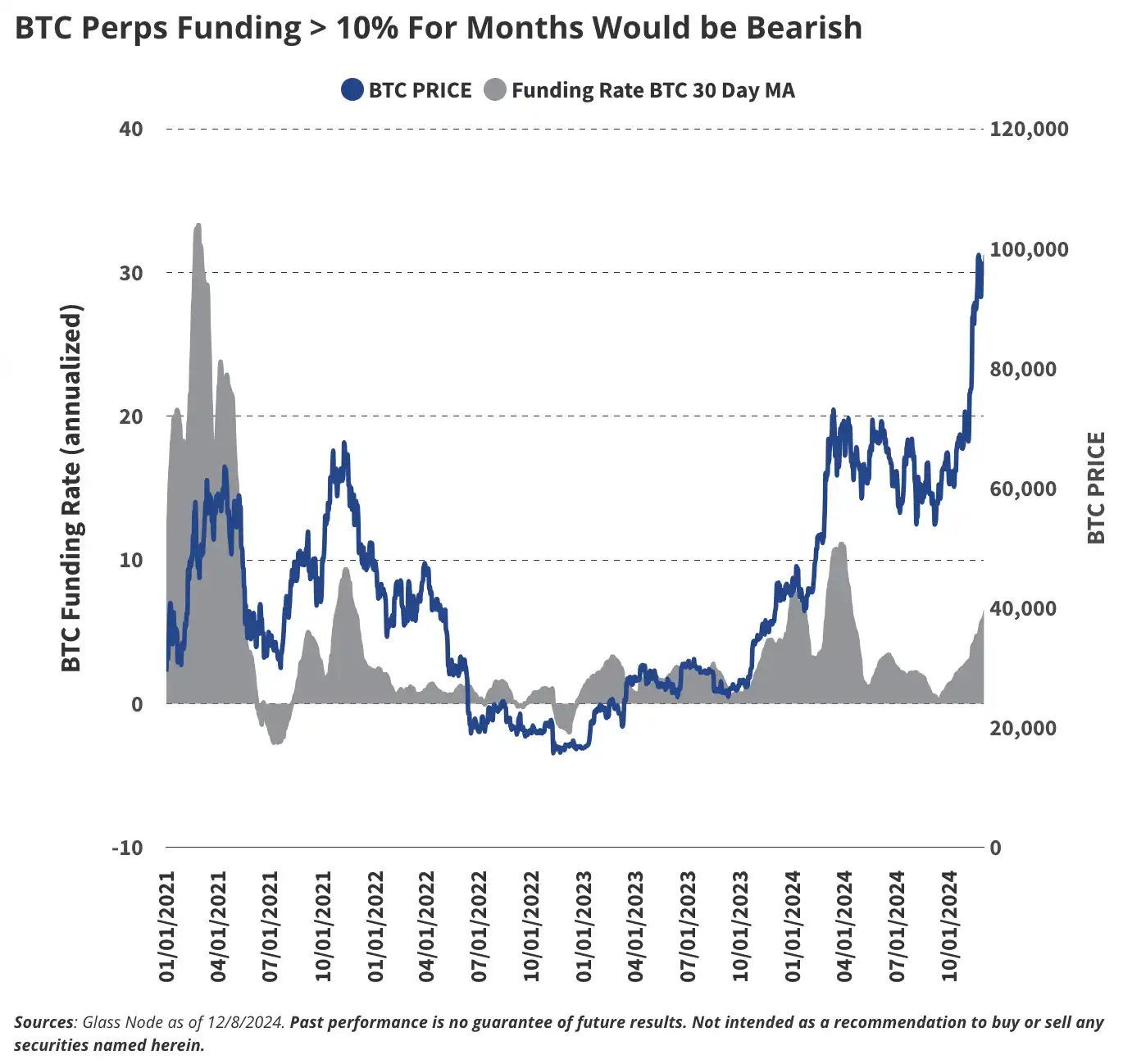
After the first high, we expect BTC to retrace by 30%, while altcoins may fall more, by 60%, reflecting the market's consolidation during the summer. However, a recovery may occur in the fall, with major tokens regaining momentum and breaking all-time highs again before the end of the year. To determine when the market is nearing a top, we will be watching for the following key signals:
· Sustained high funding rates:When traders are willing to pay funding rates of more than 10% for three months or more as they borrow to bet on BTC price increases, this indicates speculative overheating.
· Excessive unrealized profits:If a large percentage of investors holding BTC are in a state of significant paper gains (profit-to-cost ratio of 70% or more), this indicates that the market is in a state of mania.
· Overvaluation of market value relative to realized value:When the MVRV (market value to realized value ratio) score exceeds 5, it means that the BTC price is far above the average purchase price, which is usually a sign of overheated markets.
· Declining Bitcoin Dominance:If Bitcoin’s share of the total crypto market falls below 40%, it means speculative funds are moving into riskier altcoins, which is a typical late-cycle behavior.
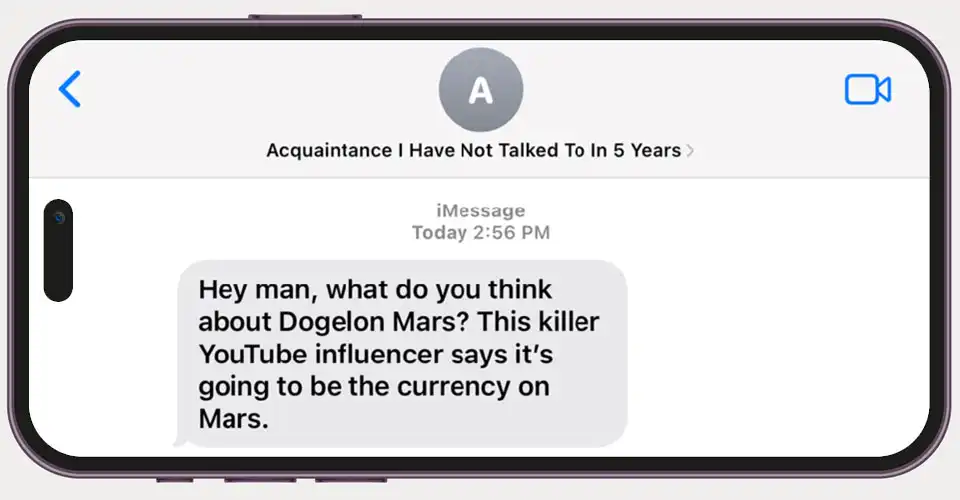
· Mainstream Speculation:When a large number of non-crypto friends start asking about suspicious projects, it is usually a reliable signal that the market is near a top.
These indicators have historically been reliable signals of market mania, and they will guide us in developing our outlook for the market cycle in 2025.
2. The United States further embraces Bitcoin through strategic reserves and cryptocurrency adoption
The election of Donald Trump has injected significant momentum into the crypto market, with his administration appointing several pro-cryptocurrency leaders to key positions, including Vice President JD Vance, National Security Advisor Michael Waltz, Commerce Secretary Howard Lutnick, Treasury Secretary Mary Bessent, Securities and Exchange Commission (SEC) Chairman Paul Atkins, Federal Deposit Insurance Corporation (FDIC) Chairman Jelena McWilliams, and Health and Human Services Secretary RFK Jr. These appointments not only mark the end of anti-crypto policies (such as the systematic de-banking of crypto companies), but also herald the beginning of a policy framework that positions Bitcoin as a strategic asset.
Crypto ETPs: Physical Creation, Staking, and New Spot Approvals
New SEC leadership (or potentially the Commodity Futures Trading Commission, CFTC) will approve multiple new spot crypto exchange-traded products (ETPs) in the US, including VanEck’s Solana product. Ethereum ETP functionality will expand to include staking, further enhancing its utility to holders, while both Ethereum and Bitcoin ETPs will support physical creation/redemption. The repeal of SEC Rule SAB 121 (either by the SEC or Congress) will pave the way for banks and brokers to custody spot cryptocurrencies, further integrating digital assets into traditional financial infrastructure.
Sovereign Bitcoin Adoption: Federal, State, and Mining Expansion
We predict that by 2025, the US federal government or at least one state (likely Pennsylvania, Florida, or Texas) will have established a Bitcoin reserve. At the federal level, this is more likely to be accomplished through executive order utilizing the Treasury Department’s Exchange Stabilization Fund (ESF), although bipartisan legislation remains an unknown. Meanwhile, state governments may act independently, looking to Bitcoin as a hedge against fiscal uncertainty or a means to attract crypto investment and innovation.
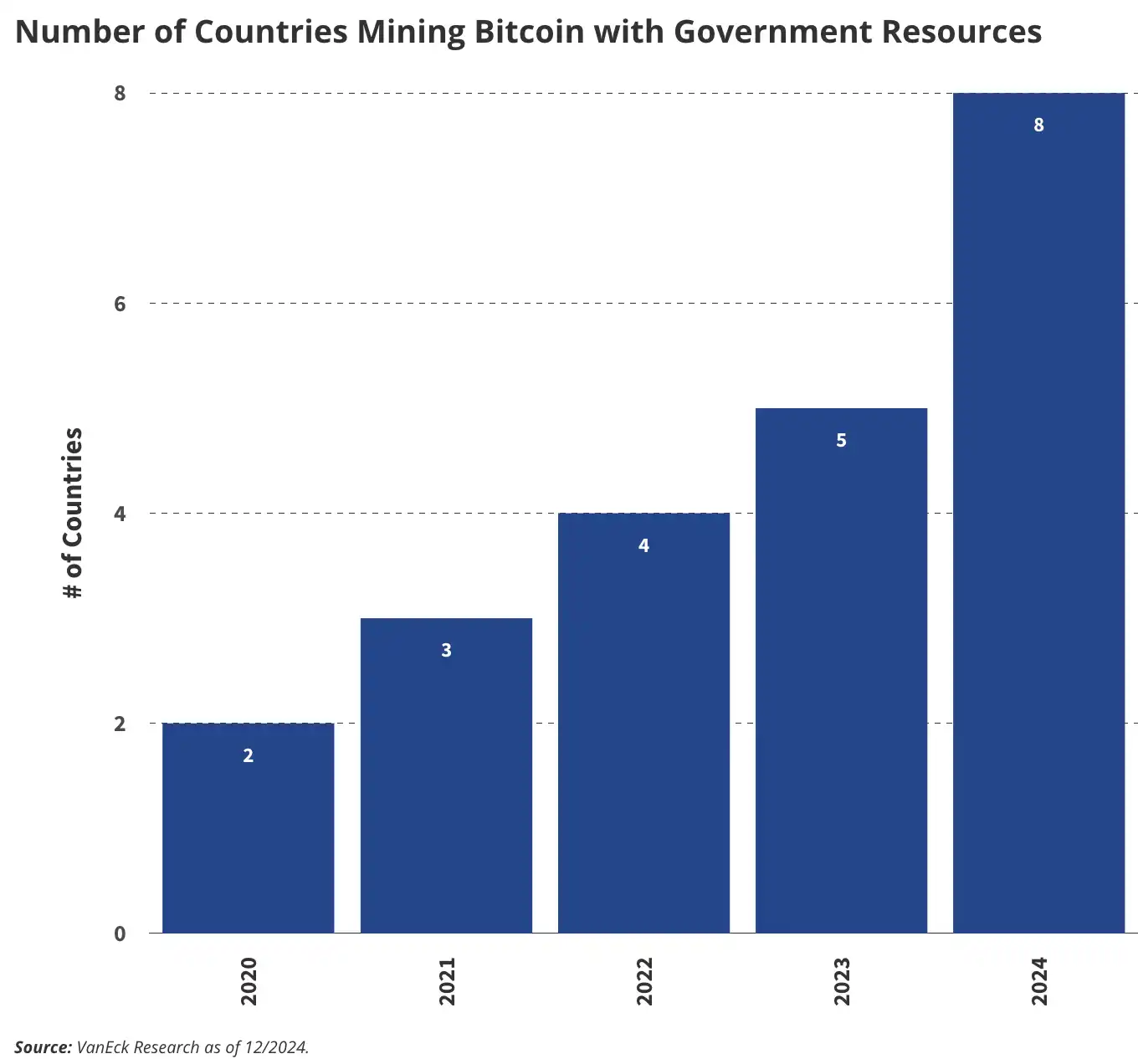
In terms of Bitcoin mining, the number of countries using government resources to mine is expected to reach double digits (currently seven), driven by the growing adoption of cryptocurrencies in the BRICS countries. This trend is driven by Russia's statement that it plans to use cryptocurrencies to settle international trade, further highlighting Bitcoin's global influence.
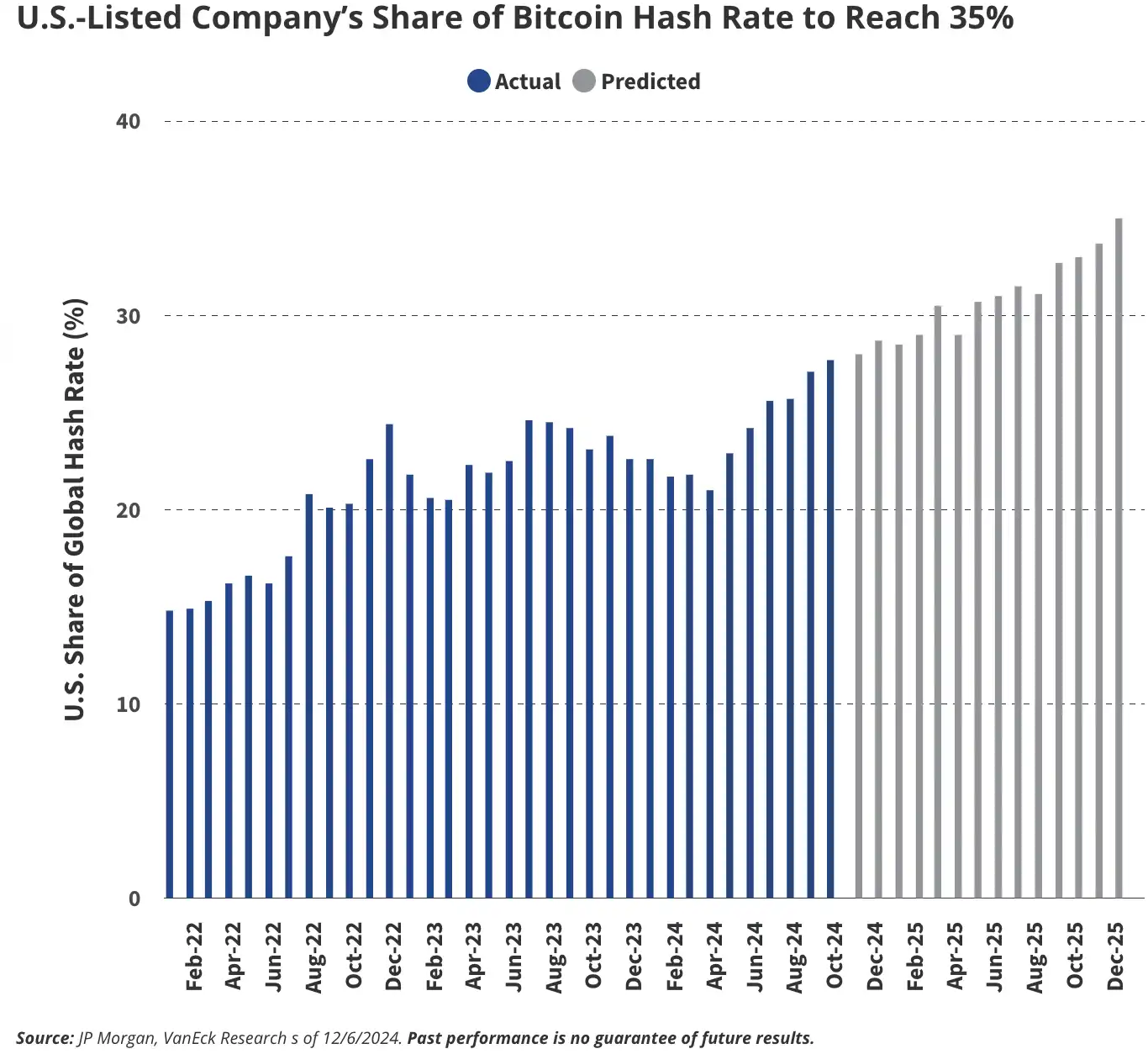
We expect this pro-Bitcoin stance to ripple through the broader U.S. crypto ecosystem. The U.S. share of global crypto developers will rise from 19% to 25% as regulatory clarity and incentives attract talent and companies back. At the same time, U.S. Bitcoin mining activity will flourish, with the U.S. share of global mining power increasing from 28% in 2024 to 35% by the end of 2025, driven by cheap energy and potential tax incentives. Together, these trends will solidify the U.S. leadership in the global Bitcoin economy.
US Public Companies to Hold 35% of Bitcoin Hashrate
Corporate Bitcoin Holdings: Expected to Grow 43%
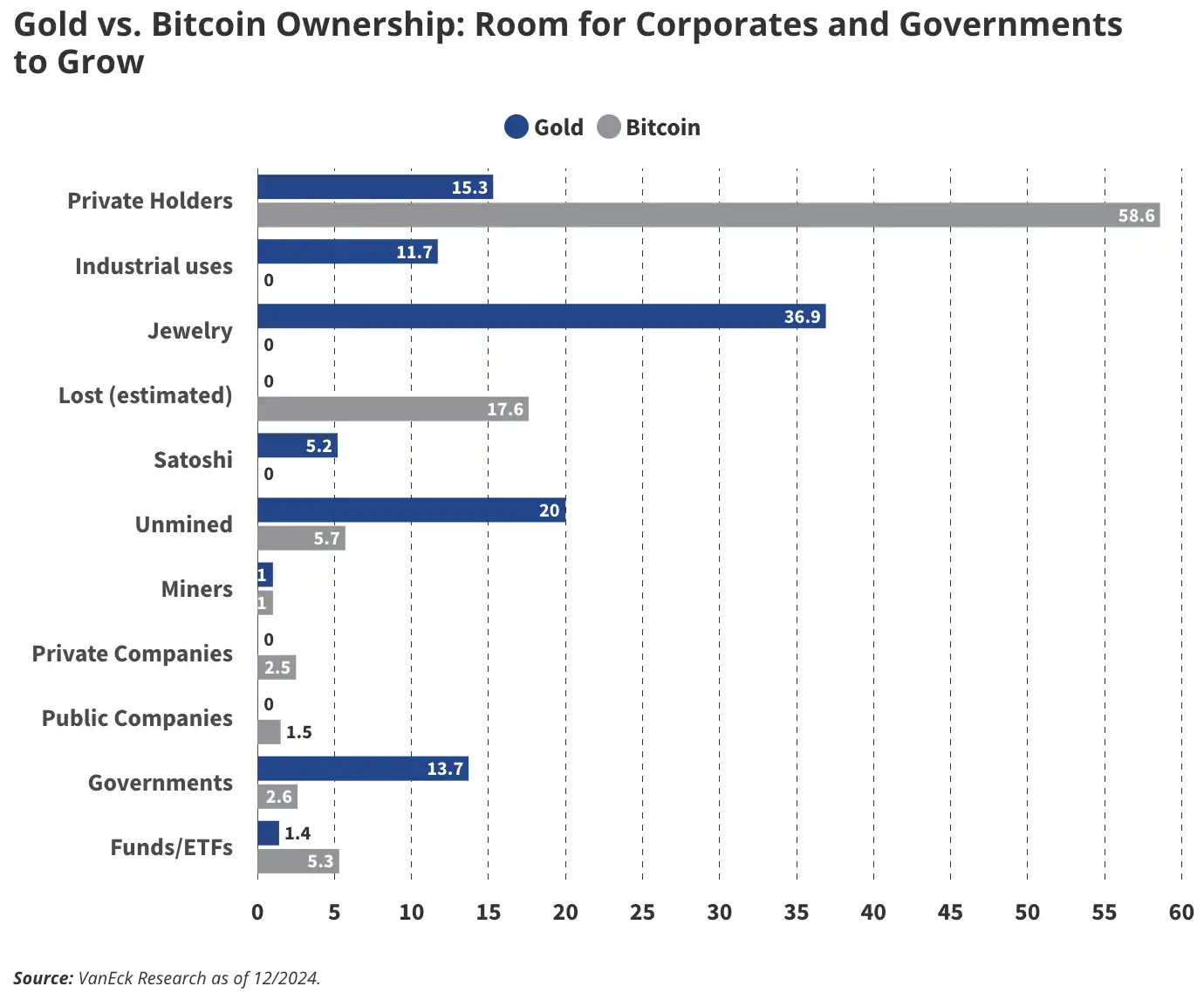
In terms of corporate adoption, we expect companies to continue to accumulate Bitcoin from retail investors. Currently, 68 public companies hold Bitcoin on their balance sheets, and we expect this number to reach 100 by 2025. Notably, we boldly predict that the total amount of Bitcoin held by private and public companies (currently 765,000 BTC) will exceed Satoshi Nakamoto's 1.1 million BTC next year. This means that corporate Bitcoin holdings will achieve a significant 43% growth in the next year.
Gold vs. Bitcoin Ownership: Room for Growth for Enterprises and Governments
3. Tokenized Securities Exceed $50 Billion
On-Chain Securities Grow 61% in 2024
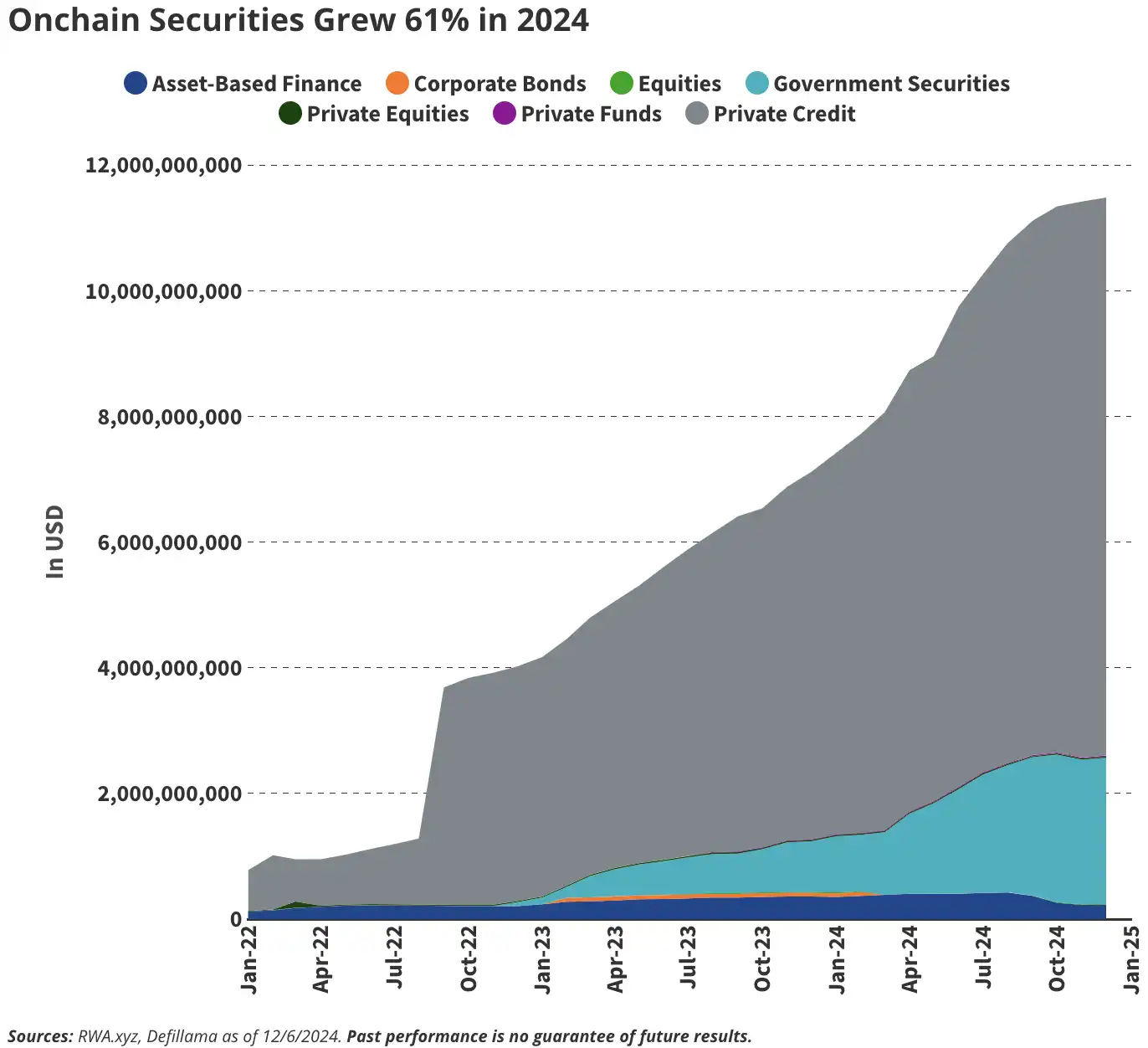
On-Chain Securities Grow 61% in 2024
Cryptocurrency infrastructure promises to improve the financial system through increased efficiency, decentralization, and greater transparency. We believe 2025 will be the year tokenized securities break out. There are already about $12 billion in tokenized securities on blockchain, the majority of which ($9.5 billion) are tokenized private credit securities on Figure’s semi-permissioned blockchain, Provenance.
In the future, we see great potential for tokenized securities to be launched on public blockchains. We believe there are many motivations for investors to push for tokenized equity or debt securities to be issued entirely on-chain. We predict that entities like the DTCC will support the seamless transition of tokenized assets between public blockchains and private closed infrastructures over the next year. This dynamic will lead to the establishment of AML/KYC standards for on-chain investors. As a bold prediction, we expect Coinbase to take the unprecedented step of tokenizing and deploying its COIN shares on its BASE blockchain.
4. Stablecoins Reach $300 Billion in Daily Settlement Volume
Monthly Stablecoin Transfers (USD) Up 180% YoY in 2024
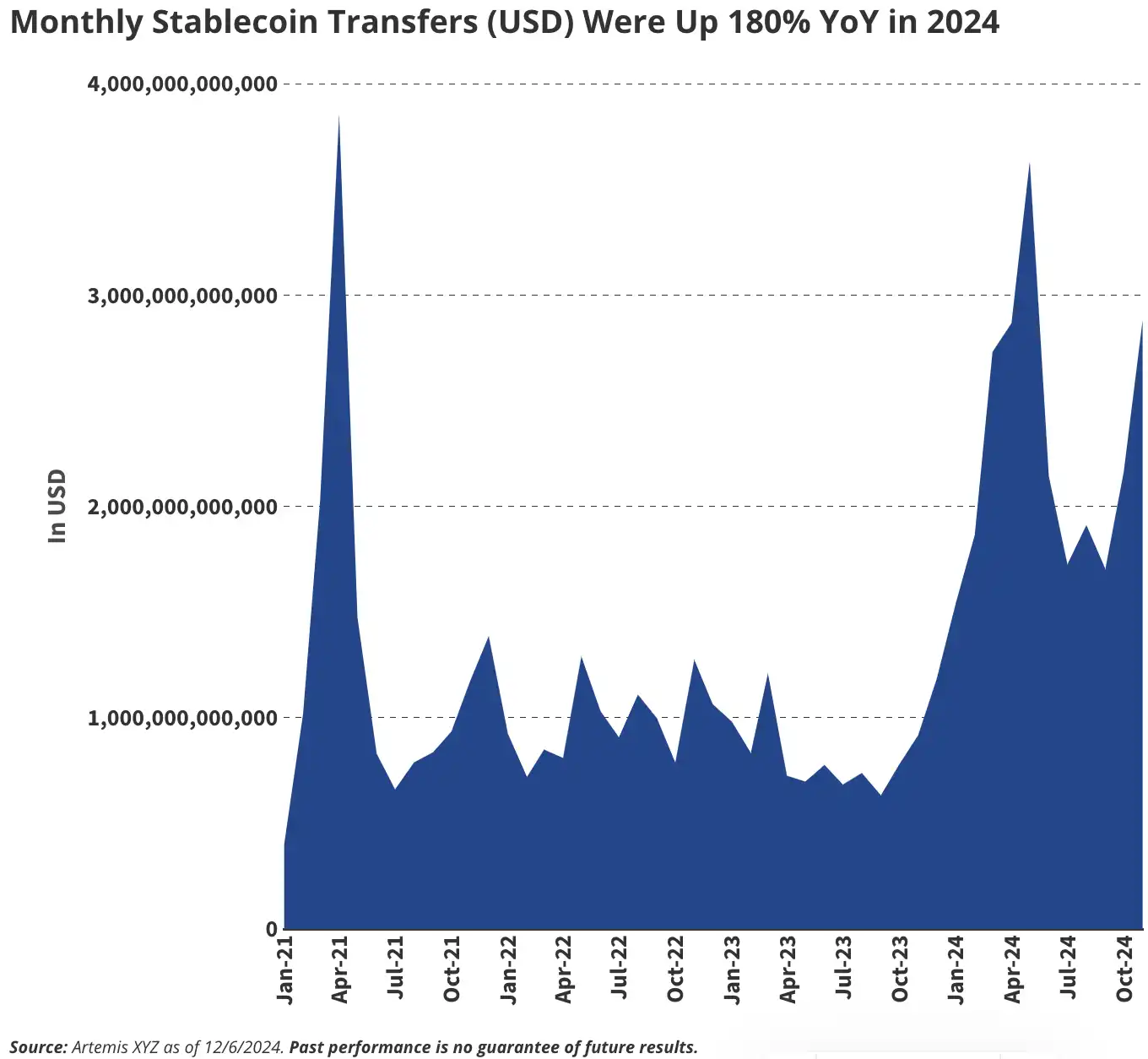
Source: Artemis XYZ, data as of December 6, 2024
Stablecoins will move from a niche role in cryptocurrency trading to a core component of global commerce. By the end of 2025, we expect stablecoins to reach $300 billion in daily settlement volume, equivalent to 5% of current DTCC trading volume, compared to daily settlement volume of approximately $100 billion in November 2024. With adoption by major technology companies (such as Apple and Google) and payment networks (Visa and Mastercard), stablecoins will redefine payment economics.
In addition to transactional uses, the remittance market will also see explosive growth. For example, stablecoin transfers between the United States and Mexico may grow 5 times from $80 million per month to $400 million. The reason is its speed, cost savings, and the fact that more and more people view stablecoins as a utility rather than an experimental technology. Although blockchain adoption is still under discussion, stablecoins are actually a "Trojan Horse" for blockchain technology.
5. AI agents have more than 1 million agents on-chain activity
AI agents have a total revenue of $8.7 million in 5 weeks
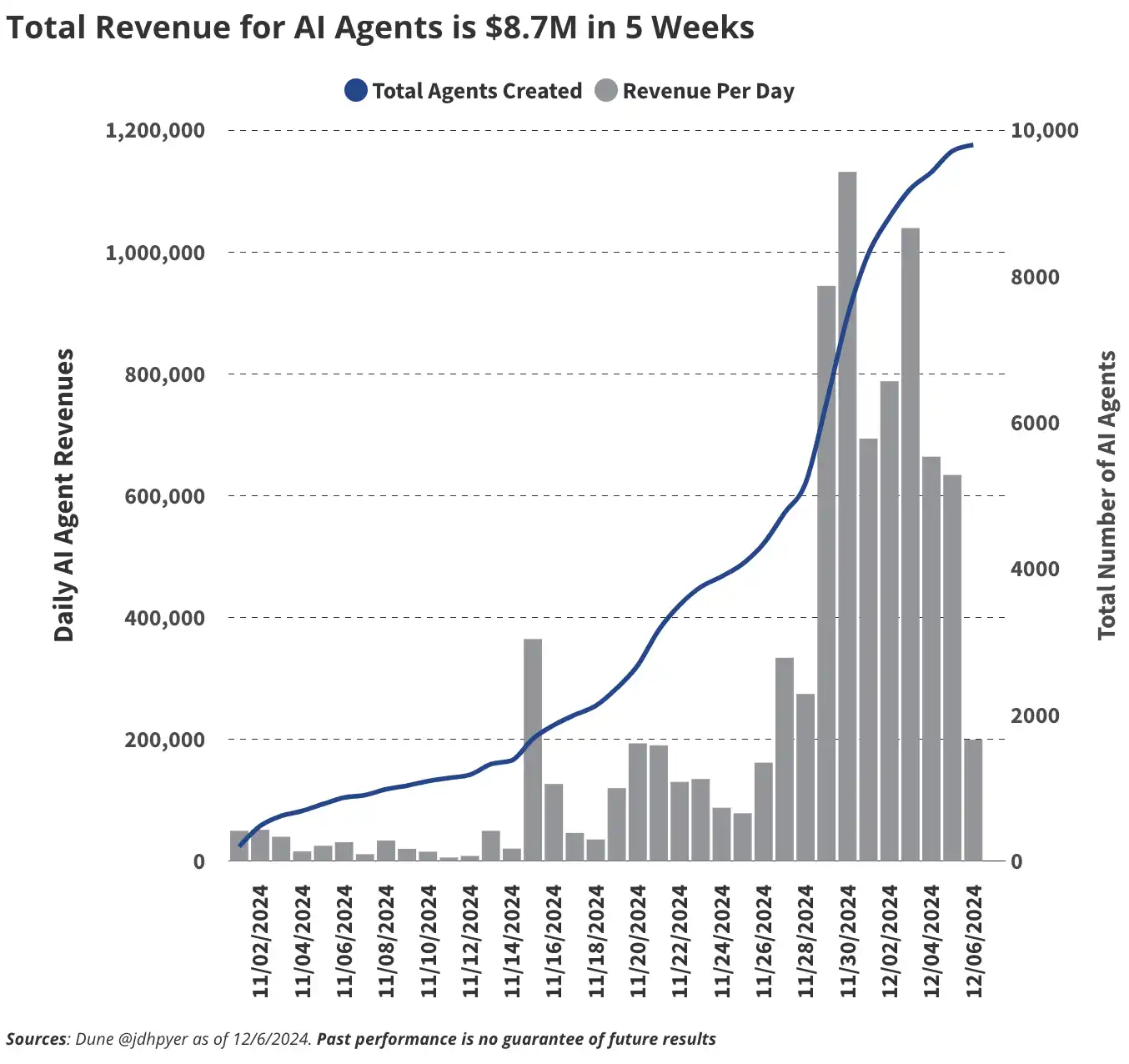
Source: Dune @jdhpyer, data as of December 6, 2024
We believe that AI Agents are the most compelling trend that will gain significant traction in 2025. AI Agents are specialized AI bots that help users achieve goals, such as "maximize revenue" or "increase engagement on X/Twitter." These agents autonomously adjust their strategies to optimize results. AI agents are typically fed data and trained to focus on a specific domain. Currently, protocols like Virtuals provide tools for anyone to create on-chain AI agents. Virtuals allows non-technical people to access decentralized AI contributors (such as fine-tuning experts, dataset providers, and model developers), allowing ordinary users to create their own agents. This model will lead to the emergence of a large number of agents whose creators can rent out the agents to generate income.
Currently, the construction of agents is mainly concentrated in the DeFi field, but we believe that AI agents will go beyond financial activities. For example, these agents can be used as influencers on social media, virtual players in games, and interactive assistants or companions in consumer applications. Agents like Bixby and Terminal of Truths have become significant X/Twitter influencers with 92k and 197k followers respectively. As a result, we expect over 1 million new agents to be created by 2025.
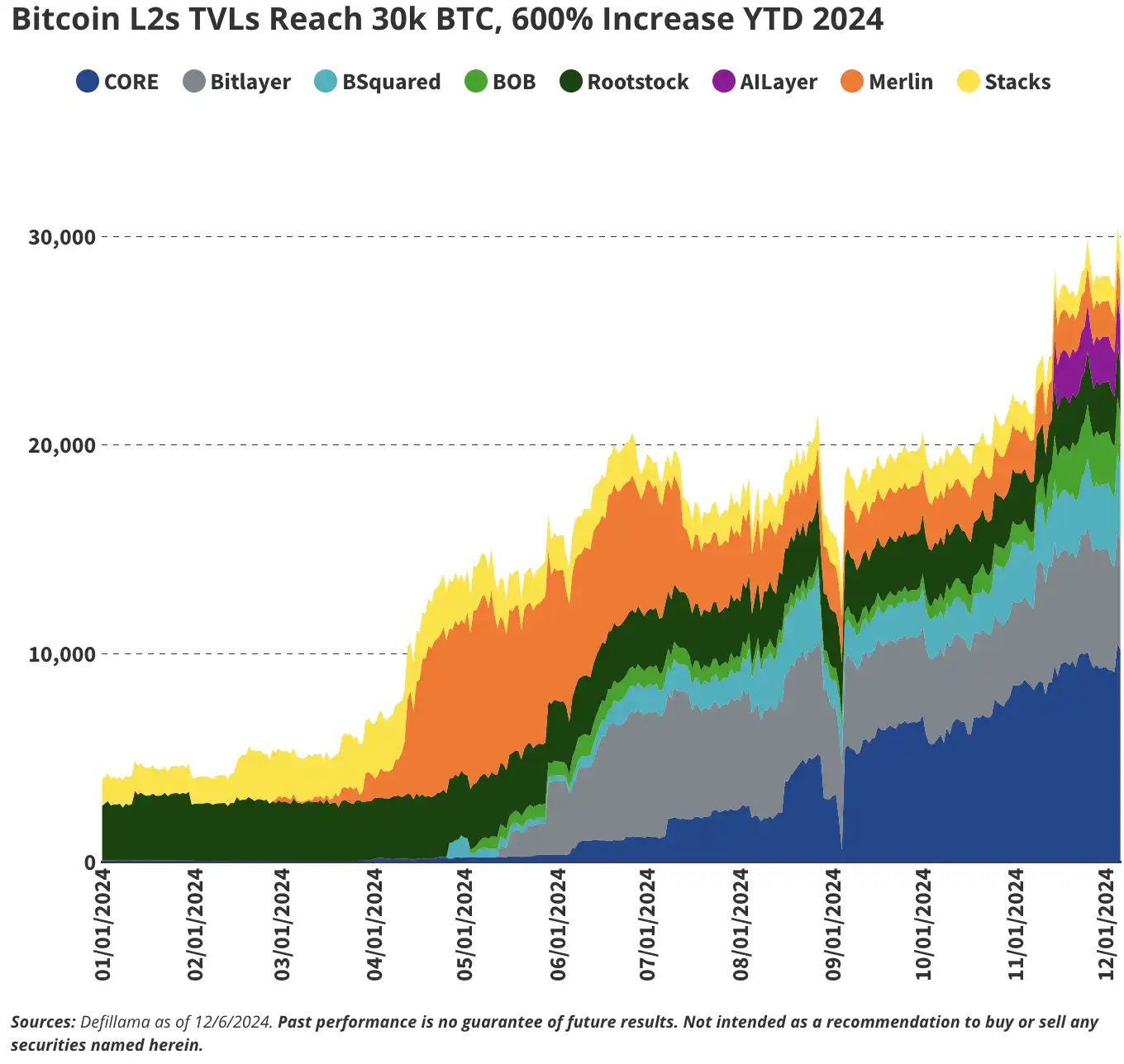
6. Bitcoin’s Second Layer (L2) Total Value Locked (TVL) Reaches 100k BTC
Bitcoin L2’s TVL Reaches 30k BTC, Up 600% YoY in 2024
Source: Deflama, data as of Dec 6, 2024
The securities mentioned in this article do not constitute a recommendation to buy or sell.
We are closely watching the rise of Bitcoin’s second layer (L2) blockchains, which have great potential to transform the Bitcoin ecosystem. By extending Bitcoin’s functionality, these L2 solutions can achieve lower latency and higher transaction throughput, addressing the limitations of the Bitcoin main chain. In addition, Bitcoin L2 also enhances Bitcoin’s capabilities by introducing smart contract functionality, supporting the decentralized finance (DeFi) ecosystem built around Bitcoin.
Currently, Bitcoin can be transferred to smart contract platforms through bridging or wrapping BTC, but these methods rely on third-party systems and are vulnerable to hacking and security vulnerabilities. Bitcoin L2 solutions aim to address these risks through a framework that integrates directly with the Bitcoin main chain, thereby reducing reliance on centralized intermediaries. Although liquidity limitations and barriers to adoption remain, Bitcoin L2 is expected to improve security and decentralization, providing BTC holders with greater confidence to more actively participate in the decentralized ecosystem.
As shown in the figure, Bitcoin L2 solutions experienced explosive growth in 2024, with the total value locked (TVL) exceeding 30,000 BTC, a year-on-year increase of 600%, equivalent to approximately $3 billion. Currently, there are more than 75 Bitcoin L2 projects in development, but only a few are likely to achieve significant adoption in the long term.
This rapid growth reflects the strong demand from BTC holders for yield generation and broader use of the asset. As chain abstraction technology and Bitcoin L2 gradually mature into products available to end users, Bitcoin will become an important part of DeFi. For example, the Ika platform on Sui or the Infinex chain abstraction technology used by Near demonstrate how innovative multi-chain solutions can enhance Bitcoin's interoperability with other ecosystems.
By supporting secure and efficient on-chain lending, borrowing, and other permissionless DeFi solutions, Bitcoin L2 and abstraction technology will transform Bitcoin from a passive store of value to an active participant in the decentralized ecosystem. As adoption scales, these technologies will unlock huge potential for on-chain liquidity, cross-chain innovation, and a more integrated financial future.
7. Ethereum Blob Space Fee Revenue Reaches $1 Billion
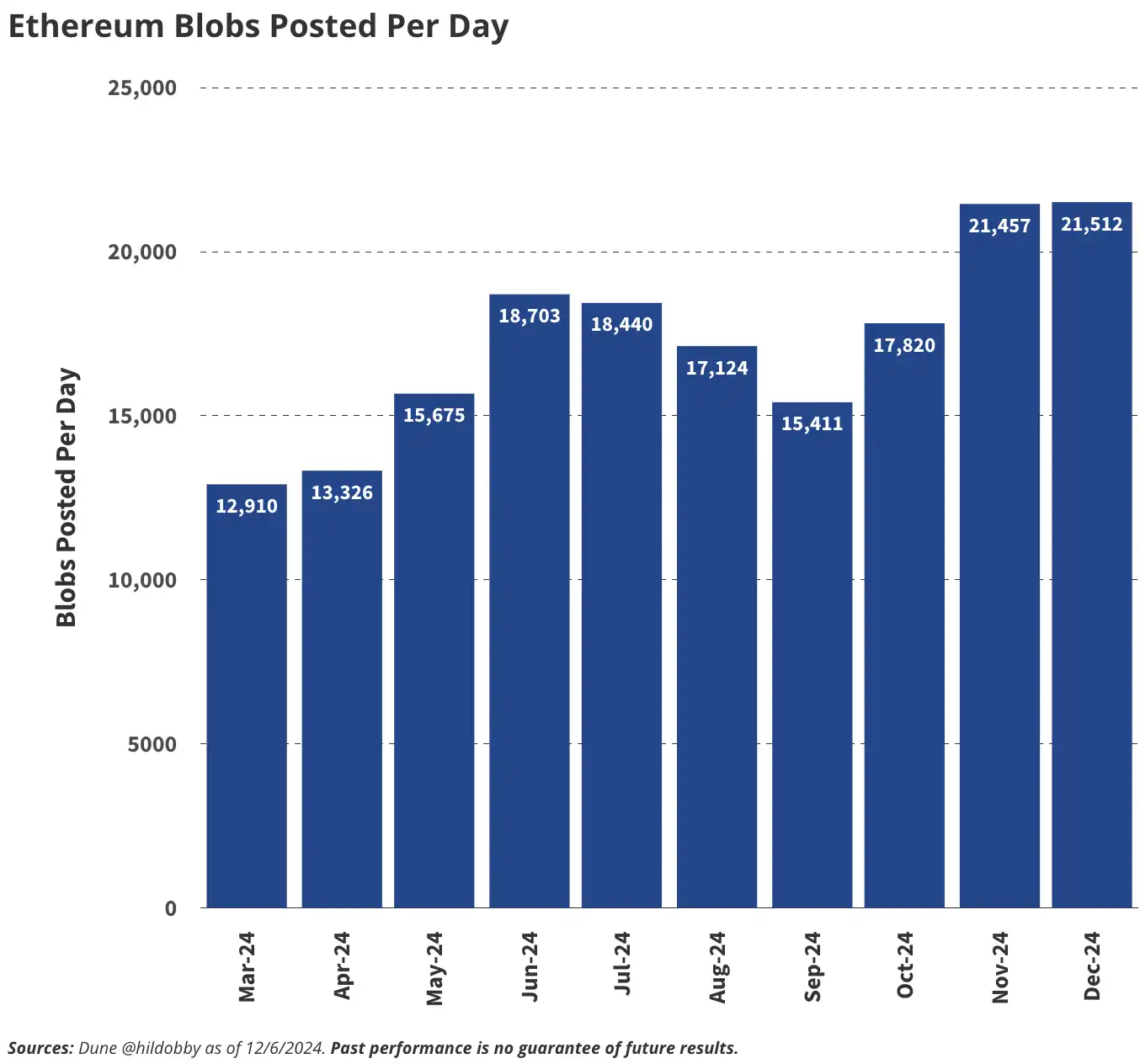
Daily Blob Space Generation on Ethereum
Source: Dune @hildobby, data as of December 6, 2024
The Ethereum community is actively discussing whether its Layer-2 (L2) network can bring enough value to the Ethereum mainnet through Blob Space. Blob Space is a key component in Ethereum's expansion roadmap. As a specialized data layer, L2 can submit a compressed version of its transaction history to Ethereum and pay ETH fees per Blob. While this architecture underpins Ethereum’s scalability, L2 currently pays less value to the mainnet, with a gross margin of around 90%. This has raised concerns that Ethereum’s economic value may be excessively transferred to L2, resulting in a decline in the utilization of the mainnet.
Despite the recent slowdown in the growth of Blob space, we expect its usage to increase significantly by 2025, driven primarily by three factors:
1. Explosive adoption of L2: Ethereum L2 transaction volume is growing at an annualized rate of over 300%, with users migrating to a low-cost, high-throughput environment for DeFi, gaming, and social applications. As more consumer-facing dApps emerge on L2, more transactions will flow back to Ethereum for final settlement, significantly increasing demand for Blob space.
2. Rollup Technology Optimization:Advances in Rollup technology, such as improved data compression and reduced costs for submitting data to Blob space, will encourage L2 to store more transaction data on Ethereum, unlocking higher throughput without sacrificing decentralization.
3. The introduction of high-fee use cases:The rise of enterprise-level applications, zk-rollup-based financial solutions, and tokenized real-world assets will drive high-value transactions that prioritize security and immutability and are therefore willing to pay Blob space fees.
By the end of 2025, we expect Blob space fees to exceed $1 billion, which is currently negligible. This growth will consolidate Ethereum's role as the final settlement layer for decentralized applications while enhancing its ability to capture value from the rapidly expanding L2 ecosystem. Blob space will not only expand the network, but will also become an important source of revenue for Ethereum, balancing the economic relationship between the mainnet and L2.
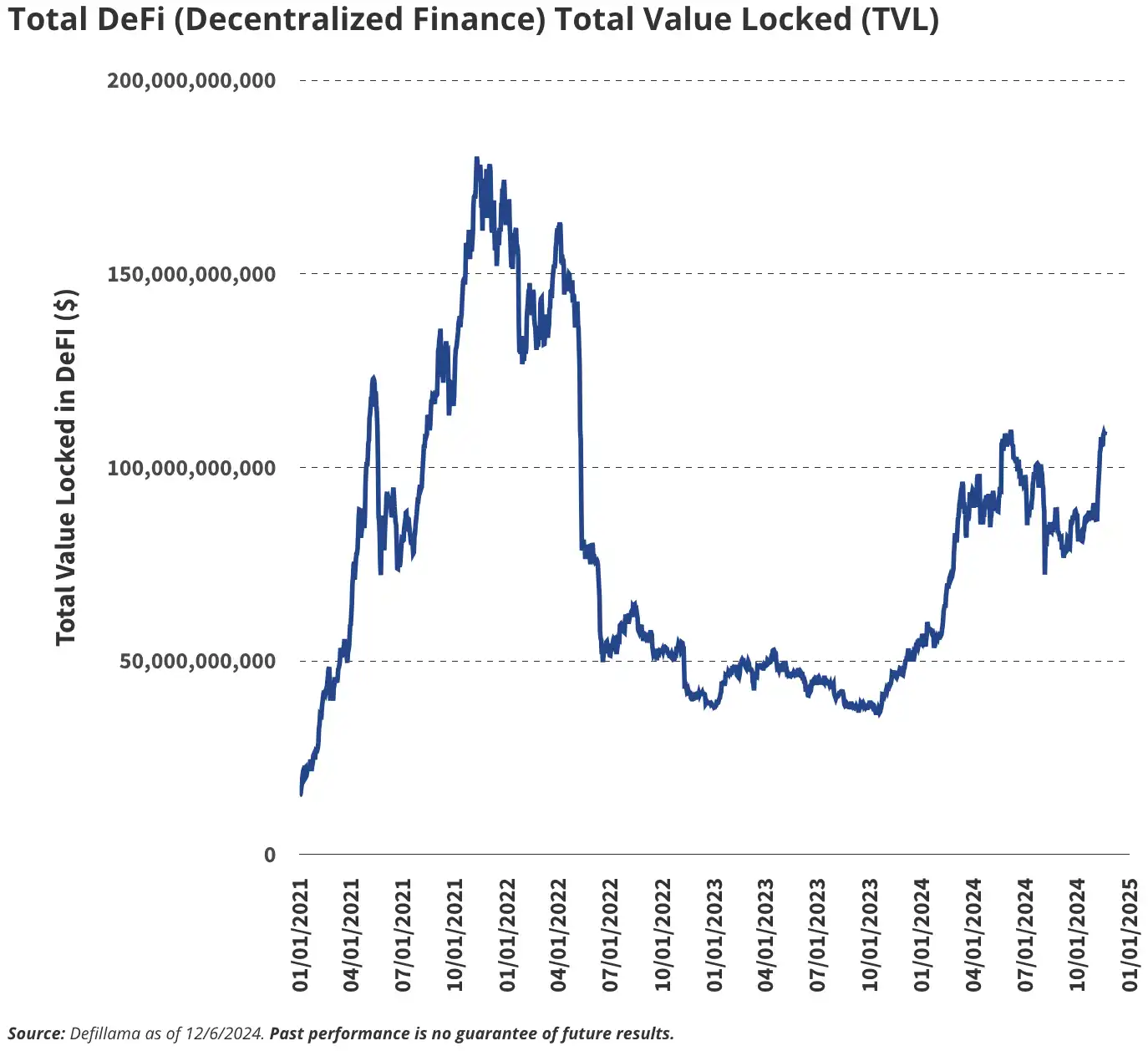
8. DeFi hits record high: DEX trading volume reaches US$4 trillion, TVL reaches US$200 billion
DeFi total locked value (TVL)
Source: Defillama, data as of December 6, 2024
Although decentralized exchanges (DEX) have hit record highs in terms of trading volume both in absolute terms and relative to centralized exchanges (CEX), the total locked value (TVL) of decentralized finance (DeFi) is still 24% lower than its historical peak. We expect DEX volume to exceed $4 trillion in 2025, accounting for 20% of CEX spot volume, driven by the popularity of AI-related tokens and the emergence of new consumer-facing dApps.
In addition, the influx of tokenized securities and high-value assets will serve as a catalyst for DeFi growth, bringing new liquidity and broader use to the ecosystem. As a result, we expect DeFi's total value locked (TVL) to rebound to over $200 billion by the end of the year.
This growth not only reflects the recovery of decentralized finance, but also signals its enhanced status in the global financial system. By introducing more user-friendly dApps and innovative financial instruments, DeFi will attract new capital inflows and consolidate its position as an alternative to traditional finance.
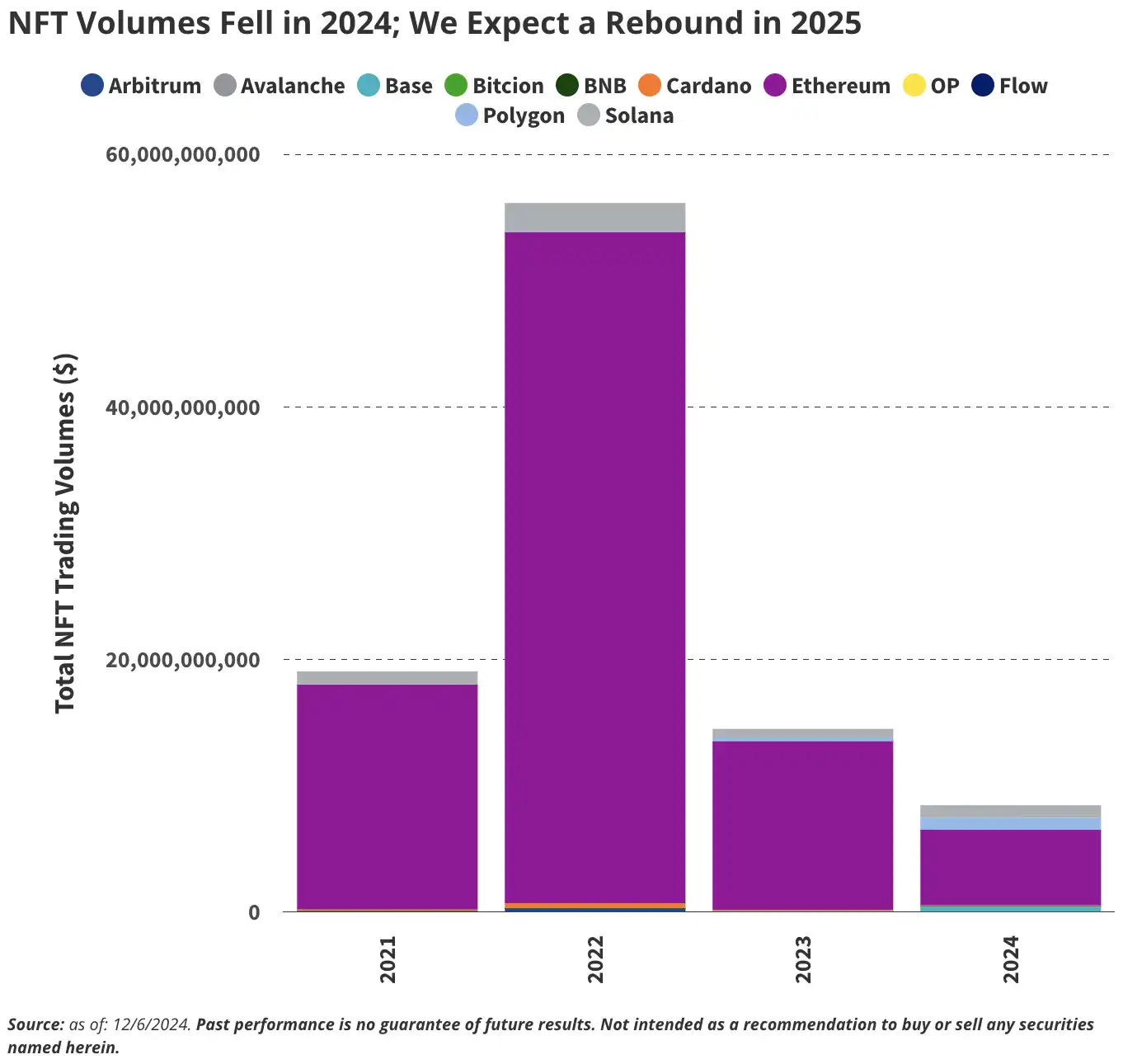
9. NFT Market Recovery: Trading Volume Reaches $30 Billion
NFT Trading Volume Declines in 2024; We Expect a Rebound in 2025
Source: Data as of December 6, 2024
The 2022-2023 bear market hit the NFT space hard, with trading volume down 39% since 2023 and plunging 84% from 2022. While Fungible Tokens prices began to recover in 2024, most NFTs lagged behind, not turning the corner until November, following weak prices and low activity. Despite these challenges, some projects with strong community bonds have bucked the trend by transcending speculative value.
For example, Pudgy Penguins successfully transitioned from collectible toys to a consumer brand, while Miladys gained cultural influence in the satirical internet culture space. Similarly, Bored Ape Yacht Club (BAYC) continues to grow as a dominant cultural force, attracting widespread attention from brands, celebrities, and mainstream media.
As crypto wealth recovers, we expect newly wealthy users to diversify into NFTs, not just as speculative investments, but also as assets of lasting cultural and historical significance. Established series like CryptoPunks and Bored Ape Yacht Club (BAYC) stand to benefit from this shift due to their strong cultural influence and relevance. While BAYC and CryptoPunks are still trading 90% and 66% below their all-time peaks (in ETH terms), other projects like Pudgy Penguins and Miladys have surpassed their previous highs.
Ethereum continues to dominate the NFT space, hosting the majority of significant collections. In 2024, Ethereum accounts for 71% of NFT trading share, and we expect this to rise to 85% in 2025. This dominance is also reflected in the market capitalization rankings, with NFTs on the Ethereum chain occupying all of the top 10 positions and 16 of the top 20 positions, highlighting Ethereum’s central role in the NFT ecosystem.
While NFT trading volume may not return to the frenetic highs of previous cycles, we believe $30 billion in annualized volume is feasible, approximately 55% of the 2021 peak. The market is shifting away from speculative hype and toward sustainability and cultural relevance.
10. dApp Tokens Close the Gap with L1 Tokens
Layer 1 Tokens Outperformed Major dApp Tokens by 2x in 2024
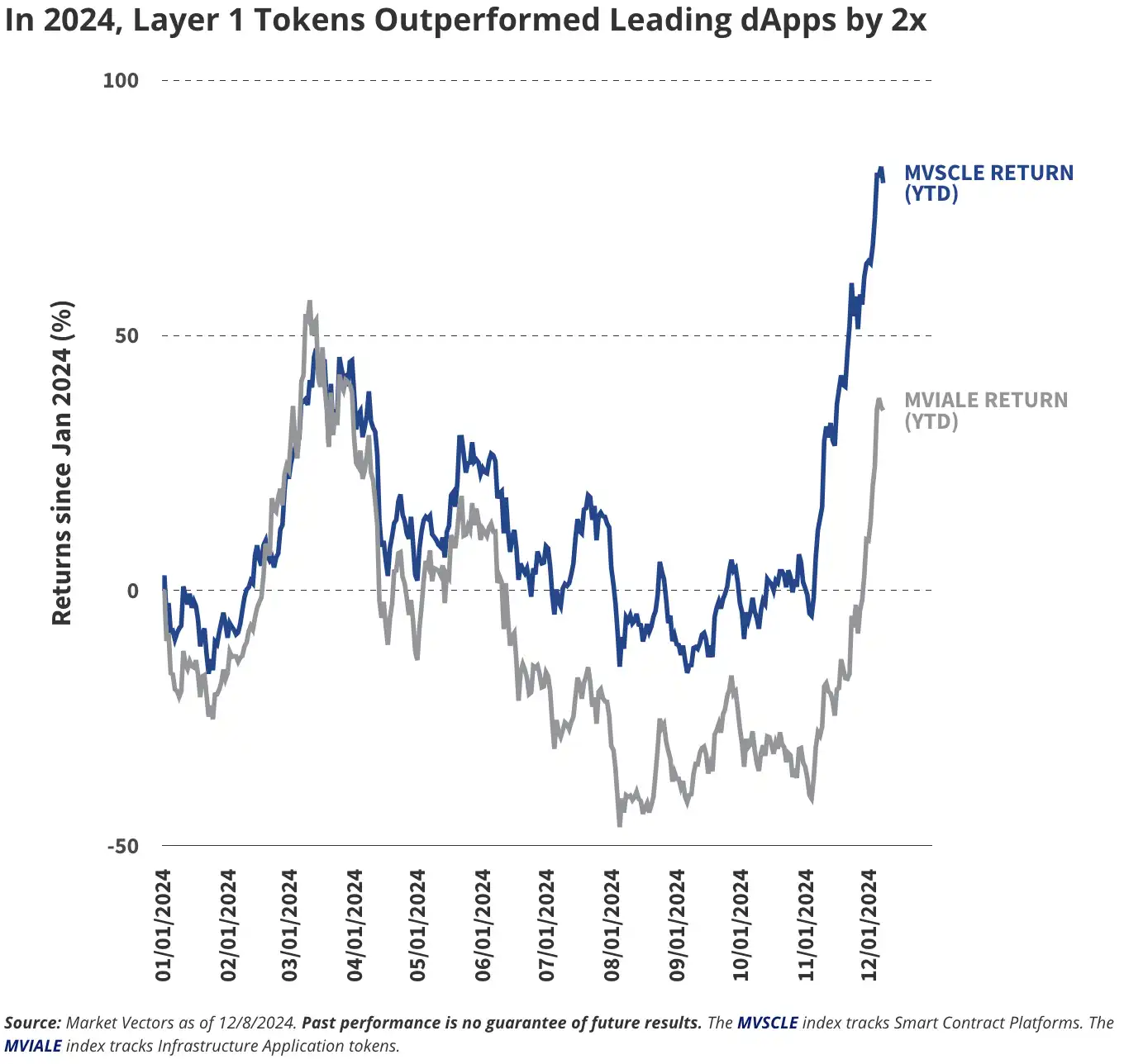
Source: Market Vectors, data as of December 8, 2024
A persistent theme of the 2024 bull run has been the significant excess returns of Layer-1 (L1) blockchain tokens relative to decentralized application (dApp) tokens. For example, the MVSCLE Index, which tracks smart contract platforms, is up 80% year-to-date, while the MVIALE Index of application tokens is up only 35% over the same period.
However, we expect this dynamic to change later in 2024 as a wave of new dApps launch with innovative and useful products, creating value for their associated tokens. Among the key thematic trends, we see Artificial Intelligence (AI) as a standout category in dApp innovation. Additionally, Decentralized Physical Infrastructure Network (DePIN) projects also have great potential to attract investor and user interest, facilitating a broader rebalancing of performance between L1 tokens and dApp tokens.
This shift highlights the importance of utility and product-market fit in determining the success of application tokens in the evolving cryptocurrency landscape.
You may also like

Token Cannot Compound, Where Is the Real Investment Opportunity?

February 6th Market Key Intelligence, How Much Did You Miss?

China's Central Bank and Eight Other Departments' Latest Regulatory Focus: Key Attention to RWA Tokenized Asset Risk
Foreword: Today, the People's Bank of China's website published the "Notice of the People's Bank of China, National Development and Reform Commission, Ministry of Industry and Information Technology, Ministry of Public Security, State Administration for Market Regulation, China Banking and Insurance Regulatory Commission, China Securities Regulatory Commission, State Administration of Foreign Exchange on Further Preventing and Dealing with Risks Related to Virtual Currency and Others (Yinfa [2026] No. 42)", the latest regulatory requirements from the eight departments including the central bank, which are basically consistent with the regulatory requirements of recent years. The main focus of the regulation is on speculative activities such as virtual currency trading, exchanges, ICOs, overseas platform services, and this time, regulatory oversight of RWA has been added, explicitly prohibiting RWA tokenization, stablecoins (especially those pegged to the RMB). The following is the full text:
To the people's governments of all provinces, autonomous regions, and municipalities directly under the Central Government, the Xinjiang Production and Construction Corps:
Recently, there have been speculative activities related to virtual currency and Real-World Assets (RWA) tokenization, disrupting the economic and financial order and jeopardizing the property security of the people. In order to further prevent and address the risks related to virtual currency and Real-World Assets tokenization, effectively safeguard national security and social stability, in accordance with the "Law of the People's Republic of China on the People's Bank of China," "Law of the People's Republic of China on Commercial Banks," "Securities Law of the People's Republic of China," "Law of the People's Republic of China on Securities Investment Funds," "Law of the People's Republic of China on Futures and Derivatives," "Cybersecurity Law of the People's Republic of China," "Regulations of the People's Republic of China on the Administration of Renminbi," "Regulations on Prevention and Disposal of Illegal Fundraising," "Regulations of the People's Republic of China on Foreign Exchange Administration," "Telecommunications Regulations of the People's Republic of China," and other provisions, after reaching consensus with the Cyberspace Administration of China, the Supreme People's Court, and the Supreme People's Procuratorate, and with the approval of the State Council, the relevant matters are notified as follows:
(I) Virtual currency does not possess the legal status equivalent to fiat currency. Virtual currencies such as Bitcoin, Ether, Tether, etc., have the main characteristics of being issued by non-monetary authorities, using encryption technology and distributed ledger or similar technology, existing in digital form, etc. They do not have legal tender status, should not and cannot be circulated and used as currency in the market.
The business activities related to virtual currency are classified as illegal financial activities. The exchange of fiat currency and virtual currency within the territory, exchange of virtual currencies, acting as a central counterparty in buying and selling virtual currencies, providing information intermediary and pricing services for virtual currency transactions, token issuance financing, and trading of virtual currency-related financial products, etc., fall under illegal financial activities, such as suspected illegal issuance of token vouchers, unauthorized public issuance of securities, illegal operation of securities and futures business, illegal fundraising, etc., are strictly prohibited across the board and resolutely banned in accordance with the law. Overseas entities and individuals are not allowed to provide virtual currency-related services to domestic entities in any form.
A stablecoin pegged to a fiat currency indirectly fulfills some functions of the fiat currency in circulation. Without the consent of relevant authorities in accordance with the law and regulations, any domestic or foreign entity or individual is not allowed to issue a RMB-pegged stablecoin overseas.
(II)Tokenization of Real-World Assets refers to the use of encryption technology and distributed ledger or similar technologies to transform ownership rights, income rights, etc., of assets into tokens (tokens) or other interests or bond certificates with token (token) characteristics, and carry out issuance and trading activities.
Engaging in the tokenization of real-world assets domestically, as well as providing related intermediary, information technology services, etc., which are suspected of illegal issuance of token vouchers, unauthorized public offering of securities, illegal operation of securities and futures business, illegal fundraising, and other illegal financial activities, shall be prohibited; except for relevant business activities carried out with the approval of the competent authorities in accordance with the law and regulations and relying on specific financial infrastructures. Overseas entities and individuals are not allowed to illegally provide services related to the tokenization of real-world assets to domestic entities in any form.
(III) Inter-agency Coordination. The People's Bank of China, together with the National Development and Reform Commission, the Ministry of Industry and Information Technology, the Ministry of Public Security, the State Administration for Market Regulation, the China Banking and Insurance Regulatory Commission, the China Securities Regulatory Commission, the State Administration of Foreign Exchange, and other departments, will improve the work mechanism, strengthen coordination with the Cyberspace Administration of China, the Supreme People's Court, and the Supreme People's Procuratorate, coordinate efforts, and overall guide regions to carry out risk prevention and disposal of virtual currency-related illegal financial activities.
The China Securities Regulatory Commission, together with the National Development and Reform Commission, the Ministry of Industry and Information Technology, the Ministry of Public Security, the People's Bank of China, the State Administration for Market Regulation, the China Banking and Insurance Regulatory Commission, the State Administration of Foreign Exchange, and other departments, will improve the work mechanism, strengthen coordination with the Cyberspace Administration of China, the Supreme People's Court, and the Supreme People's Procuratorate, coordinate efforts, and overall guide regions to carry out risk prevention and disposal of illegal financial activities related to the tokenization of real-world assets.
(IV) Strengthening Local Implementation. The people's governments at the provincial level are overall responsible for the prevention and disposal of risks related to virtual currencies and the tokenization of real-world assets in their respective administrative regions. The specific leading department is the local financial regulatory department, with participation from branches and dispatched institutions of the State Council's financial regulatory department, telecommunications regulators, public security, market supervision, and other departments, in coordination with cyberspace departments, courts, and procuratorates, to improve the normalization of the work mechanism, effectively connect with the relevant work mechanisms of central departments, form a cooperative and coordinated working pattern between central and local governments, effectively prevent and properly handle risks related to virtual currencies and the tokenization of real-world assets, and maintain economic and financial order and social stability.
(5) Enhanced Risk Monitoring. The People's Bank of China, China Securities Regulatory Commission, National Development and Reform Commission, Ministry of Industry and Information Technology, Ministry of Public Security, State Administration of Foreign Exchange, Cyberspace Administration of China, and other departments continue to improve monitoring techniques and system support, enhance cross-departmental data analysis and sharing, establish sound information sharing and cross-validation mechanisms, promptly grasp the risk situation of activities related to virtual currency and real-world asset tokenization. Local governments at all levels give full play to the role of local monitoring and early warning mechanisms. Local financial regulatory authorities, together with branches and agencies of the State Council's financial regulatory authorities, as well as departments of cyberspace and public security, ensure effective connection between online monitoring, offline investigation, and fund tracking, efficiently and accurately identify activities related to virtual currency and real-world asset tokenization, promptly share risk information, improve early warning information dissemination, verification, and rapid response mechanisms.
(6) Strengthened Oversight of Financial Institutions, Intermediaries, and Technology Service Providers. Financial institutions (including non-bank payment institutions) are prohibited from providing account opening, fund transfer, and clearing services for virtual currency-related business activities, issuing and selling financial products related to virtual currency, including virtual currency and related financial products in the scope of collateral, conducting insurance business related to virtual currency, or including virtual currency in the scope of insurance liability. Financial institutions (including non-bank payment institutions) are prohibited from providing custody, clearing, and settlement services for unauthorized real-world asset tokenization-related business and related financial products. Relevant intermediary institutions and information technology service providers are prohibited from providing intermediary, technical, or other services for unauthorized real-world asset tokenization-related businesses and related financial products.
(7) Enhanced Management of Internet Information Content and Access. Internet enterprises are prohibited from providing online business venues, commercial displays, marketing, advertising, or paid traffic diversion services for virtual currency and real-world asset tokenization-related business activities. Upon discovering clues of illegal activities, they should promptly report to relevant departments and provide technical support and assistance for related investigations and inquiries. Based on the clues transferred by the financial regulatory authorities, the cyberspace administration, telecommunications authorities, and public security departments should promptly close and deal with websites, mobile applications (including mini-programs), and public accounts engaged in virtual currency and real-world asset tokenization-related business activities in accordance with the law.
(8) Strengthened Entity Registration and Advertisement Management. Market supervision departments strengthen entity registration and management, and enterprise and individual business registrations must not contain terms such as "virtual currency," "virtual asset," "cryptocurrency," "crypto asset," "stablecoin," "real-world asset tokenization," or "RWA" in their names or business scopes. Market supervision departments, together with financial regulatory authorities, legally enhance the supervision of advertisements related to virtual currency and real-world asset tokenization, promptly investigating and handling relevant illegal advertisements.
(IX) Continued Rectification of Virtual Currency Mining Activities. The National Development and Reform Commission, together with relevant departments, strictly controls virtual currency mining activities, continuously promotes the rectification of virtual currency mining activities. The people's governments of various provinces take overall responsibility for the rectification of "mining" within their respective administrative regions. In accordance with the requirements of the National Development and Reform Commission and other departments in the "Notice on the Rectification of Virtual Currency Mining Activities" (NDRC Energy-saving Building [2021] No. 1283) and the provisions of the "Guidance Catalog for Industrial Structure Adjustment (2024 Edition)," a comprehensive review, investigation, and closure of existing virtual currency mining projects are conducted, new mining projects are strictly prohibited, and mining machine production enterprises are strictly prohibited from providing mining machine sales and other services within the country.
(X) Severe Crackdown on Related Illegal Financial Activities. Upon discovering clues to illegal financial activities related to virtual currency and the tokenization of real-world assets, local financial regulatory authorities, branches of the State Council's financial regulatory authorities, and other relevant departments promptly investigate, determine, and properly handle the issues in accordance with the law, and seriously hold the relevant entities and individuals legally responsible. Those suspected of crimes are transferred to the judicial authorities for processing according to the law.
(XI) Severe Crackdown on Related Illegal and Criminal Activities. The Ministry of Public Security, the People's Bank of China, the State Administration for Market Regulation, the China Banking and Insurance Regulatory Commission, the China Securities Regulatory Commission, as well as judicial and procuratorial organs, in accordance with their respective responsibilities, rigorously crack down on illegal and criminal activities related to virtual currency, the tokenization of real-world assets, such as fraud, money laundering, illegal business operations, pyramid schemes, illegal fundraising, and other illegal and criminal activities carried out under the guise of virtual currency, the tokenization of real-world assets, etc.
(XII) Strengthen Industry Self-discipline. Relevant industry associations should enhance membership management and policy advocacy, based on their own responsibilities, advocate and urge member units to resist illegal financial activities related to virtual currency and the tokenization of real-world assets. Member units that violate regulatory policies and industry self-discipline rules are to be disciplined in accordance with relevant self-regulatory management regulations. By leveraging various industry infrastructure, conduct risk monitoring related to virtual currency, the tokenization of real-world assets, and promptly transfer issue clues to relevant departments.
(XIII) Without the approval of relevant departments in accordance with the law and regulations, domestic entities and foreign entities controlled by them may not issue virtual currency overseas.
(XIV) Domestic entities engaging directly or indirectly in overseas external debt-based tokenization of real-world assets, or conducting asset securitization activities abroad based on domestic ownership rights, income rights, etc. (hereinafter referred to as domestic equity), should be strictly regulated in accordance with the principles of "same business, same risk, same rules." The National Development and Reform Commission, the China Securities Regulatory Commission, the State Administration of Foreign Exchange, and other relevant departments regulate it according to their respective responsibilities. For other forms of overseas real-world asset tokenization activities based on domestic equity by domestic entities, the China Securities Regulatory Commission, together with relevant departments, supervise according to their division of responsibilities. Without the consent and filing of relevant departments, no unit or individual may engage in the above-mentioned business.
(15) Overseas subsidiaries and branches of domestic financial institutions providing Real World Asset Tokenization-related services overseas shall do so legally and prudently. They shall have professional personnel and systems in place to effectively mitigate business risks, strictly implement customer onboarding, suitability management, anti-money laundering requirements, and incorporate them into the domestic financial institutions' compliance and risk management system. Intermediaries and information technology service providers offering Real World Asset Tokenization services abroad based on domestic equity or conducting Real World Asset Tokenization business in the form of overseas debt for domestic entities directly or indirectly venturing abroad must strictly comply with relevant laws and regulations. They should establish and improve relevant compliance and internal control systems in accordance with relevant normative requirements, strengthen business and risk control, and report the business developments to the relevant regulatory authorities for approval or filing.
(16) Strengthen organizational leadership and overall coordination. All departments and regions should attach great importance to the prevention of risks related to virtual currencies and Real World Asset Tokenization, strengthen organizational leadership, clarify work responsibilities, form a long-term effective working mechanism with centralized coordination, local implementation, and shared responsibilities, maintain high pressure, dynamically monitor risks, effectively prevent and mitigate risks in an orderly and efficient manner, legally protect the property security of the people, and make every effort to maintain economic and financial order and social stability.
(17) Widely carry out publicity and education. All departments, regions, and industry associations should make full use of various media and other communication channels to disseminate information through legal and policy interpretation, analysis of typical cases, and education on investment risks, etc. They should promote the illegality and harm of virtual currencies and Real World Asset Tokenization-related businesses and their manifestations, fully alert to potential risks and hidden dangers, and enhance public awareness and identification capabilities for risk prevention.
(18) Engaging in illegal financial activities related to virtual currencies and Real World Asset Tokenization in violation of this notice, as well as providing services for virtual currencies and Real World Asset Tokenization-related businesses, shall be punished in accordance with relevant regulations. If it constitutes a crime, criminal liability shall be pursued according to the law. For domestic entities and individuals who knowingly or should have known that overseas entities illegally provided virtual currency or Real World Asset Tokenization-related services to domestic entities and still assisted them, relevant responsibilities shall be pursued according to the law. If it constitutes a crime, criminal liability shall be pursued according to the law.
(19) If any unit or individual invests in virtual currencies, Real World Asset Tokens, and related financial products against public order and good customs, the relevant civil legal actions shall be invalid, and any resulting losses shall be borne by them. If there are suspicions of disrupting financial order and jeopardizing financial security, the relevant departments shall deal with them according to the law.
This notice shall enter into force upon the date of its issuance. The People's Bank of China and ten other departments' "Notice on Further Preventing and Dealing with the Risks of Virtual Currency Trading Speculation" (Yinfa [2021] No. 237) is hereby repealed.

Former Partner's Perspective on Multicoin: Kyle's Exit, But the Game He Left Behind Just Getting Started

Why Bitcoin Is Falling Now: The Real Reasons Behind BTC's Crash & WEEX's Smart Profit Playbook
Bitcoin's ongoing crash explained: Discover the 5 hidden triggers behind BTC's plunge & how WEEX's Auto Earn and Trade to Earn strategies help traders profit from crypto market volatility.

Wall Street's Hottest Trades See Exodus

Vitalik Discusses Ethereum Scaling Path, Circle Announces Partnership with Polymarket, What's the Overseas Crypto Community Talking About Today?

Believing in the Capital Markets - The Essence and Core Value of Cryptocurrency

Polymarket's 'Weatherman': Predict Temperature, Win Million-Dollar Payout

$15K+ Profits: The 4 AI Trading Secrets WEEX Hackathon Prelim Winners Used to Dominate Volatile Crypto Markets
How WEEX Hackathon's top AI trading strategies made $15K+ in crypto markets: 4 proven rules for ETH/BTC trading, market structure analysis, and risk management in volatile conditions.

A nearly 20% one-day plunge, how long has it been since you last saw a $60,000 Bitcoin?

Raoul Pal: I've seen every single panic, and they are never the end.

Key Market Information Discrepancy on February 6th - A Must-Read! | Alpha Morning Report

2026 Crypto Industry's First Snowfall
The Harsh Reality Behind the $26 Billion Crypto Liquidation: Liquidity Is Killing the Market
Why Is Gold, US Stocks, Bitcoin All Falling?

Key Market Intelligence for February 5th, how much did you miss out on?

Wintermute: By 2026, crypto had gradually become the settlement layer of the Internet economy
Token Cannot Compound, Where Is the Real Investment Opportunity?
February 6th Market Key Intelligence, How Much Did You Miss?
China's Central Bank and Eight Other Departments' Latest Regulatory Focus: Key Attention to RWA Tokenized Asset Risk
Foreword: Today, the People's Bank of China's website published the "Notice of the People's Bank of China, National Development and Reform Commission, Ministry of Industry and Information Technology, Ministry of Public Security, State Administration for Market Regulation, China Banking and Insurance Regulatory Commission, China Securities Regulatory Commission, State Administration of Foreign Exchange on Further Preventing and Dealing with Risks Related to Virtual Currency and Others (Yinfa [2026] No. 42)", the latest regulatory requirements from the eight departments including the central bank, which are basically consistent with the regulatory requirements of recent years. The main focus of the regulation is on speculative activities such as virtual currency trading, exchanges, ICOs, overseas platform services, and this time, regulatory oversight of RWA has been added, explicitly prohibiting RWA tokenization, stablecoins (especially those pegged to the RMB). The following is the full text:
To the people's governments of all provinces, autonomous regions, and municipalities directly under the Central Government, the Xinjiang Production and Construction Corps:
Recently, there have been speculative activities related to virtual currency and Real-World Assets (RWA) tokenization, disrupting the economic and financial order and jeopardizing the property security of the people. In order to further prevent and address the risks related to virtual currency and Real-World Assets tokenization, effectively safeguard national security and social stability, in accordance with the "Law of the People's Republic of China on the People's Bank of China," "Law of the People's Republic of China on Commercial Banks," "Securities Law of the People's Republic of China," "Law of the People's Republic of China on Securities Investment Funds," "Law of the People's Republic of China on Futures and Derivatives," "Cybersecurity Law of the People's Republic of China," "Regulations of the People's Republic of China on the Administration of Renminbi," "Regulations on Prevention and Disposal of Illegal Fundraising," "Regulations of the People's Republic of China on Foreign Exchange Administration," "Telecommunications Regulations of the People's Republic of China," and other provisions, after reaching consensus with the Cyberspace Administration of China, the Supreme People's Court, and the Supreme People's Procuratorate, and with the approval of the State Council, the relevant matters are notified as follows:
(I) Virtual currency does not possess the legal status equivalent to fiat currency. Virtual currencies such as Bitcoin, Ether, Tether, etc., have the main characteristics of being issued by non-monetary authorities, using encryption technology and distributed ledger or similar technology, existing in digital form, etc. They do not have legal tender status, should not and cannot be circulated and used as currency in the market.
The business activities related to virtual currency are classified as illegal financial activities. The exchange of fiat currency and virtual currency within the territory, exchange of virtual currencies, acting as a central counterparty in buying and selling virtual currencies, providing information intermediary and pricing services for virtual currency transactions, token issuance financing, and trading of virtual currency-related financial products, etc., fall under illegal financial activities, such as suspected illegal issuance of token vouchers, unauthorized public issuance of securities, illegal operation of securities and futures business, illegal fundraising, etc., are strictly prohibited across the board and resolutely banned in accordance with the law. Overseas entities and individuals are not allowed to provide virtual currency-related services to domestic entities in any form.
A stablecoin pegged to a fiat currency indirectly fulfills some functions of the fiat currency in circulation. Without the consent of relevant authorities in accordance with the law and regulations, any domestic or foreign entity or individual is not allowed to issue a RMB-pegged stablecoin overseas.
(II)Tokenization of Real-World Assets refers to the use of encryption technology and distributed ledger or similar technologies to transform ownership rights, income rights, etc., of assets into tokens (tokens) or other interests or bond certificates with token (token) characteristics, and carry out issuance and trading activities.
Engaging in the tokenization of real-world assets domestically, as well as providing related intermediary, information technology services, etc., which are suspected of illegal issuance of token vouchers, unauthorized public offering of securities, illegal operation of securities and futures business, illegal fundraising, and other illegal financial activities, shall be prohibited; except for relevant business activities carried out with the approval of the competent authorities in accordance with the law and regulations and relying on specific financial infrastructures. Overseas entities and individuals are not allowed to illegally provide services related to the tokenization of real-world assets to domestic entities in any form.
(III) Inter-agency Coordination. The People's Bank of China, together with the National Development and Reform Commission, the Ministry of Industry and Information Technology, the Ministry of Public Security, the State Administration for Market Regulation, the China Banking and Insurance Regulatory Commission, the China Securities Regulatory Commission, the State Administration of Foreign Exchange, and other departments, will improve the work mechanism, strengthen coordination with the Cyberspace Administration of China, the Supreme People's Court, and the Supreme People's Procuratorate, coordinate efforts, and overall guide regions to carry out risk prevention and disposal of virtual currency-related illegal financial activities.
The China Securities Regulatory Commission, together with the National Development and Reform Commission, the Ministry of Industry and Information Technology, the Ministry of Public Security, the People's Bank of China, the State Administration for Market Regulation, the China Banking and Insurance Regulatory Commission, the State Administration of Foreign Exchange, and other departments, will improve the work mechanism, strengthen coordination with the Cyberspace Administration of China, the Supreme People's Court, and the Supreme People's Procuratorate, coordinate efforts, and overall guide regions to carry out risk prevention and disposal of illegal financial activities related to the tokenization of real-world assets.
(IV) Strengthening Local Implementation. The people's governments at the provincial level are overall responsible for the prevention and disposal of risks related to virtual currencies and the tokenization of real-world assets in their respective administrative regions. The specific leading department is the local financial regulatory department, with participation from branches and dispatched institutions of the State Council's financial regulatory department, telecommunications regulators, public security, market supervision, and other departments, in coordination with cyberspace departments, courts, and procuratorates, to improve the normalization of the work mechanism, effectively connect with the relevant work mechanisms of central departments, form a cooperative and coordinated working pattern between central and local governments, effectively prevent and properly handle risks related to virtual currencies and the tokenization of real-world assets, and maintain economic and financial order and social stability.
(5) Enhanced Risk Monitoring. The People's Bank of China, China Securities Regulatory Commission, National Development and Reform Commission, Ministry of Industry and Information Technology, Ministry of Public Security, State Administration of Foreign Exchange, Cyberspace Administration of China, and other departments continue to improve monitoring techniques and system support, enhance cross-departmental data analysis and sharing, establish sound information sharing and cross-validation mechanisms, promptly grasp the risk situation of activities related to virtual currency and real-world asset tokenization. Local governments at all levels give full play to the role of local monitoring and early warning mechanisms. Local financial regulatory authorities, together with branches and agencies of the State Council's financial regulatory authorities, as well as departments of cyberspace and public security, ensure effective connection between online monitoring, offline investigation, and fund tracking, efficiently and accurately identify activities related to virtual currency and real-world asset tokenization, promptly share risk information, improve early warning information dissemination, verification, and rapid response mechanisms.
(6) Strengthened Oversight of Financial Institutions, Intermediaries, and Technology Service Providers. Financial institutions (including non-bank payment institutions) are prohibited from providing account opening, fund transfer, and clearing services for virtual currency-related business activities, issuing and selling financial products related to virtual currency, including virtual currency and related financial products in the scope of collateral, conducting insurance business related to virtual currency, or including virtual currency in the scope of insurance liability. Financial institutions (including non-bank payment institutions) are prohibited from providing custody, clearing, and settlement services for unauthorized real-world asset tokenization-related business and related financial products. Relevant intermediary institutions and information technology service providers are prohibited from providing intermediary, technical, or other services for unauthorized real-world asset tokenization-related businesses and related financial products.
(7) Enhanced Management of Internet Information Content and Access. Internet enterprises are prohibited from providing online business venues, commercial displays, marketing, advertising, or paid traffic diversion services for virtual currency and real-world asset tokenization-related business activities. Upon discovering clues of illegal activities, they should promptly report to relevant departments and provide technical support and assistance for related investigations and inquiries. Based on the clues transferred by the financial regulatory authorities, the cyberspace administration, telecommunications authorities, and public security departments should promptly close and deal with websites, mobile applications (including mini-programs), and public accounts engaged in virtual currency and real-world asset tokenization-related business activities in accordance with the law.
(8) Strengthened Entity Registration and Advertisement Management. Market supervision departments strengthen entity registration and management, and enterprise and individual business registrations must not contain terms such as "virtual currency," "virtual asset," "cryptocurrency," "crypto asset," "stablecoin," "real-world asset tokenization," or "RWA" in their names or business scopes. Market supervision departments, together with financial regulatory authorities, legally enhance the supervision of advertisements related to virtual currency and real-world asset tokenization, promptly investigating and handling relevant illegal advertisements.
(IX) Continued Rectification of Virtual Currency Mining Activities. The National Development and Reform Commission, together with relevant departments, strictly controls virtual currency mining activities, continuously promotes the rectification of virtual currency mining activities. The people's governments of various provinces take overall responsibility for the rectification of "mining" within their respective administrative regions. In accordance with the requirements of the National Development and Reform Commission and other departments in the "Notice on the Rectification of Virtual Currency Mining Activities" (NDRC Energy-saving Building [2021] No. 1283) and the provisions of the "Guidance Catalog for Industrial Structure Adjustment (2024 Edition)," a comprehensive review, investigation, and closure of existing virtual currency mining projects are conducted, new mining projects are strictly prohibited, and mining machine production enterprises are strictly prohibited from providing mining machine sales and other services within the country.
(X) Severe Crackdown on Related Illegal Financial Activities. Upon discovering clues to illegal financial activities related to virtual currency and the tokenization of real-world assets, local financial regulatory authorities, branches of the State Council's financial regulatory authorities, and other relevant departments promptly investigate, determine, and properly handle the issues in accordance with the law, and seriously hold the relevant entities and individuals legally responsible. Those suspected of crimes are transferred to the judicial authorities for processing according to the law.
(XI) Severe Crackdown on Related Illegal and Criminal Activities. The Ministry of Public Security, the People's Bank of China, the State Administration for Market Regulation, the China Banking and Insurance Regulatory Commission, the China Securities Regulatory Commission, as well as judicial and procuratorial organs, in accordance with their respective responsibilities, rigorously crack down on illegal and criminal activities related to virtual currency, the tokenization of real-world assets, such as fraud, money laundering, illegal business operations, pyramid schemes, illegal fundraising, and other illegal and criminal activities carried out under the guise of virtual currency, the tokenization of real-world assets, etc.
(XII) Strengthen Industry Self-discipline. Relevant industry associations should enhance membership management and policy advocacy, based on their own responsibilities, advocate and urge member units to resist illegal financial activities related to virtual currency and the tokenization of real-world assets. Member units that violate regulatory policies and industry self-discipline rules are to be disciplined in accordance with relevant self-regulatory management regulations. By leveraging various industry infrastructure, conduct risk monitoring related to virtual currency, the tokenization of real-world assets, and promptly transfer issue clues to relevant departments.
(XIII) Without the approval of relevant departments in accordance with the law and regulations, domestic entities and foreign entities controlled by them may not issue virtual currency overseas.
(XIV) Domestic entities engaging directly or indirectly in overseas external debt-based tokenization of real-world assets, or conducting asset securitization activities abroad based on domestic ownership rights, income rights, etc. (hereinafter referred to as domestic equity), should be strictly regulated in accordance with the principles of "same business, same risk, same rules." The National Development and Reform Commission, the China Securities Regulatory Commission, the State Administration of Foreign Exchange, and other relevant departments regulate it according to their respective responsibilities. For other forms of overseas real-world asset tokenization activities based on domestic equity by domestic entities, the China Securities Regulatory Commission, together with relevant departments, supervise according to their division of responsibilities. Without the consent and filing of relevant departments, no unit or individual may engage in the above-mentioned business.
(15) Overseas subsidiaries and branches of domestic financial institutions providing Real World Asset Tokenization-related services overseas shall do so legally and prudently. They shall have professional personnel and systems in place to effectively mitigate business risks, strictly implement customer onboarding, suitability management, anti-money laundering requirements, and incorporate them into the domestic financial institutions' compliance and risk management system. Intermediaries and information technology service providers offering Real World Asset Tokenization services abroad based on domestic equity or conducting Real World Asset Tokenization business in the form of overseas debt for domestic entities directly or indirectly venturing abroad must strictly comply with relevant laws and regulations. They should establish and improve relevant compliance and internal control systems in accordance with relevant normative requirements, strengthen business and risk control, and report the business developments to the relevant regulatory authorities for approval or filing.
(16) Strengthen organizational leadership and overall coordination. All departments and regions should attach great importance to the prevention of risks related to virtual currencies and Real World Asset Tokenization, strengthen organizational leadership, clarify work responsibilities, form a long-term effective working mechanism with centralized coordination, local implementation, and shared responsibilities, maintain high pressure, dynamically monitor risks, effectively prevent and mitigate risks in an orderly and efficient manner, legally protect the property security of the people, and make every effort to maintain economic and financial order and social stability.
(17) Widely carry out publicity and education. All departments, regions, and industry associations should make full use of various media and other communication channels to disseminate information through legal and policy interpretation, analysis of typical cases, and education on investment risks, etc. They should promote the illegality and harm of virtual currencies and Real World Asset Tokenization-related businesses and their manifestations, fully alert to potential risks and hidden dangers, and enhance public awareness and identification capabilities for risk prevention.
(18) Engaging in illegal financial activities related to virtual currencies and Real World Asset Tokenization in violation of this notice, as well as providing services for virtual currencies and Real World Asset Tokenization-related businesses, shall be punished in accordance with relevant regulations. If it constitutes a crime, criminal liability shall be pursued according to the law. For domestic entities and individuals who knowingly or should have known that overseas entities illegally provided virtual currency or Real World Asset Tokenization-related services to domestic entities and still assisted them, relevant responsibilities shall be pursued according to the law. If it constitutes a crime, criminal liability shall be pursued according to the law.
(19) If any unit or individual invests in virtual currencies, Real World Asset Tokens, and related financial products against public order and good customs, the relevant civil legal actions shall be invalid, and any resulting losses shall be borne by them. If there are suspicions of disrupting financial order and jeopardizing financial security, the relevant departments shall deal with them according to the law.
This notice shall enter into force upon the date of its issuance. The People's Bank of China and ten other departments' "Notice on Further Preventing and Dealing with the Risks of Virtual Currency Trading Speculation" (Yinfa [2021] No. 237) is hereby repealed.
Former Partner's Perspective on Multicoin: Kyle's Exit, But the Game He Left Behind Just Getting Started
Why Bitcoin Is Falling Now: The Real Reasons Behind BTC's Crash & WEEX's Smart Profit Playbook
Bitcoin's ongoing crash explained: Discover the 5 hidden triggers behind BTC's plunge & how WEEX's Auto Earn and Trade to Earn strategies help traders profit from crypto market volatility.


 App
App