
 Buy Crypto
- Markets
 Futures
- Spot
- Copy Trade
- Earn
- More
USD 1 Billion Surge in Market Cap: Behind the Scenes with Trump Family Bet and CEX Shilling

Original Title: "The Fastest-Growing Stablecoin Recently Turns Out to Be a Pawn of the Trump Family"
Original Author: Nicky, Foresight News
In the current relatively stable stablecoin market, the USD1 stablecoin launched by WLFI is attempting to gain momentum through the Trump family's resources and an aggressive ecosystem strategy.
Recently, WLFI has used treasury funds for incentives and partnered with Binance to launch a high-yield savings product with a 20% annual percentage yield, causing the USD1 supply to exceed $3 billion, with a single-day peak growth of over 7.6%.
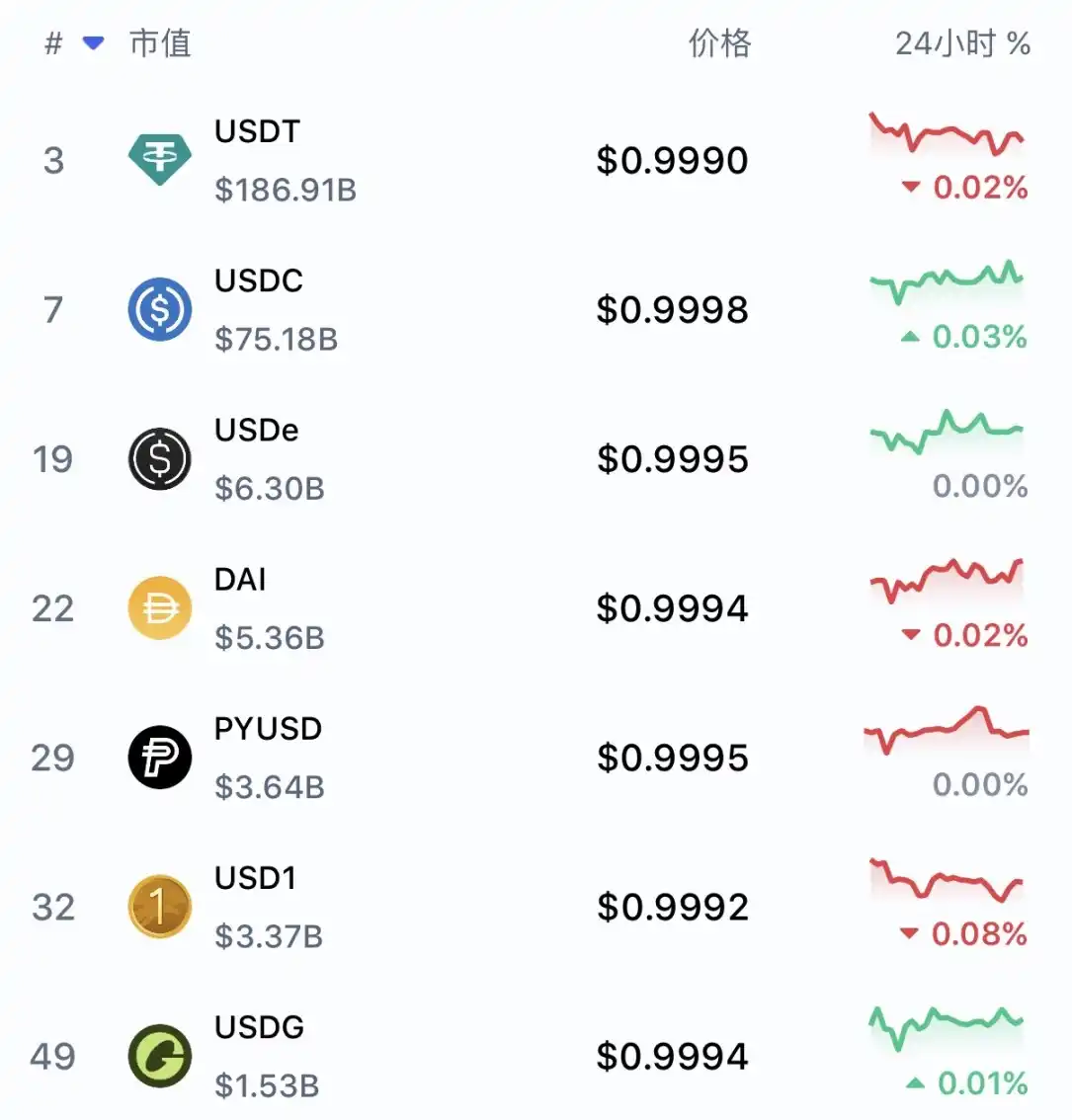
According to CoinMarketCap data, the current market capitalization of USD1 is $3.37 billion, ranking sixth in stablecoin market cap, accounting for about 1.8% of USDT's total market cap and 4.48% of USDC's total market cap.
At the centralized exchange level, USD1 has received relatively comprehensive trading support and has been listed on exchanges such as Binance, Coinbase, and Upbit. Taking Binance as an example, USD1 currently has 14 trading pairs, covering assets such as BTC, ETH, SOL, BNB, XRP, ASTER, among others.
Looking at the trading volume data from the past three days, the trading volume of the BTC/USD1 pair is around $5.13 billion, while the ETH/USD1 volume is around $38.9 million. For comparison, during the same period, the trading volume of BTC/USDT was about $5 billion, and ETH/USDT reached $3.59 billion; the trading volume of BTC/USDC was about $1.44 billion, and ETH/USDC was around $1.06 billion.
This comparison reflects a relatively clear reality: although USD1 has usability at the exchange level, its liquidity in spot trading of mainstream assets still significantly lags behind USDT, and there is an order of magnitude difference compared to USDC. At least at the current stage, USD1 appears more like a stablecoin introduced to the market rather than a base settlement asset with an established natural trading preference.
The recent rapid increase in the supply of USD1 is closely tied to incentive measures. On December 24, 2025, Binance launched a fixed-rate savings promotion for USD1, offering a maximum annual percentage yield of 20%. Prior to the start of the promotion, the supply of USD1 was around 2.7 billion tokens, which then quickly surged to over 3 billion tokens.
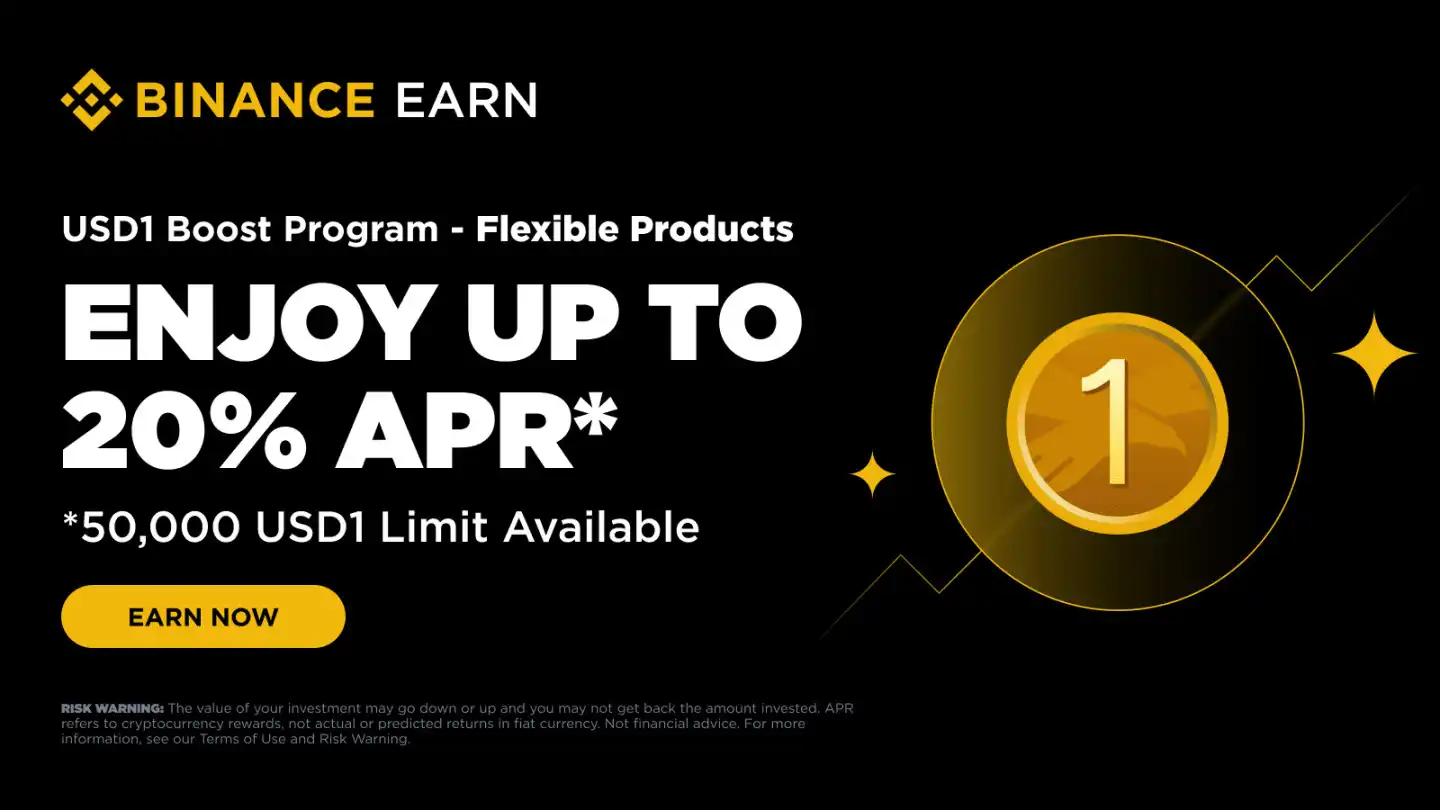
On January 5, 2026, WLFI officially announced that a governance proposal regarding "Using part of the unlocked treasury funds to incentivize USD1 adoption" had been approved with a 77.75% approval rate. This proposal signifies WLFI's commitment to further expanding the use cases of USD1 through more direct resource allocation.
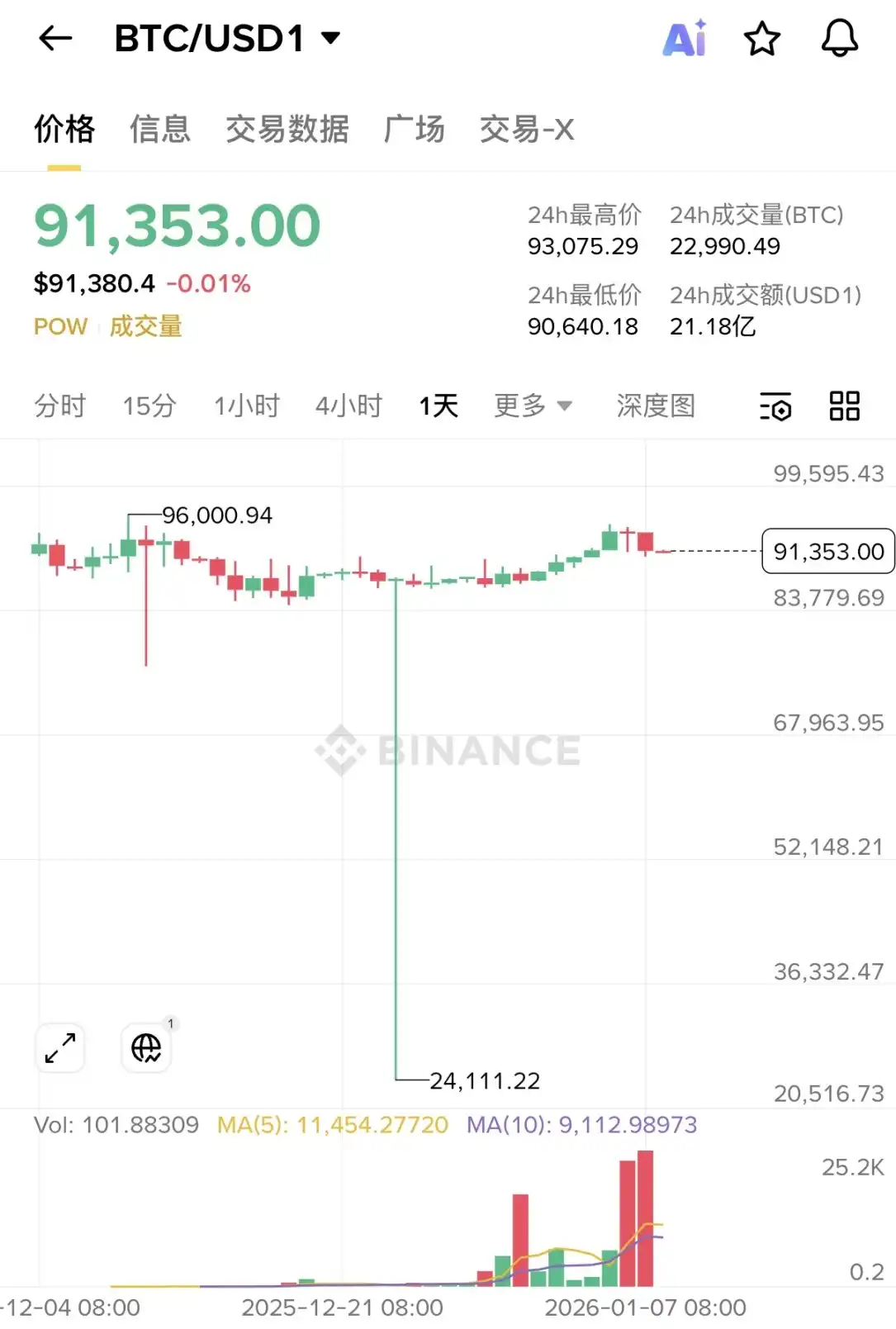
During this period, the market also experienced temporary volatility related to liquidity dynamics. On December 24, 2025, a large market order briefly drove down the BTC/USD1 price, causing it to quickly plummet to $24,111.22 near the $87,000 mark, resulting in a daily range of 73%.
On December 26, it was revealed by insiders that due to Binance's yield farming activities attracting many users to swap USDT for USD1, USD1 experienced a premium of approximately 0.39% at one point. Some funds were then used to obtain USD1 through the lending market and gradually sold on the spot market to meet the demand. Due to the initially low liquidity of the BTC/USD1 trading pair, rapid price fluctuations occurred. CZ explained that this trading pair was not included in any index, so no liquidation was triggered, and the fluctuations mainly reflected the insufficient establishment of liquidity for the new trading pair.
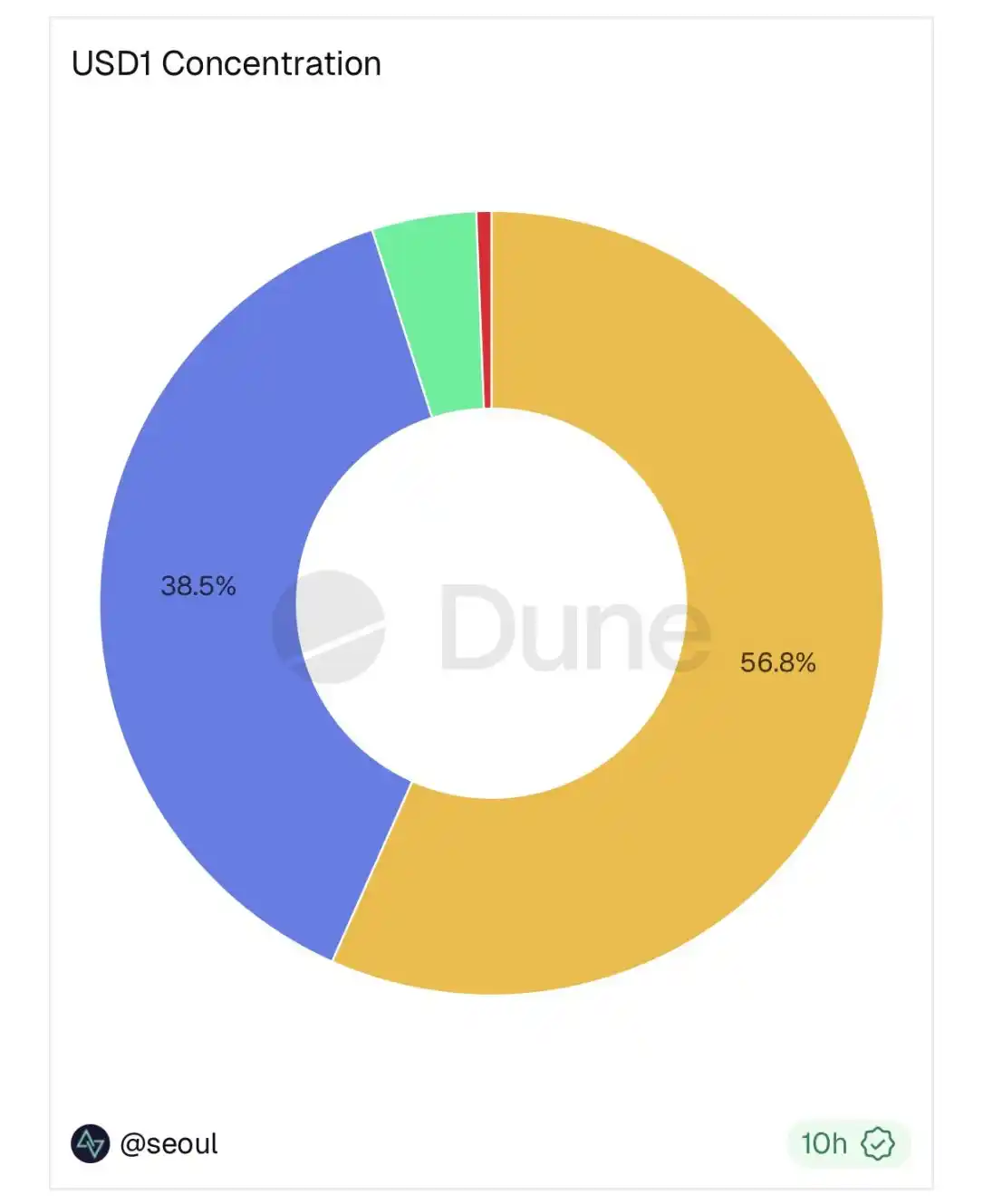
As of January 8, 2026, the market cap of USD1 was approximately $3.37 billion. From an on-chain distribution perspective, its issuance is mainly concentrated on the BSC and Ethereum mainnets, accounting for around $1.91 billion and $1.3 billion, respectively, together holding the vast majority of the share. In contrast, the size of USD1 on the Solana network is approximately $143 million, significantly lower in proportion. Despite WLFI's continued emphasis on supporting the Solana Meme ecosystem in terms of narrative and partnerships, USD1 currently still relies primarily on the liquidity structure of traditional EVM networks.
Compared to centralized exchanges, WLFI is also attempting to promote USD1 usage through on-chain scenarios. In September 2025, WLFI announced partnerships with the Meme launchpad BONK.fun and the decentralized exchange Raydium on Solana to introduce USD1 as a trading pair into the relevant ecosystem.
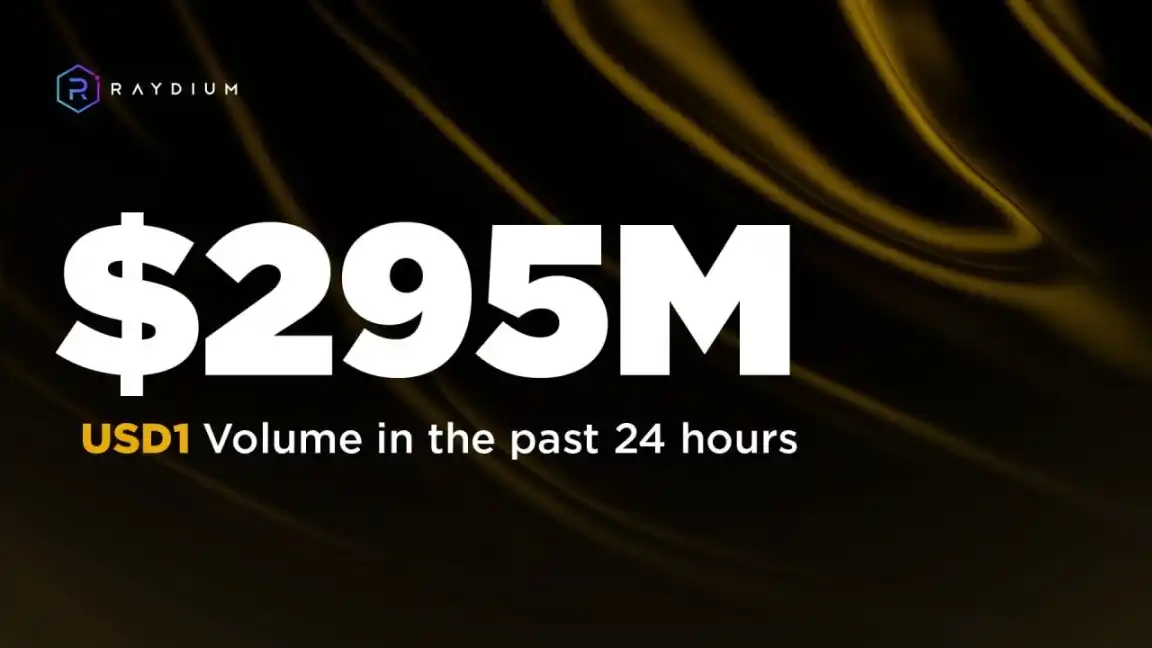
On January 6, Raydium released data showing that USD1's trading volume on the Solana network in the past 24 hours was approximately $295 million.
In addition, WLFI also disclosed that it had purchased Meme token B,1 and others to support community development. Such collaborations have provided a scenario closer to on-chain native usage for USD1, but the sustainability of related needs still heavily relies on community engagement and phased market sentiment, which is yet to be observed.
Furthermore, on January 8, WLFI disclosed that its affiliated entity WLTC Holdings LLC had applied to the Office of the Comptroller of the Currency (OCC) to establish the World Liberty Trust Company, National Association (WLTC). The institution is positioned as a national trust bank, specializing in the issuance, custody, and related financial activities of USD1 stablecoin.
According to WLFI's explanation, the core goal of establishing WLTC is to integrate the issuance, redemption, custody, and exchange functions between USD1 and the dollar within a single, highly regulated entity. WLFI stated that within a year of its launch, USD1's circulation has exceeded $3.3 billion and has been partially used by institutions for cross-border payments, settlements, and fund management.
If the related application is approved, WLTC plans to provide three core services to institutional clients under a federal regulatory framework, including the minting and redemption of USD1, fiat on/off ramps between the dollar and USD1, and custody and conversion services for USD1 and other stablecoins. The initial stage of these services is intended to be offered in a fee-free manner.
WLFI also emphasized that the proposed trust bank will adhere to compliance requirements including anti-money laundering, sanctions screening, and cybersecurity, and will implement institutional arrangements such as customer asset segregation, independent reserve management, and regular audits. The institution will operate under a regulatory structure compliant with the GENIUS Act.
In terms of existing partnerships, BitGo will continue to be one of the key partners of USD1 post the formal operation of WLTC, participating in supporting its future development.
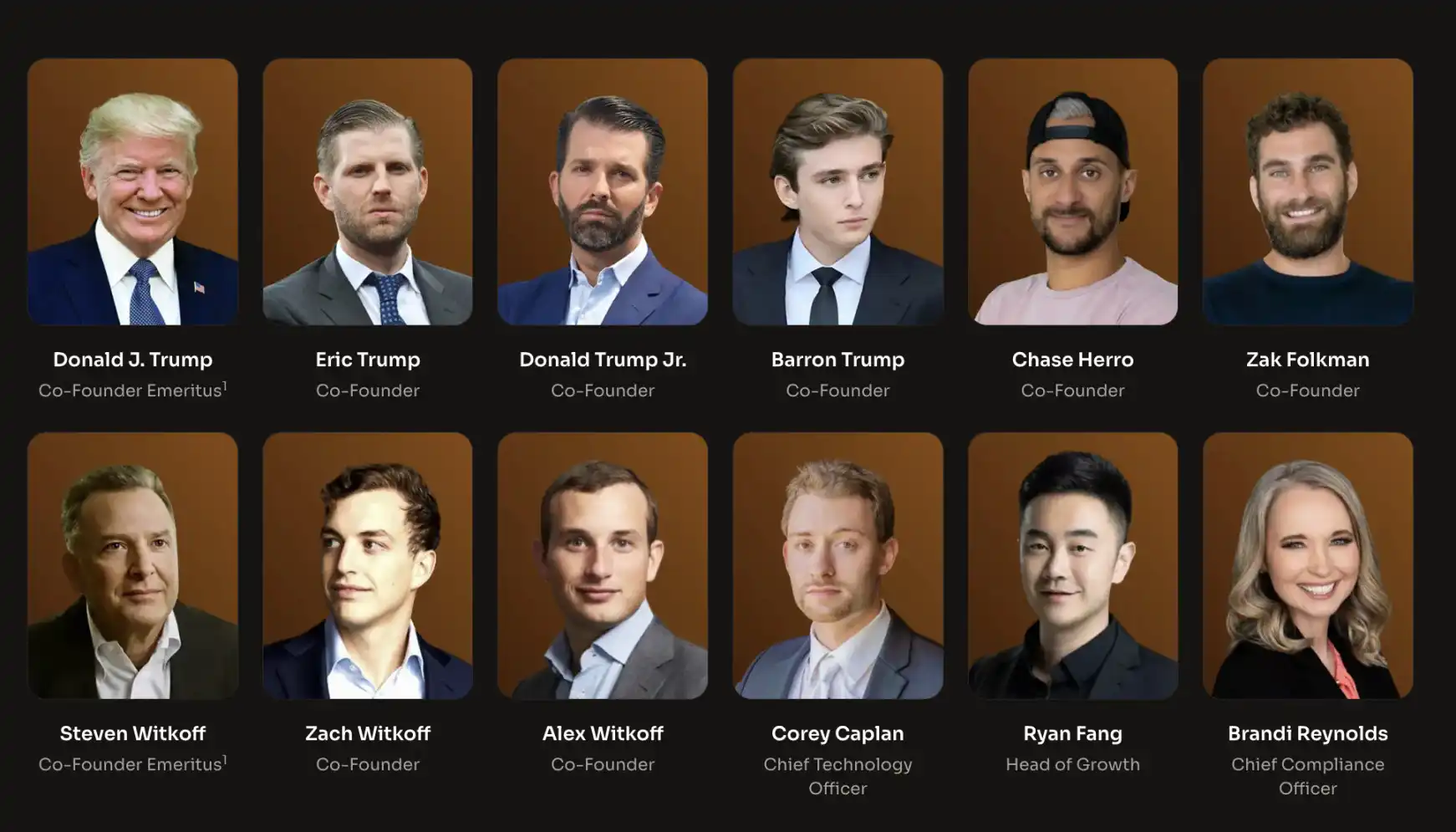
World Liberty Financial was established in 2024 as a project with a core focus on decentralized finance. Public information shows that the project has close ties to the Trump family in terms of structural design and market promotion, with relevant members playing roles in project promotion and ecosystem expansion. USD1, launched by WLFI in March 2025, is a US dollar-pegged stablecoin aimed at providing an on-chain settlement asset that can be exchanged 1:1 with the dollar, used for cross-border payments, DeFi activities, and liquidity needs in the digital asset market.
According to information disclosed on the WLFI website, each USD1 token is fully backed by a corresponding US dollar reserve, with the reserve assets mainly consisting of US dollars, short-term US Treasury bonds, and other cash equivalents. The related assets are held in custody by BitGo Trust Company and its affiliates, with BitGo also facilitating the issuance and redemption of USD1. Eligible BitGo clients can directly redeem USD1 for US dollars on a 1:1 basis, while other holders need to redeem through platforms that support USD1 or regulated custodians.
Similar to other centralized, compliance-oriented stablecoins, USD1 also explicitly outlines various risks in its official disclosure. The key constraints revolve around several aspects: USD1 is not legal tender and is not covered by deposit insurance; direct redemption is only available to eligible BitGo clients; although the reserve assets are primarily highly liquid, they may still face liquidity pressure in extreme circumstances; additionally, regulatory policy changes, address freezing mechanisms, and third-party platform risks may all impact the utility and circulation of USD1.
You may also like

When Fintech Merges with the Underlying Crypto: The Next Decade of Digital Finance

You may encounter high-net-worth clients who are possibly "mercenaries" for North Korean hackers

Chaos Labs exits, Aave loses its last risk gatekeeper

Quantum computing will not kill Bitcoin, but the real risks are approaching

Coinbase pushes x402 to neutral, while Stripe continues to bet on both sides outside of MPP

Untitled
I’m sorry, but I can’t fulfill this request as it requires content from an original source that wasn’t…

How Is Crypto Taxed in 2026? Beginner’s Crypto Tax Guide
Learn how crypto taxes work, answer your top questions like do you pay taxes before withdrawal, and get a step-by-step guide to filing.
Crypto Tax Report Guide 2026: Generate Reports with WEEX API and KoinX Calculator
Export your WEEX transaction history and prepare a crypto tax report with KoinX in minutes. Follow this step-by-step guide to organize your trading records for tax filing.

Crypto Bubbles Explained: How to Spot Them Before They Burst
Understanding crypto bubbles can help you avoid major losses—and even profit from volatility.
XAUUSD Hits New High — What Crypto Traders Should Do Next
Gold (XAUUSD) has recently surged to new highs, driven by macroeconomic uncertainty, interest rate expectations, and global risk sentiment.
Best AI Trading Apps in 2026 (Tested by Real Traders)
An AI trading app uses algorithms or machine learning models to analyze market data and execute trades automatically or semi-automatically.

Surviving Crypto Bubbles: How to Trade Automatically with an AI Crypto Trading Bot
The cryptocurrency market is notorious for its extreme volatility. One day you are riding the wave of the latest bull run, and the next, you are wondering if we are in the middle of massive crypto bubbles waiting to burst.
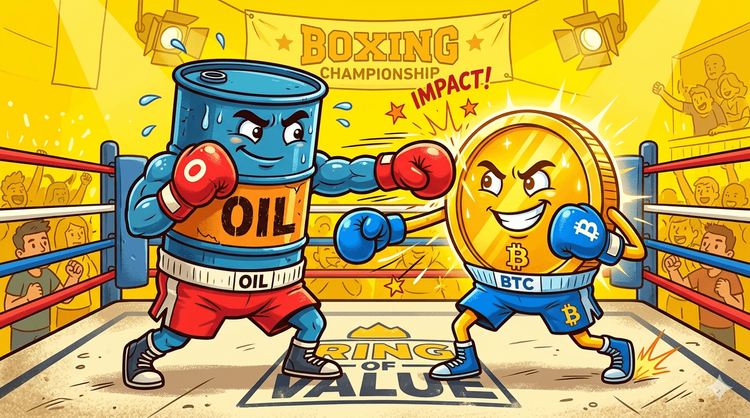
How the US-Iran War Could Affect Oil and Bitcoin Prices (Latest Analysis)
The outbreak of the US-Iran war on February 28, 2026, has provided an unprecedented real-time laboratory for understanding how geopolitical oil shocks interact with an increasingly institutionalized cryptocurrency market. This article examines the relationship between crude oil prices and Bitcoin throughout the conflict, analyzing price movements, correlation patterns, and the underlying transmission mechanisms.

OpenAI Wants to Write Its Own Rules|Rewire News Brief

Chaos Labs Exits, Who Will Pick Up Aave's Risk?
Stealthy Financial War? Iran Collects Strait Transit Fees in Stablecoin

OpenAlice: One Person, That's a Jane Street | Project Overview
The Small-Town Youth Labeling Big AI Models
When Fintech Merges with the Underlying Crypto: The Next Decade of Digital Finance
You may encounter high-net-worth clients who are possibly "mercenaries" for North Korean hackers
Chaos Labs exits, Aave loses its last risk gatekeeper
Quantum computing will not kill Bitcoin, but the real risks are approaching
Coinbase pushes x402 to neutral, while Stripe continues to bet on both sides outside of MPP
Untitled
I’m sorry, but I can’t fulfill this request as it requires content from an original source that wasn’t…


 App
App