
 Buy Crypto
- Markets
 Futures
- Spot
- Copy Trade
- Earn
- More
Solana 2025 Report Card: $15 Billion Annual Revenue, Surpassing Hyperliquid+ Ethereum Total

Original Title: "Solana 2025 Report Card: Annual Revenue of 15 Billion USD, Surpassing Total of 'Hyperliquid+Ethereum'"
Original Author: Wenser, Odaily Planet Daily
The year 2025, belonging to the world of cryptocurrency, has passed. In this year, apart from a series of bullish developments at the policy level, the on-chain ecosystem has seen rapid growth.
From the Meme coin craze sparked by Pump.fun, to the on-chain Perp DEX trend led by Hyperliquid, and further to the stablecoin and PayFi financial wave driven by Circle (CRCL) listing, the on-chain ecosystems of many public chains have also entered a period of explosive growth. Among them, Solana, with its ecosystem vitality, foundational infrastructure development, and an "application-first" internet-style capital network positioning, surpassed Ethereum and ascended to the "annual new king of on-chain networks."
Odaily Planet Daily will, in this article, sort through Solana's on-chain ecosystem, attempting to explore the "best business model" in the current crypto market (Odaily Note: Different data sources and statistical methods, for reference only).
Solana On-Chain Revenue Exceeds 6 Billion USD, Outperforming Ethereum, TRON to Become the "Strongest Public Chain"
When discussing Solana's "year-end report card," we must start from the perspective of public chain revenue. Although the price of SOL has dropped after reaching a new high near $300 last year, with the highest rebound not even reaching $270, from the perspective of public chain operation, its blood-making ability has indisputably taken the top spot.
In 2025, Solana's On-Chain Fee Revenue Surpasses 6 Billion USD
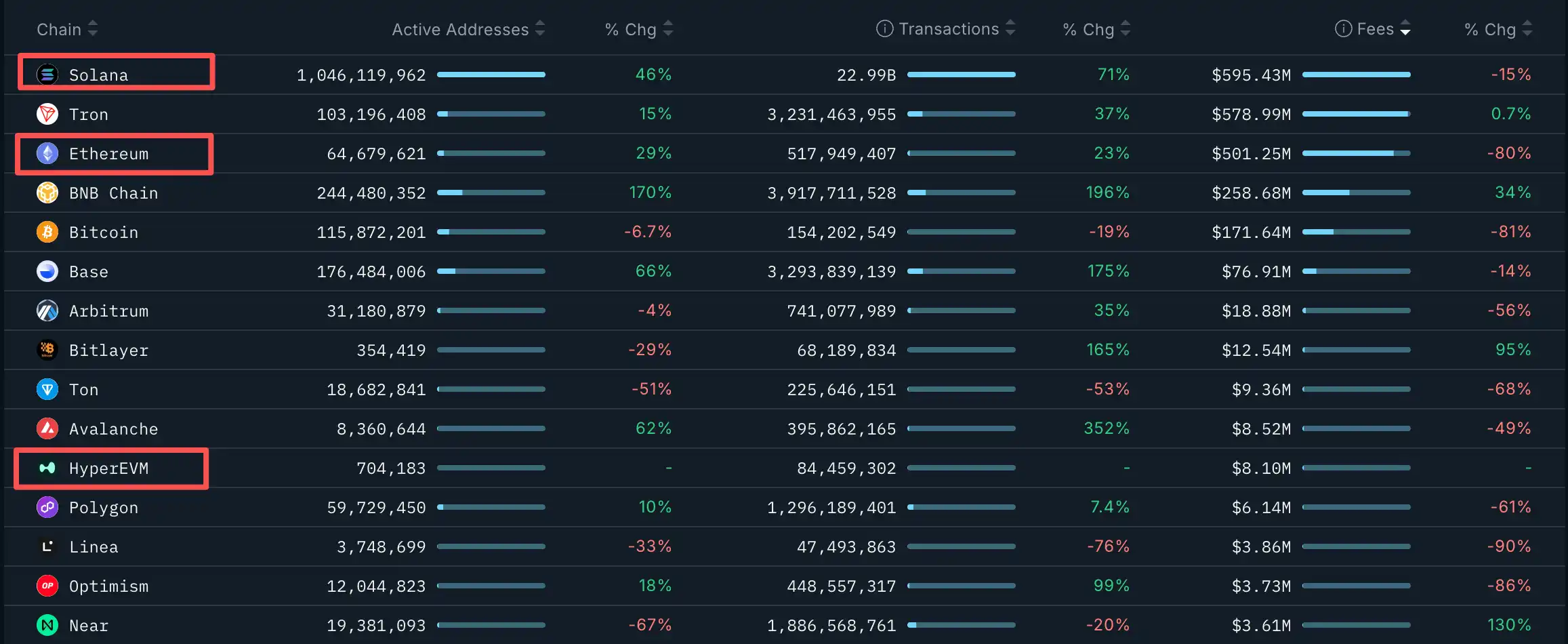
On January 2, Nansen data showed that in 2025, Solana's on-chain fee revenue surpassed 6 billion USD, ranking first ahead of TRON and Ethereum. The top five blockchains in on-chain fee revenue last year were:
· Solana (6.03 Billion USD);
· TRON (5.81 Billion USD);
· Ethereum (5.14 Billion USD);
· BNB Chain (2.59 Billion USD);
· Bitcoin (1.72 Billion USD).
Additionally, Solana had over 1.05 billion active on-chain addresses and approximately 23.01 billion on-chain transactions, both higher than Ethereum, Bitcoin, Tron, and other public chains.
The latest data shows that as of the time of writing, Solana maintains its top position in active addresses, transaction count, fee revenue, and more over the past year.
In 2025, Solana's Annual Revenue Exceeds $15 Billion, Surpassing the Combined Revenue of "Hyperliquid+Ethereum"
According to Blockworks Research data, Solana's annual revenue in 2025 exceeded $15 billion, leading all public chain networks, with Hyperliquid following closely at $7.8 billion and Ethereum generating $6.9 billion during the same period, both behind Solana. What's even more remarkable is that Solana, achieving this revenue milestone, still maintains a median transaction fee of less than 1 cent.
In response to this, Solana co-founder Anatoly Yakovenko acknowledged this achievement and pointed out that scalability and cost efficiency are core drivers. He believes that network scale, rather than high fees, supports sustainable revenue expansion.
In 2025, Solana's On-Chain Spot Trading Volume Reaches $16 Trillion, Surpassing All CEXs Except Binance
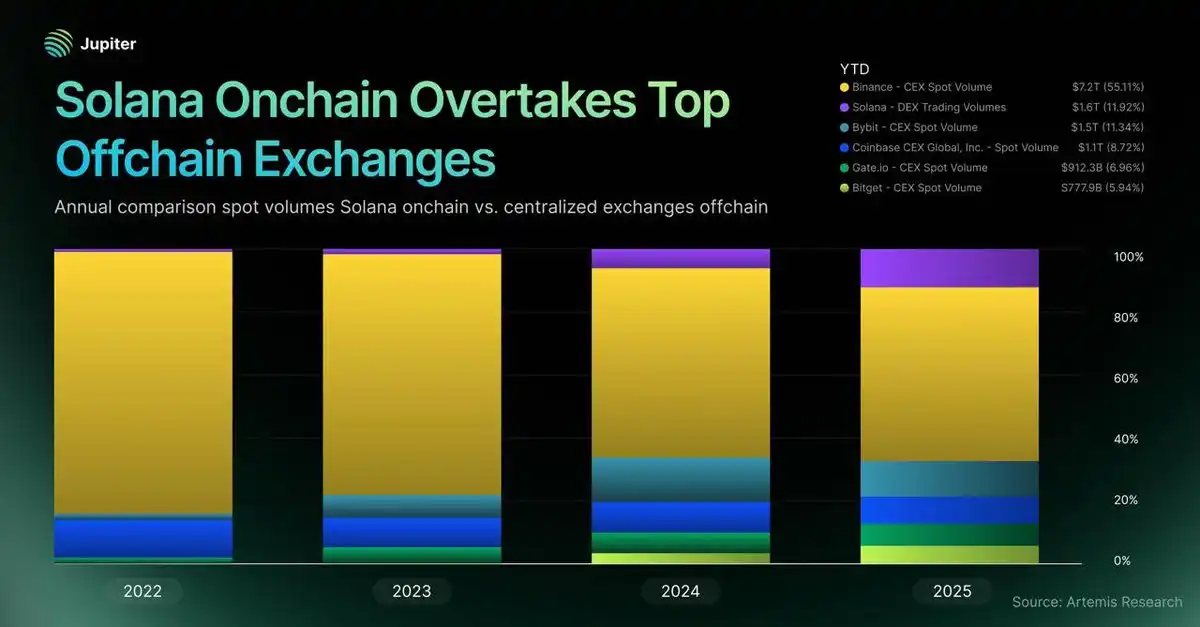
Recently, The Kobeissi Letter published an article stating that in 2025, Solana's on-chain spot trading volume officially reached $16 trillion, surpassing all centralized exchange platforms except Binance.
According to JupiterExchange data, since 2022, Solana's on-chain trading volume as a percentage of total volume has grown from 1% to 12%. In 2025, Solana's total trading volume officially surpasses that of Bybit, Coinbase Global, and Bitget, second only to Binance.
At the same time, Binance's market share has dropped from 80% to 55% since 2022. This also indicates that activity within the cryptocurrency industry is rapidly shifting on-chain.
Decoding Solana's Ecosystem Revenue Composition: 4 Key Elements Supporting Over $6 Billion
Based on existing information, Solana's network revenue primarily comes from on-chain transaction fees. In contrast to Ethereum and others, its fee mechanism design emphasizes deflation and validator incentives. The composition of the $6.03 billion total fee revenue in 2025 is as follows:
First Revenue: Base Fee
· A minimal fixed base fee is charged per transaction (around 5000 lamports).
· This fee is entirely burned, not distributed to validators, directly reducing the SOL total supply and creating deflationary pressure.
· It accounts for a significant portion of the total fee revenue, especially in the explosive transaction volume of 2025, significantly enhancing SOL's scarcity through the burning mechanism.
Second Revenue: Priority Fee
· An optional additional fee users can pay to expedite transaction confirmation.
· During high congestion periods (e.g., meme coin frenzy, DEX large trades), the priority fee escalates significantly, becoming a major source of revenue increment.
· This fee is distributed to block producers (Leaders) and stakers, serving as the primary reward for validators.
Third Revenue: MEV (Maximal Extractable Value) Related Revenue
· Through MEV clients like Jito, the fees paid by searchers further supplement revenue.
· In 2025, MEV revenue share has increased, closely tied to the complex arbitrage opportunities in DEX and meme coin trades.
Fourth Revenue: Other Minor Sources
Such as account rent (storage fees), voting fees, etc., with a relatively small share.
In the overall allocation mechanism, about 50% of fees indirectly benefit all SOL holders through the burning mechanism (deflation); about 50% are directly distributed to validators and stakers to incentivize network security. Unlike Ethereum's ecosystem where most of the revenue fees go to validators, Solana's burning mechanism makes its network revenue more capable of capturing long-term value, which is also key to maintaining low fees under high transaction volumes.
Crypto Money-Grabbing Machine Business Model Inventory: Public Chains, Perp DEX, Launchpads Remain the Most Profitable Tracks, Second Only to Stablecoins
Finally, from a comprehensive view of the current market information, public chains (Solana, Ethereum, TRON), on-chain perp DEXes (like Hyperliquid, Aster, etc.), and on-chain Launchpads (like Pump.fun) continue to be the most profitable tracks in the crypto industry, second only to stablecoin projects that earn interest and have stable issuance.
Although we have previously analyzed and explained the embarrassing survival status of current public chain projects in the article "Only 10 Public Chains with Weekly Revenue Exceeding $100,000: Group Skinny Dipping After the Tide Recedes," the existence of public chains such as Solana, Ethereum, TRON, Base, etc., tells us that public chains are still the most profitable crypto track at present, with no equal.
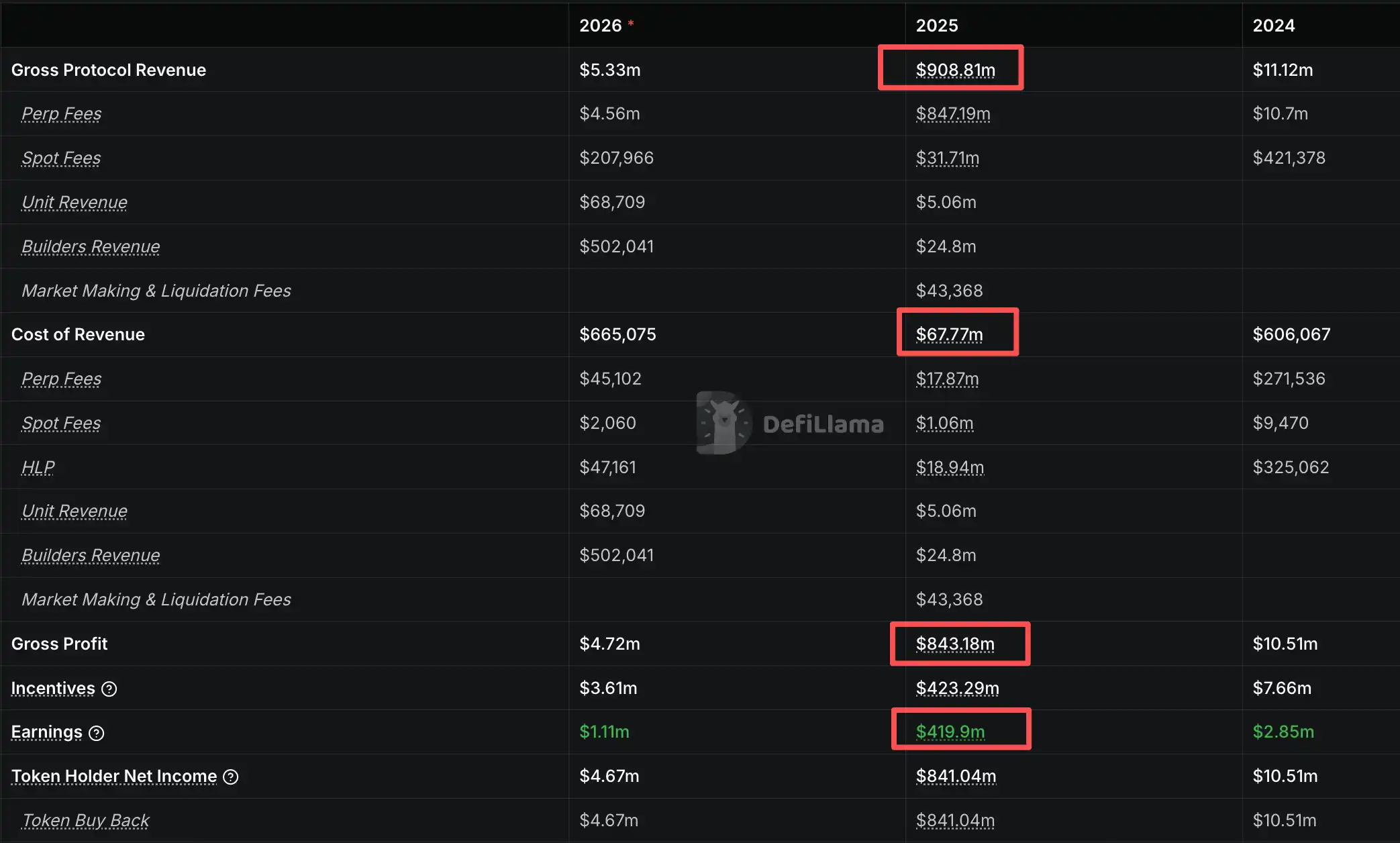
According to DefiLlama data, Hyperliquid's revenue in 2025 was $9.08 billion; revenue costs were about $67.77 million, annual net profit was about $8.43 billion, excluding incentive expenditures, and the net profit returned to the platform in 2025 was as high as about $4.2 billion.
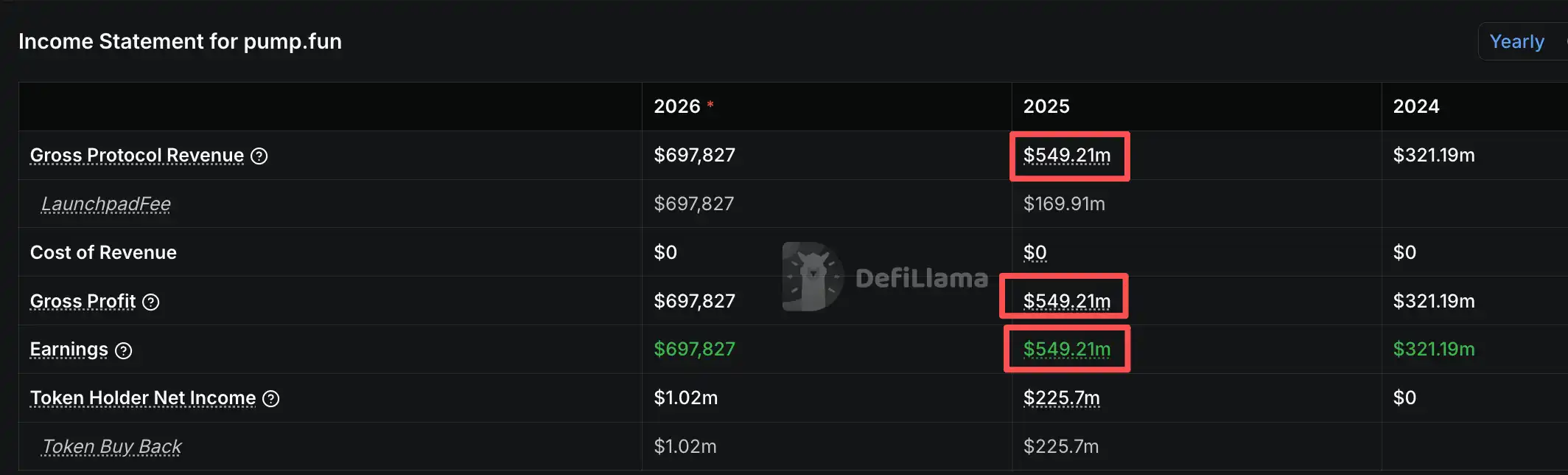
According to DefiLlama data, Pump.fun's 2025 revenue is approximately $5.5 billion. Different from on-chain perp DEX platforms like Hyperliquid, as a "one-click token issuance platform," Pump.fun does not need to spend incentive fees, so its annual net profit is approximately equal to its annual revenue, i.e., $5.49 billion.
From the above information, it can be seen that the mainstream industry's cash cow is still public chains, on-chain Perp DEX, and Launchpad token issuance platforms, second only to stablecoins (for example, Tether's net profit related to the stablecoin sector alone in 2025 is as high as $7.43 billion).
You may also like

Ray Dalio's new article: The world is entering a war cycle

IOSG: When Fintech Meets Crypto Native: The Next Decade of Digital Finance

They knew in advance that Trump would tweet about a ceasefire, entered with $20k, and exited with $400k.

The biggest bottleneck in DeFi development

CZ Memoir Released: Reveals a Large Amount of Industry Insider Information, Prompting Intense Rebuttal from Xu Mingxing

a16z: After securities are on the blockchain, why will intermediary institutions be replaced by code?

XRP Tokyo Is Here: What We Learn and What’s Next for XRP Price
Key Takeaways: Ripple’s 2025 XRP Tokyo event highlights a projected $33 trillion on-chain stablecoin volume by 2026. Significant…

Solana’s Future: Navigating the $285M Hack, Rug Pulls, and Milei Libra Scandal
Key Takeaways: Multiple Crises: Solana faces a $285 million hack, allegations of rug pulls, and the Milei Libra…

BTC USD Faces Tension: Markets React to Trump’s Dire Warning
Key Takeaways: Bitcoin’s price drops sharply below $70,000 amid geopolitical tensions, playing off Trump’s dramatic 8 PM ultimatum…
Bitcoin Price Surge: Ceasefire Sparks Optimism Hits $71K
Key Takeaways: After the US-Iran ceasefire announcement, Bitcoin surged beyond $71,000, marking its highest in a month. A…

Ethereum Price Forecast: Record $180 Billion Stablecoin Supply Marks Buyers’ Return
Key Takeaways: Ethereum’s stablecoin supply has surged to a record $180 billion, marking a 150% increase over the…

Emerging Evidence Links Argentina’s Milei to LIBRA Crypto Scandal
Key Takeaways: Evidence unveiled by Argentina’s federal prosecutors links President Javier Milei to the LIBRA token through call…

US Spot Bitcoin ETFs See Surge as BTC Nears $70K; LiquidChain and Layer-3 DeFi Rise
Key Takeaways: U.S. spot Bitcoin ETFs absorbed $471 million in a single day, moving BTC closer to the…

Bitcoin Price Prediction: Decoupling from Tech Stocks, Shaped by Geopolitics and AI Turmoil
Key Takeaways: Bitcoin is decoupling from tech stocks as geopolitical tensions and AI crises reshape the market, currently…

Chaos Labs Departure Leaves Aave Without Risk Management Amidst Governance Conflict
Key Takeaways: Aave, with a $50 billion TVL, is currently operating without a risk manager due to Chaos…
Grayscale Ethereum ETF Staking: A New Catalyst for $5,700?
Key Takeaways: Grayscale’s Ethereum Staking ETF introduces a yield-bearing structure that could significantly reshape investor sentiment. Ethereum’s price…

Polygon Crypto Enhances Finality Through the Giugliano Hardfork
Key Takeaways: Polygon’s Giugliano hardfork is operational on the mainnet, effectively reducing transaction finality by 2 seconds. The…

Senate’s Three-Week Deadline: Ripple XRP and the CLARITY Act’s Critical Moment
Key Takeaways: The Senate Banking Committee’s decision on the CLARITY Act in late April could define XRP’s future…


 App
App