
 Buy Crypto
- Markets
 Futures
- Spot
- Copy Trade
- Earn
- More
Quick Look at the Top 10 Winning Projects from the ETHGlobal Buenos Aires Hackathon

Original Title: The ETHGlobal Buenos Aires 2025 winners are here
Original Source: ETHGlobal
Original Translation: Felix, PANews
The ETHGlobal Buenos Aires hackathon event concluded on November 23. This hackathon brought together top talents and experts from the Ethereum ecosystem, attracting many developer teams to explore new blockchain technology applications. The event had a prize pool of $500,000.
After the judging process, ten projects stood out among the 475 projects submitted, covering areas such as NFTs, DeFi, and prediction markets. PANews takes you through a quick look at these 10 projects.
Paybot
Paybot showcased the X402 Payment Required protocol based on blockchain micro-payments, used to control access to physical devices. The system was specifically developed for the Coinbase Developer Platform hackathon, demonstrating fee-less transactions where users can pay the robot rental fee using the QUSD stablecoin without holding ETH to pay gas fees.
The system implemented a complete payment service architecture: users sign a QUSD payment authorization in their wallets, and the service provider submits the transaction to the chain and pays the gas fee. This project enables IoT and robot applications to truly achieve micro-payments, which would otherwise be unaffordable due to high gas fees.
The project was built by @sprpstsn.
JetLagged
JetLagged is a decentralized prediction market platform built on Celo and Oasis, where users can predict flight delays and cancellations. This platform is built using Next.js, Bun.js, and Solidity, and is deployed on the Celo blockchain.
• Real-time Flight Market: Predict real flights with real-time odds.
• Real-time Pricing: Based on an AMM pricing mechanism that automatically updates based on market demand.
• Decentralized Resolution: Automatically validate flight status through the Oasis backend oracle.
• Farcaster Integration: Support for the Farcaster Frame widget.
• Celo Blockchain: Conduct fast, low-cost transactions on the Celo network.
This project is built by Faezeh, TheMonkeyCoder, zkfriendly.eth.
Hubble Trading Arena
The Hubble Trading Arena is a fully open-source autonomous trading environment, where on-chain agents engage in hiring, payment, and coordination using the x402 and ERC-8004 protocols, and run real-time reasoning and actual transactions. It demonstrates the complete on-chain collaborative loop required for thousands of professional financial agents to work together without human intervention.
This project is built by Amy@MeetHubble.
Payload Exchange
The Payload Exchange allows merchants to accept any form of payment through x402 agents, where senders can choose tokens, and receivers seamlessly receive stable assets.
The Payload Exchange operates as an intermediary layer intercepting x402 payment requests and introducing a third party - the Sponsor. This enhances the end-user payment experience, allowing users to choose payment methods beyond stablecoins or other currencies. Sponsors pay part or all of the amount in exchange for user actions or data.
The tripartite collaboration model benefits all participants:
• Sponsor: Acquire users, gather data, or drive specific behaviors by paying for content access fees.
• Content Provider: Lower the access barrier. Monetize content without setting up paywalls.
• User: Obtain premium content/tools for free or at a discounted price through transactional actions/data instead of money.
This project is built by qap, luis, Marcelo, Soko.
Yoga
The Yoga project has implemented a Non-Fungible (NF) Position Manager that allows LPs to manage complex multi-range positions within a single NFT. Unlike traditional position managers where each NFT represents only one price range, Yoga can manage multiple sub-positions (different price ranges) under a single ERC721 token, enabling sophisticated liquidity allocation strategies across price ranges.
The contract provides a simple Application Binary Interface (ABI) that allows LPs to easily specify the changes they want to apply (liquidity increments), and the contract automatically calculates how to adjust the underlying UniV4 position.
The project is built by Charlie Mack, Duncan Townsend, Luigi, Michael Fautch.
LensMint Web3 Camera
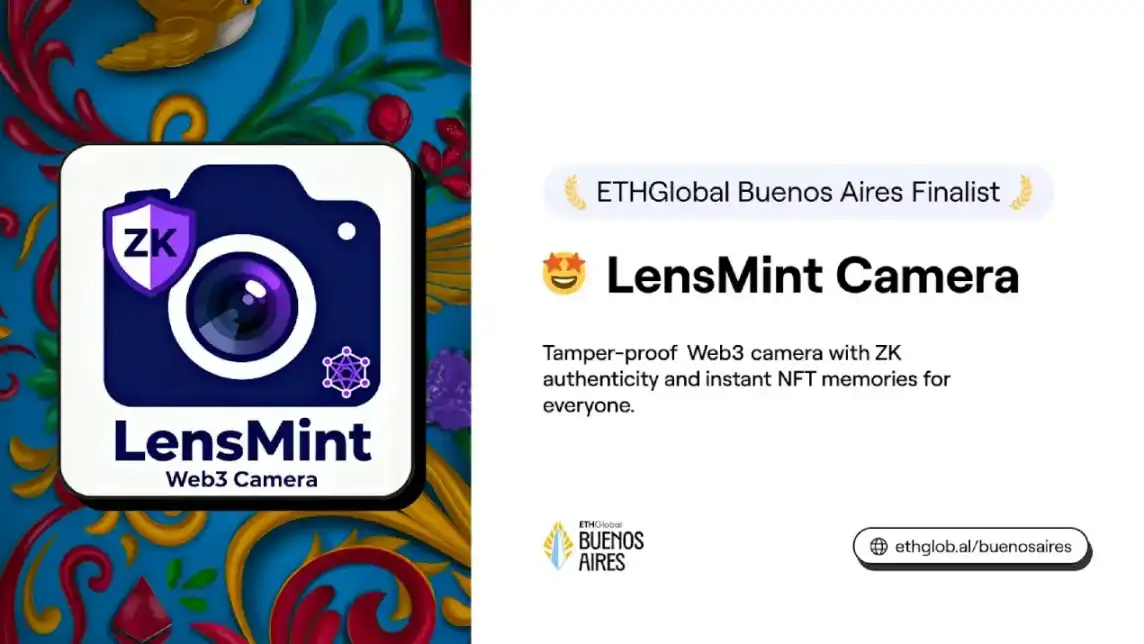
The LensMint Web3 Camera is a hardware-based system that signs photos upon capture, generating on-chain NFTs with zero-knowledge proofs to achieve tamper-proof, authenticated memories.
LensMint is a complete hardware-to-blockchain camera system designed to ensure the authenticity and ownership of real-world photos. The system is based on a Raspberry Pi camera, utilizing hardware-level encryption identity. Each photo is signed, hashed upon capture, validated for authenticity through a zero-knowledge proof generated by vlayer, and verified on-chain through RISC Zero. All media is uploaded to Filecoin for permanent decentralized storage and mints an ERC-1155 NFT representing the authenticated memory. A built-in QR code system allows individuals in the photos to immediately claim their NFT, enabling proof of attendance, authenticated memories, and automatic revenue sharing.
LensMint offers a trustless way to prove the device origin, timestamp, and integrity of the photos, addressing authenticity, sourcing, and monetization concerns for creators, journalists, event organizers, and scientific literature.
The project is built by Mohit Bhat.
Halo
Halo is a mini-app based on World Chain that converts real-world shopping receipts into on-chain rewards distributed to verified users. Users scan any store's receipt, Halo evaluates it through a lightweight process, and then rewards it to users verified through World ID. Throughout the entire process, the user's personal identity remains private.
A shopping receipt contains important information about real-world economic transactions, but this information is often lost or locked in closed systems. Halo captures this information, processing each receipt to extract details such as the merchant, timestamp, total amount, currency, and category. Rewards can only be claimed by specific users, creating a witch attack-resistant, privacy-preserving way to link offline behavior to on-chain rewards.
This project is built by hellocrypto, @DNC_Labs.
zkx402 (ProofofLeak)
zkx402 is an extension of the x402 protocol that integrates zero-knowledge proofs to verify mutable payments and verifiable content.
Consumers (human or AI agents) have different pricing tiers, with users able to use zero-knowledge credentials to verify identity receiving discounts. Producers can prove the source of their content by attaching zero-knowledge proofs. For example, identity confirmation by a specific journalist, human-authored proof, or IoT data with GPS/sensor details.
Whistleblowers can receive rewards without revealing their identity. Journalists can lower access costs by proving their human status or affiliation with reputable media outlets. AI agents controlled by journalists access private sensitive data through x402 autonomous payments on Base.
This project is built by Guilherme, Lam, Ra's Al Ghul, Mark Ballew, vaughn.
Aqua0
Aqua0 is a cross-chain shared liquidity DApp that enables seamless asset transfers using Aqua AMM and LayerZero messaging.
Aqua is a shared liquidity layer developed by 1inch to address the inefficiencies present in current AMMs. These issues include: 1) 90% of AMM liquidity is never used, leading to liquidity stagnation. 2) This results in liquidity fragmentation as AMMs end up with idle and unused liquidity across LPs in different protocols and chains.
Aqua0 enhances Aqua in a cross-chain manner. The current issue with Aqua is that it acts as a settlement layer, usable on only one chain at a time. Aqua0 will establish a cross-chain AMM market, leveraging Layer Zero's cross-chain components and Aqua's shared liquidity contracts to enable LPs to unlock new yield opportunities, thus improving capital efficiency.
This project is built by Yudhishthra Sugumaran, Andrei De Stefani, and @tomasmazzi.
BMCP
BMCP (Bitcoin Multi-Chain Protocol) enables true cross-chain programmability connecting Bitcoin and EVM chains. Users can use native Schnorr signatures (Taproot/BIP340) to sign Bitcoin transactions to trigger EVM transactions (DeFi swaps, token transfers, contract calls).
The Cross-Chain Relay Engine (CRE) scans Bitcoin blocks and upon detecting a valid Schnorr-authenticated BMCP message embedded in OP_RETURN, executes off-chain (risk management, validation) and on-chain (contract invocation) secure calls on chains like Polygon, Ethereum, seamlessly leveraging Chainlink's CCIP. BMCP ensures all processes remain trust-minimized, anchored to Bitcoin's finality through cryptographic techniques, and are composable across different ecosystems.
This project is built by Vibhav Sharma, Vollantre, James Scaur, and Manuel.
You may also like

Found a "meme coin" that skyrocketed in just a few days. Any tips?

TAO is Elon Musk, who invested in OpenAI, and Subnet is Sam Altman

The era of "mass coin distribution" on public chains comes to an end

Soaring 50 times, with an FDV exceeding 10 billion USD, why RaveDAO?

1 billion DOTs were minted out of thin air, but the hacker only made 230,000 dollars

After the blockade of the Strait of Hormuz, when will the war end?

Before using Musk's "Western WeChat" X Chat, you need to understand these three questions
The X Chat will be available for download on the App Store this Friday. The media has already covered the feature list, including self-destructing messages, screenshot prevention, 481-person group chats, Grok integration, and registration without a phone number, positioning it as the "Western WeChat." However, there are three questions that have hardly been addressed in any reports.
There is a sentence on X's official help page that is still hanging there: "If malicious insiders or X itself cause encrypted conversations to be exposed through legal processes, both the sender and receiver will be completely unaware."
No. The difference lies in where the keys are stored.
In Signal's end-to-end encryption, the keys never leave your device. X, the court, or any external party does not hold your keys. Signal's servers have nothing to decrypt your messages; even if they were subpoenaed, they could only provide registration timestamps and last connection times, as evidenced by past subpoena records.
X Chat uses the Juicebox protocol. This solution divides the key into three parts, each stored on three servers operated by X. When recovering the key with a PIN code, the system retrieves these three shards from X's servers and recombines them. No matter how complex the PIN code is, X is the actual custodian of the key, not the user.
This is the technical background of the "help page sentence": because the key is on X's servers, X has the ability to respond to legal processes without the user's knowledge. Signal does not have this capability, not because of policy, but because it simply does not have the key.
The following illustration compares the security mechanisms of Signal, WhatsApp, Telegram, and X Chat along six dimensions. X Chat is the only one of the four where the platform holds the key and the only one without Forward Secrecy.
The significance of Forward Secrecy is that even if a key is compromised at a certain point in time, historical messages cannot be decrypted because each message has a unique key. Signal's Double Ratchet protocol automatically updates the key after each message, a mechanism lacking in X Chat.
After analyzing the X Chat architecture in June 2025, Johns Hopkins University cryptology professor Matthew Green commented, "If we judge XChat as an end-to-end encryption scheme, this seems like a pretty game-over type of vulnerability." He later added, "I would not trust this any more than I trust current unencrypted DMs."
From a September 2025 TechCrunch report to being live in April 2026, this architecture saw no changes.
In a February 9, 2026 tweet, Musk pledged to undergo rigorous security tests of X Chat before its launch on X Chat and to open source all the code.
As of the April 17 launch date, no independent third-party audit has been completed, there is no official code repository on GitHub, the App Store's privacy label reveals X Chat collects five or more categories of data including location, contact info, and search history, directly contradicting the marketing claim of "No Ads, No Trackers."
Not continuous monitoring, but a clear access point.
For every message on X Chat, users can long-press and select "Ask Grok." When this button is clicked, the message is delivered to Grok in plaintext, transitioning from encrypted to unencrypted at this stage.
This design is not a vulnerability but a feature. However, X Chat's privacy policy does not state whether this plaintext data will be used for Grok's model training or if Grok will store this conversation content. By actively clicking "Ask Grok," users are voluntarily removing the encryption protection of that message.
There is also a structural issue: How quickly will this button shift from an "optional feature" to a "default habit"? The higher the quality of Grok's replies, the more frequently users will rely on it, leading to an increase in the proportion of messages flowing out of encryption protection. The actual encryption strength of X Chat, in the long run, depends not only on the design of the Juicebox protocol but also on the frequency of user clicks on "Ask Grok."
X Chat's initial release only supports iOS, with the Android version simply stating "coming soon" without a timeline.
In the global smartphone market, Android holds about 73%, while iOS holds about 27% (IDC/Statista, 2025). Of WhatsApp's 3.14 billion monthly active users, 73% are on Android (according to Demand Sage). In India, WhatsApp covers 854 million users, with over 95% Android penetration. In Brazil, there are 148 million users, with 81% on Android, and in Indonesia, there are 112 million users, with 87% on Android.
WhatsApp's dominance in the global communication market is built on Android. Signal, with a monthly active user base of around 85 million, also relies mainly on privacy-conscious users in Android-dominant countries.
X Chat circumvented this battlefield, with two possible interpretations. One is technical debt; X Chat is built with Rust, and achieving cross-platform support is not easy, so prioritizing iOS may be an engineering constraint. The other is a strategic choice; with iOS holding a market share of nearly 55% in the U.S., X's core user base being in the U.S., prioritizing iOS means focusing on their core user base rather than engaging in direct competition with Android-dominated emerging markets and WhatsApp.
These two interpretations are not mutually exclusive, leading to the same result: X Chat's debut saw it willingly forfeit 73% of the global smartphone user base.
This matter has been described by some: X Chat, along with X Money and Grok, forms a trifecta creating a closed-loop data system parallel to the existing infrastructure, similar in concept to the WeChat ecosystem. This assessment is not new, but with X Chat's launch, it's worth revisiting the schematic.
X Chat generates communication metadata, including information on who is talking to whom, for how long, and how frequently. This data flows into X's identity system. Part of the message content goes through the Ask Grok feature and enters Grok's processing chain. Financial transactions are handled by X Money: external public testing was completed in March, opening to the public in April, enabling fiat peer-to-peer transfers via Visa Direct. A senior Fireblocks executive confirmed plans for cryptocurrency payments to go live by the end of the year, holding money transmitter licenses in over 40 U.S. states currently.
Every WeChat feature operates within China's regulatory framework. Musk's system operates within Western regulatory frameworks, but he also serves as the head of the Department of Government Efficiency (DOGE). This is not a WeChat replica; it is a reenactment of the same logic under different political conditions.
The difference is that WeChat has never explicitly claimed to be "end-to-end encrypted" on its main interface, whereas X Chat does. "End-to-end encryption" in user perception means that no one, not even the platform, can see your messages. X Chat's architectural design does not meet this user expectation, but it uses this term.
X Chat consolidates the three data lines of "who this person is, who they are talking to, and where their money comes from and goes to" in one company's hands.
The help page sentence has never been just technical instructions.
Parse Noise's newly launched Beta version, how to "on-chain" this heat?

Is Lobster a Thing of the Past? Unpacking the Hermes Agent Tools that Supercharge Your Throughput to 100x

Declare War on AI? The Doomsday Narrative Behind Ultraman's Residence in Flames
Crypto VCs Are Dead? The Market Extinction Cycle Has Begun
Claude's Journey to Foolishness in Diagrams: The Cost of Thriftiness, or How API Bill Increased 100-Fold

Edge Land Regress: A Rehash Around Maritime Power, Energy, and the Dollar
Arthur Hayes Latest Interview: How Should Retail Investors Navigate the Iran Conflict?
Just now, Sam Altman was attacked again, this time by gunfire

Straits Blockade, Stablecoin Recap | Rewire News Morning Edition
From High Expectations to Controversial Turnaround, Genius Airdrop Triggers Community Backlash


 App
App