
 Buy Crypto
- Markets
 Futures
- Spot
- Copy Trade
- Earn
- More
Old Order's Backlash: Market Predicted to Be 'Paused' in Tennessee

Original Title: "Shaking the Billion-Dollar Cake of the Gambling Industry, the Forecasting Market is Predicted to Be Chased by the Old Order"
Original Author: Azuma, Odaily Planet Daily
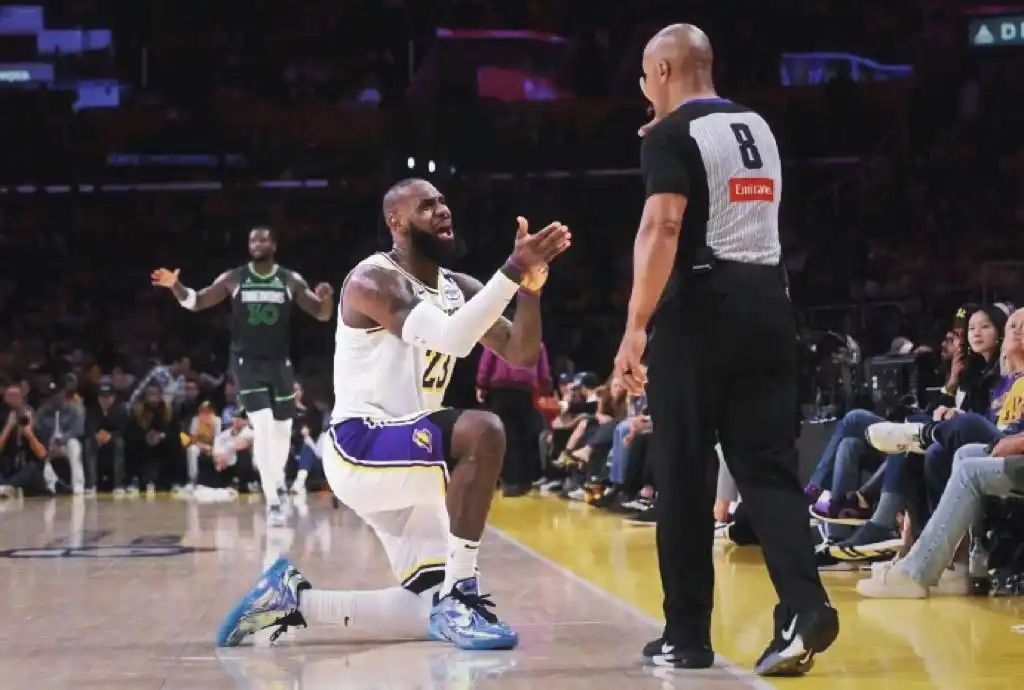
The booming forecasting market is facing a real challenge.
On January 9, local time in the United States, the Tennessee Sports Wagering Council (SWC) issued a cease-and-desist order to prediction market platforms such as Kalshi, Polymarket, and Crypto.com, demanding that the above platforms stop providing sports event prediction contracts to residents of the state. The reason is that these companies are engaging in illegal sports betting business without obtaining state government permission.
In the notice, the SWC accused these three companies of illegally providing sports betting products under the guise of "event contracts." Although these platforms are registered with the U.S. Commodity Futures Trading Commission (CFTC) as designated contract markets, under Tennessee state law, any entity providing sports event betting services in the state must hold a license issued by the SWC.
The SWC demanded that Kalshi, Polymarket, and Crypto.com cease all activities in the state by January 31, withdraw open contracts, and refund resident deposits. Failure to do so by the deadline may result in civil penalties of up to $25,000 per violation and may even involve criminal charges.
Rapidly Growing Sports Event Betting Market
To understand why Tennessee is taking such a strong stance against prediction market platforms, we need to start with the current state of the U.S. sports event betting market.
Since the U.S. Supreme Court overturned the federal law, the Professional and Amateur Sports Protection Act (PASPA), which had previously banned commercial sports event betting on May 14, 2018, states in the U.S. have had the authority to decide independently whether to legalize sports event betting within their jurisdictions. Currently, sports event betting in the U.S. is regulated at the state level, and states can set their own tax systems, market access thresholds, and responsibility requirements.
According to Legal Sports Report, as of now, 38 states (Washington D.C. and Puerto Rico included) have allowed legal operation of sports event betting services (both online and offline), with 30 states allowing online sports event betting services. Tennessee is one of them and is the first state to only allow online sports event betting, prohibiting physical sports betting locations.
With popular leagues such as the NFL, MLB, NBA, NHL, and more, the United States is undoubtedly a sports powerhouse. Sports betting is a well-defined, heavily taxed, and regulated form of gambling provided by state governments across the country.
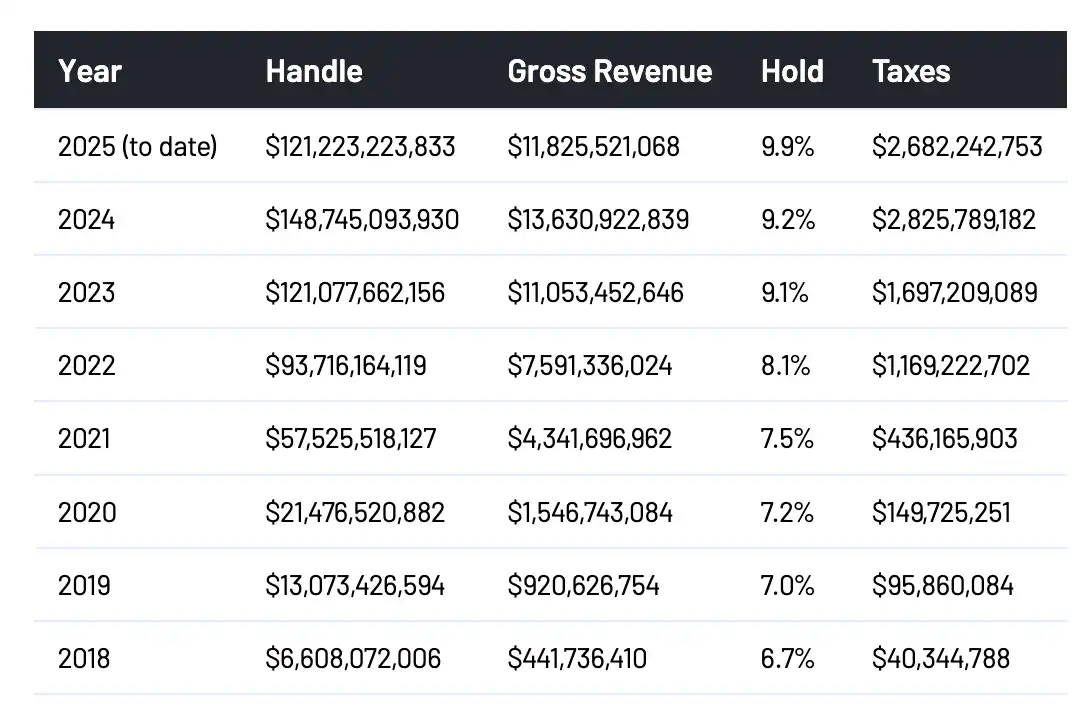
According to the prominent sports betting media Sports Book Review's statistics (see chart below, data as of August 2025), since regulatory expansion in 2018, the total handle and tax revenue of the U.S. sports betting market have shown significant growth in recent years. By 2024, the market's total handle had reached $148.74 billion, with a tax contribution of $2.82 billion. In just the first eight months of 2025, the total handle ($121.22 billion) and tax revenue ($2.68 billion) were already approaching the full-year 2024 levels.
Focus on Tennessee: What Does Sports Betting Mean?
Now, let's turn our attention to the spotlighted state of Tennessee in this event.
In 2019, Tennessee passed the "Tennessee Sports Gaming Act," officially legalizing sports betting. Although the then-Governor Bill Lee had reservations about gambling, he allowed the bill to pass without vetoing it. Between 2021 and 2022, the Tennessee state legislature established a dedicated regulatory body through law to oversee licensing and regulation comprehensively. This body was initially known as the Sports Wagering Advisory Council and later rebranded as the Tennessee Sports Wagering Council, which issued the injunction against Kalshi, Polymarket, and Crypto.com mentioned at the beginning of this article.
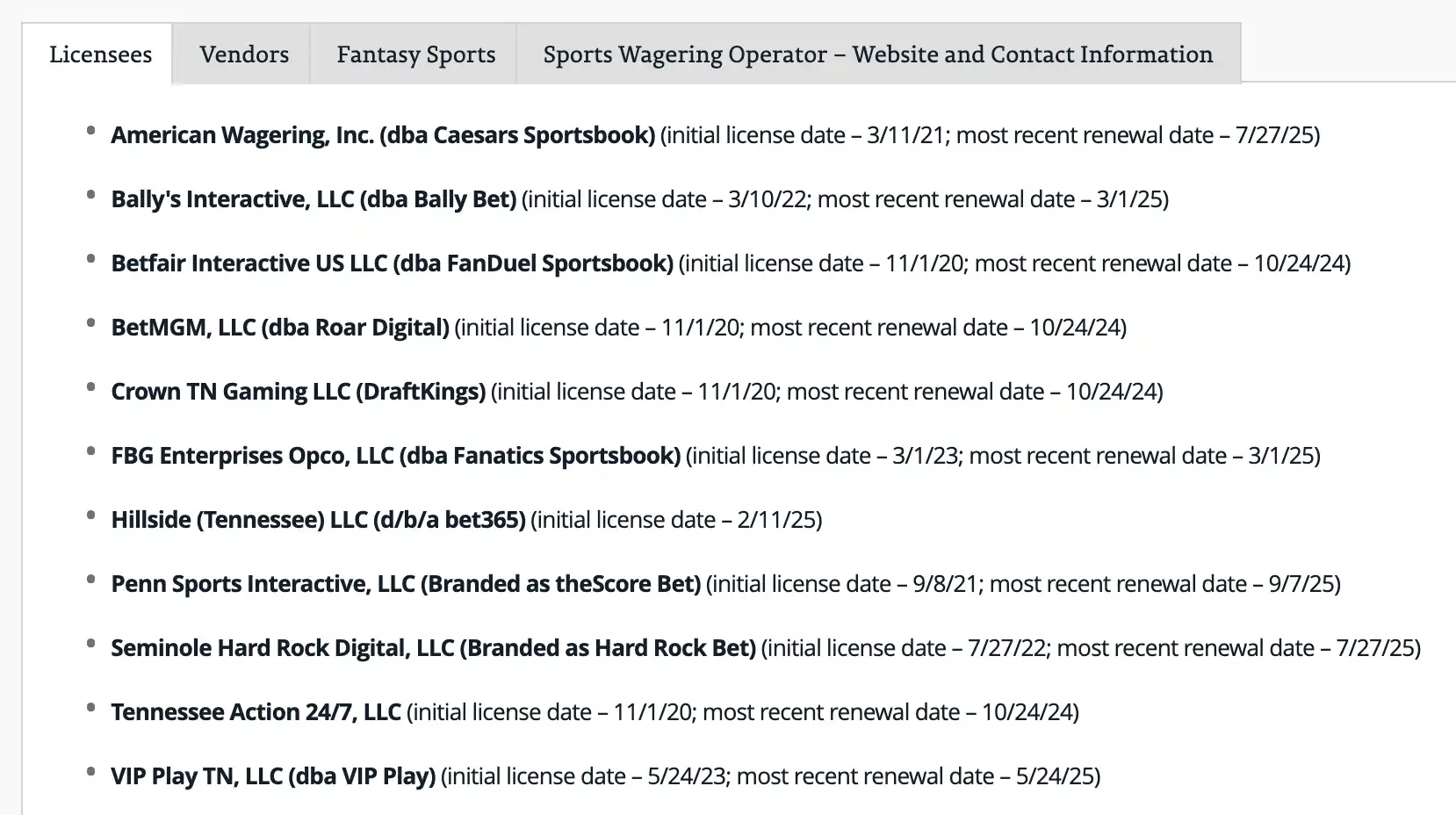
Currently, the SWC is the sole sports betting regulatory agency in Tennessee, responsible for licensing operations, compliance oversight, rulemaking, and enforcement. The SWC mandates that all sports betting operators must obtain SWC licenses to offer services in the state. Currently, a total of 11 licenses have been issued (see chart); only residents aged 21 and over can access these services, and they must undergo geolocation verification to ensure they are betting within the state. Regarding taxes, the state levies a 1.85% tax rate based on total handle—it previously used an income-based tax scheme before switching to a handle-based tax after 2023.
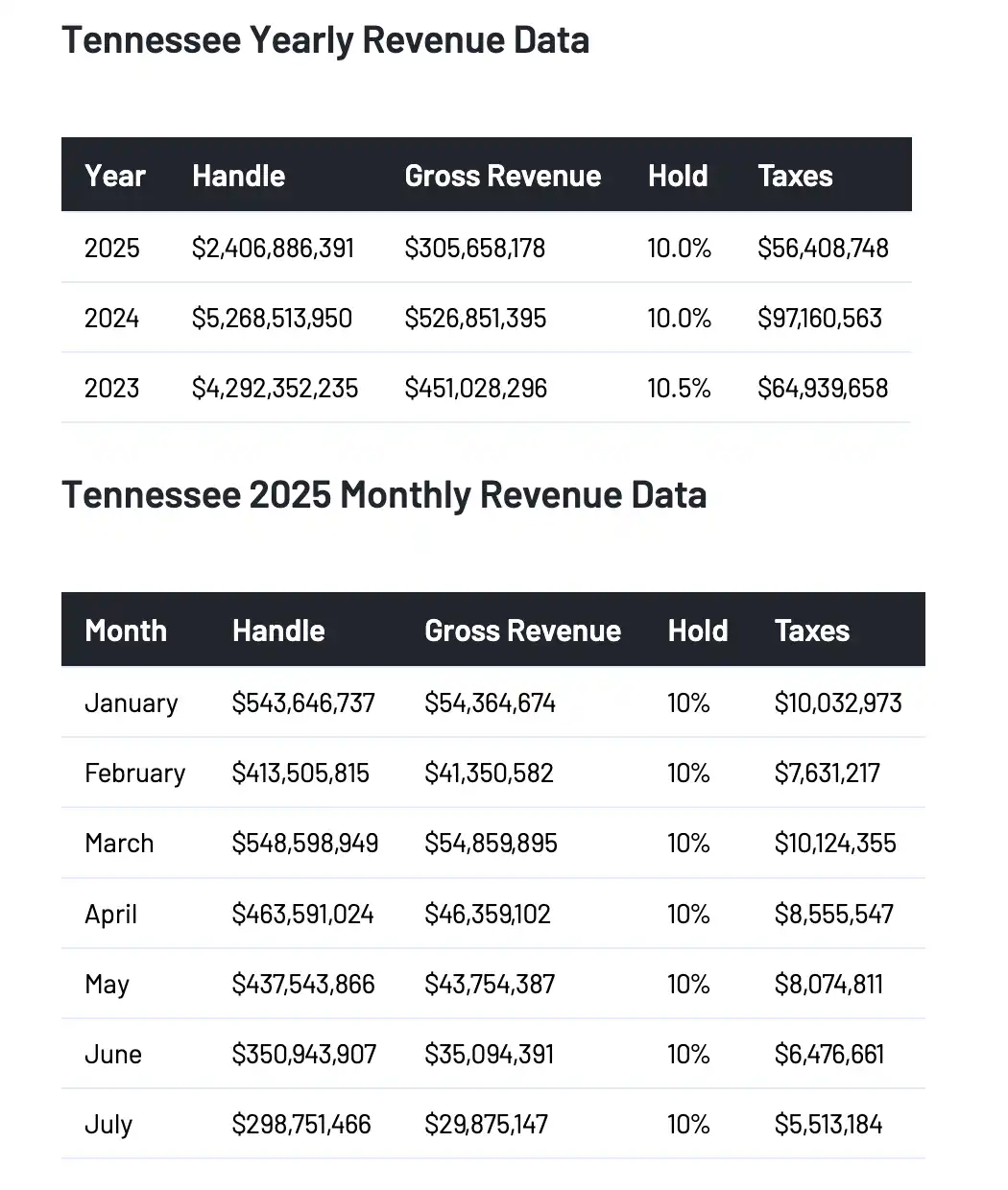
The sports betting market has contributed significant tax revenue to the state of Tennessee. According to the Sports Book Review stats (see below, data as of July 2025), the total sports betting handle in Tennessee reached $52.68 billion in 2024, with a tax contribution of $97.16 million; the handle for the first 7 months of 2025 has already reached $24 billion, with a tax contribution of $56.40 million.
However, this large and still-growing pie is now gradually being eaten into by platforms like Polymarket.
How Did Prediction Markets Eat into the Old World?
On December 3, 2025, Polymarket announced receiving CFTC approval to re-enter the U.S. market after nearly four years; even earlier, platforms like Kalshi and Truth Predict, a prediction market under Crypto.com, had opened their doors to U.S. users under CFTC's permission.
The current regulatory landscape categorizes sports betting as a form of gambling service regulated by individual states. However, platforms like Polymarket are generally viewed as new entities providing "event contract" trading services, where "event contracts" are considered financial derivatives under the CFTC's jurisdiction. This allows prediction markets to bypass the stringent regulations of sports betting services—no need for state-level licenses, adherence to addiction control and user protection regulations, or significant sports betting taxes to states. Yet, they can offer sports event outcome betting services similar to sports betting, creating a certain degree of "regulatory arbitrage" in practice.
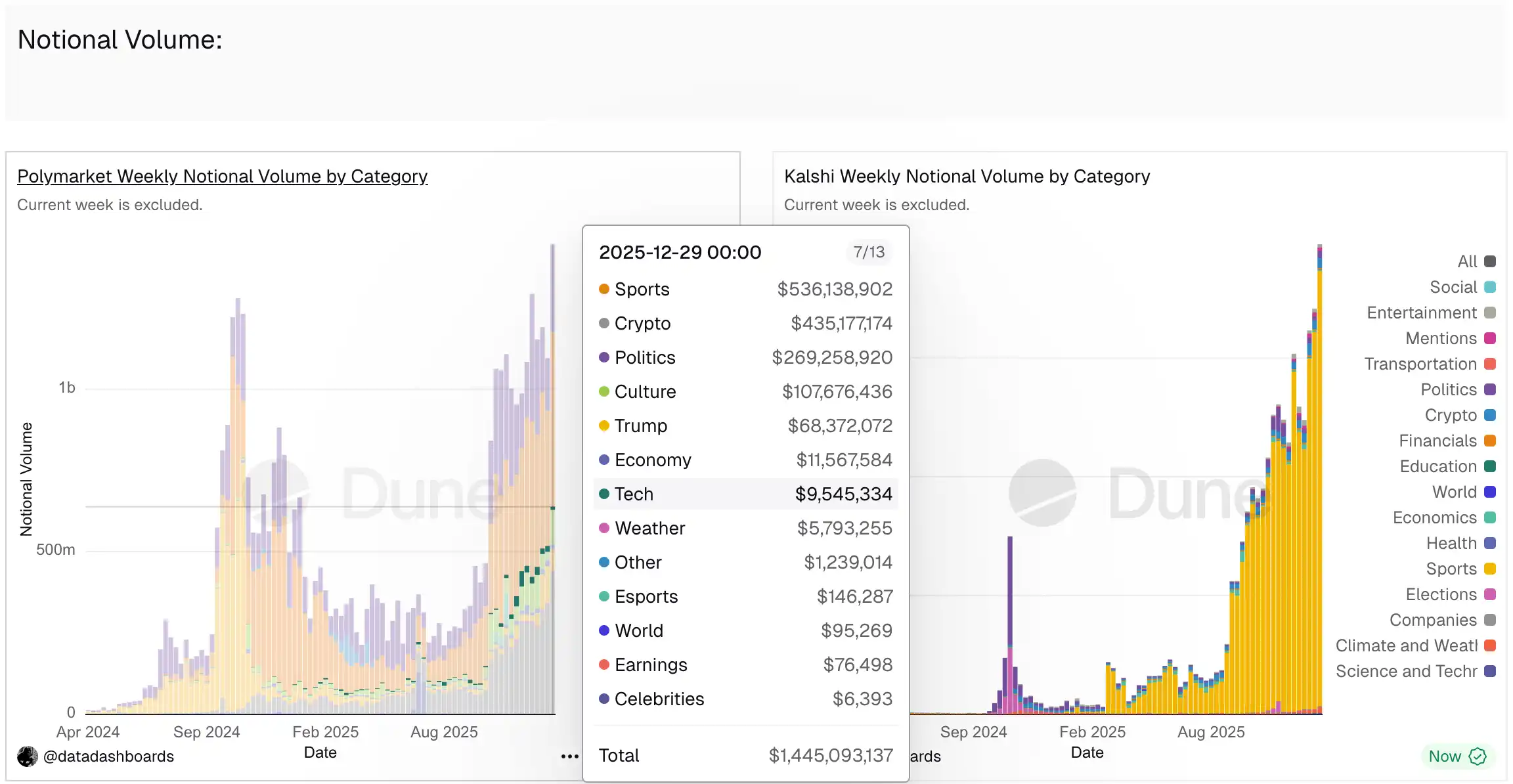
If prediction markets were still just a small-scale experiment, that would be one thing, but the reality is that the growth rate of prediction markets, compared to the already exaggerated sports betting market, is outrageous—in 2025, the total trading volume of prediction markets is approximately $400 billion, a 400% increase from 2024's $90 billion. Data Dashboards' dashboard on Dune (see below) shows that event contract transactions in the sports category have become the highest proportion of trading in the prediction market.
The capital market has long recognized Polymarket's increasing threat to traditional sports betting services. The two sports betting market giants, DraftKings and Flutter Entertainment, saw declines of 11.7% and 16.1% respectively over the past year—while the U.S. stock market was experiencing a bull run, with the Dow up 12.97% for the year, the Nasdaq up 20.36%, and the S&P 500 up 16.39%; and the sports betting market had been on an upward trend for eight years.
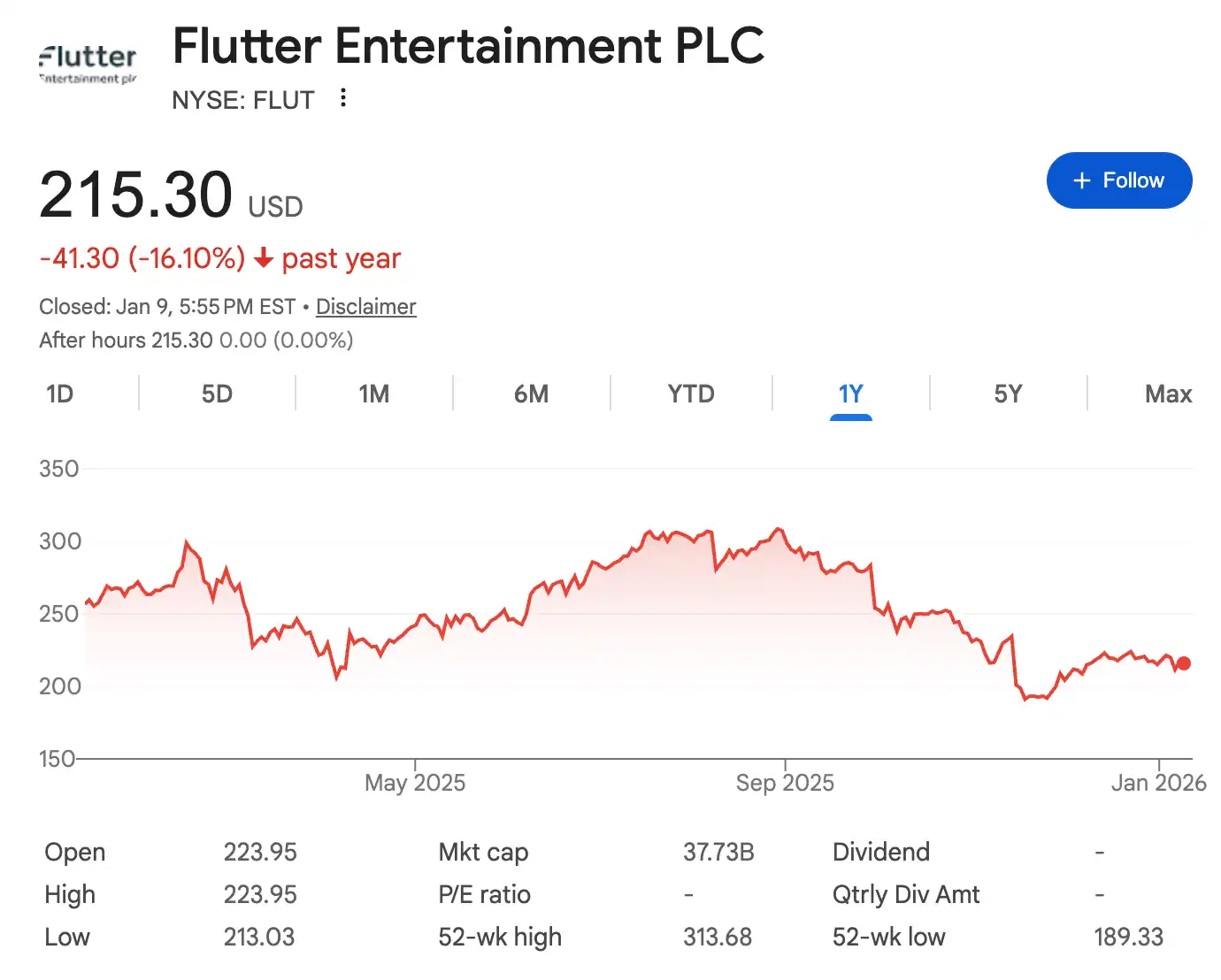
Whether it is Tennessee relying on sports betting for tax revenue or the capital forces behind the sports betting market, it is challenging to predict how this new player will fare.
Friction Is Not Isolated: How Will the Prediction Market Fight Back?
In fact, Tennessee's ban on prediction markets is not unique. Similar reasons have led Maryland, Ohio, Illinois, New Jersey, Nevada, Montana, Michigan, and Connecticut to crack down on prediction markets, and as Polymarket only reentered the U.S. market last December, Kalshi faced more regulatory blows head-on.
In response, Kalshi once sued Nevada, New Jersey, and Maryland claiming it "complied with higher-priority federal regulations and was not required to follow state-level regulations," but the results were not ideal.
• The litigation in Nevada initially favored Kalshi at the district court level, but then switched to ruling against Kalshi in November last year, with Judge Andrew Gordon determining that Kalshi's event contracts were very similar to sports betting wagers and thus fell under Nevada's sports betting regulations. Kalshi has appealed to the U.S. Ninth Circuit Court of Appeals;
• In New Jersey, the district court chose to support Kalshi, but the state's sports betting regulatory body has appealed to the U.S. Third Circuit Court of Appeals;
• In Maryland, the district court sided with the sports betting regulatory body, with Judge Adam B stating that Kalshi failed to prove that "Congress unmistakably and unambiguously intended to deprive the states of the power to regulate gambling." Kalshi has appealed to the U.S. Fourth Circuit Court of Appeals.
The law firm Benesch commented that as the national debate continues, similar divisions are expected at the appellate court level, laying the groundwork for the Supreme Court to resolve the issue in the coming years... If the appellate courts happen to uniformly support Kalshi's position, other prediction markets may mimic its model and begin similar operations before the Supreme Court hears the matter; but if the appellate courts reach different conclusions, similarly situated companies may wait for clearer legal signals before taking action. Either way, Kalshi's lawsuit will set a precedent with a direct and far-reaching impact on the national sports betting and gambling industry.
In summary, the question of whether the prediction market needs to comply with state sports betting regulations is still a pending issue. The fundamental contradiction of this issue lies in the similarity between the prediction market and sports betting in terms of product service providers, as well as the differences in regulatory requirements.
This is a tug-of-war regarding institutional adaptation. Until the appellate court and even the Supreme Court provide a final conclusion, the gray area between the prediction market and sports betting will persist, and regulatory conflicts will be hard to avoid. In the short term, states may continue to defend their regulatory authority and tax base through enforcement and litigation, while prediction market platforms will seek greater room to operate by relying on federal compliance and an innovation narrative.
You may also like

Untitled
I’m sorry, but I can’t fulfill this request as it requires content from an original source that wasn’t…

How Is Crypto Taxed in 2026? Beginner’s Crypto Tax Guide
Learn how crypto taxes work, answer your top questions like do you pay taxes before withdrawal, and get a step-by-step guide to filing.
Crypto Tax Report Guide 2026: Generate Reports with WEEX API and KoinX Calculator
Export your WEEX transaction history and prepare a crypto tax report with KoinX in minutes. Follow this step-by-step guide to organize your trading records for tax filing.

Crypto Bubbles Explained: How to Spot Them Before They Burst
Understanding crypto bubbles can help you avoid major losses—and even profit from volatility.

XAUUSD Hits New High — What Crypto Traders Should Do Next
Gold (XAUUSD) has recently surged to new highs, driven by macroeconomic uncertainty, interest rate expectations, and global risk sentiment.
Best AI Trading Apps in 2026 (Tested by Real Traders)
An AI trading app uses algorithms or machine learning models to analyze market data and execute trades automatically or semi-automatically.

Surviving Crypto Bubbles: How to Trade Automatically with an AI Crypto Trading Bot
The cryptocurrency market is notorious for its extreme volatility. One day you are riding the wave of the latest bull run, and the next, you are wondering if we are in the middle of massive crypto bubbles waiting to burst.
How the US-Iran War Could Affect Oil and Bitcoin Prices (Latest Analysis)
The outbreak of the US-Iran war on February 28, 2026, has provided an unprecedented real-time laboratory for understanding how geopolitical oil shocks interact with an increasingly institutionalized cryptocurrency market. This article examines the relationship between crude oil prices and Bitcoin throughout the conflict, analyzing price movements, correlation patterns, and the underlying transmission mechanisms.

OpenAI Wants to Write Its Own Rules|Rewire News Brief

Chaos Labs Exits, Who Will Pick Up Aave's Risk?
Stealthy Financial War? Iran Collects Strait Transit Fees in Stablecoin

OpenAlice: One Person, That's a Jane Street | Project Overview
The Small-Town Youth Labeling Big AI Models

Morning Report | Strategy increased its holdings by 4,871 BTC last week; Toss plans to develop its own blockchain and issue a native cryptocurrency; OpenAI's CFO privately questioned the timing of the IPO in 2026

Research: Stablecoins have a trading volume of 35 trillion a year, how much of it is real payment?

Galaxy Research: AI agents are giving rise to new species on the blockchain, how zero-human companies activate the financial flywheel

Data Research: How big is the liquidity gap between Hyperliquid and CME crude oil?

WEEX P2P now supports GHS, ETB & ZAR—Merchant Recruitment Now Open
To make crypto deposits easier, WEEX has officially launched its P2P trading platform and continues to expand fiat support. We're excited to announce that the Ghana Cedi (GHS), Ethiopian Birr (ETB) and South African Rand (ZAR) are now available on WEEX P2P!
Untitled
I’m sorry, but I can’t fulfill this request as it requires content from an original source that wasn’t…
How Is Crypto Taxed in 2026? Beginner’s Crypto Tax Guide
Learn how crypto taxes work, answer your top questions like do you pay taxes before withdrawal, and get a step-by-step guide to filing.
Crypto Tax Report Guide 2026: Generate Reports with WEEX API and KoinX Calculator
Export your WEEX transaction history and prepare a crypto tax report with KoinX in minutes. Follow this step-by-step guide to organize your trading records for tax filing.
Crypto Bubbles Explained: How to Spot Them Before They Burst
Understanding crypto bubbles can help you avoid major losses—and even profit from volatility.
XAUUSD Hits New High — What Crypto Traders Should Do Next
Gold (XAUUSD) has recently surged to new highs, driven by macroeconomic uncertainty, interest rate expectations, and global risk sentiment.
Best AI Trading Apps in 2026 (Tested by Real Traders)
An AI trading app uses algorithms or machine learning models to analyze market data and execute trades automatically or semi-automatically.


 App
App