
 Buy Crypto
- Markets
 Futures
- Spot
- Copy Trade
- Earn
- More
How to Flip Real Estate in the Prediction Market

Original Title: "Birth of House Price 'Shorting Tool,' Polymarket Launches Real Estate Prediction Market"
Original Author: Asher, Odaily Planet Daily
"Everything is predictable," and the value of predictions is on the rise.
On the evening of January 5th, the on-chain real estate platform Parcl announced a partnership with the prediction market Polymarket, aiming to introduce Parcl's daily house price index into Polymarket's novel real estate prediction market. In response to this news, Parcl's platform token PRCL saw a short-term surge of over 150%, which has since retraced. The price is currently at $0.042, with a market cap of $19 million.
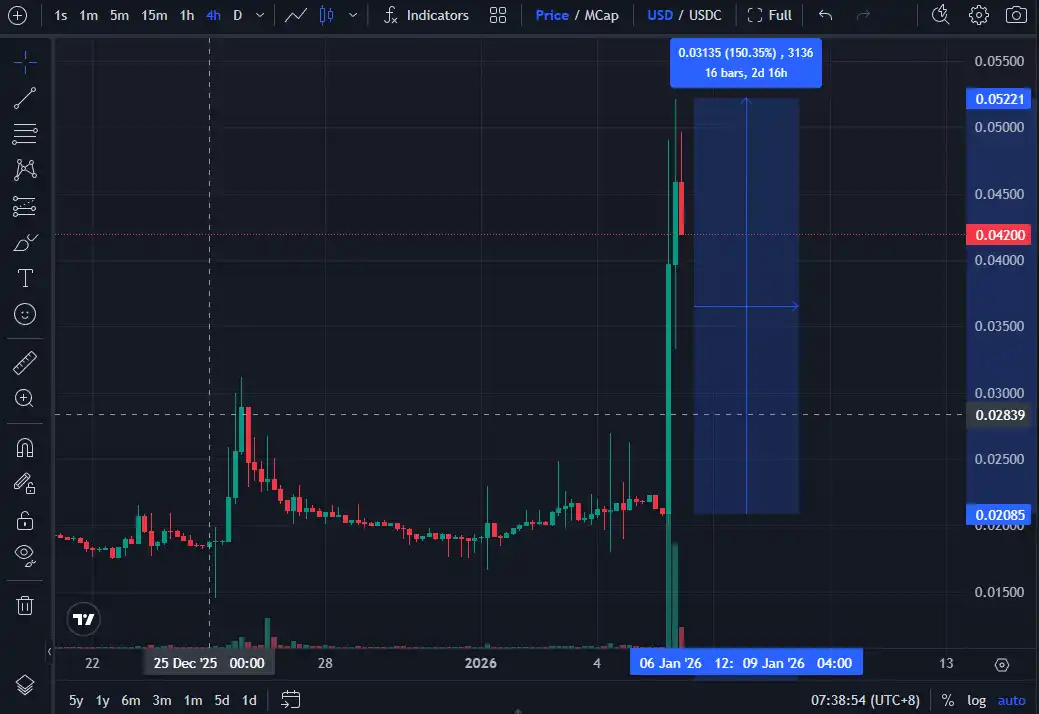
PRCL Candlestick Chart
Polymarket Real Estate Prediction Market Section Operating Rules
Partnership Details:
· Parcl provides daily housing price indices as independent, transparent reference data for market settlement;
· Polymarket is responsible for listing and operating the market, where users can trade on the Polygon chain using USDC;
· Market settlement is based on Parcl's publicly verifiable indices, avoiding the delays (usually monthly) and subjectivity of traditional real estate data.
Market Types:
· Predicting house price increases/decreases on a monthly, quarterly, or annual basis;
· Threshold markets: e.g., whether the house price will exceed a specific level; each market links to Parcl's dedicated settlement page, showing the final value, historical data, and index calculation method.
Coverage:
· Initially starting from highly liquid US cities such as New York, Miami, San Francisco, Austin, etc.;
Subsequently expanding to more cities and market types based on user demand.
Example Display:
Currently, this category has only launched 7 monthly real estate prediction events, with low liquidity, and the event with the highest trading volume, "US Los Angeles February 1st Home Median Price," is only $3700.
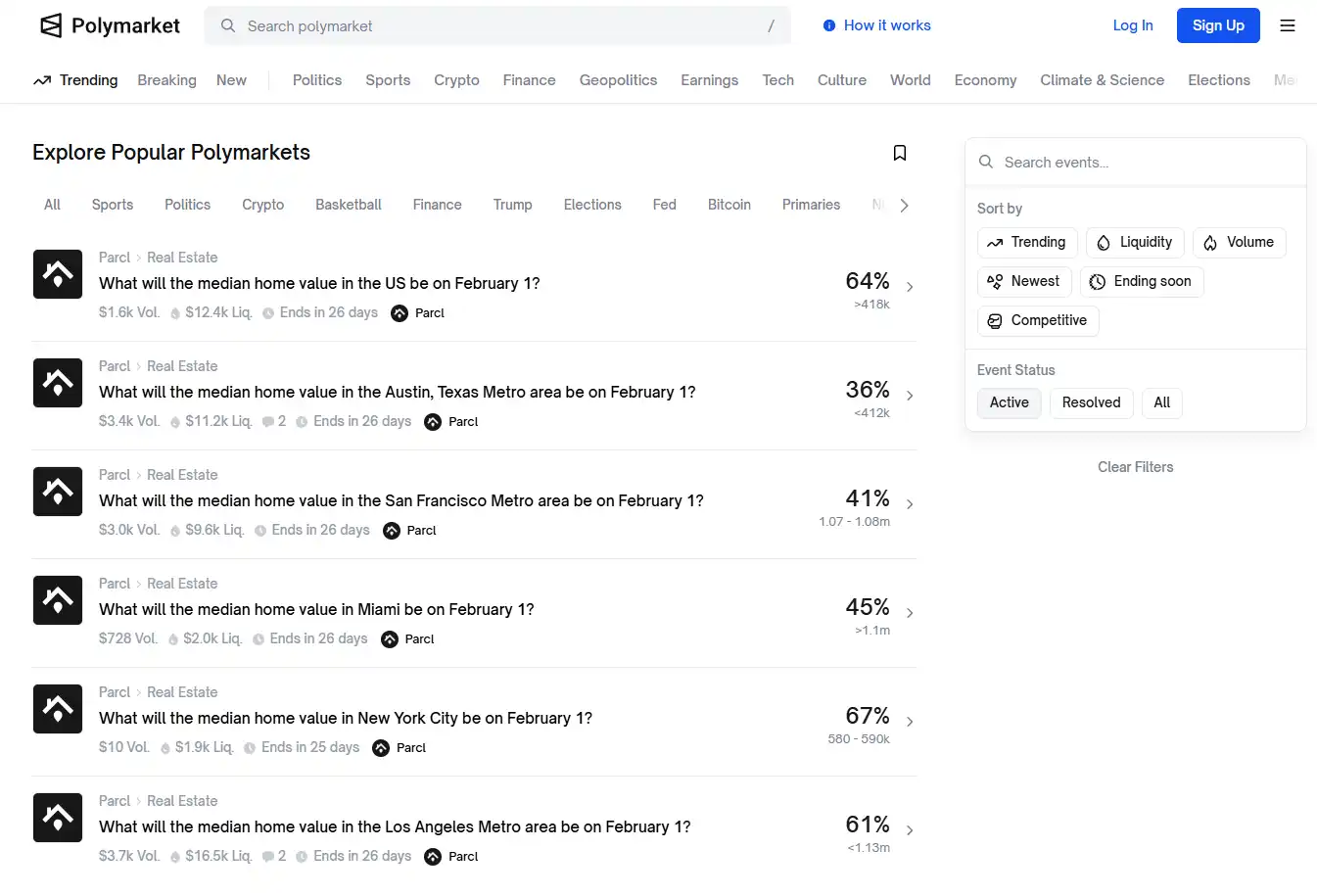
Polymarket Introduces New Real Estate Prediction Market Category
For the traditional real estate market, whether bullish or bearish, this kind of expectation is difficult to express directly, let alone form a continuous market signal. The introduction by Polymarket essentially separates the "judgment on housing prices" from asset trading, as long as there is a clear settlement standard, the expectation itself can be priced independently.
Real Estate Market Finally Sees a "Shorting Tool"
An easily overlooked fact is that the potential demand for real estate-related markets does not only come from the native speculators of the crypto world.
In the traditional financial system, "falling house prices" is almost an unhedgeable risk. Whether holding real estate, asset structures, or income sources highly dependent on a city's real estate cycle. The real-world response is often either to continue holding or to sell physical assets directly—high transaction costs, long cycles, and a lack of flexible intermediate options. As KOL 0xMarioNawfal (@RoundtableSpace) put it: "This is much more than just betting, it is bringing liquidity to one of the world's most illiquid markets. Imagine the house price is at a historical high, and you expect a crash but can't sell the house—now you can hedge, short the market."
The introduction of prediction markets abstracts the downward trend of housing prices into a tradable risk assessment. When house prices are high and market expectations begin to weaken, the trend of real estate prices can be priced independently without the need to dispose of underlying assets for risk management.
Through Polymarket, the downside risk of real estate prices has been abstracted into a tradable judgment rather than the necessity to dispose of physical assets. From this perspective, the real estate prediction market on Polymarket is more akin to a simplified macro hedging mechanism rather than a purely speculative game of ups and downs. It has not altered the liquidity structure of real estate assets themselves but has provided a real-time trading layer that reflects expectations for a long-term illiquid market.
Polymarket CMO Matthew Modabber said: "Prediction markets are most suitable for events with clear, verifiable data. Parcl's daily house price index provides us with a transparent, consistent settlement basis, and real estate should be a primary category for prediction markets."
This collaboration between Polymarket and Parcl also brings the price signal of traditional real estate into the crypto system: What was originally a low-frequency, closed, and highly exclusive asset has been broken down into a settleable, verifiable, and tradable index outcome, resembling stock indices or crypto derivatives. This may be a practical path to ground the RWA narrative in something more realistic and closer to real-world needs.
You may also like

Ceasefire Overnight Erases War Premium, Three Fault Lines Only One Sealed | Rewire News Morning Brief

Robinhood Secures 'Trump Account': Enabling Millions of Newborns to Access the Stock Market

Afraid to Open the Pandora's Box? Anthropic's Most Powerful Model Ever Dares Not Be Disclosed

Iran Ceasefire Oil Prices: Why Crude Fell in April 2026
Iran ceasefire oil prices fell sharply on April 8, 2026 as traders removed part of the war premium tied to Strait of Hormuz supply disruption.

US-Iran Ceasefire: A Temporary Pause or Prelude to Renewed Conflict? Market Outlook for Oil, Gold, and Bitcoin
April 8, 2026 – A temporary ceasefire between the U.S. and Iran has provided some immediate relief to the global markets, but the fundamental question remains: Will the cessation of hostilities hold, or is this merely a brief reprieve before a resumption of conflict? As the situation unfolds, market observers are closely monitoring how key assets like oil, gold, and Bitcoin will react in the coming weeks. This article explores whether the ceasefire is a sign of lasting peace, assesses the short-term market implications, and delves into the evolving role of Bitcoin in the global financial landscape.

WEEX Market Update: U.S.-Iran Ceasefire Sparks Bitcoin Price Surge
April 8, 2026 – In a significant shift in global geopolitics, U.S. President Donald Trump has announced a temporary two-week ceasefire with Iran, resulting in a notable market reaction across various asset classes. This development comes after discussions between Trump, Pakistani Prime Minister Shahbaz Sharif, and Army Chief General Asim Munir. The announcement is already reverberating through markets, particularly in oil, gold, and cryptocurrencies.
Morning Report | South Korean financial institutions pilot stablecoin payments for foreign users; Morgan Stanley Bitcoin ETF is about to be listed; CME plans to launch AVAX and SUI futures contracts

EigenCloud Founder: AI and Cryptocurrency are Creating the Next Trillion-Dollar Asset Class

From Panic to Pumps: How Bitcoin Traders Are Playing the 2-Week US-Iran Ceasefire
For most people, the two-week US-Iran ceasefire is about geopolitics, oil prices, and whether World War III gets postponed. But for crypto traders glued to their screens late Sunday night, it was something else entirely: the clearest risk-on signal in months.

US-Iran Ceasefire Triggers Oil Plunge, Bitcoin Surge, and Gold Rally
Despite the sharp rally, caution is warranted. The $70,000–$72,000 zone has historically been strong resistance. The ceasefire is only temporary (two weeks), and any breakdown in negotiations could trigger a sell-off toward the $62,000–$65,000 support zone. For now, Bitcoin needs to close decisively above $72,500 to confirm a true breakout; failure to do so within 48–72 hours could lead to a swift retracement.

OpenAI has no "New Deal," a blueprint for AI that refuses to pay.

Wall Street Flash Mob Run? Mega-Cap Stock Plunge, Goldman's Great Escape, Illustrated Guide to Private Credit Crisis

OpenAI Feud: Power, Trust, and the Uncontrollable Boundaries of AGI
「AI Doomsday Cult」 Sends Operatives into the Strait of Hormuz: What Did They Find?
Everyone is waiting for the war to end, but is the oil price signaling a prolonged conflict?
Data Analysis: How Wide is the Liquidity Gap Between Hyperliquid and CME Crude Oil?
After a 40% Reduction in Staff, Twitter's Founder to Give Away $1 Million in Bitcoin

Trade.xyz: Pricing the World? On-Chain Markets Are Becoming the Market
Ceasefire Overnight Erases War Premium, Three Fault Lines Only One Sealed | Rewire News Morning Brief
Robinhood Secures 'Trump Account': Enabling Millions of Newborns to Access the Stock Market
Afraid to Open the Pandora's Box? Anthropic's Most Powerful Model Ever Dares Not Be Disclosed
Iran Ceasefire Oil Prices: Why Crude Fell in April 2026
Iran ceasefire oil prices fell sharply on April 8, 2026 as traders removed part of the war premium tied to Strait of Hormuz supply disruption.
US-Iran Ceasefire: A Temporary Pause or Prelude to Renewed Conflict? Market Outlook for Oil, Gold, and Bitcoin
April 8, 2026 – A temporary ceasefire between the U.S. and Iran has provided some immediate relief to the global markets, but the fundamental question remains: Will the cessation of hostilities hold, or is this merely a brief reprieve before a resumption of conflict? As the situation unfolds, market observers are closely monitoring how key assets like oil, gold, and Bitcoin will react in the coming weeks. This article explores whether the ceasefire is a sign of lasting peace, assesses the short-term market implications, and delves into the evolving role of Bitcoin in the global financial landscape.
WEEX Market Update: U.S.-Iran Ceasefire Sparks Bitcoin Price Surge
April 8, 2026 – In a significant shift in global geopolitics, U.S. President Donald Trump has announced a temporary two-week ceasefire with Iran, resulting in a notable market reaction across various asset classes. This development comes after discussions between Trump, Pakistani Prime Minister Shahbaz Sharif, and Army Chief General Asim Munir. The announcement is already reverberating through markets, particularly in oil, gold, and cryptocurrencies.


 App
App