
- Buy Crypto
- Markets
 Futures
- Spot
- Copy Trade
 Earn
Earn- More
Horizontal Comparison of the Four Major AI Frameworks: A Comprehensive Analysis of Adoption Status, Strengths and Weaknesses, and Growth Potential

Original Article Title: A Deep Dive into Frameworks: A Sector we think Could Grow to $20b+
Original Source: Deep Value Memetics
Original Article Translation: Azuma, Odaily Planet Daily
Key Points Overview
In this report, we discuss the development landscape of several mainstream frameworks in the Crypto & AI field. We will examine the current four mainstream frameworks—Eliza (AI16Z), G.A.M.E (GAME), Rig (ARC), ZerePy (ZEREBRO), analyzing their technical differences and development potential.
Over the past week, we have analyzed and tested the above four major frameworks, and the key conclusions are summarized below.
· We believe Eliza (with a market share of about 60%, valued at approximately $900 million when the original article was written, and valued at around $1.4 billion at the time of publication) will continue to dominate the market share. Eliza's value lies in its first-mover advantage and accelerated developer adoption, with 193 contributors on GitHub, 1800 forks, and over 6000 stars proving this, making it one of the most popular repositories on GitHub.
· G.A.M.E (with a market share of about 20%, valued at approximately $300 million when the original article was written, and valued at around $257 million at the time of publication) has experienced a very smooth development up to now, and is also undergoing rapid adoption, as previously announced by the Virtuals Protocol, with over 200 projects built on G.A.M.E, daily request counts exceeding 150,000, and a weekly growth rate of over 200%. G.A.M.E will continue to benefit from the VIRTUAL's breakout and has the potential to become one of the biggest winners in the ecosystem.
· Rig (with a market share of about 15%, valued at approximately $160 million when the original article was written, and valued at around $279 million at the time of publication) has a very eye-catching and easy-to-use modular design, and is poised to dominate in the Solana ecosystem (RUST).
· Zerepy (with a market share of about 5%, valued at approximately $300 million when the original article was written, and valued at around $424 million at the time of publication) is a more niche application, specific to a fervent ZEREBRO community, and its recent collaboration with the ai16z community may result in some synergies.
In the above statistics, "Market Share" calculates a comprehensive way considering market capitalization, development track record, and the breadth of the underlying operating system's terminal market.
We believe AI frameworks will be the fastest-growing sector in this cycle, with the current market cap of approximately $17 billion likely easily growing to $200 billion. Compared to the peak valuations of Layer 1 in 2021, this number may still be relatively conservative—many individual project valuations exceeded $200 billion at that time. Although the above frameworks serve different terminal markets (chains/ecosystems), considering our view that this sector will grow overall, adopting a market cap-weighted approach may be relatively more prudent.
Four Major Frameworks
At the intersection of AI and Crypto, several frameworks have emerged to accelerate AI development, including Eliza (AI16Z), G.A.M.E (GAME), Rig (ARC), and ZerePy (ZEREBRO). From open-source community projects to performance-focused enterprise solutions, each framework caters to different needs and philosophies of agent development.
In the table below, we list the key technologies, components, and advantages of each framework.
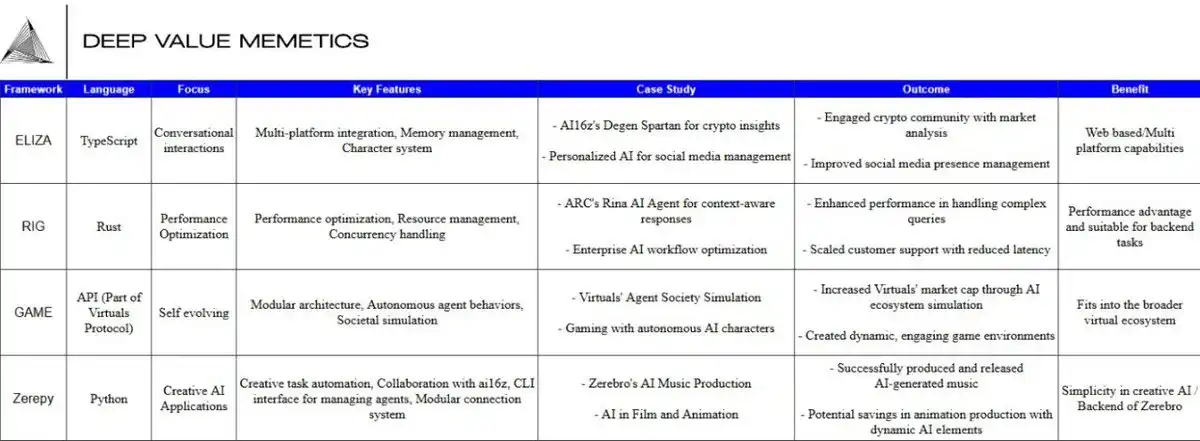
This report will first focus on what these frameworks are, the programming languages they use, technical architecture, algorithms, and unique features with potential use cases. Then, we will compare each framework based on usability, scalability, adaptability, and performance, while discussing their strengths and limitations.
Eliza
Eliza is an open-source multi-agent simulation framework developed by AI16Z, aimed at creating, deploying, and managing autonomous AI agents. It is developed in TypeScript as the programming language, providing a flexible, scalable platform for building intelligent agents that can interact with humans across multiple platforms while maintaining consistent personalities and knowledge.
The core features of this framework include: supporting the simultaneous deployment and management of multiple unique AI personality multi-agent architectures; creating a diverse agent role system using a role file framework; providing long-term memory and context-aware memory management through an advanced retrieval-augmented generation (RAG) system. Additionally, the Eliza framework also offers seamless platform integrations for reliable connections with Discord, X, and other social media platforms.
Eliza excels in AI agent communication and media capabilities. In terms of communication, the framework supports integration with Discord's voice channel feature, X feature, Telegram, and direct API access for custom use cases. On the other hand, the framework's media handling capabilities have expanded to PDF document reading and analysis, link content extraction and summarization, audio transcription, video content processing, image analysis, and conversation summarization, effectively handling various media inputs and outputs.
Eliza offers flexible AI model support, enabling on-device inference using open-source models, cloud-based inference using default configurations such as OpenAI and Nous Hermes Llama 3.1 B, and integration with Claude for handling complex queries. Eliza features a modular architecture with extensive action systems, custom client support, and a comprehensive API, ensuring cross-application scalability and adaptability.
Eliza's use cases span across various domains, such as AI assistants for customer support, community management, and personal tasks; social media roles like automatic content creators and brand representatives; knowledge workers playing roles like research assistants, content analysts, and document processors; as well as interactive roles in the form of role-playing bots, educational tutors, and entertainment agents.
Eliza's architecture is built around an agent runtime that seamlessly integrates with role systems (supported by model providers), a memory manager (linked to a database), and action systems (interfacing with platform clients). Unique features of this framework include a plugin system allowing modular feature extensions, support for multi-modal interactions such as voice, text, and media, and compatibility with leading AI models like Llama, GPT-4, and Claude. With its versatility and robust design, Eliza has become a powerful tool for developing cross-domain AI applications.
G.A.M.E
G.A.M.E, developed by the Virtuals official team, stands for "The Generative Autonomous Multimodal Entities Framework." This framework aims to provide developers with an application programming interface (API) and software development kit (SDK) to experiment with AI agents. The framework offers a structured approach to managing AI agent behaviors, decisions, and learning processes.
· The key components of G.A.M.E include, firstly, the "Agent Prompting Interface," which is the developer's entry point to integrating G.A.M.E into an agent to elicit agent behaviors.
· The "Perception Subsystem" initiates a session by specifying parameters such as session ID, agent ID, user, and other relevant details. It synthesizes incoming messages into a format suitable for the "Strategic Planning Engine," serving as the sensory input mechanism for the AI agent, whether in the form of dialogue or reaction. At the core is the "Dialogue Processing Module," responsible for handling messages and responses from the agent and collaborating with the "Perception Subsystem" to effectively interpret and react to input.
· The "Strategic Planning Engine" works in conjunction with the "Dialogue Processing Module" and the "On-chain Wallet Operator" to generate responses and plans. This engine operates on two levels: as a high-level planner creating broad strategies based on context or goals; and as a low-level strategist that transforms these strategies into executable policies, further segmented into an action planner (for task specification) and a plan executor (for task execution).
· A separate but key component is the "World Context," which references the environment, world information, and game state to provide necessary context for the agent's decision-making. Additionally, the "Agent Repository" is used to store long-term attributes such as goals, reflections, experiences, and personality, collectively shaping the agent's behavior and decision-making process. The framework utilizes "Short-Term Working Memory" and a "Long-Term Memory Processor" — the short-term memory retains pertinent information about previous actions, outcomes, and current plans; in contrast, the long-term memory processor extracts key information based on criteria such as importance, recency, and relevance. This memory stores knowledge about the agent's experiences, reflections, dynamic personality, world context, and working memory to enhance decision-making and provide a foundation for learning.
· To enhance adaptability, the "Learning Module" obtains data from the "Perception Subsystem" to generate general knowledge, which is fed back into the system to optimize future interactions. Developers can provide feedback on actions, game states, and sensory data through the interface to enhance the AI agent's learning and improve its planning and decision-making capabilities.
The workflow begins with developers interacting through the agent prompt interface; the "Perception Subsystem" processes the input and forwards it to the "Dialogue Processing Module," which manages the interaction logic; then, the "Strategic Planning Engine" formulates and executes plans based on this information, utilizing high-level strategies and detailed action planning.
Data from the "World Context" and "Agent Repository" informs these processes, while the working memory tracks real-time tasks. Simultaneously, the "Long-Term Memory Processor" stores and retrieves knowledge over time. The "Learning Module" analyzes outcomes and integrates new knowledge into the system, continuously improving the agent's behavior and interactions.
Rig
Rig is an open-source framework based on Rust, designed to streamline the development of Large Language Model (LLM) applications. It offers a unified interface for interacting with multiple LLM providers (such as OpenAI and Anthropic) and supports various vector storages, including MongoDB and Neo4j. The framework's modular architecture features core components like the "Provider Abstraction Layer," "Vector Storage Integration," and "Agent System," facilitating seamless interactions with LLMs.
Rig's primary audience includes developers building AI/ML applications in Rust, while the secondary audience comprises organizations seeking to integrate multiple LLM providers and vector storages into their Rust applications. The repository is organized based on a workspace structure, containing multiple crates that achieve scalability and efficient project management. Key features of Rig include the "Provider Abstraction Layer," which standardizes APIs for LLM providers through consistent error handling; the "Vector Storage Integration" component provides an abstract interface for multiple backends and supports vector similarity search; the "Agent System" simplifies LLM interactions, supporting Retrieve-and-Generate (RAG) and tool integrations. Additionally, the embedded framework offers batch processing capabilities and type-safe embedding operations.
Rig leverages multiple technological advantages to ensure reliability and performance. Asynchronous operations utilize Rust's asynchronous runtime to efficiently handle a large number of concurrent requests; the framework's inherent error handling mechanism enhances resilience to failures from AI providers or database operations; type safety prevents errors at compile time, thus improving code maintainability; efficient serialization and deserialization processes assist in handling data in formats such as JSON, which is crucial for communication and storage in AI services; detailed logging and instrumentation further aid in debugging and monitoring applications.
The workflow in Rig begins with a client initiating a request, which flows through the "provider abstraction layer" interacting with the respective LLM model; then, the data is processed by the core layer, where agents can utilize tools or access vector storage for context; responses are generated and enhanced through complex workflows like RAG, which involve document retrieval and context understanding, before being returned to the client. The system integrates multiple LLM providers and vector storage, adapting to model availability or performance changes.
Rig's use cases are diverse, including retrieving relevant documents to provide accurate answers in question-answering systems, document search and retrieval for efficient content discovery, and chatbots or virtual assistants providing context-aware interactions for customer service or education. It also supports content generation, capable of creating text and other materials based on learned patterns, serving as a versatile tool for developers and organizations.
ZerePy
ZerePy is an open-source framework written in Python designed to deploy agents on X utilizing OpenAI or Anthropic LLM. ZerePy originates from a modular version of the Zerebro backend, allowing developers to kickstart agents with functionalities similar to the Zerebro core. While the framework provides the foundation for agent deployment, fine-tuning of models is necessary to generate creative outputs. ZerePy simplifies the development and deployment of personalized AI agents, particularly suited for content creation on social platforms, fostering an AI creative ecosystem aimed at art and decentralized applications.
Built using the Python language, the framework emphasizes agent autonomy, focusing on creative output generation, aligning with Eliza's architecture + partnerships. Its modular design supports memory system integration, facilitating agent deployment on social platforms. Key features include a command-line interface for agent management, integration with X, support for OpenAI and Anthropic LLM, and a modular connection system for enhanced functionalities.
ZerePy's use cases cover social media automation, where users can deploy AI agents for posting, replying, liking, and retweeting to increase platform engagement. Additionally, it is suitable for content creation in areas such as music, memetics, and NFTs, serving as a key tool for digital art and blockchain-based content platforms.
Horizontal Comparison
In our view, each of the above frameworks has offered a unique approach to AI development, catering to specific needs and environments. This has shifted the debate away from whether these frameworks are direct competitors to focusing on whether each framework can provide unique utility and value.
· Eliza stands out for its user-friendly interface, particularly suitable for developers familiar with JavaScript and Node.js environments. Its comprehensive documentation aids in setting up AI agents across various platforms. Despite its rich feature set, which may present a moderate learning curve, Eliza is well-suited for building agents embedded in networks, especially considering most frontend web infrastructure is TypeScript-based. The framework is renowned for its multi-agent architecture, allowing diverse AI personality agents to be deployed across platforms like Discord, X, and Telegram. Its advanced RAG system for memory management makes it particularly suitable for building AI assistants for customer support or social media applications. While it offers flexibility, strong community support, and consistent cross-platform performance, it is still in its early stages, potentially posing a learning curve for developers.
· G.A.M.E is designed specifically for game developers, offering a low-code or no-code interface through APIs, making it accessible to users with lower technical expertise in the gaming field. However, it focuses on game development and blockchain integration, with a steeper learning curve for those without relevant experience. It excels in procedural content generation and NPC behavior but is constrained by its niche focus and additional complexity when integrating with blockchain.
· Rig, utilizing the Rust language, may present a challenge to users due to the complexity of the language, posing a significant learning curve. However, for those proficient in systems programming, it can provide an intuitive interaction. Compared to TypeScript, Rust is renowned for its performance and memory safety. It features strict compile-time checks and zero-cost abstractions, essential for running complex AI algorithms. The language's efficiency and low-level control make it an ideal choice for resource-intensive AI applications. The framework adopts a modular and scalable design, offering high-performance solutions, making it well-suited for enterprise applications. Nevertheless, for developers unfamiliar with the Rust language, using Rust can introduce a steep learning curve.
· ZerePy uses the Python language, providing higher usability for creative AI tasks. For Python developers, especially those with an AI/ML background, the learning curve is lower, and due to Zerebro's popularity, strong community support is available. ZerePy excels in creative AI applications such as NFTs and positions itself as a powerful tool in the digital media and art fields. While it shines in creativity, its scope is relatively narrow compared to other frameworks.
Here is a comparison of the four frameworks in terms of scalability.
· Eliza made significant progress after the V2 version update, introducing a unified messaging pipeline and an extensible core framework, achieving efficient cross-platform management. However, without optimization, managing such cross-platform interactions may pose scalability challenges.
· G.A.M.E excels in real-time processing required for gaming, and its scalability can be managed through efficient algorithms and the potential of a blockchain distributed system. However, it may be constrained by specific game engines or blockchain network limitations.
· The Rig framework leverages Rust's performance benefits for better scalability, inherently designed for high-throughput applications, which may be particularly effective for enterprise deployments. However, achieving true scalability may require complex configurations.
· ZerePy's scalability is geared towards creative output and has support from the community. However, the framework's focus may limit its application in a broader artificial intelligence environment, and its scalability may be tested by the diversity of creative tasks rather than user volume.
In terms of applicability, Eliza leads by a large margin with its plugin system and cross-platform compatibility, followed by G.A.M.E in the gaming environment and Rig for handling complex AI tasks. ZerePy shows high adaptability in the creative field but is less suitable for broader AI applications.
In terms of performance, here are the test results for the four frameworks.
· Eliza is optimized for quick interaction on social media, but its performance may vary when handling more complex computational tasks.
· G.A.M.E focuses on high-performance real-time interaction in gaming scenarios, leveraging efficient decision-making processes and potential blockchain for decentralized AI operations.
· Rig, based on Rust, offers outstanding performance for high-performance computing tasks, suitable for enterprise applications where computational efficiency is critical.
· ZerePy's performance is geared towards creative content creation, with metrics centered around the efficiency and quality of content generation, which may not be as applicable outside the creative domain.
Combining the above strengths and weaknesses in a comprehensive analysis, Eliza provides greater flexibility and scalability. Its plugin system and role configuration make it highly adaptable and beneficial for cross-platform social AI interaction. G.A.M.E offers unique real-time interaction capabilities in gaming scenarios and provides novel AI participation through blockchain integration. Rig excels in performance and scalability, catering to enterprise-level AI tasks, with a focus on clean and modular code to ensure long-term project health. ZerePy excels in fostering creativity, leading in AI applications for digital art and supported by a vibrant community-driven development model.
In conclusion, each framework has its limitations. Eliza is still in its early stages, with potential stability issues and a steep learning curve for new developers. G.A.M.E's niche focus may limit its broader application, and blockchain integration adds complexity. Rig's learning curve is steeper due to the complexity of the Rust language, which may deter some developers. Zerepy's narrow focus on creative output may limit its application in other AI fields.
Core Comparison Items Overview
Rig (ARC)
· Language: Rust, focusing on security and performance.
· Use Case: Prioritizes efficiency and scalability, making it an ideal choice for enterprise-level AI applications.
· Community: Less community-driven, more focused on technical developers.
Eliza (AI16Z)
· Language: TypeScript, emphasizing the flexibility of Web3 and community involvement.
· Use Case: Specifically designed for social interaction, DAOs, and transactions, with a particular emphasis on multi-agent systems.
· Community: Highly community-driven, with extensive ties to GitHub.
ZerePy (ZEREBRO):
· Language: Python, which is more easily embraced by a broader AI developer community.
· Use Case: Suitable for social media automation and simpler AI agent tasks.
· Community: Relatively new, but poised for growth due to Python's popularity and support from ai16z contributors.
G.A.M.E (VIRTUAL, GMAE):
· Focus: Autonomous, adaptive AI agents that can evolve based on interactions in a virtual environment.
· Use Case: Most suitable for scenarios where agents need to learn and adapt, such as in gaming or virtual worlds.
· Community: Innovative but still establishing its position amidst competition.
Github Stars Growth Data
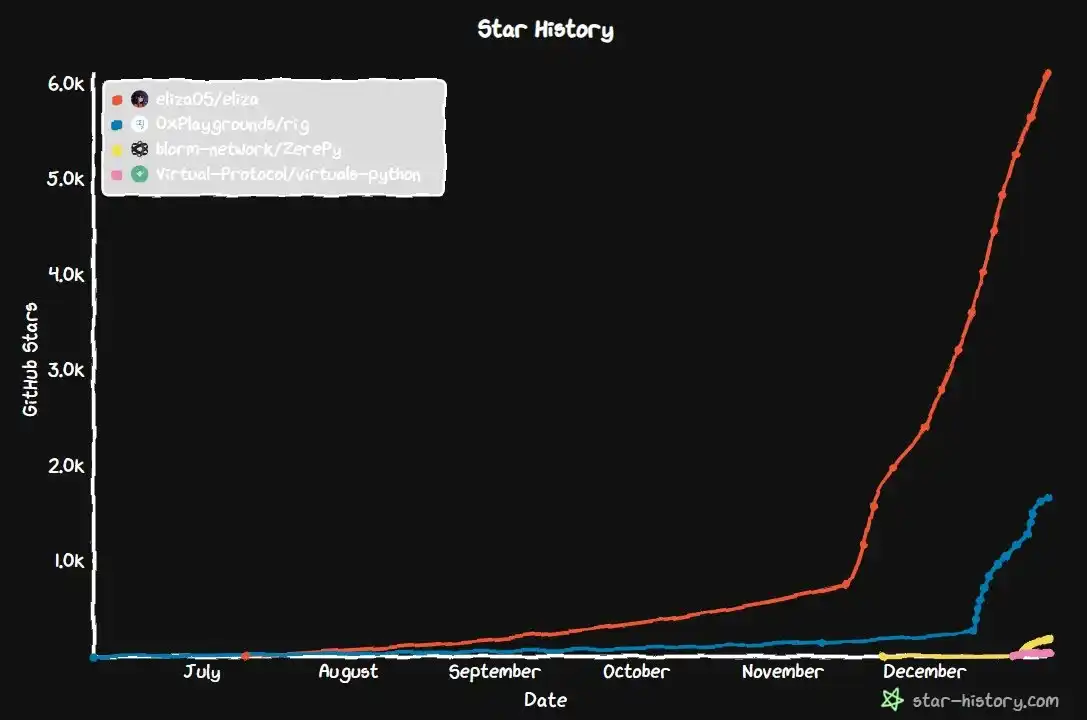
The above chart depicts the change in GitHub star counts since the launch of these frameworks. Generally, GitHub stars serve as an indicator of community interest, project popularity, and perceived project value.
· Eliza (Red Line): The chart demonstrates a significant and stable growth in star count for this framework, starting from a low base in July and spiking in late November, now reaching 6100 stars. This indicates a rapid surge in interest surrounding the framework, capturing developers' attention. The exponential growth suggests that Eliza has garnered significant attraction due to its features, updates, and community engagement, far surpassing other products in popularity. This signifies robust community support, indicating broader applicability or interest within the AI community.
· Rig (Blue Line): Rig stands out as the oldest among the four frameworks, with a modest yet steady increase in stars, showing a noticeable uptick in the last month. It has amassed a total of 1700 stars, still on an upward trajectory. The consistent accumulation of attention is attributed to ongoing development, updates, and a growing user base. This might reflect Rig's position as a framework still building reputation.
· ZerePy (Yellow Line): ZerePy, launched just a few days ago, has seen its star count rise to 181. It is important to note that ZerePy would require further development to enhance its visibility and adoption, and collaboration with ai16z might draw more contributors to engage with its codebase.
· G.A.M.E (Green Line): While this framework has a modest number of stars, it is worth noting that it can be directly applied to agents in Virtual ecosystems through an API, eliminating the need for a GitHub presence. Despite being made available for builders just over a month ago, over 200 projects are already using G.A.M.E for development.
Expected Upgrades to AI Frameworks
Version 2.0 of Eliza will include integration with the Coinbase Agent Toolkit. All projects using Eliza will receive support for future native TEE (Trusted Execution Environment), allowing agents to run in a secure environment. The Plugin Registry is a forthcoming feature of Eliza that will enable developers to seamlessly register and integrate plugins.
Furthermore, Eliza 2.0 will support automated anonymous cross-platform messaging. The Tokenomics whitepaper (proposal disclosed) expected to be released on January 1, 2025, will have a positive impact on the AI16Z token that underpins the Eliza framework. AI16Z plans to further enhance the utility of the framework and leverage the efforts of its key contributors to bring in top-tier talent.
The G.A.M.E framework offers no-code integration for agents, allowing both G.A.M.E and Eliza to be used within a single project, each serving a specific use case. This approach is expected to attract builders focused on business logic rather than technical complexity. Despite being publicly available for just over 30 days, the framework has made significant progress with the team's efforts to attract more contributors. It is expected that every project launched on VirtuaI will adopt G.A.M.E.
The Rig framework, driven by the ARC token, has significant potential. While the growth of the framework is in its early stages, the project contract plan driving Rig adoption has only been live for a few days. However, high-quality projects paired with ARC are expected to emerge shortly, similar to the Virtual Flywheel but focused on Solana. The Rig team is optimistic about their collaboration with Solana, positioning ARC as the Virtual for Solana. It is worth noting that the team not only incentivizes new projects launched using Rig but also incentivizes developers to enhance the Rig framework itself.
Zerepy is a newly launched framework that has garnered significant attention due to its collaboration with ai16z (Eliza framework). With contributions from Eliza actively working to improve the framework, Zerepy has gained enthusiastic support from the ZEREBRO community, creating a new opportunity for Python developers who previously lacked space in the competitive AI infrastructure arena. It is expected that this framework will play a significant role in the creative aspects of AI.
You may also like

Token Cannot Compound, Where Is the Real Investment Opportunity?

February 6th Market Key Intelligence, How Much Did You Miss?

China's Central Bank and Eight Other Departments' Latest Regulatory Focus: Key Attention to RWA Tokenized Asset Risk
Foreword: Today, the People's Bank of China's website published the "Notice of the People's Bank of China, National Development and Reform Commission, Ministry of Industry and Information Technology, Ministry of Public Security, State Administration for Market Regulation, China Banking and Insurance Regulatory Commission, China Securities Regulatory Commission, State Administration of Foreign Exchange on Further Preventing and Dealing with Risks Related to Virtual Currency and Others (Yinfa [2026] No. 42)", the latest regulatory requirements from the eight departments including the central bank, which are basically consistent with the regulatory requirements of recent years. The main focus of the regulation is on speculative activities such as virtual currency trading, exchanges, ICOs, overseas platform services, and this time, regulatory oversight of RWA has been added, explicitly prohibiting RWA tokenization, stablecoins (especially those pegged to the RMB). The following is the full text:
To the people's governments of all provinces, autonomous regions, and municipalities directly under the Central Government, the Xinjiang Production and Construction Corps:
Recently, there have been speculative activities related to virtual currency and Real-World Assets (RWA) tokenization, disrupting the economic and financial order and jeopardizing the property security of the people. In order to further prevent and address the risks related to virtual currency and Real-World Assets tokenization, effectively safeguard national security and social stability, in accordance with the "Law of the People's Republic of China on the People's Bank of China," "Law of the People's Republic of China on Commercial Banks," "Securities Law of the People's Republic of China," "Law of the People's Republic of China on Securities Investment Funds," "Law of the People's Republic of China on Futures and Derivatives," "Cybersecurity Law of the People's Republic of China," "Regulations of the People's Republic of China on the Administration of Renminbi," "Regulations on Prevention and Disposal of Illegal Fundraising," "Regulations of the People's Republic of China on Foreign Exchange Administration," "Telecommunications Regulations of the People's Republic of China," and other provisions, after reaching consensus with the Cyberspace Administration of China, the Supreme People's Court, and the Supreme People's Procuratorate, and with the approval of the State Council, the relevant matters are notified as follows:
(I) Virtual currency does not possess the legal status equivalent to fiat currency. Virtual currencies such as Bitcoin, Ether, Tether, etc., have the main characteristics of being issued by non-monetary authorities, using encryption technology and distributed ledger or similar technology, existing in digital form, etc. They do not have legal tender status, should not and cannot be circulated and used as currency in the market.
The business activities related to virtual currency are classified as illegal financial activities. The exchange of fiat currency and virtual currency within the territory, exchange of virtual currencies, acting as a central counterparty in buying and selling virtual currencies, providing information intermediary and pricing services for virtual currency transactions, token issuance financing, and trading of virtual currency-related financial products, etc., fall under illegal financial activities, such as suspected illegal issuance of token vouchers, unauthorized public issuance of securities, illegal operation of securities and futures business, illegal fundraising, etc., are strictly prohibited across the board and resolutely banned in accordance with the law. Overseas entities and individuals are not allowed to provide virtual currency-related services to domestic entities in any form.
A stablecoin pegged to a fiat currency indirectly fulfills some functions of the fiat currency in circulation. Without the consent of relevant authorities in accordance with the law and regulations, any domestic or foreign entity or individual is not allowed to issue a RMB-pegged stablecoin overseas.
(II)Tokenization of Real-World Assets refers to the use of encryption technology and distributed ledger or similar technologies to transform ownership rights, income rights, etc., of assets into tokens (tokens) or other interests or bond certificates with token (token) characteristics, and carry out issuance and trading activities.
Engaging in the tokenization of real-world assets domestically, as well as providing related intermediary, information technology services, etc., which are suspected of illegal issuance of token vouchers, unauthorized public offering of securities, illegal operation of securities and futures business, illegal fundraising, and other illegal financial activities, shall be prohibited; except for relevant business activities carried out with the approval of the competent authorities in accordance with the law and regulations and relying on specific financial infrastructures. Overseas entities and individuals are not allowed to illegally provide services related to the tokenization of real-world assets to domestic entities in any form.
(III) Inter-agency Coordination. The People's Bank of China, together with the National Development and Reform Commission, the Ministry of Industry and Information Technology, the Ministry of Public Security, the State Administration for Market Regulation, the China Banking and Insurance Regulatory Commission, the China Securities Regulatory Commission, the State Administration of Foreign Exchange, and other departments, will improve the work mechanism, strengthen coordination with the Cyberspace Administration of China, the Supreme People's Court, and the Supreme People's Procuratorate, coordinate efforts, and overall guide regions to carry out risk prevention and disposal of virtual currency-related illegal financial activities.
The China Securities Regulatory Commission, together with the National Development and Reform Commission, the Ministry of Industry and Information Technology, the Ministry of Public Security, the People's Bank of China, the State Administration for Market Regulation, the China Banking and Insurance Regulatory Commission, the State Administration of Foreign Exchange, and other departments, will improve the work mechanism, strengthen coordination with the Cyberspace Administration of China, the Supreme People's Court, and the Supreme People's Procuratorate, coordinate efforts, and overall guide regions to carry out risk prevention and disposal of illegal financial activities related to the tokenization of real-world assets.
(IV) Strengthening Local Implementation. The people's governments at the provincial level are overall responsible for the prevention and disposal of risks related to virtual currencies and the tokenization of real-world assets in their respective administrative regions. The specific leading department is the local financial regulatory department, with participation from branches and dispatched institutions of the State Council's financial regulatory department, telecommunications regulators, public security, market supervision, and other departments, in coordination with cyberspace departments, courts, and procuratorates, to improve the normalization of the work mechanism, effectively connect with the relevant work mechanisms of central departments, form a cooperative and coordinated working pattern between central and local governments, effectively prevent and properly handle risks related to virtual currencies and the tokenization of real-world assets, and maintain economic and financial order and social stability.
(5) Enhanced Risk Monitoring. The People's Bank of China, China Securities Regulatory Commission, National Development and Reform Commission, Ministry of Industry and Information Technology, Ministry of Public Security, State Administration of Foreign Exchange, Cyberspace Administration of China, and other departments continue to improve monitoring techniques and system support, enhance cross-departmental data analysis and sharing, establish sound information sharing and cross-validation mechanisms, promptly grasp the risk situation of activities related to virtual currency and real-world asset tokenization. Local governments at all levels give full play to the role of local monitoring and early warning mechanisms. Local financial regulatory authorities, together with branches and agencies of the State Council's financial regulatory authorities, as well as departments of cyberspace and public security, ensure effective connection between online monitoring, offline investigation, and fund tracking, efficiently and accurately identify activities related to virtual currency and real-world asset tokenization, promptly share risk information, improve early warning information dissemination, verification, and rapid response mechanisms.
(6) Strengthened Oversight of Financial Institutions, Intermediaries, and Technology Service Providers. Financial institutions (including non-bank payment institutions) are prohibited from providing account opening, fund transfer, and clearing services for virtual currency-related business activities, issuing and selling financial products related to virtual currency, including virtual currency and related financial products in the scope of collateral, conducting insurance business related to virtual currency, or including virtual currency in the scope of insurance liability. Financial institutions (including non-bank payment institutions) are prohibited from providing custody, clearing, and settlement services for unauthorized real-world asset tokenization-related business and related financial products. Relevant intermediary institutions and information technology service providers are prohibited from providing intermediary, technical, or other services for unauthorized real-world asset tokenization-related businesses and related financial products.
(7) Enhanced Management of Internet Information Content and Access. Internet enterprises are prohibited from providing online business venues, commercial displays, marketing, advertising, or paid traffic diversion services for virtual currency and real-world asset tokenization-related business activities. Upon discovering clues of illegal activities, they should promptly report to relevant departments and provide technical support and assistance for related investigations and inquiries. Based on the clues transferred by the financial regulatory authorities, the cyberspace administration, telecommunications authorities, and public security departments should promptly close and deal with websites, mobile applications (including mini-programs), and public accounts engaged in virtual currency and real-world asset tokenization-related business activities in accordance with the law.
(8) Strengthened Entity Registration and Advertisement Management. Market supervision departments strengthen entity registration and management, and enterprise and individual business registrations must not contain terms such as "virtual currency," "virtual asset," "cryptocurrency," "crypto asset," "stablecoin," "real-world asset tokenization," or "RWA" in their names or business scopes. Market supervision departments, together with financial regulatory authorities, legally enhance the supervision of advertisements related to virtual currency and real-world asset tokenization, promptly investigating and handling relevant illegal advertisements.
(IX) Continued Rectification of Virtual Currency Mining Activities. The National Development and Reform Commission, together with relevant departments, strictly controls virtual currency mining activities, continuously promotes the rectification of virtual currency mining activities. The people's governments of various provinces take overall responsibility for the rectification of "mining" within their respective administrative regions. In accordance with the requirements of the National Development and Reform Commission and other departments in the "Notice on the Rectification of Virtual Currency Mining Activities" (NDRC Energy-saving Building [2021] No. 1283) and the provisions of the "Guidance Catalog for Industrial Structure Adjustment (2024 Edition)," a comprehensive review, investigation, and closure of existing virtual currency mining projects are conducted, new mining projects are strictly prohibited, and mining machine production enterprises are strictly prohibited from providing mining machine sales and other services within the country.
(X) Severe Crackdown on Related Illegal Financial Activities. Upon discovering clues to illegal financial activities related to virtual currency and the tokenization of real-world assets, local financial regulatory authorities, branches of the State Council's financial regulatory authorities, and other relevant departments promptly investigate, determine, and properly handle the issues in accordance with the law, and seriously hold the relevant entities and individuals legally responsible. Those suspected of crimes are transferred to the judicial authorities for processing according to the law.
(XI) Severe Crackdown on Related Illegal and Criminal Activities. The Ministry of Public Security, the People's Bank of China, the State Administration for Market Regulation, the China Banking and Insurance Regulatory Commission, the China Securities Regulatory Commission, as well as judicial and procuratorial organs, in accordance with their respective responsibilities, rigorously crack down on illegal and criminal activities related to virtual currency, the tokenization of real-world assets, such as fraud, money laundering, illegal business operations, pyramid schemes, illegal fundraising, and other illegal and criminal activities carried out under the guise of virtual currency, the tokenization of real-world assets, etc.
(XII) Strengthen Industry Self-discipline. Relevant industry associations should enhance membership management and policy advocacy, based on their own responsibilities, advocate and urge member units to resist illegal financial activities related to virtual currency and the tokenization of real-world assets. Member units that violate regulatory policies and industry self-discipline rules are to be disciplined in accordance with relevant self-regulatory management regulations. By leveraging various industry infrastructure, conduct risk monitoring related to virtual currency, the tokenization of real-world assets, and promptly transfer issue clues to relevant departments.
(XIII) Without the approval of relevant departments in accordance with the law and regulations, domestic entities and foreign entities controlled by them may not issue virtual currency overseas.
(XIV) Domestic entities engaging directly or indirectly in overseas external debt-based tokenization of real-world assets, or conducting asset securitization activities abroad based on domestic ownership rights, income rights, etc. (hereinafter referred to as domestic equity), should be strictly regulated in accordance with the principles of "same business, same risk, same rules." The National Development and Reform Commission, the China Securities Regulatory Commission, the State Administration of Foreign Exchange, and other relevant departments regulate it according to their respective responsibilities. For other forms of overseas real-world asset tokenization activities based on domestic equity by domestic entities, the China Securities Regulatory Commission, together with relevant departments, supervise according to their division of responsibilities. Without the consent and filing of relevant departments, no unit or individual may engage in the above-mentioned business.
(15) Overseas subsidiaries and branches of domestic financial institutions providing Real World Asset Tokenization-related services overseas shall do so legally and prudently. They shall have professional personnel and systems in place to effectively mitigate business risks, strictly implement customer onboarding, suitability management, anti-money laundering requirements, and incorporate them into the domestic financial institutions' compliance and risk management system. Intermediaries and information technology service providers offering Real World Asset Tokenization services abroad based on domestic equity or conducting Real World Asset Tokenization business in the form of overseas debt for domestic entities directly or indirectly venturing abroad must strictly comply with relevant laws and regulations. They should establish and improve relevant compliance and internal control systems in accordance with relevant normative requirements, strengthen business and risk control, and report the business developments to the relevant regulatory authorities for approval or filing.
(16) Strengthen organizational leadership and overall coordination. All departments and regions should attach great importance to the prevention of risks related to virtual currencies and Real World Asset Tokenization, strengthen organizational leadership, clarify work responsibilities, form a long-term effective working mechanism with centralized coordination, local implementation, and shared responsibilities, maintain high pressure, dynamically monitor risks, effectively prevent and mitigate risks in an orderly and efficient manner, legally protect the property security of the people, and make every effort to maintain economic and financial order and social stability.
(17) Widely carry out publicity and education. All departments, regions, and industry associations should make full use of various media and other communication channels to disseminate information through legal and policy interpretation, analysis of typical cases, and education on investment risks, etc. They should promote the illegality and harm of virtual currencies and Real World Asset Tokenization-related businesses and their manifestations, fully alert to potential risks and hidden dangers, and enhance public awareness and identification capabilities for risk prevention.
(18) Engaging in illegal financial activities related to virtual currencies and Real World Asset Tokenization in violation of this notice, as well as providing services for virtual currencies and Real World Asset Tokenization-related businesses, shall be punished in accordance with relevant regulations. If it constitutes a crime, criminal liability shall be pursued according to the law. For domestic entities and individuals who knowingly or should have known that overseas entities illegally provided virtual currency or Real World Asset Tokenization-related services to domestic entities and still assisted them, relevant responsibilities shall be pursued according to the law. If it constitutes a crime, criminal liability shall be pursued according to the law.
(19) If any unit or individual invests in virtual currencies, Real World Asset Tokens, and related financial products against public order and good customs, the relevant civil legal actions shall be invalid, and any resulting losses shall be borne by them. If there are suspicions of disrupting financial order and jeopardizing financial security, the relevant departments shall deal with them according to the law.
This notice shall enter into force upon the date of its issuance. The People's Bank of China and ten other departments' "Notice on Further Preventing and Dealing with the Risks of Virtual Currency Trading Speculation" (Yinfa [2021] No. 237) is hereby repealed.

Former Partner's Perspective on Multicoin: Kyle's Exit, But the Game He Left Behind Just Getting Started

Why Bitcoin Is Falling Now: The Real Reasons Behind BTC's Crash & WEEX's Smart Profit Playbook
Bitcoin's ongoing crash explained: Discover the 5 hidden triggers behind BTC's plunge & how WEEX's Auto Earn and Trade to Earn strategies help traders profit from crypto market volatility.

Wall Street's Hottest Trades See Exodus

Vitalik Discusses Ethereum Scaling Path, Circle Announces Partnership with Polymarket, What's the Overseas Crypto Community Talking About Today?

Believing in the Capital Markets - The Essence and Core Value of Cryptocurrency

Polymarket's 'Weatherman': Predict Temperature, Win Million-Dollar Payout

$15K+ Profits: The 4 AI Trading Secrets WEEX Hackathon Prelim Winners Used to Dominate Volatile Crypto Markets
How WEEX Hackathon's top AI trading strategies made $15K+ in crypto markets: 4 proven rules for ETH/BTC trading, market structure analysis, and risk management in volatile conditions.

A nearly 20% one-day plunge, how long has it been since you last saw a $60,000 Bitcoin?

Raoul Pal: I've seen every single panic, and they are never the end.

Key Market Information Discrepancy on February 6th - A Must-Read! | Alpha Morning Report

2026 Crypto Industry's First Snowfall
The Harsh Reality Behind the $26 Billion Crypto Liquidation: Liquidity Is Killing the Market
Why Is Gold, US Stocks, Bitcoin All Falling?

Key Market Intelligence for February 5th, how much did you miss out on?

Wintermute: By 2026, crypto had gradually become the settlement layer of the Internet economy
Token Cannot Compound, Where Is the Real Investment Opportunity?
February 6th Market Key Intelligence, How Much Did You Miss?
China's Central Bank and Eight Other Departments' Latest Regulatory Focus: Key Attention to RWA Tokenized Asset Risk
Foreword: Today, the People's Bank of China's website published the "Notice of the People's Bank of China, National Development and Reform Commission, Ministry of Industry and Information Technology, Ministry of Public Security, State Administration for Market Regulation, China Banking and Insurance Regulatory Commission, China Securities Regulatory Commission, State Administration of Foreign Exchange on Further Preventing and Dealing with Risks Related to Virtual Currency and Others (Yinfa [2026] No. 42)", the latest regulatory requirements from the eight departments including the central bank, which are basically consistent with the regulatory requirements of recent years. The main focus of the regulation is on speculative activities such as virtual currency trading, exchanges, ICOs, overseas platform services, and this time, regulatory oversight of RWA has been added, explicitly prohibiting RWA tokenization, stablecoins (especially those pegged to the RMB). The following is the full text:
To the people's governments of all provinces, autonomous regions, and municipalities directly under the Central Government, the Xinjiang Production and Construction Corps:
Recently, there have been speculative activities related to virtual currency and Real-World Assets (RWA) tokenization, disrupting the economic and financial order and jeopardizing the property security of the people. In order to further prevent and address the risks related to virtual currency and Real-World Assets tokenization, effectively safeguard national security and social stability, in accordance with the "Law of the People's Republic of China on the People's Bank of China," "Law of the People's Republic of China on Commercial Banks," "Securities Law of the People's Republic of China," "Law of the People's Republic of China on Securities Investment Funds," "Law of the People's Republic of China on Futures and Derivatives," "Cybersecurity Law of the People's Republic of China," "Regulations of the People's Republic of China on the Administration of Renminbi," "Regulations on Prevention and Disposal of Illegal Fundraising," "Regulations of the People's Republic of China on Foreign Exchange Administration," "Telecommunications Regulations of the People's Republic of China," and other provisions, after reaching consensus with the Cyberspace Administration of China, the Supreme People's Court, and the Supreme People's Procuratorate, and with the approval of the State Council, the relevant matters are notified as follows:
(I) Virtual currency does not possess the legal status equivalent to fiat currency. Virtual currencies such as Bitcoin, Ether, Tether, etc., have the main characteristics of being issued by non-monetary authorities, using encryption technology and distributed ledger or similar technology, existing in digital form, etc. They do not have legal tender status, should not and cannot be circulated and used as currency in the market.
The business activities related to virtual currency are classified as illegal financial activities. The exchange of fiat currency and virtual currency within the territory, exchange of virtual currencies, acting as a central counterparty in buying and selling virtual currencies, providing information intermediary and pricing services for virtual currency transactions, token issuance financing, and trading of virtual currency-related financial products, etc., fall under illegal financial activities, such as suspected illegal issuance of token vouchers, unauthorized public issuance of securities, illegal operation of securities and futures business, illegal fundraising, etc., are strictly prohibited across the board and resolutely banned in accordance with the law. Overseas entities and individuals are not allowed to provide virtual currency-related services to domestic entities in any form.
A stablecoin pegged to a fiat currency indirectly fulfills some functions of the fiat currency in circulation. Without the consent of relevant authorities in accordance with the law and regulations, any domestic or foreign entity or individual is not allowed to issue a RMB-pegged stablecoin overseas.
(II)Tokenization of Real-World Assets refers to the use of encryption technology and distributed ledger or similar technologies to transform ownership rights, income rights, etc., of assets into tokens (tokens) or other interests or bond certificates with token (token) characteristics, and carry out issuance and trading activities.
Engaging in the tokenization of real-world assets domestically, as well as providing related intermediary, information technology services, etc., which are suspected of illegal issuance of token vouchers, unauthorized public offering of securities, illegal operation of securities and futures business, illegal fundraising, and other illegal financial activities, shall be prohibited; except for relevant business activities carried out with the approval of the competent authorities in accordance with the law and regulations and relying on specific financial infrastructures. Overseas entities and individuals are not allowed to illegally provide services related to the tokenization of real-world assets to domestic entities in any form.
(III) Inter-agency Coordination. The People's Bank of China, together with the National Development and Reform Commission, the Ministry of Industry and Information Technology, the Ministry of Public Security, the State Administration for Market Regulation, the China Banking and Insurance Regulatory Commission, the China Securities Regulatory Commission, the State Administration of Foreign Exchange, and other departments, will improve the work mechanism, strengthen coordination with the Cyberspace Administration of China, the Supreme People's Court, and the Supreme People's Procuratorate, coordinate efforts, and overall guide regions to carry out risk prevention and disposal of virtual currency-related illegal financial activities.
The China Securities Regulatory Commission, together with the National Development and Reform Commission, the Ministry of Industry and Information Technology, the Ministry of Public Security, the People's Bank of China, the State Administration for Market Regulation, the China Banking and Insurance Regulatory Commission, the State Administration of Foreign Exchange, and other departments, will improve the work mechanism, strengthen coordination with the Cyberspace Administration of China, the Supreme People's Court, and the Supreme People's Procuratorate, coordinate efforts, and overall guide regions to carry out risk prevention and disposal of illegal financial activities related to the tokenization of real-world assets.
(IV) Strengthening Local Implementation. The people's governments at the provincial level are overall responsible for the prevention and disposal of risks related to virtual currencies and the tokenization of real-world assets in their respective administrative regions. The specific leading department is the local financial regulatory department, with participation from branches and dispatched institutions of the State Council's financial regulatory department, telecommunications regulators, public security, market supervision, and other departments, in coordination with cyberspace departments, courts, and procuratorates, to improve the normalization of the work mechanism, effectively connect with the relevant work mechanisms of central departments, form a cooperative and coordinated working pattern between central and local governments, effectively prevent and properly handle risks related to virtual currencies and the tokenization of real-world assets, and maintain economic and financial order and social stability.
(5) Enhanced Risk Monitoring. The People's Bank of China, China Securities Regulatory Commission, National Development and Reform Commission, Ministry of Industry and Information Technology, Ministry of Public Security, State Administration of Foreign Exchange, Cyberspace Administration of China, and other departments continue to improve monitoring techniques and system support, enhance cross-departmental data analysis and sharing, establish sound information sharing and cross-validation mechanisms, promptly grasp the risk situation of activities related to virtual currency and real-world asset tokenization. Local governments at all levels give full play to the role of local monitoring and early warning mechanisms. Local financial regulatory authorities, together with branches and agencies of the State Council's financial regulatory authorities, as well as departments of cyberspace and public security, ensure effective connection between online monitoring, offline investigation, and fund tracking, efficiently and accurately identify activities related to virtual currency and real-world asset tokenization, promptly share risk information, improve early warning information dissemination, verification, and rapid response mechanisms.
(6) Strengthened Oversight of Financial Institutions, Intermediaries, and Technology Service Providers. Financial institutions (including non-bank payment institutions) are prohibited from providing account opening, fund transfer, and clearing services for virtual currency-related business activities, issuing and selling financial products related to virtual currency, including virtual currency and related financial products in the scope of collateral, conducting insurance business related to virtual currency, or including virtual currency in the scope of insurance liability. Financial institutions (including non-bank payment institutions) are prohibited from providing custody, clearing, and settlement services for unauthorized real-world asset tokenization-related business and related financial products. Relevant intermediary institutions and information technology service providers are prohibited from providing intermediary, technical, or other services for unauthorized real-world asset tokenization-related businesses and related financial products.
(7) Enhanced Management of Internet Information Content and Access. Internet enterprises are prohibited from providing online business venues, commercial displays, marketing, advertising, or paid traffic diversion services for virtual currency and real-world asset tokenization-related business activities. Upon discovering clues of illegal activities, they should promptly report to relevant departments and provide technical support and assistance for related investigations and inquiries. Based on the clues transferred by the financial regulatory authorities, the cyberspace administration, telecommunications authorities, and public security departments should promptly close and deal with websites, mobile applications (including mini-programs), and public accounts engaged in virtual currency and real-world asset tokenization-related business activities in accordance with the law.
(8) Strengthened Entity Registration and Advertisement Management. Market supervision departments strengthen entity registration and management, and enterprise and individual business registrations must not contain terms such as "virtual currency," "virtual asset," "cryptocurrency," "crypto asset," "stablecoin," "real-world asset tokenization," or "RWA" in their names or business scopes. Market supervision departments, together with financial regulatory authorities, legally enhance the supervision of advertisements related to virtual currency and real-world asset tokenization, promptly investigating and handling relevant illegal advertisements.
(IX) Continued Rectification of Virtual Currency Mining Activities. The National Development and Reform Commission, together with relevant departments, strictly controls virtual currency mining activities, continuously promotes the rectification of virtual currency mining activities. The people's governments of various provinces take overall responsibility for the rectification of "mining" within their respective administrative regions. In accordance with the requirements of the National Development and Reform Commission and other departments in the "Notice on the Rectification of Virtual Currency Mining Activities" (NDRC Energy-saving Building [2021] No. 1283) and the provisions of the "Guidance Catalog for Industrial Structure Adjustment (2024 Edition)," a comprehensive review, investigation, and closure of existing virtual currency mining projects are conducted, new mining projects are strictly prohibited, and mining machine production enterprises are strictly prohibited from providing mining machine sales and other services within the country.
(X) Severe Crackdown on Related Illegal Financial Activities. Upon discovering clues to illegal financial activities related to virtual currency and the tokenization of real-world assets, local financial regulatory authorities, branches of the State Council's financial regulatory authorities, and other relevant departments promptly investigate, determine, and properly handle the issues in accordance with the law, and seriously hold the relevant entities and individuals legally responsible. Those suspected of crimes are transferred to the judicial authorities for processing according to the law.
(XI) Severe Crackdown on Related Illegal and Criminal Activities. The Ministry of Public Security, the People's Bank of China, the State Administration for Market Regulation, the China Banking and Insurance Regulatory Commission, the China Securities Regulatory Commission, as well as judicial and procuratorial organs, in accordance with their respective responsibilities, rigorously crack down on illegal and criminal activities related to virtual currency, the tokenization of real-world assets, such as fraud, money laundering, illegal business operations, pyramid schemes, illegal fundraising, and other illegal and criminal activities carried out under the guise of virtual currency, the tokenization of real-world assets, etc.
(XII) Strengthen Industry Self-discipline. Relevant industry associations should enhance membership management and policy advocacy, based on their own responsibilities, advocate and urge member units to resist illegal financial activities related to virtual currency and the tokenization of real-world assets. Member units that violate regulatory policies and industry self-discipline rules are to be disciplined in accordance with relevant self-regulatory management regulations. By leveraging various industry infrastructure, conduct risk monitoring related to virtual currency, the tokenization of real-world assets, and promptly transfer issue clues to relevant departments.
(XIII) Without the approval of relevant departments in accordance with the law and regulations, domestic entities and foreign entities controlled by them may not issue virtual currency overseas.
(XIV) Domestic entities engaging directly or indirectly in overseas external debt-based tokenization of real-world assets, or conducting asset securitization activities abroad based on domestic ownership rights, income rights, etc. (hereinafter referred to as domestic equity), should be strictly regulated in accordance with the principles of "same business, same risk, same rules." The National Development and Reform Commission, the China Securities Regulatory Commission, the State Administration of Foreign Exchange, and other relevant departments regulate it according to their respective responsibilities. For other forms of overseas real-world asset tokenization activities based on domestic equity by domestic entities, the China Securities Regulatory Commission, together with relevant departments, supervise according to their division of responsibilities. Without the consent and filing of relevant departments, no unit or individual may engage in the above-mentioned business.
(15) Overseas subsidiaries and branches of domestic financial institutions providing Real World Asset Tokenization-related services overseas shall do so legally and prudently. They shall have professional personnel and systems in place to effectively mitigate business risks, strictly implement customer onboarding, suitability management, anti-money laundering requirements, and incorporate them into the domestic financial institutions' compliance and risk management system. Intermediaries and information technology service providers offering Real World Asset Tokenization services abroad based on domestic equity or conducting Real World Asset Tokenization business in the form of overseas debt for domestic entities directly or indirectly venturing abroad must strictly comply with relevant laws and regulations. They should establish and improve relevant compliance and internal control systems in accordance with relevant normative requirements, strengthen business and risk control, and report the business developments to the relevant regulatory authorities for approval or filing.
(16) Strengthen organizational leadership and overall coordination. All departments and regions should attach great importance to the prevention of risks related to virtual currencies and Real World Asset Tokenization, strengthen organizational leadership, clarify work responsibilities, form a long-term effective working mechanism with centralized coordination, local implementation, and shared responsibilities, maintain high pressure, dynamically monitor risks, effectively prevent and mitigate risks in an orderly and efficient manner, legally protect the property security of the people, and make every effort to maintain economic and financial order and social stability.
(17) Widely carry out publicity and education. All departments, regions, and industry associations should make full use of various media and other communication channels to disseminate information through legal and policy interpretation, analysis of typical cases, and education on investment risks, etc. They should promote the illegality and harm of virtual currencies and Real World Asset Tokenization-related businesses and their manifestations, fully alert to potential risks and hidden dangers, and enhance public awareness and identification capabilities for risk prevention.
(18) Engaging in illegal financial activities related to virtual currencies and Real World Asset Tokenization in violation of this notice, as well as providing services for virtual currencies and Real World Asset Tokenization-related businesses, shall be punished in accordance with relevant regulations. If it constitutes a crime, criminal liability shall be pursued according to the law. For domestic entities and individuals who knowingly or should have known that overseas entities illegally provided virtual currency or Real World Asset Tokenization-related services to domestic entities and still assisted them, relevant responsibilities shall be pursued according to the law. If it constitutes a crime, criminal liability shall be pursued according to the law.
(19) If any unit or individual invests in virtual currencies, Real World Asset Tokens, and related financial products against public order and good customs, the relevant civil legal actions shall be invalid, and any resulting losses shall be borne by them. If there are suspicions of disrupting financial order and jeopardizing financial security, the relevant departments shall deal with them according to the law.
This notice shall enter into force upon the date of its issuance. The People's Bank of China and ten other departments' "Notice on Further Preventing and Dealing with the Risks of Virtual Currency Trading Speculation" (Yinfa [2021] No. 237) is hereby repealed.
Former Partner's Perspective on Multicoin: Kyle's Exit, But the Game He Left Behind Just Getting Started
Why Bitcoin Is Falling Now: The Real Reasons Behind BTC's Crash & WEEX's Smart Profit Playbook
Bitcoin's ongoing crash explained: Discover the 5 hidden triggers behind BTC's plunge & how WEEX's Auto Earn and Trade to Earn strategies help traders profit from crypto market volatility.


 App
App