
 Buy Crypto
- Markets
 Futures
- Spot
- Copy Trade
- Earn
- More
Doubling in a single day won't make up for a 98% crash - Did Parcl's 'Polymarket Story' Hold Up?

Original Title: "Hard to Conceal 98% Plummet Even with Daily Doubling, Polymarket Won't Be Parcl's Lifesaver"
Original Author: Sanqing, Foresight News
On January 5th, the real estate RWA protocol Parcl partnered with the prediction market giant Polymarket. This collaboration will introduce Parcl's daily house price index to Polymarket's newly launched real estate prediction market series. The two parties will introduce prediction products centered around the housing market, with settlement based on Parcl's published house price index.

Image - Parcl Twitter Announcement of Partnership with Polymarket (Translated)
Polymarket will be responsible for listing and operating the market, while Parcl will provide independent index data. Encouraged by this news, the PRCL token showed strong performance on the day. According to Bitget's market data, PRCL reached a daily high of 0.05217 USDT, marking a 94.21% daily increase, with an intraday peak increase of approximately 138%.
The Lingering "Airdrop Fiasco"
For many long-time users, the name Parcl is associated with "betrayal." Despite the project team stating in their technical papers that their mission was to "break the asymmetry of real estate data and empower users," the token issuance in April 2024 became a turning point in community trust.
After a long-running point system activity, PRCL opened below the listing price, and in the following days, over $120 million was withdrawn from the protocol, leading to a TVL drop of over 60%.
Over time, Parcl's token performance has been significantly disconnected from its narrative, with the PRCL token price falling below $0.02 by the end of 2025, a drop of approximately 97.6% from the April 2024 peak of $0.737.
Now, it is attempting to "whitewash" its identity through a partnership with Polymarket, rebranding itself as a high-quality real estate data platform and oracle.
Is the Daily Updated House Price Index Genuine?
Parcl's selling point is its House Price Index published by Parcl Labs, providing "daily updated" city-level house price data. In its whitepaper, Parcl claims that its data has a high correlation of 0.98 with the traditional Case-Shiller index.
Lack of Transparency in Data Source. The team emphasizes a 24/7 operational data retrieval process to maintain a high-quality, real-time real estate data ecosystem. However, the specific details of original data providers and weighting are not disclosed in the documentation.
Reliance of Data Source on Listing Information. Parcl's real-time nature relies heavily on active listing information rather than just sales transactions.
Listed prices often reflect seller optimism, usually higher than the actual transaction price. This data structure may cause the index to appear more aggressive during market upswings or exhibit larger fluctuations during volatile periods.
Lack of Independent Validation and Institutional Endorsement. While Parcl has outlier filtering mechanisms (such as sampling only the 35th to 65th percentiles), the daily update mechanism is heavily reliant on real-time input of massive amounts of data.
Compared to widely referenced indices like the Case-Shiller Index used by institutions such as the Federal Reserve, Parcl currently relies mainly on self-attestation and endorsements from partners.
Low Transaction Activity
Internal Platform Data: Based on the platform's records over the past six months, only a few markets have transaction volumes in the millions: namely Austin (12.95M), Chicago (3.85M), Miami Beach (2.94M), and Brooklyn (2.2M).
However, most markets have holdings below ten thousand dollars, with only a few maintaining levels in the hundreds of thousands, such as Austin at 321K, Brooklyn at 360K, and Chicago peaking at around 950K.
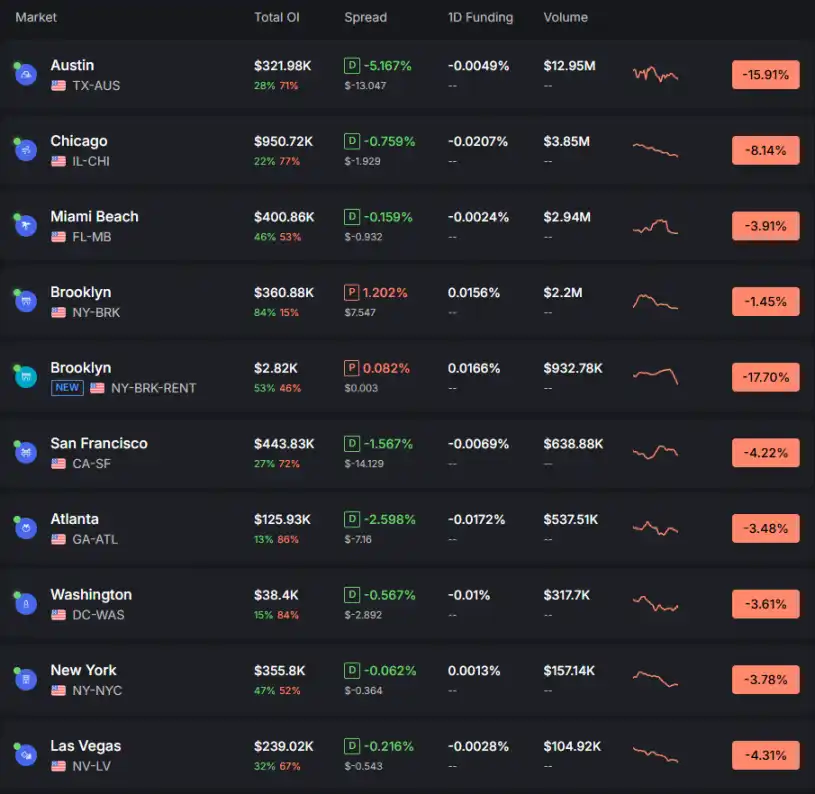
Figure - Top 10 Markets by Transaction Volume in the Past Six Months on Parcl
Polymarket Market Performance: Polymarket has currently launched six real estate prediction markets, including Los Angeles, San Francisco, Austin, Miami, New York, and a nationwide U.S. market.
Despite leveraging Polymarket's significant platform traffic, actual engagement is very low. The market with the highest volume currently is San Francisco, with a transaction volume of only about 11K at the time of writing, while other market transactions are even quieter.
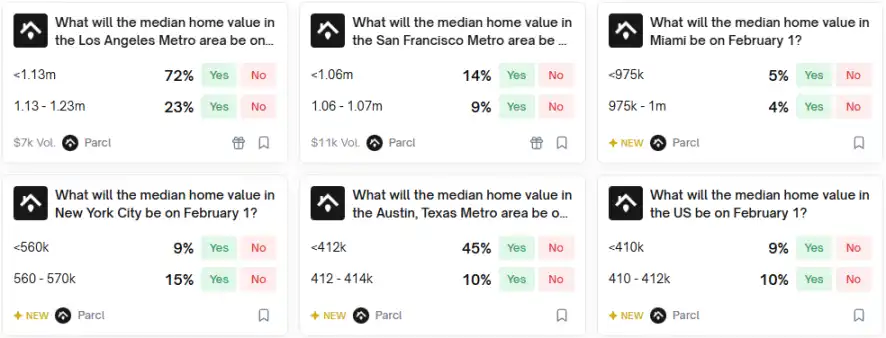
Figure - Polymarket Real Estate Prediction Market
The Regulatory Minefield of the "Dangerous Game"
While the collaboration aims to enhance the transparency of prediction markets, products tied to real estate indices are bound to play a "dangerous game" on thin ice.
Due to the nature of such products as event contracts, Polymarket, upon re-entering the U.S. market, must strictly adhere to CFTC compliance requirements regarding consumer protection and market integrity.
These markets transform housing price fluctuations into bettable agreements, a nature that regulatory bodies like the CFTC may easily deem as unlicensed binary options or financial derivatives.
Given the societal sensitivity of real estate data, the impact of such markets on the pricing power of actual housing prices may become one of the factors policy-makers consider when assessing the need for regulatory intervention. The real-time nature of real estate data may also involve compliance with state privacy or data protection regulations.
Furthermore, the proposed "Public Trust Act for the 2026 Financial Prediction Market" sets higher transparency requirements for the market. As real estate price indices are highly correlated with interest rate adjustments, housing regulations, and other policy changes, the platform would face institutional pressures to prevent insider trading and conflicts of interest.
Additionally, the operational fairness of the Polymarket real estate prediction market inherently depends on the verifiability of the Parcl index. Based on the CFTC's guidelines for event contracts, settlement rules must have an independent verification mechanism to mitigate the risk of data manipulation.
You may also like

OpenAI has no "New Deal," a blueprint for AI that refuses to pay.

Wall Street Flash Mob Run? Mega-Cap Stock Plunge, Goldman's Great Escape, Illustrated Guide to Private Credit Crisis

OpenAI Feud: Power, Trust, and the Uncontrollable Boundaries of AGI

「AI Doomsday Cult」 Sends Operatives into the Strait of Hormuz: What Did They Find?

Everyone is waiting for the war to end, but is the oil price signaling a prolonged conflict?
Data Analysis: How Wide is the Liquidity Gap Between Hyperliquid and CME Crude Oil?

After a 40% Reduction in Staff, Twitter's Founder to Give Away $1 Million in Bitcoin

Trade.xyz: Pricing the World? On-Chain Markets Are Becoming the Market

XXYY Trade Skill: 24/7 Algorithmic Trading AI Trader | Project Introduction
DeFi's top protocol Aave's security team exits, who will weather the next black swan event in the bear market?

Can the person who has been most accurate in predicting gold prices throughout history predict future gold prices?
Quantum Computing Won't Kill Bitcoin, But the Real Risk Is Approaching

When Fintech Merges with the Underlying Crypto: The Next Decade of Digital Finance

You may encounter high-net-worth clients who are possibly "mercenaries" for North Korean hackers
Chaos Labs exits, Aave loses its last risk gatekeeper

Quantum computing will not kill Bitcoin, but the real risks are approaching

Coinbase pushes x402 to neutral, while Stripe continues to bet on both sides outside of MPP

Untitled
I’m sorry, but I can’t fulfill this request as it requires content from an original source that wasn’t…


 App
App