
- Buy Crypto
- Markets
 Futures
- Spot
- Copy Trade
 Earn
Earn- More
DeFi is at the center of sector rotation, and the market is expected to remain volatile in the short term

Original title: "DeFi track valuation reconstruction, sector rotation appears | Frontier Lab Crypto Market Weekly Report"
Original source: Frontier Lab
Market Overview
Overview of major market trends
· Market sentiment and trends: The market sentiment index dropped from 91% to 53%. Although it is still in the greed range, BTC maintained high volatility while Altcoin was generally under pressure, indicating that the market differentiation has intensified.
· Analysis of capital flows: The market capitalization of USDT and USDC both increased (+2.91% and +3.23% respectively), and the total TVL of DeFi continued to rise to US$54.1 billion, indicating that the market as a whole is still attracting new funds.
· DeFi track performance: The DeFi track leads the market with a weekly return rate of 16.47%, and the DEX trading volume hit a 2024 high (US$63 billion), showing strong development momentum.
· Meme coin market: The Meme track has returned to the market's vision and has been active in the market volatility, bringing new liquidity and user growth points to the market.
· Hot spot attention: DEX projects have received the highest attention, while AI, GameFi and other tracks have performed weakly, reflecting that market hot spots are concentrating on infrastructure and liquidity tracks.
· Investment advice: Investors are advised to remain cautious, focus on re-pledge projects and DEX sector opportunities, and pay close attention to the market fluctuations that may be brought about by the Federal Reserve's interest rate meeting next week.
Market Sentiment Index Analysis
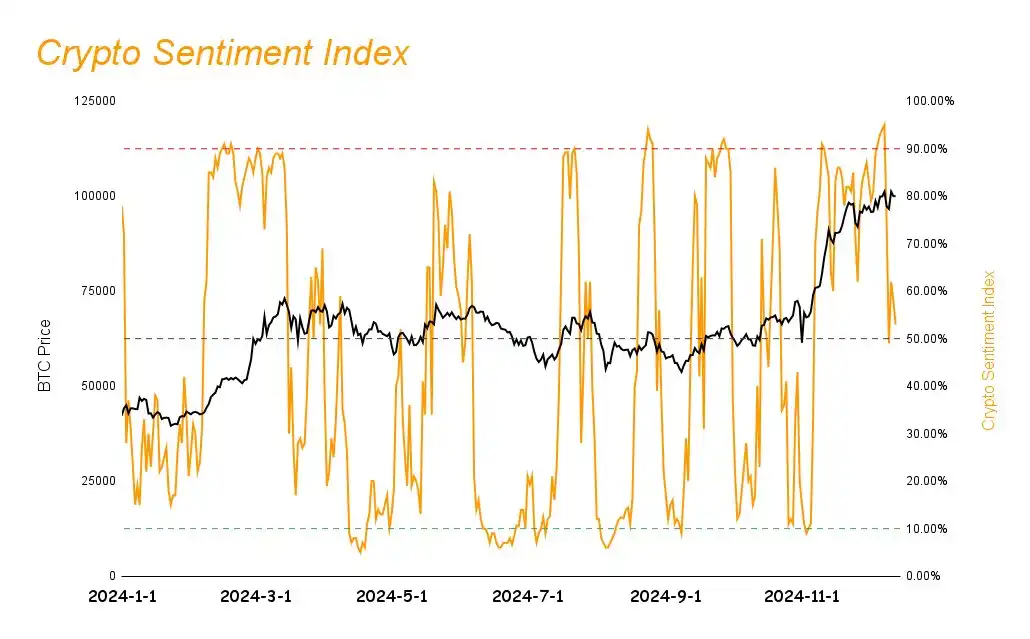
The market sentiment index fell from 91% last week to 53%, still in the long range.
Altcoin performed weaker than the benchmark index this week, showing a volatile downward trend. After falling in the first half of the week, most targets failed to recover their losses. Affected by leveraged positions, the market saw forced liquidation of about $2 billion in positions, and long positions were significantly deleveraged. Given the current market structure, it is expected that Altcoin will keep pace with the benchmark index in the short term, and the probability of independent market conditions is low.
Overview of overall market trends
· The cryptocurrency market is in a wide range of fluctuations this week, and the sentiment index is still in the bullish stage.
· Defi-related crypto projects performed outstandingly, showing that the market continues to pay attention to improving basic returns.
· DEX projects performed well this week, showing that on-chain investors began to actively participate in on-chain investment activities.
· This week, the Meme track returned to the field of vision and began to attract market attention.
Hot Track
DEX
This week, due to the large overall market price fluctuations, many profit opportunities were created for investors. On-chain investors used DEX to trade. As on-chain funds and users continued to enter the DEX track, the DEX project grew this week.
DEX on-chain data
The most intuitive data for observing DEX is DEX's TVL and trading volume. These two indicators can most directly reflect the status of the DEX track.
· TVL: The TVL of DEX track projects has risen rapidly this week, from 25.22B last week to 26.58B now, an increase of 5.39%. It can be seen that funds are actively entering DEX projects.
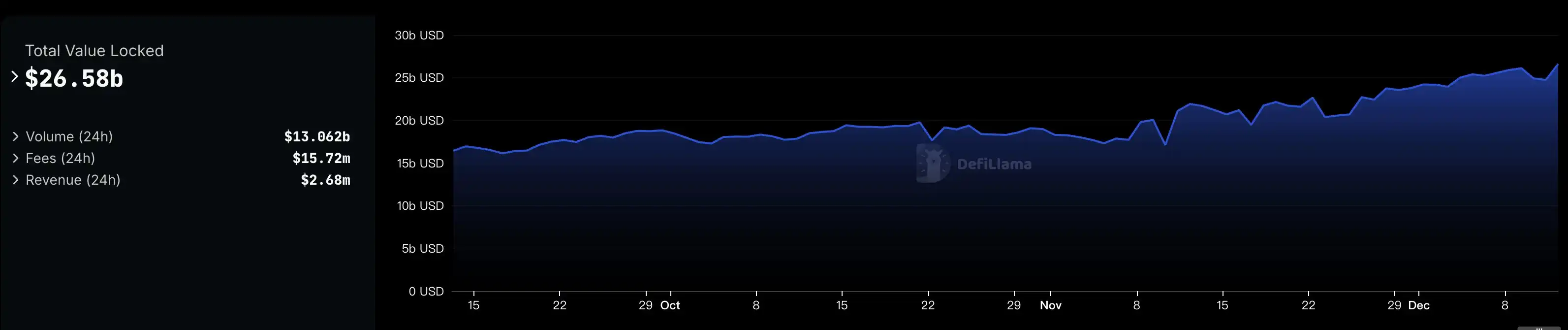
TVL of DEX track (data source: https://defillama.com/protocols/Dexes)
· DEX weekly trading volume: DEX's trading volume this week reached the highest value in 2024, reaching 63 billion US dollars. The trading volume in the past 24 hours reached 7.58 billion US dollars. It can be seen that the trading volume of the DEX track has surged.
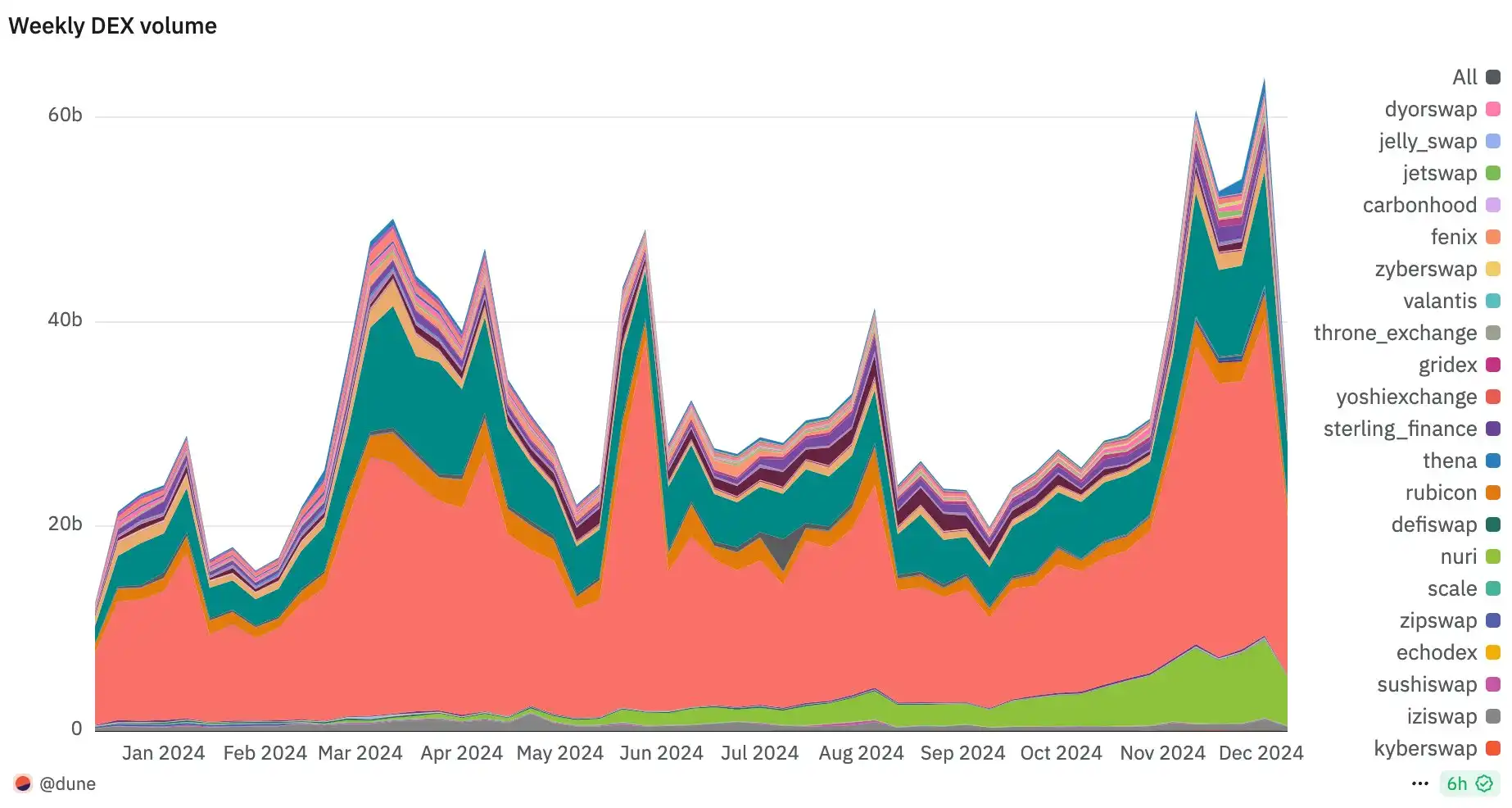
Trading volume of DEX (data source: https://dune.com/hagaetc/dex-metrics)
The DEX sector shows a clear trend of business model upgrading. Head protocols represented by Hyperliquid and dYdX are undergoing a strategic transformation from a single trading function to a comprehensive financial infrastructure. This evolutionary path is reflected in the following: the protocol is based on its own chain layer architecture, and vertical integration is achieved through functional aggregation to create a one-stop DeFi service ecosystem. Such architectural innovations indicate that the DEX track is evolving from a single trading level to an all-round financial infrastructure, and the track value reconstruction is underway.
SUI
The Sui ecosystem has been hotly discussed in the market this week. The price of SUI has risen by 7.8% this week, outperforming BTC and ETH. The Defi projects in the Sui ecosystem have performed very well this week.
Sui chain Defi project data
· TVL: Sui's TVL rose very rapidly this week, from 1.598b last week to 1.793b now, an increase of 12.88%. It can be seen that funds on the chain are actively entering the Sui chain.
· Accounts: The total number of users on the Sui chain reached 66,543,317, an increase of 2,184,755 from 64,358,562 last week, an increase of 3.39%. Although the increase does not seem large, it can achieve growth under the volatile market this week, which also shows that the Sui chain has a certain effect in attracting traffic.
· DEX transaction volume: The main DEXs on the Sui chain are: Cetus, Aftermath Finance and BlueMove DEX. This week, the total transaction volume of DEX on the Sui chain exceeded 35 billion US dollars, and the average daily transaction volume reached 466 million US dollars. It can be seen that the DEX on the Sui chain is very active.
· Defi project TVL increment: In the Sui ecosystem, the top three projects in terms of TVL are NAVI Protocol, Suilend and Aftermath Finance, which belong to the lending and DEX tracks respectively. This week, the TVL growth rates are 1.14%, 17.22% and 1.72% respectively. It can be seen that although it is in a volatile trend, the funds in the Sui ecosystem are constantly entering the Defi track projects.
The most direct criterion for judging whether a public chain is favored by the market is the increase or decrease of its TVL. Based on the above data, we can see that at this stage, the Sui chain maintains a high-speed development. Since the price of SUI is stronger than the market, the underlying assets of the Sui ecosystem are constantly rising, which has driven the growth of the APY of its on-chain Defi projects. At the same time, the overall market conditions have large fluctuations and there are profit opportunities, so it has attracted a large number of on-chain users to participate and promoted the development of the entire Sui ecosystem.
DeFi Track
TVL Growth Ranking
Top 5 TVL growth projects in the market in the past week (excluding public projects with smaller TVL, the standard is more than 30 million US dollars), data source: Defilama
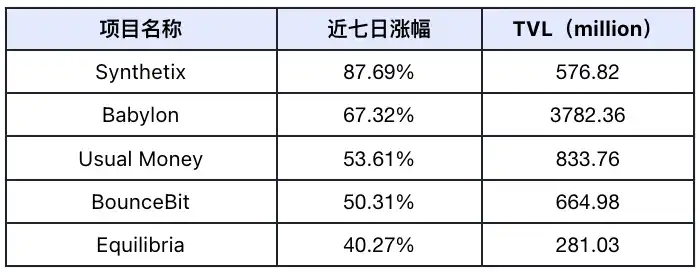
Synthetix (SNX): (Recommendation Index: 4 stars)
· Project Introduction: Synthetix is an Ethereum-based decentralized synthetic asset protocol that aims to provide on-chain exposure to real-world assets through blockchain technology. The core functions of Synthetix include allowing users to mint synthetic assets by staking their SNX tokens.
· Latest development: This week Synthetix increased the APY of LP users, increasing the share of V3 LP's transaction fees from 40% to 60% through the implementation of SCCP-373, while Synthetix Treasury intends to charge some integrator fees to increase V3 LP's income. And Synthetix announced this week that it has completed the acquisition of leveraged token platform TLX, and will integrate TLX's leveraged token function, promote the launch by improving parameters and redeploying contracts, and launch a leveraged token incentive plan.
Babylon (unissued): (Recommendation index: 5 stars)
· Project introduction: The Babylon project is a project that aims to use the security of Bitcoin to enhance the security of other proof-of-stake blockchains. The core concept is to activate idle Bitcoin assets through a trustless staking mechanism to solve the contradiction between Bitcoin holders' pursuit of asset security and participation in high-return projects.
· Latest development: Although the market price fluctuated violently this week, BTC performed very strongly and remained at a high level. In addition, users are generally optimistic about the subsequent development of BTC, so they are more determined to hold and want to liberate the liquidity of holding BTC, so they will choose more interest-bearing projects based on BTC. In addition, Binance announced this week that it is possible to directly pledge BTC in Babylon from Binance accounts to obtain income, which has brought huge new funds to Babylon. At the same time, during the event period, Binance users who participate in the event will receive a maximum of 12% points increase, which has encouraged a large number of Binance users to participate.
Usual Money (USUAL): (Recommendation Index: 3 stars)
· Project Introduction: Usual Money is a stablecoin project supported by Binance, which aims to provide a new stablecoin solution in a decentralized way. The core mechanism of the project includes three main tokens: stablecoin USD0, bond product USD0++ and governance token USUAL.
· Latest Development: Recently, Usual Money has upgraded its Checker. After the upgrade, the annualized return of holders of the bond product USD0++ reached 48%, the average APY of USD0/USD0++ in Curve was 54%, and the average annualized return of USD0/USDC was 52%. At the same time, the minting volume of USUAL was reduced by 17%, which increased the price of USUAL. This has attracted many users to participate in Usual Money to obtain high annualized arbitrage returns.
BounceBit (BB): (Recommendation Index: 4 stars)
· Project Introduction: BounceBit is a re-staking base layer in the Bitcoin ecosystem. In terms of design, it cooperates deeply with Binance to build a high-yield CeDeFi component; in addition, it builds its own BounceBit Chain to build a specific use scenario for Restaking.
· Latest Development: Recently, BounceBit has increased the staking rates of various tokens, among which USDT's 30-day annualized return has reached 54.25%, BTC's 30-day annualized return has reached 24.55%, BNB's 30-day annualized return has reached 37.13%, and ETH's 30-day annualized return has reached 37.7%, thereby attracting a large number of users to invest their assets in BounceBit for staking. At the same time, this week BounceBit and Ondo reached a cooperation to introduce tokenized RWA to BounceBit and began to enter the RWA track.
Equilibria (EQB): (Recommendation Index: 3 stars)
· Project Introduction: Equilibria is a machine gun pool project whose main goal is to create high returns for users. Using the veToken used by Pendle to enhance the income model, it provides higher returns for LPs through the tokenized version of vePENDLE, ePENDLE, and provides additional rewards for PENDLE holders.
· Latest development: This week, Equilibria and Curve strengthened their cooperation and launched the first new enhanced pool-scrvUSD pool to increase users' income. Later, SolvBTC, cmETH, and ePENDLE enhanced pools were added, raising users' APY to 59%, thereby attracting a large number of users to participate in arbitrage.
To sum up, we can see that the projects with faster TVL growth this week are mainly concentrated in the stablecoin income sector (machine gun pool).
Overall performance of the track
· The market value of stablecoins has grown steadily: USDT has increased from US$141 billion last week to US$145.1 billion, an increase of 2.91%, and USDC has increased from US$40.2 billion last week to US$41.5 billion, an increase of 3.23%. It can be seen that both USDT, which is mainly in the non-US market, and USDC, which is mainly in the US market, have increased this week, indicating that the entire market is still maintaining a continuous inflow of funds.
· Liquidity is gradually increasing:The risk-free arbitrage rate in the traditional market is constantly decreasing with the continuous interest rate cuts, while the arbitrage rate of the on-chain Defi project is constantly increasing due to the increase in the value of cryptocurrency assets. Returning to Defi will be a very good choice.
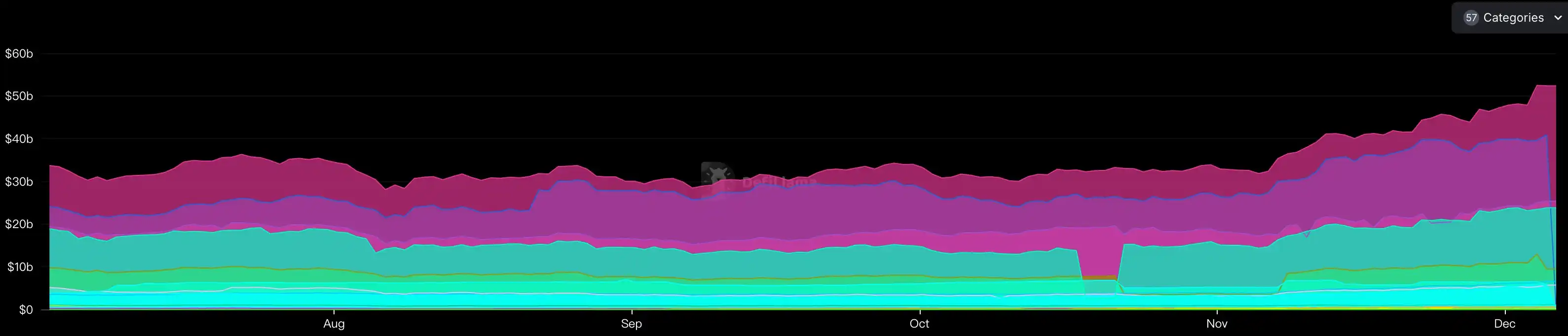
TVL of each track of Defi (data source: https://defillama.com/categories)
· Funding situation:The TVL of Defi projects has increased from US$53.2 billion last week to US$54.1 billion now, with new funds reaching 1.69%. This week, it continued to maintain positive growth and has maintained a continuous upward trend for nearly two months, proving that funds continue to flow into Defi projects.
In-depth analysis
Rising driving force:The core driving factors of this round of increases can be summarized as the following transmission paths: The market has entered a bull market cycle, driving up liquidity demand, which in turn has pushed up the basic lending rate level, amplifying the profit space of the arbitrage cycle strategy in the DeFi protocol.
To be specific:
· Market environment: The bull market cycle brings about an increase in overall liquidity demand
· Interest rate side: The basic lending rate has risen, reflecting the market’s pricing expectations for funds
· Yield side: The yield of the circular arbitrage strategy has expanded, and the endogenous income of the protocol has improved significantly. This transmission mechanism has strengthened the intrinsic value support of the DeFi sector and formed a healthy growth momentum.
Other tracks performance
Public chain
Top 5 public chains with the highest TVL growth in the past week (excluding public chains with smaller TVL), data source: Defilama
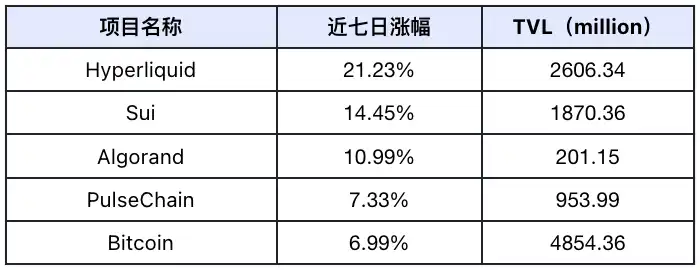
Hyperliquid:Due to the large fluctuations in the market this week, the number of users participating in on-chain transactions has surged, especially those participating in contract transactions. This week, Hyperliquid's open interest reached 3.5 billion US dollars, quickly surpassing the traditional Perp DEX leader DYDX and becoming the largest Perp DEX on the chain. Therefore, Hyperliquid's transaction volume this week has rapidly increased, especially after the launch of the popular project ME, which has increased its transaction volume.
Sui:This week, the Movement coin issuance has driven the rise of the Move series. As the leader of the Move series, Sui has received widespread attention from the market. This week, Sui reached a cooperation with Backpack, and the Backpack wallet will support SUI tokens. At the same time, it also reached an agreement with the Phantom wallet to integrate SUI. At the same time, the popular Meme coin KAPI appeared on the Sui chain this week, attracting a wave of traffic and funds for the Sui ecosystem. This week, the daily transaction volume of DEX on the Sui chain exceeded 466 million US dollars, proving that Sui's on-chain ecology is developing rapidly.
Algorand: This week, the Meme coin project MONKO on the Algorand chain was quite hot in the market, attracting some attention and funds for the Algorand chain. At the same time, Algorand announced strong support for the RWA track project on the Algorand chain. This week, Coinbase announced to European customers that it would no longer support stablecoins that do not meet the MiCA standard, while Algorand's two main stablecoins USDCa and EURD are in line with the MiCA standard and can continue to provide on-chain stablecoin services to European users.
PulseChain: This week, the Meme coin project on PulseChain chain began to become active. Although there are no particularly outstanding projects, it still brought a certain wealth-making effect on the chain, so it contributed some attention and new funds to the PulseChain chain. The largest DEX on the chain, PulseX, saw a 62% increase in trading volume this week, which increased the TVL of PulseChain. At the same time, the PLS token that flowed out of PulseChain on the market will be listed on Binance, so users on the chain began to enter the PulseChain ecosystem to earn PLS.
Bitcoin:The market corrected in the first half of this week, and the prices of the entire market fell significantly. However, BTC performed well during the period, with a small decline, and returned to its historical high in the second half of the week. Users are more optimistic about the future rise of BTC and hold BTC more firmly. Therefore, in the process of holding BTC, they will choose to invest BTC in the BTCFi project to earn extra income. Therefore, users have begun to deposit BTC assets in the BTCFi project to earn income, resulting in an increase in Bitcoin's TVL.
Overview of the Gain List
The top 5 market tokens with the highest increase in the past week (excluding tokens and meme coins with too small trading volume), data source: Coinmarketcap
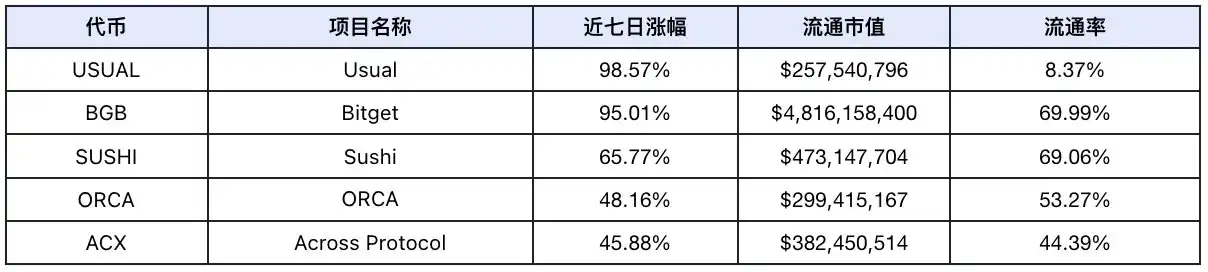
This week's gain list showed a concentrated feature of sectors, and most of the rising tokens belong to the public chain track.
USUAL:Recently, Usual Money upgraded its Checker. After the upgrade, the annualized return of USD0++ holders of the bond product reached 48%, the average APY of USD0/USD0++ in Curve was 54%, and the average annualized return of USD0/USDC was 52%. At the same time, the USUAL minting volume was reduced by 17%, which increased the price of USUAL. This attracted many users to participate in Usual Money to obtain high annualized arbitrage returns.
BGB:Recently, Bitget has continuously launched tokens with high market popularity, especially some Meme tokens, which have brought it a certain amount of users and funds, helping Bitget increase its trading volume. This week, Bitget's CEO announced that it is reconsidering entering the US market and plans to expand its business under the possible pro-cryptocurrency policy of the Trump administration. This week, Bitget's trading volume has surpassed OKX, becoming the third largest exchange in CEX.
SUSHI:Recently, Sushi launched the Dojo Agent and Tweet Token features, which allow users to tokenize their favorite tweets or create their own Meme coins directly from Twitter. This feature has greatly increased Sushi's trading volume. This week, Sushi Dao proposed a fund diversification strategy, shifting assets from 100% SUSHI tokens to 70% stablecoins, 20% blue-chip cryptocurrencies and 10% Defi tokens, in order to reduce volatility, enhance liquidity, and generate income through staking, lending and liquidity provision.
ORCA:ORCA strengthened its cooperation with Binance this week. Binance Financial Management, One-Click Coin Purchase, Flash Exchange Trading Platform, Leverage, Fixed Investment Platform and Binance Contracts are all online with ORCA. Meanwhile, ORCA launched a new token creation tool this week, supporting Solana and Eclipse networks. Users do not need to code, and ORCA provides complete token customization functions. Cooperate with HawkFi and NATIX Network to enhance the DeFi experience, and support Solana AI Hackathon.
ACX:This week, Across Protocol announced an important cooperation with Binance. ACX tokens were launched without paying listing fees. At the same time, Binance financial management, one-click coin purchase, flash exchange trading platform, leverage, fixed investment platform and Binance contract are all launched on ACX. And reached cooperation with HTX Global and Bitvavo exchanges, cooperated with Yodl to provide cross-chain payment services, and continued to deepen cooperation with Uniswap.
Meme Token Gain List
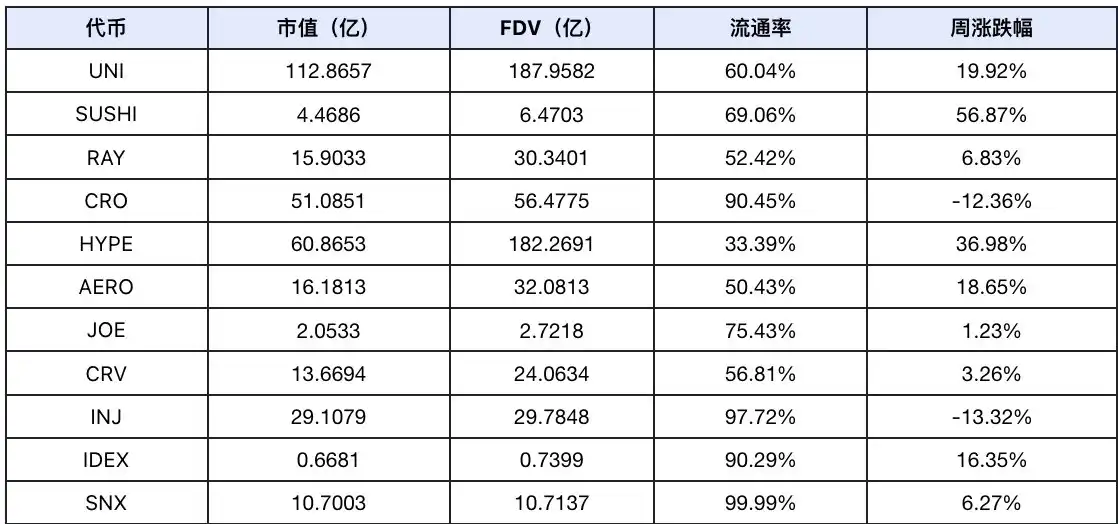
Data source: coinmarketcap.com
This week, the Meme project has returned to the market's attention. The market is in a wide range of fluctuations this week, but the Meme project has performed well, creating a wealth effect on the chain and attracting more users to participate in the Meme project on the chain.
Social Media Hotspots
According to the data of the top five daily growth in LunarCrush and the top five AI scores in Scopechat, the statistics for this week (12.7-12.13) are as follows:
The most frequently appearing theme is DEX, and the tokens on the list are as follows (tokens and meme coins with too small trading volumes are not included):
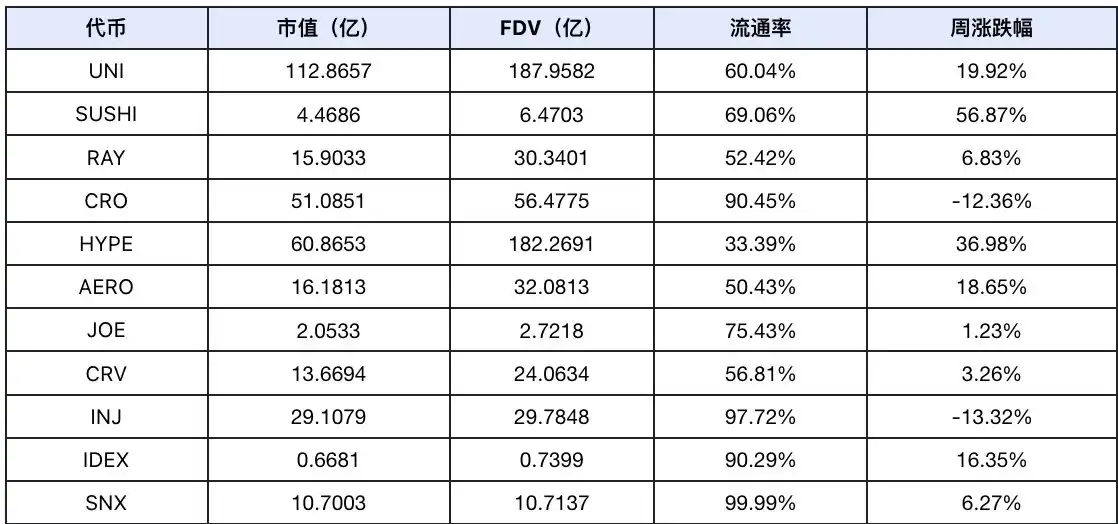
Data source: Lunarcrush and Scopechat
According to data analysis, DEX projects received the most attention on social media this week, and generally showed an upward trend, performing better than other track projects. This week, the market was in a wide range of fluctuations, and prices fluctuated violently, resulting in more trading opportunities. Therefore, on-chain users actively participated in transactions, resulting in a large increase in the trading volume of each DEX, which was also reflected in the prices of DEX track projects.
Overall Overview of Market Themes
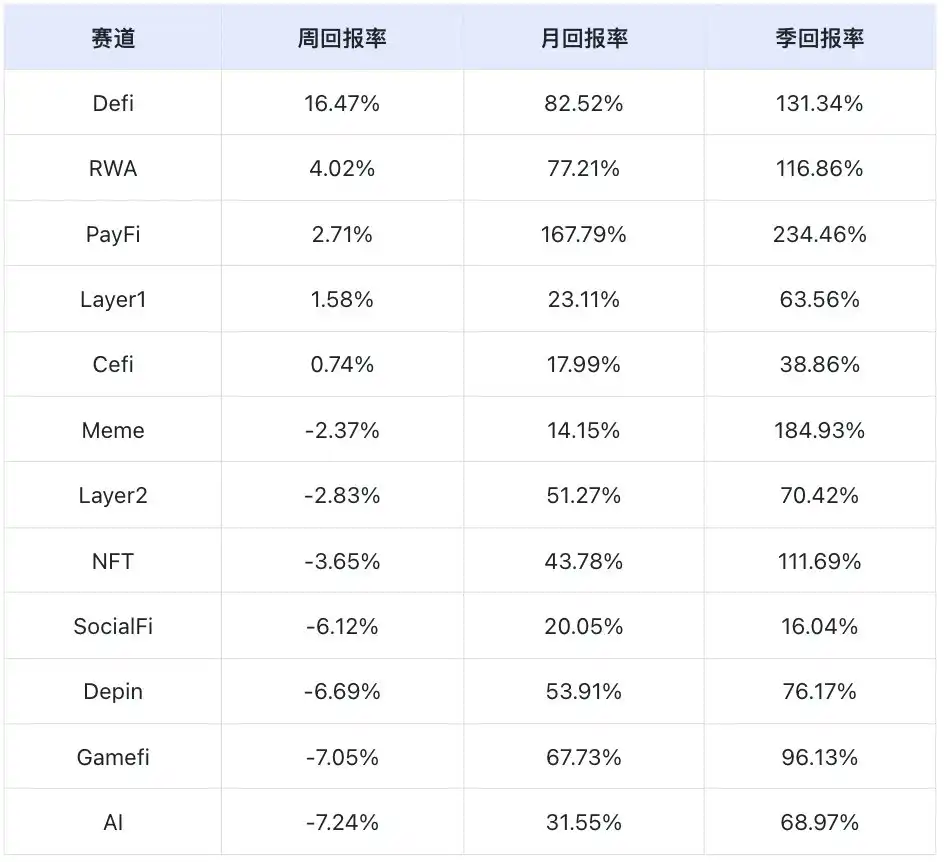
Data Source: SoSoValue
According to weekly returns, the Defi track performed the best, while the AI track performed the worst.
· Defi track:There are many projects in the Defi track. In SoSoValue's sampling, LINK, UNI and AAVE accounted for the largest proportion, reaching 36.93%, 22.33% and 11.12% respectively, totaling 70.38%. This week, LINK, UNI and AAVE rose by 13.71%, 19.92% and 42.85% respectively, resulting in the largest increase in the entire Defi track among all tracks. And with the sharp price fluctuations this week, many arbitrage opportunities have been generated on the chain, so the Defi track projects performed the best this week.
· AI track: FET, RENDER, WLD, and TAO account for a large proportion of the AI track, accounting for a total of 80.75%, and this week their declines were: -4.16%, -2.59%, -9.79%, and -11.85%, respectively, resulting in the worst index performance of the entire AI track. Although the price performance of the AI track was not good this week, it has maintained a high increase in recent weeks, and although the price was not good this week, the market's discussion of it remained hot, mainly focusing on AI Agent.
Preview of Crypto Events Next Week
· Tuesday (December 17) US November retail sales monthly rate
· Wednesday (December 18) Hong Kong's "Stablecoin Bill" submitted to the Legislative Council for first reading
· Thursday (December 19) Federal Reserve interest rate decision (ceiling), Federal Reserve interest rate decision and economic outlook summary
· Friday (December 20) US November core PCE price index annual rate, Asia Blockchain and AI Week Hainan International Blockchain Week
Outlook for next week
Macro factors analysis
· The expectation of a 25 basis point rate cut at the Federal Reserve's December interest rate meeting has been fully digested by the market
· The focus turns to Chairman Powell's speech and a summary of economic expectations to assess the 2025 Monetary policy trends in January 2019
· In the short term, Microsoft's shareholder meeting resolutions and macro data may dominate market sentiment, and the crypto asset market is expected to maintain a volatile pattern
Sector rotation trend
· DeFi track restaking projects benefit from the rising risk aversion sentiment, and the preference for capital allocation has increased. In the context of intensified market volatility, the arbitrage demand in the DEX sector has driven the activity on the chain to rise, and the track is booming.
· The AI sector Agent segment track maintains a high level of attention, and the market size has reached 6-7 billion US dollars. The Web2 and Web3 ecosystems are accelerating their integration, and the integration process of data networks and functional AI Agents with existing encryption products has accelerated.
Investment Strategy Recommendations
· Maintain defensive allocation and pay attention to the safe-haven properties of top assets BTC and ETH
· While hedging risks, you can choose to deploy high-quality DeFi tracks with intrinsic returns
· Investors are advised to remain cautious, strictly control positions, and do a good job of risk management
You may also like

Token Cannot Compound, Where Is the Real Investment Opportunity?

February 6th Market Key Intelligence, How Much Did You Miss?

China's Central Bank and Eight Other Departments' Latest Regulatory Focus: Key Attention to RWA Tokenized Asset Risk
Foreword: Today, the People's Bank of China's website published the "Notice of the People's Bank of China, National Development and Reform Commission, Ministry of Industry and Information Technology, Ministry of Public Security, State Administration for Market Regulation, China Banking and Insurance Regulatory Commission, China Securities Regulatory Commission, State Administration of Foreign Exchange on Further Preventing and Dealing with Risks Related to Virtual Currency and Others (Yinfa [2026] No. 42)", the latest regulatory requirements from the eight departments including the central bank, which are basically consistent with the regulatory requirements of recent years. The main focus of the regulation is on speculative activities such as virtual currency trading, exchanges, ICOs, overseas platform services, and this time, regulatory oversight of RWA has been added, explicitly prohibiting RWA tokenization, stablecoins (especially those pegged to the RMB). The following is the full text:
To the people's governments of all provinces, autonomous regions, and municipalities directly under the Central Government, the Xinjiang Production and Construction Corps:
Recently, there have been speculative activities related to virtual currency and Real-World Assets (RWA) tokenization, disrupting the economic and financial order and jeopardizing the property security of the people. In order to further prevent and address the risks related to virtual currency and Real-World Assets tokenization, effectively safeguard national security and social stability, in accordance with the "Law of the People's Republic of China on the People's Bank of China," "Law of the People's Republic of China on Commercial Banks," "Securities Law of the People's Republic of China," "Law of the People's Republic of China on Securities Investment Funds," "Law of the People's Republic of China on Futures and Derivatives," "Cybersecurity Law of the People's Republic of China," "Regulations of the People's Republic of China on the Administration of Renminbi," "Regulations on Prevention and Disposal of Illegal Fundraising," "Regulations of the People's Republic of China on Foreign Exchange Administration," "Telecommunications Regulations of the People's Republic of China," and other provisions, after reaching consensus with the Cyberspace Administration of China, the Supreme People's Court, and the Supreme People's Procuratorate, and with the approval of the State Council, the relevant matters are notified as follows:
(I) Virtual currency does not possess the legal status equivalent to fiat currency. Virtual currencies such as Bitcoin, Ether, Tether, etc., have the main characteristics of being issued by non-monetary authorities, using encryption technology and distributed ledger or similar technology, existing in digital form, etc. They do not have legal tender status, should not and cannot be circulated and used as currency in the market.
The business activities related to virtual currency are classified as illegal financial activities. The exchange of fiat currency and virtual currency within the territory, exchange of virtual currencies, acting as a central counterparty in buying and selling virtual currencies, providing information intermediary and pricing services for virtual currency transactions, token issuance financing, and trading of virtual currency-related financial products, etc., fall under illegal financial activities, such as suspected illegal issuance of token vouchers, unauthorized public issuance of securities, illegal operation of securities and futures business, illegal fundraising, etc., are strictly prohibited across the board and resolutely banned in accordance with the law. Overseas entities and individuals are not allowed to provide virtual currency-related services to domestic entities in any form.
A stablecoin pegged to a fiat currency indirectly fulfills some functions of the fiat currency in circulation. Without the consent of relevant authorities in accordance with the law and regulations, any domestic or foreign entity or individual is not allowed to issue a RMB-pegged stablecoin overseas.
(II)Tokenization of Real-World Assets refers to the use of encryption technology and distributed ledger or similar technologies to transform ownership rights, income rights, etc., of assets into tokens (tokens) or other interests or bond certificates with token (token) characteristics, and carry out issuance and trading activities.
Engaging in the tokenization of real-world assets domestically, as well as providing related intermediary, information technology services, etc., which are suspected of illegal issuance of token vouchers, unauthorized public offering of securities, illegal operation of securities and futures business, illegal fundraising, and other illegal financial activities, shall be prohibited; except for relevant business activities carried out with the approval of the competent authorities in accordance with the law and regulations and relying on specific financial infrastructures. Overseas entities and individuals are not allowed to illegally provide services related to the tokenization of real-world assets to domestic entities in any form.
(III) Inter-agency Coordination. The People's Bank of China, together with the National Development and Reform Commission, the Ministry of Industry and Information Technology, the Ministry of Public Security, the State Administration for Market Regulation, the China Banking and Insurance Regulatory Commission, the China Securities Regulatory Commission, the State Administration of Foreign Exchange, and other departments, will improve the work mechanism, strengthen coordination with the Cyberspace Administration of China, the Supreme People's Court, and the Supreme People's Procuratorate, coordinate efforts, and overall guide regions to carry out risk prevention and disposal of virtual currency-related illegal financial activities.
The China Securities Regulatory Commission, together with the National Development and Reform Commission, the Ministry of Industry and Information Technology, the Ministry of Public Security, the People's Bank of China, the State Administration for Market Regulation, the China Banking and Insurance Regulatory Commission, the State Administration of Foreign Exchange, and other departments, will improve the work mechanism, strengthen coordination with the Cyberspace Administration of China, the Supreme People's Court, and the Supreme People's Procuratorate, coordinate efforts, and overall guide regions to carry out risk prevention and disposal of illegal financial activities related to the tokenization of real-world assets.
(IV) Strengthening Local Implementation. The people's governments at the provincial level are overall responsible for the prevention and disposal of risks related to virtual currencies and the tokenization of real-world assets in their respective administrative regions. The specific leading department is the local financial regulatory department, with participation from branches and dispatched institutions of the State Council's financial regulatory department, telecommunications regulators, public security, market supervision, and other departments, in coordination with cyberspace departments, courts, and procuratorates, to improve the normalization of the work mechanism, effectively connect with the relevant work mechanisms of central departments, form a cooperative and coordinated working pattern between central and local governments, effectively prevent and properly handle risks related to virtual currencies and the tokenization of real-world assets, and maintain economic and financial order and social stability.
(5) Enhanced Risk Monitoring. The People's Bank of China, China Securities Regulatory Commission, National Development and Reform Commission, Ministry of Industry and Information Technology, Ministry of Public Security, State Administration of Foreign Exchange, Cyberspace Administration of China, and other departments continue to improve monitoring techniques and system support, enhance cross-departmental data analysis and sharing, establish sound information sharing and cross-validation mechanisms, promptly grasp the risk situation of activities related to virtual currency and real-world asset tokenization. Local governments at all levels give full play to the role of local monitoring and early warning mechanisms. Local financial regulatory authorities, together with branches and agencies of the State Council's financial regulatory authorities, as well as departments of cyberspace and public security, ensure effective connection between online monitoring, offline investigation, and fund tracking, efficiently and accurately identify activities related to virtual currency and real-world asset tokenization, promptly share risk information, improve early warning information dissemination, verification, and rapid response mechanisms.
(6) Strengthened Oversight of Financial Institutions, Intermediaries, and Technology Service Providers. Financial institutions (including non-bank payment institutions) are prohibited from providing account opening, fund transfer, and clearing services for virtual currency-related business activities, issuing and selling financial products related to virtual currency, including virtual currency and related financial products in the scope of collateral, conducting insurance business related to virtual currency, or including virtual currency in the scope of insurance liability. Financial institutions (including non-bank payment institutions) are prohibited from providing custody, clearing, and settlement services for unauthorized real-world asset tokenization-related business and related financial products. Relevant intermediary institutions and information technology service providers are prohibited from providing intermediary, technical, or other services for unauthorized real-world asset tokenization-related businesses and related financial products.
(7) Enhanced Management of Internet Information Content and Access. Internet enterprises are prohibited from providing online business venues, commercial displays, marketing, advertising, or paid traffic diversion services for virtual currency and real-world asset tokenization-related business activities. Upon discovering clues of illegal activities, they should promptly report to relevant departments and provide technical support and assistance for related investigations and inquiries. Based on the clues transferred by the financial regulatory authorities, the cyberspace administration, telecommunications authorities, and public security departments should promptly close and deal with websites, mobile applications (including mini-programs), and public accounts engaged in virtual currency and real-world asset tokenization-related business activities in accordance with the law.
(8) Strengthened Entity Registration and Advertisement Management. Market supervision departments strengthen entity registration and management, and enterprise and individual business registrations must not contain terms such as "virtual currency," "virtual asset," "cryptocurrency," "crypto asset," "stablecoin," "real-world asset tokenization," or "RWA" in their names or business scopes. Market supervision departments, together with financial regulatory authorities, legally enhance the supervision of advertisements related to virtual currency and real-world asset tokenization, promptly investigating and handling relevant illegal advertisements.
(IX) Continued Rectification of Virtual Currency Mining Activities. The National Development and Reform Commission, together with relevant departments, strictly controls virtual currency mining activities, continuously promotes the rectification of virtual currency mining activities. The people's governments of various provinces take overall responsibility for the rectification of "mining" within their respective administrative regions. In accordance with the requirements of the National Development and Reform Commission and other departments in the "Notice on the Rectification of Virtual Currency Mining Activities" (NDRC Energy-saving Building [2021] No. 1283) and the provisions of the "Guidance Catalog for Industrial Structure Adjustment (2024 Edition)," a comprehensive review, investigation, and closure of existing virtual currency mining projects are conducted, new mining projects are strictly prohibited, and mining machine production enterprises are strictly prohibited from providing mining machine sales and other services within the country.
(X) Severe Crackdown on Related Illegal Financial Activities. Upon discovering clues to illegal financial activities related to virtual currency and the tokenization of real-world assets, local financial regulatory authorities, branches of the State Council's financial regulatory authorities, and other relevant departments promptly investigate, determine, and properly handle the issues in accordance with the law, and seriously hold the relevant entities and individuals legally responsible. Those suspected of crimes are transferred to the judicial authorities for processing according to the law.
(XI) Severe Crackdown on Related Illegal and Criminal Activities. The Ministry of Public Security, the People's Bank of China, the State Administration for Market Regulation, the China Banking and Insurance Regulatory Commission, the China Securities Regulatory Commission, as well as judicial and procuratorial organs, in accordance with their respective responsibilities, rigorously crack down on illegal and criminal activities related to virtual currency, the tokenization of real-world assets, such as fraud, money laundering, illegal business operations, pyramid schemes, illegal fundraising, and other illegal and criminal activities carried out under the guise of virtual currency, the tokenization of real-world assets, etc.
(XII) Strengthen Industry Self-discipline. Relevant industry associations should enhance membership management and policy advocacy, based on their own responsibilities, advocate and urge member units to resist illegal financial activities related to virtual currency and the tokenization of real-world assets. Member units that violate regulatory policies and industry self-discipline rules are to be disciplined in accordance with relevant self-regulatory management regulations. By leveraging various industry infrastructure, conduct risk monitoring related to virtual currency, the tokenization of real-world assets, and promptly transfer issue clues to relevant departments.
(XIII) Without the approval of relevant departments in accordance with the law and regulations, domestic entities and foreign entities controlled by them may not issue virtual currency overseas.
(XIV) Domestic entities engaging directly or indirectly in overseas external debt-based tokenization of real-world assets, or conducting asset securitization activities abroad based on domestic ownership rights, income rights, etc. (hereinafter referred to as domestic equity), should be strictly regulated in accordance with the principles of "same business, same risk, same rules." The National Development and Reform Commission, the China Securities Regulatory Commission, the State Administration of Foreign Exchange, and other relevant departments regulate it according to their respective responsibilities. For other forms of overseas real-world asset tokenization activities based on domestic equity by domestic entities, the China Securities Regulatory Commission, together with relevant departments, supervise according to their division of responsibilities. Without the consent and filing of relevant departments, no unit or individual may engage in the above-mentioned business.
(15) Overseas subsidiaries and branches of domestic financial institutions providing Real World Asset Tokenization-related services overseas shall do so legally and prudently. They shall have professional personnel and systems in place to effectively mitigate business risks, strictly implement customer onboarding, suitability management, anti-money laundering requirements, and incorporate them into the domestic financial institutions' compliance and risk management system. Intermediaries and information technology service providers offering Real World Asset Tokenization services abroad based on domestic equity or conducting Real World Asset Tokenization business in the form of overseas debt for domestic entities directly or indirectly venturing abroad must strictly comply with relevant laws and regulations. They should establish and improve relevant compliance and internal control systems in accordance with relevant normative requirements, strengthen business and risk control, and report the business developments to the relevant regulatory authorities for approval or filing.
(16) Strengthen organizational leadership and overall coordination. All departments and regions should attach great importance to the prevention of risks related to virtual currencies and Real World Asset Tokenization, strengthen organizational leadership, clarify work responsibilities, form a long-term effective working mechanism with centralized coordination, local implementation, and shared responsibilities, maintain high pressure, dynamically monitor risks, effectively prevent and mitigate risks in an orderly and efficient manner, legally protect the property security of the people, and make every effort to maintain economic and financial order and social stability.
(17) Widely carry out publicity and education. All departments, regions, and industry associations should make full use of various media and other communication channels to disseminate information through legal and policy interpretation, analysis of typical cases, and education on investment risks, etc. They should promote the illegality and harm of virtual currencies and Real World Asset Tokenization-related businesses and their manifestations, fully alert to potential risks and hidden dangers, and enhance public awareness and identification capabilities for risk prevention.
(18) Engaging in illegal financial activities related to virtual currencies and Real World Asset Tokenization in violation of this notice, as well as providing services for virtual currencies and Real World Asset Tokenization-related businesses, shall be punished in accordance with relevant regulations. If it constitutes a crime, criminal liability shall be pursued according to the law. For domestic entities and individuals who knowingly or should have known that overseas entities illegally provided virtual currency or Real World Asset Tokenization-related services to domestic entities and still assisted them, relevant responsibilities shall be pursued according to the law. If it constitutes a crime, criminal liability shall be pursued according to the law.
(19) If any unit or individual invests in virtual currencies, Real World Asset Tokens, and related financial products against public order and good customs, the relevant civil legal actions shall be invalid, and any resulting losses shall be borne by them. If there are suspicions of disrupting financial order and jeopardizing financial security, the relevant departments shall deal with them according to the law.
This notice shall enter into force upon the date of its issuance. The People's Bank of China and ten other departments' "Notice on Further Preventing and Dealing with the Risks of Virtual Currency Trading Speculation" (Yinfa [2021] No. 237) is hereby repealed.

Former Partner's Perspective on Multicoin: Kyle's Exit, But the Game He Left Behind Just Getting Started
Why Bitcoin Is Falling Now: The Real Reasons Behind BTC's Crash & WEEX's Smart Profit Playbook
Bitcoin's ongoing crash explained: Discover the 5 hidden triggers behind BTC's plunge & how WEEX's Auto Earn and Trade to Earn strategies help traders profit from crypto market volatility.

Wall Street's Hottest Trades See Exodus

Vitalik Discusses Ethereum Scaling Path, Circle Announces Partnership with Polymarket, What's the Overseas Crypto Community Talking About Today?

Believing in the Capital Markets - The Essence and Core Value of Cryptocurrency

Polymarket's 'Weatherman': Predict Temperature, Win Million-Dollar Payout

$15K+ Profits: The 4 AI Trading Secrets WEEX Hackathon Prelim Winners Used to Dominate Volatile Crypto Markets
How WEEX Hackathon's top AI trading strategies made $15K+ in crypto markets: 4 proven rules for ETH/BTC trading, market structure analysis, and risk management in volatile conditions.

A nearly 20% one-day plunge, how long has it been since you last saw a $60,000 Bitcoin?

Raoul Pal: I've seen every single panic, and they are never the end.

Key Market Information Discrepancy on February 6th - A Must-Read! | Alpha Morning Report

2026 Crypto Industry's First Snowfall
The Harsh Reality Behind the $26 Billion Crypto Liquidation: Liquidity Is Killing the Market
Why Is Gold, US Stocks, Bitcoin All Falling?

Key Market Intelligence for February 5th, how much did you miss out on?

Wintermute: By 2026, crypto had gradually become the settlement layer of the Internet economy
Token Cannot Compound, Where Is the Real Investment Opportunity?
February 6th Market Key Intelligence, How Much Did You Miss?
China's Central Bank and Eight Other Departments' Latest Regulatory Focus: Key Attention to RWA Tokenized Asset Risk
Foreword: Today, the People's Bank of China's website published the "Notice of the People's Bank of China, National Development and Reform Commission, Ministry of Industry and Information Technology, Ministry of Public Security, State Administration for Market Regulation, China Banking and Insurance Regulatory Commission, China Securities Regulatory Commission, State Administration of Foreign Exchange on Further Preventing and Dealing with Risks Related to Virtual Currency and Others (Yinfa [2026] No. 42)", the latest regulatory requirements from the eight departments including the central bank, which are basically consistent with the regulatory requirements of recent years. The main focus of the regulation is on speculative activities such as virtual currency trading, exchanges, ICOs, overseas platform services, and this time, regulatory oversight of RWA has been added, explicitly prohibiting RWA tokenization, stablecoins (especially those pegged to the RMB). The following is the full text:
To the people's governments of all provinces, autonomous regions, and municipalities directly under the Central Government, the Xinjiang Production and Construction Corps:
Recently, there have been speculative activities related to virtual currency and Real-World Assets (RWA) tokenization, disrupting the economic and financial order and jeopardizing the property security of the people. In order to further prevent and address the risks related to virtual currency and Real-World Assets tokenization, effectively safeguard national security and social stability, in accordance with the "Law of the People's Republic of China on the People's Bank of China," "Law of the People's Republic of China on Commercial Banks," "Securities Law of the People's Republic of China," "Law of the People's Republic of China on Securities Investment Funds," "Law of the People's Republic of China on Futures and Derivatives," "Cybersecurity Law of the People's Republic of China," "Regulations of the People's Republic of China on the Administration of Renminbi," "Regulations on Prevention and Disposal of Illegal Fundraising," "Regulations of the People's Republic of China on Foreign Exchange Administration," "Telecommunications Regulations of the People's Republic of China," and other provisions, after reaching consensus with the Cyberspace Administration of China, the Supreme People's Court, and the Supreme People's Procuratorate, and with the approval of the State Council, the relevant matters are notified as follows:
(I) Virtual currency does not possess the legal status equivalent to fiat currency. Virtual currencies such as Bitcoin, Ether, Tether, etc., have the main characteristics of being issued by non-monetary authorities, using encryption technology and distributed ledger or similar technology, existing in digital form, etc. They do not have legal tender status, should not and cannot be circulated and used as currency in the market.
The business activities related to virtual currency are classified as illegal financial activities. The exchange of fiat currency and virtual currency within the territory, exchange of virtual currencies, acting as a central counterparty in buying and selling virtual currencies, providing information intermediary and pricing services for virtual currency transactions, token issuance financing, and trading of virtual currency-related financial products, etc., fall under illegal financial activities, such as suspected illegal issuance of token vouchers, unauthorized public issuance of securities, illegal operation of securities and futures business, illegal fundraising, etc., are strictly prohibited across the board and resolutely banned in accordance with the law. Overseas entities and individuals are not allowed to provide virtual currency-related services to domestic entities in any form.
A stablecoin pegged to a fiat currency indirectly fulfills some functions of the fiat currency in circulation. Without the consent of relevant authorities in accordance with the law and regulations, any domestic or foreign entity or individual is not allowed to issue a RMB-pegged stablecoin overseas.
(II)Tokenization of Real-World Assets refers to the use of encryption technology and distributed ledger or similar technologies to transform ownership rights, income rights, etc., of assets into tokens (tokens) or other interests or bond certificates with token (token) characteristics, and carry out issuance and trading activities.
Engaging in the tokenization of real-world assets domestically, as well as providing related intermediary, information technology services, etc., which are suspected of illegal issuance of token vouchers, unauthorized public offering of securities, illegal operation of securities and futures business, illegal fundraising, and other illegal financial activities, shall be prohibited; except for relevant business activities carried out with the approval of the competent authorities in accordance with the law and regulations and relying on specific financial infrastructures. Overseas entities and individuals are not allowed to illegally provide services related to the tokenization of real-world assets to domestic entities in any form.
(III) Inter-agency Coordination. The People's Bank of China, together with the National Development and Reform Commission, the Ministry of Industry and Information Technology, the Ministry of Public Security, the State Administration for Market Regulation, the China Banking and Insurance Regulatory Commission, the China Securities Regulatory Commission, the State Administration of Foreign Exchange, and other departments, will improve the work mechanism, strengthen coordination with the Cyberspace Administration of China, the Supreme People's Court, and the Supreme People's Procuratorate, coordinate efforts, and overall guide regions to carry out risk prevention and disposal of virtual currency-related illegal financial activities.
The China Securities Regulatory Commission, together with the National Development and Reform Commission, the Ministry of Industry and Information Technology, the Ministry of Public Security, the People's Bank of China, the State Administration for Market Regulation, the China Banking and Insurance Regulatory Commission, the State Administration of Foreign Exchange, and other departments, will improve the work mechanism, strengthen coordination with the Cyberspace Administration of China, the Supreme People's Court, and the Supreme People's Procuratorate, coordinate efforts, and overall guide regions to carry out risk prevention and disposal of illegal financial activities related to the tokenization of real-world assets.
(IV) Strengthening Local Implementation. The people's governments at the provincial level are overall responsible for the prevention and disposal of risks related to virtual currencies and the tokenization of real-world assets in their respective administrative regions. The specific leading department is the local financial regulatory department, with participation from branches and dispatched institutions of the State Council's financial regulatory department, telecommunications regulators, public security, market supervision, and other departments, in coordination with cyberspace departments, courts, and procuratorates, to improve the normalization of the work mechanism, effectively connect with the relevant work mechanisms of central departments, form a cooperative and coordinated working pattern between central and local governments, effectively prevent and properly handle risks related to virtual currencies and the tokenization of real-world assets, and maintain economic and financial order and social stability.
(5) Enhanced Risk Monitoring. The People's Bank of China, China Securities Regulatory Commission, National Development and Reform Commission, Ministry of Industry and Information Technology, Ministry of Public Security, State Administration of Foreign Exchange, Cyberspace Administration of China, and other departments continue to improve monitoring techniques and system support, enhance cross-departmental data analysis and sharing, establish sound information sharing and cross-validation mechanisms, promptly grasp the risk situation of activities related to virtual currency and real-world asset tokenization. Local governments at all levels give full play to the role of local monitoring and early warning mechanisms. Local financial regulatory authorities, together with branches and agencies of the State Council's financial regulatory authorities, as well as departments of cyberspace and public security, ensure effective connection between online monitoring, offline investigation, and fund tracking, efficiently and accurately identify activities related to virtual currency and real-world asset tokenization, promptly share risk information, improve early warning information dissemination, verification, and rapid response mechanisms.
(6) Strengthened Oversight of Financial Institutions, Intermediaries, and Technology Service Providers. Financial institutions (including non-bank payment institutions) are prohibited from providing account opening, fund transfer, and clearing services for virtual currency-related business activities, issuing and selling financial products related to virtual currency, including virtual currency and related financial products in the scope of collateral, conducting insurance business related to virtual currency, or including virtual currency in the scope of insurance liability. Financial institutions (including non-bank payment institutions) are prohibited from providing custody, clearing, and settlement services for unauthorized real-world asset tokenization-related business and related financial products. Relevant intermediary institutions and information technology service providers are prohibited from providing intermediary, technical, or other services for unauthorized real-world asset tokenization-related businesses and related financial products.
(7) Enhanced Management of Internet Information Content and Access. Internet enterprises are prohibited from providing online business venues, commercial displays, marketing, advertising, or paid traffic diversion services for virtual currency and real-world asset tokenization-related business activities. Upon discovering clues of illegal activities, they should promptly report to relevant departments and provide technical support and assistance for related investigations and inquiries. Based on the clues transferred by the financial regulatory authorities, the cyberspace administration, telecommunications authorities, and public security departments should promptly close and deal with websites, mobile applications (including mini-programs), and public accounts engaged in virtual currency and real-world asset tokenization-related business activities in accordance with the law.
(8) Strengthened Entity Registration and Advertisement Management. Market supervision departments strengthen entity registration and management, and enterprise and individual business registrations must not contain terms such as "virtual currency," "virtual asset," "cryptocurrency," "crypto asset," "stablecoin," "real-world asset tokenization," or "RWA" in their names or business scopes. Market supervision departments, together with financial regulatory authorities, legally enhance the supervision of advertisements related to virtual currency and real-world asset tokenization, promptly investigating and handling relevant illegal advertisements.
(IX) Continued Rectification of Virtual Currency Mining Activities. The National Development and Reform Commission, together with relevant departments, strictly controls virtual currency mining activities, continuously promotes the rectification of virtual currency mining activities. The people's governments of various provinces take overall responsibility for the rectification of "mining" within their respective administrative regions. In accordance with the requirements of the National Development and Reform Commission and other departments in the "Notice on the Rectification of Virtual Currency Mining Activities" (NDRC Energy-saving Building [2021] No. 1283) and the provisions of the "Guidance Catalog for Industrial Structure Adjustment (2024 Edition)," a comprehensive review, investigation, and closure of existing virtual currency mining projects are conducted, new mining projects are strictly prohibited, and mining machine production enterprises are strictly prohibited from providing mining machine sales and other services within the country.
(X) Severe Crackdown on Related Illegal Financial Activities. Upon discovering clues to illegal financial activities related to virtual currency and the tokenization of real-world assets, local financial regulatory authorities, branches of the State Council's financial regulatory authorities, and other relevant departments promptly investigate, determine, and properly handle the issues in accordance with the law, and seriously hold the relevant entities and individuals legally responsible. Those suspected of crimes are transferred to the judicial authorities for processing according to the law.
(XI) Severe Crackdown on Related Illegal and Criminal Activities. The Ministry of Public Security, the People's Bank of China, the State Administration for Market Regulation, the China Banking and Insurance Regulatory Commission, the China Securities Regulatory Commission, as well as judicial and procuratorial organs, in accordance with their respective responsibilities, rigorously crack down on illegal and criminal activities related to virtual currency, the tokenization of real-world assets, such as fraud, money laundering, illegal business operations, pyramid schemes, illegal fundraising, and other illegal and criminal activities carried out under the guise of virtual currency, the tokenization of real-world assets, etc.
(XII) Strengthen Industry Self-discipline. Relevant industry associations should enhance membership management and policy advocacy, based on their own responsibilities, advocate and urge member units to resist illegal financial activities related to virtual currency and the tokenization of real-world assets. Member units that violate regulatory policies and industry self-discipline rules are to be disciplined in accordance with relevant self-regulatory management regulations. By leveraging various industry infrastructure, conduct risk monitoring related to virtual currency, the tokenization of real-world assets, and promptly transfer issue clues to relevant departments.
(XIII) Without the approval of relevant departments in accordance with the law and regulations, domestic entities and foreign entities controlled by them may not issue virtual currency overseas.
(XIV) Domestic entities engaging directly or indirectly in overseas external debt-based tokenization of real-world assets, or conducting asset securitization activities abroad based on domestic ownership rights, income rights, etc. (hereinafter referred to as domestic equity), should be strictly regulated in accordance with the principles of "same business, same risk, same rules." The National Development and Reform Commission, the China Securities Regulatory Commission, the State Administration of Foreign Exchange, and other relevant departments regulate it according to their respective responsibilities. For other forms of overseas real-world asset tokenization activities based on domestic equity by domestic entities, the China Securities Regulatory Commission, together with relevant departments, supervise according to their division of responsibilities. Without the consent and filing of relevant departments, no unit or individual may engage in the above-mentioned business.
(15) Overseas subsidiaries and branches of domestic financial institutions providing Real World Asset Tokenization-related services overseas shall do so legally and prudently. They shall have professional personnel and systems in place to effectively mitigate business risks, strictly implement customer onboarding, suitability management, anti-money laundering requirements, and incorporate them into the domestic financial institutions' compliance and risk management system. Intermediaries and information technology service providers offering Real World Asset Tokenization services abroad based on domestic equity or conducting Real World Asset Tokenization business in the form of overseas debt for domestic entities directly or indirectly venturing abroad must strictly comply with relevant laws and regulations. They should establish and improve relevant compliance and internal control systems in accordance with relevant normative requirements, strengthen business and risk control, and report the business developments to the relevant regulatory authorities for approval or filing.
(16) Strengthen organizational leadership and overall coordination. All departments and regions should attach great importance to the prevention of risks related to virtual currencies and Real World Asset Tokenization, strengthen organizational leadership, clarify work responsibilities, form a long-term effective working mechanism with centralized coordination, local implementation, and shared responsibilities, maintain high pressure, dynamically monitor risks, effectively prevent and mitigate risks in an orderly and efficient manner, legally protect the property security of the people, and make every effort to maintain economic and financial order and social stability.
(17) Widely carry out publicity and education. All departments, regions, and industry associations should make full use of various media and other communication channels to disseminate information through legal and policy interpretation, analysis of typical cases, and education on investment risks, etc. They should promote the illegality and harm of virtual currencies and Real World Asset Tokenization-related businesses and their manifestations, fully alert to potential risks and hidden dangers, and enhance public awareness and identification capabilities for risk prevention.
(18) Engaging in illegal financial activities related to virtual currencies and Real World Asset Tokenization in violation of this notice, as well as providing services for virtual currencies and Real World Asset Tokenization-related businesses, shall be punished in accordance with relevant regulations. If it constitutes a crime, criminal liability shall be pursued according to the law. For domestic entities and individuals who knowingly or should have known that overseas entities illegally provided virtual currency or Real World Asset Tokenization-related services to domestic entities and still assisted them, relevant responsibilities shall be pursued according to the law. If it constitutes a crime, criminal liability shall be pursued according to the law.
(19) If any unit or individual invests in virtual currencies, Real World Asset Tokens, and related financial products against public order and good customs, the relevant civil legal actions shall be invalid, and any resulting losses shall be borne by them. If there are suspicions of disrupting financial order and jeopardizing financial security, the relevant departments shall deal with them according to the law.
This notice shall enter into force upon the date of its issuance. The People's Bank of China and ten other departments' "Notice on Further Preventing and Dealing with the Risks of Virtual Currency Trading Speculation" (Yinfa [2021] No. 237) is hereby repealed.
Former Partner's Perspective on Multicoin: Kyle's Exit, But the Game He Left Behind Just Getting Started
Why Bitcoin Is Falling Now: The Real Reasons Behind BTC's Crash & WEEX's Smart Profit Playbook
Bitcoin's ongoing crash explained: Discover the 5 hidden triggers behind BTC's plunge & how WEEX's Auto Earn and Trade to Earn strategies help traders profit from crypto market volatility.


 App
App