
- Buy Crypto
- Markets
 Futures
- Spot
- Copy Trade
 Earn
Earn- More
"Crypto Robin Hood" LUIGI: Shooting and killing the CEO of a 100 billion yuan group; the market value of the meme with the same name fell by 80% after soaring.

Original title: "When Meme Coins Meet Social Hotspots: LUIGI Stages a "Crypto Robin Hood" Plot"
Original author: Wenser, Odaily Planet Daily
At 2 a.m. on December 10, a meme coin called LUIGI was listed on the popular coin selection platform Moonshot about 30 minutes after the opening of pupm.fun. Amid market speculation about whether it was a "conspiracy plate" or a "big golden dog", its market value rose rapidly, once breaking through to nearly 80 million US dollars. Subsequently, the news that "the CEO of the largest insurance company in the United States was shot and killed by digital nomad Luigi Nicholas Mangione" became popular. In this regard, another "news hot meme coin" has attracted countless market attention, and more news about the incident behind the token involving sensitive factors such as US health insurance, social justice and illegal sanctions has gradually surfaced, which makes people sigh.
On the third day after the incident, let us review this "tragedy of the commons in the US health insurance industry" and understand the love-hate relationship between Meme coin and news from another perspective.
When a man named Luigi decided to commit a crime: the whole story of the shooting of the CEO
December 4, which is set as "Constitution Day" in China, is just an ordinary day in the United States.
Of course, for UnitedHealthcare, the largest insurance company in the United States and the second largest in terms of global turnover, this day is not ordinary, because the annual investor exchange meeting of this US health insurance giant is about to begin.
By then, Brian Thompson, the CEO and helmsman of this industry giant, will share the company's impressive achievements this year with people from all walks of life. After all, in the 2024 Fortune 500 list, UnitedHealth Group, the parent company behind UnitedHealthcare, has an annual revenue of $371.622 billion, ranking 8th in the world, even $7.14 billion more than Berkshire Hathaway, which is well-known to everyone, Buffett. The previous one is the global technology giant Apple; its market value once reached $560 billion, covering nearly 50 million American citizens. He certainly has reason and qualifications to be proud of himself and the company's achievements.
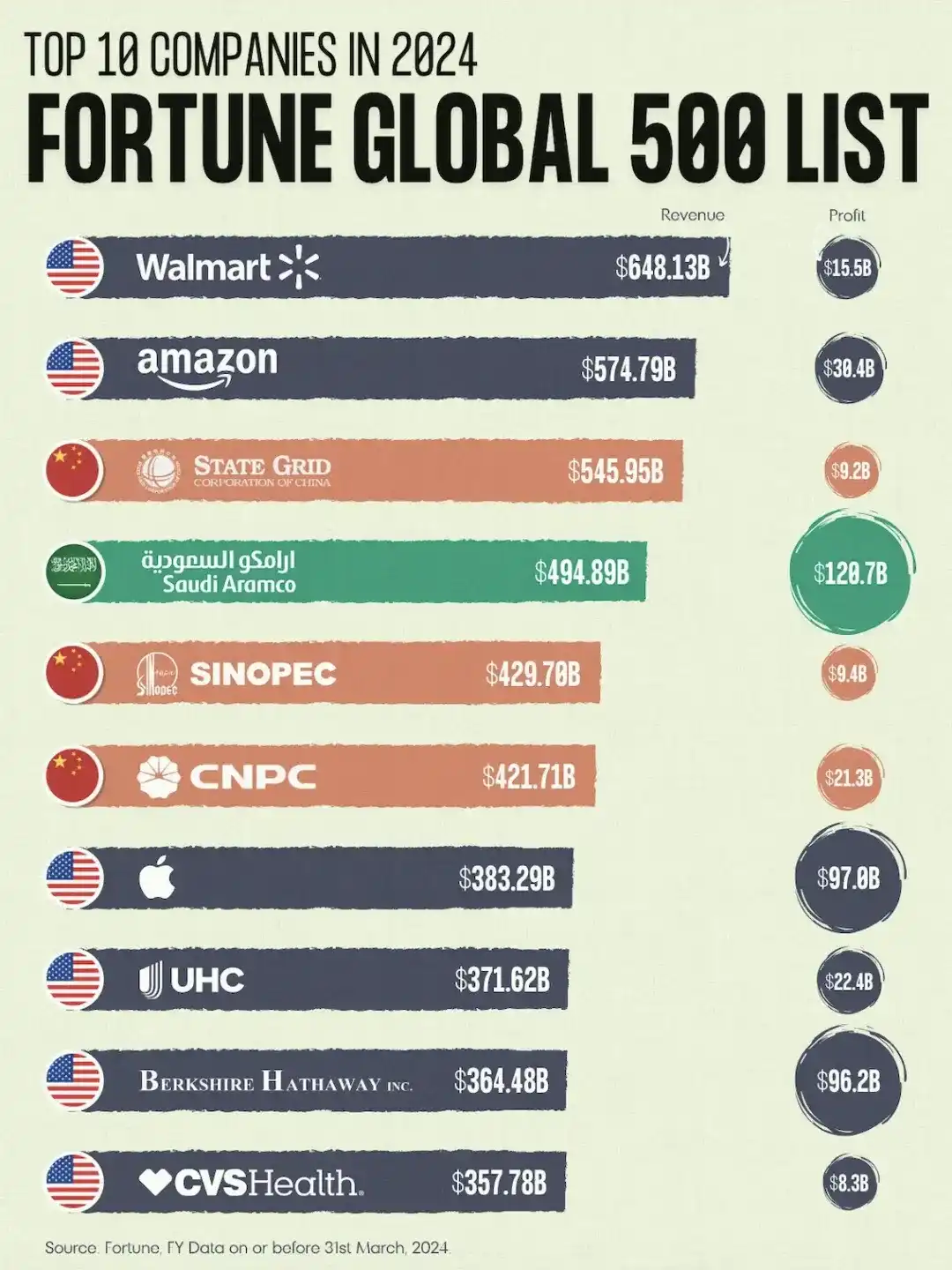
Fortune Magazine-UnitedHealth Group ranked 8th
6:45, facing the slightly chilly weather in Manhattan, New York, Brian Thompson was about to go to the Hilton Hotel where the exchange meeting was held. Because it was not far from his hotel, he chose to walk there and did not arrange security personnel for protection. Although he had received several death threats before, for him who had worked at UnitedHealth for 20 years, such threats were commonplace and he never took them seriously.
Just as he was walking on the sidewalk as usual, an accident happened - a masked man wearing a black hooded jacket and carrying a gray backpack suddenly appeared behind him like a ghost, and fired several shots with a 9 mm silencer pistol in his hand, hitting his back and calf. Although the pistol had a jammed shell in the middle, the man in black tidied himself up and walked towards Brian Thompson who had fallen down and fired another shot. Afterwards, the man crossed an alley and quickly fled the scene. Witnesses said he rode an electric bicycle into New York's Central Park.
6:48, 3 minutes after the shooting, New York police arrived at the scene and found several bullet shells left on the ground, engraved with the words "Deny, Defend, Depose" (another saying is Delay, Deny, Depose), and these three words starting with D just correspond to a set of unwritten industry rules in the US insurance industry when dealing with insurance incidents - delay: delay the claim time; refuse: refuse to pay the claim; question: question the insured in an attempt to make him give up the lawsuit.
7:04, according to the surveillance video, he took a taxi to the bus terminal, and then did not appear again in the video surveillance of the bus station, and left New York.
At 7:12, less than 30 minutes after being rushed to the hospital, Brian Thompson was pronounced dead after failed rescue efforts. The helmsman of a multi-billion dollar business empire was thus turned into a lonely soul under the gun.
As the news of the incident spread, American society was in an uproar.
Some people regard him as a "blatant murderer". After all, it is hard to imagine how cruel and cold-blooded this bloodthirsty demon is when he calmly kills and escapes in broad daylight. Some people think that there may be other hidden reasons for his "shooting the CEO of the largest insurance company in the United States". Such a seamless murder plan and a clear target object cannot rule out personal grudges or other possibilities. Some people think that this incident is just another repetition of the "gun murder incident" that has long been common in American society, but this time the victim is no longer a civilian as before, but the CEO of a giant company.
As time went on, more information was gradually revealed:
On December 5, the police investigation found that the gunman had stayed at the HI New York City Hostel on Manhattan's Upper West Side and had a brief conversation with a female staff member when checking in at the front desk. To be precise, "they were flirting, and then he (the gunman) took off (a mask or other covering) and smiled brightly." CBS News quoted a person associated with the New York police as saying.

Screen of the gunman talking to the front desk
On December 9, at a McDonald's at 407 Plank Road East in Altoona, Pennsylvania, about 450 kilometers from New York, a McDonald's clerk reported to the police that he had found a man wearing a medical mask and a beanie and carrying a backpack who was suspected to be the "New York street shooting gunman". When the police rushed over, they found that his facial features were consistent with the murderer, and confirmed him as the suspect in the "12.4 CEO shooting incident" during the interrogation, and subsequently arrested him.
It is reported that the man is named Luigi Nicholas Mangione, 26 years old, and he was in possession of a gun believed to be the one used to shoot Brian Thompson on the 4th (later confirmed to be 3D printed, which also confirmed the reason why it had jammed before). The police also found a three-page handwritten document in his personal belongings, in which Luigi wrote: "To the federal personnel, I will be brief because I do respect what you have done for our country. To save you a lengthy investigation, I clearly state that I have not cooperated with anyone." In addition, he wrote in the handwritten document: "I apologize for any disputes or trauma caused, but it must be done. Frankly speaking, these parasites deserve it."  3D printed "murder weapon" With Luigi's arrest, information about his identity and motive for the crime gradually came to light. At this time, people realized that the matter was far from being summarized by a phrase "ordinary shooting incident."
When justice and morality collide head-on: The chronic disease of the US health insurance industry VS patients’ claims
The incident has further fermented as Luigi Nicholas Mangione's identity information has become increasingly clear, and the spearhead is directed at the slightly deformed medical insurance system in the United States.
According to netizens, Luigi Nicholas Mangione is an Italian American who was born in Maryland, USA. He graduated from Gilman School, a famous private high school in Baltimore (the school has an annual tuition of up to $37,000) in 2016 and spoke as a representative of outstanding graduates; he graduated from the University of Pennsylvania, one of the "8 Ivy League schools in the United States" in May 2020. He previously studied computer science and minored in mathematics, and obtained a bachelor's and master's degree in engineering; he served as the chief counselor of the preparatory research project at Stanford University, and the video game development club he founded in college was also selected into the Computer Honor Society. He himself has interned at the famous 3A masterpiece Civilization series game company, and has also worked as a data engineer at California car shopping website TrueCar. In 2023, he went to Hawaii to start his digital nomad life.
Later, someone found his Goodreads book list, and The Four Hour Workweek by Tim Ferries, a well-known investor and digital nomad advocate, was on the list. In addition, he also wrote a long review of On Industrial Society and Its Future by Ted Kaczynski, an extremist, American mathematician, and notorious "University Unabomber" in January this year. He mentioned: "(We) can easily and quickly regard this as a madman's manifesto without thinking. But it is impossible to ignore how prescient many of his predictions about modern society are... When all other forms of communication fail, violence is necessary for survival... These companies don't care about you, your children or your grandchildren... 'Violence will never solve anything' This is a statement made by cowards and predators." It is worth mentioning that after his arrest, the US police quickly blocked and hid all of Luigi's social media (but his X platform account @PepMangione was spared because it had not posted for a long time), and his Goodreads book reviews were no exception.
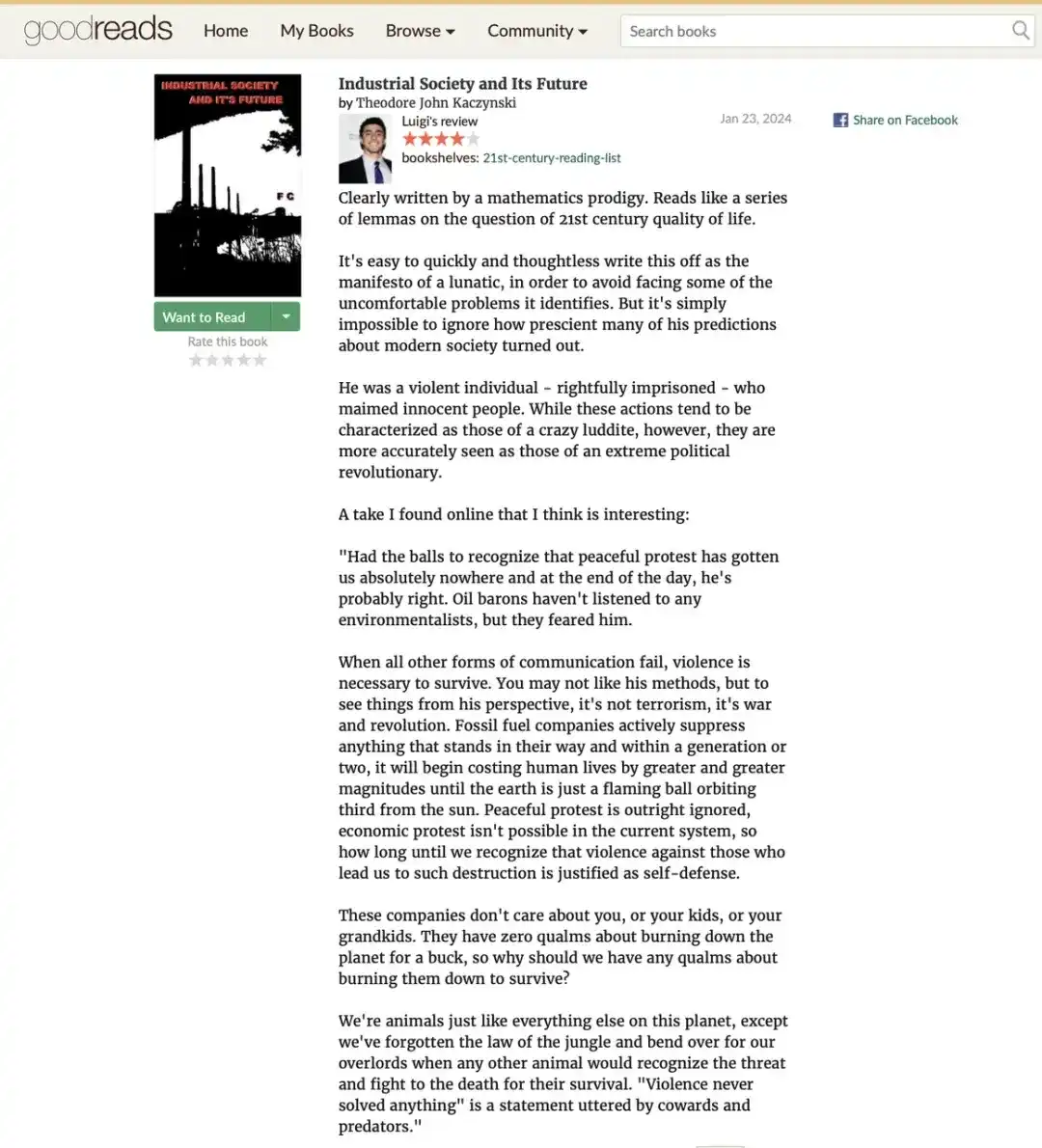
Goodreads long review left by Luigi
In addition to his personal past experiences, his family background has also been put in the spotlight. People have discovered that the family behind Luigi is a well-known and prominent family in the local area - his grandparents are real estate developers, the family has many properties in Maryland, and operates several elderly rehabilitation centers and two country clubs; his cousin Nino Mangione is a Republican member of the Maryland House of Representatives and also serves as the co-chairman of the Trump campaign team in Baltimore County. It is worth mentioning that after Luigi Nicholas Mangione was arrested, Nino Mangione posted on social media: "Our whole family is shocked and saddened by Luigi's arrest. We pray for Brian Thompson's family and ask everyone to pray for everyone involved."
A few weeks before the shooting, Luigi had lost contact with his family. According to his friends, Mangione had back surgery a few months ago, and the surgery was not effective. The back pain caused great trouble to his daily life. Netizens speculated that he suffered from spondylolisthesis based on his Goodreads bookshelf information.
According to netizens, based on the information leaked to the New York Times by law enforcement officials and other information, the handwritten declaration that Mangione carried with him when he was arrested may be as follows:
"To the federal personnel, I will try to be brief because I respect everything you have done for our country. To save you a lengthy investigation, I will say bluntly that I am not cooperating with anyone.This is pretty simple: some basic social engineering, basic computer-aided design, and a lot of patience. If you find the spiral notebook, there are some scattered notes and to-do items in it that can give you a rough idea of what happened. My electronic devices are strictly protected because I work in engineering, so there may not be much information there.
I am deeply sorry for any conflict or trauma caused, but it must be done. Frankly speaking, these parasites have purely brought this upon themselves.A reminder: The United States has the most expensive health care system in the world, but our life expectancy ranks around 42nd. UnitedHealth is the [xxx] The largest company, second only to Apple, Google and Walmart. It keeps getting bigger, but what about our life expectancy? No, the reality is that these [xxx] have become too powerful, and they continue to abuse our country for huge profits because the American public indulges them with impunity. Obviously, the problem is much more complicated, but I don’t have enough space to expand on it, and frankly, I am not the most qualified person to discuss it in detail. But many people (such as Rosenthal and Moore) have exposed this corruption and greed many years ago, and the problem still exists. This is no longer a problem of cognition, but obviously a power game. Obviously, I am the first person to face it in such a straightforward way. "
Combined with his previous "elite resume", it is difficult not to feel a sense of pity for this speech. The opposite of this sense of pity is the cruel and ruthless other side of the current American health care system.
It is understood that the proportion of US medical and health expenses in GDP has always been significantly higher than that of other countries: according to a number of data, the average hospitalization cost in the United States is as high as 22,500 US dollars; common appendectomy surgery in China costs about 30,000 US dollars in the United States, and complex surgery can easily cost hundreds of thousands of dollars. Without medical insurance, ordinary people simply cannot afford it; and medical insurance in the United States is also difficult for people to accept easily.
A Gallup poll found that in 2023, about 81% of Americans were dissatisfied with their health insurance costs in the United States, the highest level in 16 years; KFF research showed that in 2024, the average health insurance cost for American families was $25,572, while the average health insurance cost for unmarried adult citizens was $8,951, an increase of 6% and 7% respectively over the previous year; since 2000, except for a few years, the increase in health insurance premiums has exceeded inflation.
In addition, a 2023 survey by the American Medical Association found that one-third of doctors reported that the "approval first, then treatment" prior authorization model promoted by American health insurance companies caused many patients to develop serious lesions, 94% of patients had necessary treatments delayed, 80% of patients chose to give up treatment, and 9% of patients became disabled or even died. Not to mention, health insurance companies will use various reasons, various procedures and claims processes as obstacles, and try every means to reduce claims costs or even refuse insurance. It is no wonder that the book "Delay, Denial, Defense: Why Insurance Companies Don't Pay Claims and What You Can Do?" published by Jay M. Feinman, a professor at Rutgers University in the United States in 2010, was previously very popular.
As for UnitedHealth Group, which has 140,000 employees, according to the financial website Value Pengui, its rejection rate may be as high as 32%. Almost one out of every three customers who request a claim is rejected, which is twice the industry average (16%). The reason behind this is naturally inseparable from Brian Thompson, who was promoted to CEO in 2021.
It is understood that since 2021, UnitedHealthcare's refusal rate has been increasing: in 2020, the figure was 10.9%; in 2022, it doubled to 22.7%. In contrast, the company's profits have risen: in 2021, the profit was US$12 billion; in 2023, the figure increased to US$16 billion. You know, this is the company's revenue performance during the COVID period. At the same time, Brian Thompson, the CEO of UnitedHealthcare, received an annual salary of US$10.2 million, US$9.8 million, and US$9.6 million from 2021 to 2023, respectively.
Under Brian Thompson's leadership, UnitedHealthcare also prepared to launch a plan in 2021 to refuse to pay for emergency room visits to what it considered "non-critical hospitals", but it was shelved due to too many protests. At the 2023 investor conference, it also outlined that the company would prefer to pay claims "based on valuable care," that is, the post-hospitalization care phase rather than the treatment phase.
Even according to a report from the U.S. Senate Permanent Subcommittee on Investigations in October this year, UnitedHealthcare has been using AI tools and an algorithm called nH Predict to screen insurance policies, among which post-acute care is the most frequently denied item, and the acute care denial rate is about three times the overall denial rate. At the end of last year, the families of two deceased customers sued UnitedHealthcare, claiming that it deliberately used a flawed algorithm to refuse to provide elderly patients with extended care that doctors deemed necessary, with an error rate of up to 90%. A previous investigation by ProPublica also found that UnitedHealthcare used algorithms to effectively cut or limit some treatment costs, endangering the mental health insurance of many Americans. In California, Massachusetts and New York, this practice of insurance companies is considered illegal.
It should be noted that American insurance companies have always been regarded as "unbeatable money-making beasts". Due to their numerous insurance regulations and strong legal power, most people can only choose to accept reality after being denied compensation. Only 0.1% of people will appeal against the denial of compensation.
When the cold and cruel social reality meets the seemingly passionate justice sanctions, the "Robin Hood-style" heroic plot is undoubtedly more touching. This is also the reason why many people, including some American media, focus on UnitedHealthcare and the American health insurance system rather than "Luigi himself shot the CEO". Social media platforms including X, Reddit, Tiktok, etc. have been filled with slogans such as "FreeLuigi" and "Free the man" in recent days. Some people even fabricated "alibi" for him on news website message boards and social media. What's more, the McDonald's was "besieged" by netizens, and people gave it a one-star bad review on the map software.

This McDonald's "suffered a one-star bad review" because of public outrage
Of course, not everyone will be overwhelmed by this passionate idea of "eliminating harm for the people".
On December 10, Pennsylvania Democratic Governor Josh Shapiro publicly condemned Luigi Nicholas Mangione: "In some dark corners, this killer is hailed as a hero. Listen to me, he is not a hero. The real hero in this story is the person who called 911 at McDonald's."
In addition, a screenshot taken by a netizen showed that Musk had expressed his opinion on the matter on December 7: "It's disgusting. Everyone is making that guy into some kind of folk hero. Insurance companies, like any company, have a responsibility to maximize profits for shareholders, no matter how ruthless the means. The radical left who don't buy this need to grow up and mature."However, the tweet is not currently found under Musk's account content, and it is suspected to have been deleted or a Photoshop spoof.
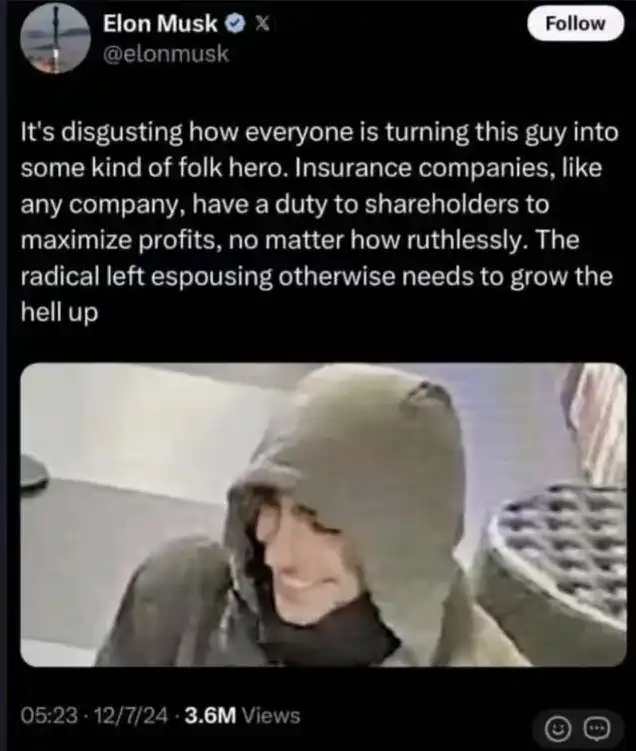
Internet screenshot
There were also different online news later, saying that Luigi Nicholas Mangione may have committed this because of his mother's chronic back pain claim or his grandparents' medical insurance claim. The specific situation still depends on further investigation by the US police. On December 10, the New York police charged him with second-degree murder in connection with the death of UnitedHealthcare CEO, as well as five other charges, including forgery of documents, false identity, and illegal possession of firearms. However, since different states in the United States have different laws and judicial systems, it may take days or weeks to transfer fugitives between states. When cryptocurrency becomes the "fire zone" of news, can speculation prolong the life of the hot spot? According to GMGN data, as of the time of writing, the price of LUIGI, the eponymous token of the protagonist of this incident, is currently reported at $0.015, with a market value of approximately $15 million, which has fallen by about 80% from the high of $78 million.
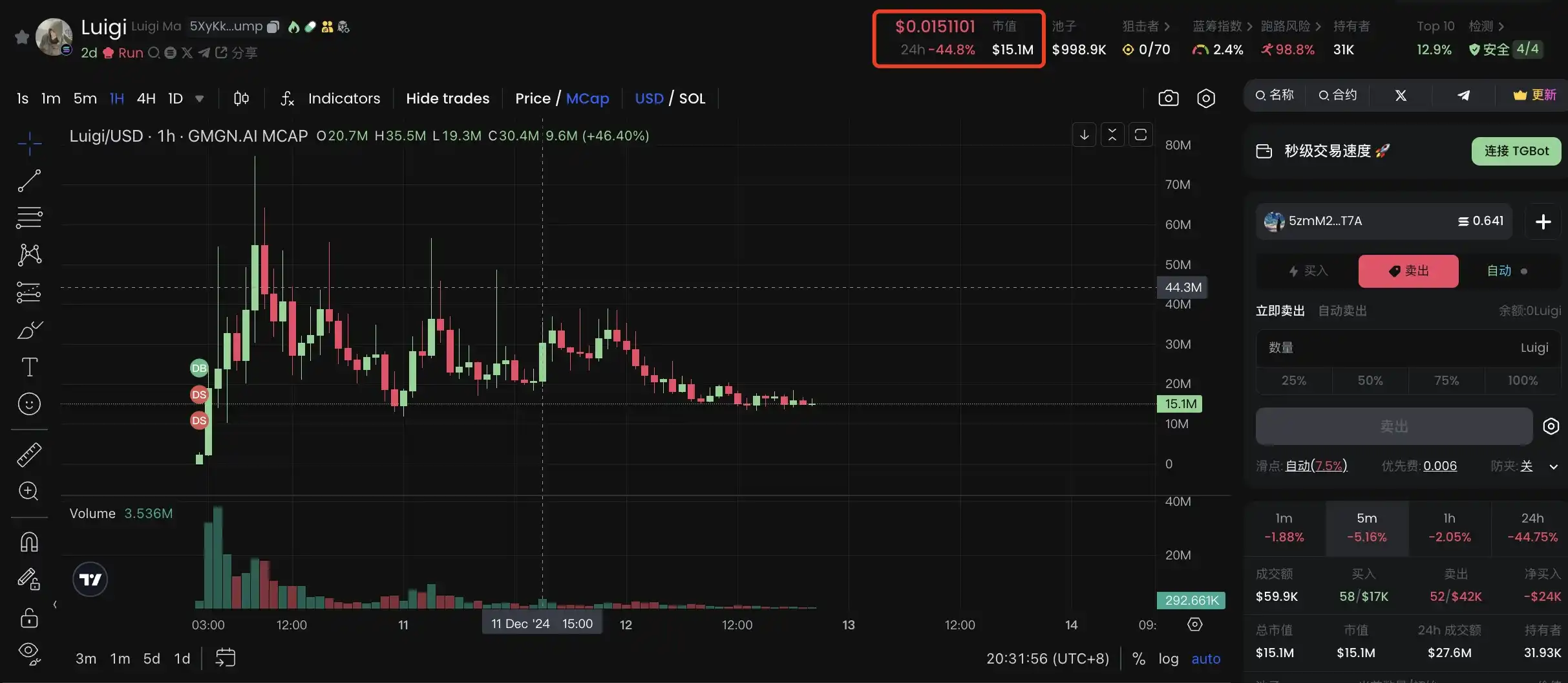
LUIGI Token Information
Like the crypto prediction market Polymarket that successfully predicted Trump’s victory this year, today’s Meme coins have become a “social hot spot weathervane” in a sense. The squirrel and related Meme coin PUNT that were “cruelly killed” before were even highly praised by Musk, who said that “a squirrel and a Meme coin saved the United States.” Although it is somewhat exaggerated, it is still an affirmation of the social news value of Meme coins. Including the Ethereum Meme coin MOODENG, which was created by borrowing the Tiktok animal internet celebrity image of the hippopotamus, the subsequent use of token donations to support charity is also one of the rare “Mass Adoption” (large-scale adoption) test examples in the cryptocurrency industry.
In addition, the popularity of news hotspots is also directly reflected in the market performance of a number of cryptocurrencies, including Meme coins. However, for many projects, pure speculation can only be a "one-wave zero-sum game". Whether it can inject new vitality into news hotspots often depends on the lasting influence of a cryptocurrency project narrative.
LUIGI is just the intersection of Meme coins and news hotspots. More projects will emerge later. Can Meme coins at that time promote similar events to have a different direction and outcome? Only time can tell us the answer.
References:
Shooting! UnitedHealthcare CEO was attacked and killed at the annual investor meeting
Catch the man who shot the CEO | Prism
The suspect who shot the boss of the largest insurance company in the United States is called the contemporary Batman
The rejection rate is as high as 32%! Behind the shooting of the insurance giant CEO
You may also like

Token Cannot Compound, Where Is the Real Investment Opportunity?

February 6th Market Key Intelligence, How Much Did You Miss?

China's Central Bank and Eight Other Departments' Latest Regulatory Focus: Key Attention to RWA Tokenized Asset Risk
Foreword: Today, the People's Bank of China's website published the "Notice of the People's Bank of China, National Development and Reform Commission, Ministry of Industry and Information Technology, Ministry of Public Security, State Administration for Market Regulation, China Banking and Insurance Regulatory Commission, China Securities Regulatory Commission, State Administration of Foreign Exchange on Further Preventing and Dealing with Risks Related to Virtual Currency and Others (Yinfa [2026] No. 42)", the latest regulatory requirements from the eight departments including the central bank, which are basically consistent with the regulatory requirements of recent years. The main focus of the regulation is on speculative activities such as virtual currency trading, exchanges, ICOs, overseas platform services, and this time, regulatory oversight of RWA has been added, explicitly prohibiting RWA tokenization, stablecoins (especially those pegged to the RMB). The following is the full text:
To the people's governments of all provinces, autonomous regions, and municipalities directly under the Central Government, the Xinjiang Production and Construction Corps:
Recently, there have been speculative activities related to virtual currency and Real-World Assets (RWA) tokenization, disrupting the economic and financial order and jeopardizing the property security of the people. In order to further prevent and address the risks related to virtual currency and Real-World Assets tokenization, effectively safeguard national security and social stability, in accordance with the "Law of the People's Republic of China on the People's Bank of China," "Law of the People's Republic of China on Commercial Banks," "Securities Law of the People's Republic of China," "Law of the People's Republic of China on Securities Investment Funds," "Law of the People's Republic of China on Futures and Derivatives," "Cybersecurity Law of the People's Republic of China," "Regulations of the People's Republic of China on the Administration of Renminbi," "Regulations on Prevention and Disposal of Illegal Fundraising," "Regulations of the People's Republic of China on Foreign Exchange Administration," "Telecommunications Regulations of the People's Republic of China," and other provisions, after reaching consensus with the Cyberspace Administration of China, the Supreme People's Court, and the Supreme People's Procuratorate, and with the approval of the State Council, the relevant matters are notified as follows:
(I) Virtual currency does not possess the legal status equivalent to fiat currency. Virtual currencies such as Bitcoin, Ether, Tether, etc., have the main characteristics of being issued by non-monetary authorities, using encryption technology and distributed ledger or similar technology, existing in digital form, etc. They do not have legal tender status, should not and cannot be circulated and used as currency in the market.
The business activities related to virtual currency are classified as illegal financial activities. The exchange of fiat currency and virtual currency within the territory, exchange of virtual currencies, acting as a central counterparty in buying and selling virtual currencies, providing information intermediary and pricing services for virtual currency transactions, token issuance financing, and trading of virtual currency-related financial products, etc., fall under illegal financial activities, such as suspected illegal issuance of token vouchers, unauthorized public issuance of securities, illegal operation of securities and futures business, illegal fundraising, etc., are strictly prohibited across the board and resolutely banned in accordance with the law. Overseas entities and individuals are not allowed to provide virtual currency-related services to domestic entities in any form.
A stablecoin pegged to a fiat currency indirectly fulfills some functions of the fiat currency in circulation. Without the consent of relevant authorities in accordance with the law and regulations, any domestic or foreign entity or individual is not allowed to issue a RMB-pegged stablecoin overseas.
(II)Tokenization of Real-World Assets refers to the use of encryption technology and distributed ledger or similar technologies to transform ownership rights, income rights, etc., of assets into tokens (tokens) or other interests or bond certificates with token (token) characteristics, and carry out issuance and trading activities.
Engaging in the tokenization of real-world assets domestically, as well as providing related intermediary, information technology services, etc., which are suspected of illegal issuance of token vouchers, unauthorized public offering of securities, illegal operation of securities and futures business, illegal fundraising, and other illegal financial activities, shall be prohibited; except for relevant business activities carried out with the approval of the competent authorities in accordance with the law and regulations and relying on specific financial infrastructures. Overseas entities and individuals are not allowed to illegally provide services related to the tokenization of real-world assets to domestic entities in any form.
(III) Inter-agency Coordination. The People's Bank of China, together with the National Development and Reform Commission, the Ministry of Industry and Information Technology, the Ministry of Public Security, the State Administration for Market Regulation, the China Banking and Insurance Regulatory Commission, the China Securities Regulatory Commission, the State Administration of Foreign Exchange, and other departments, will improve the work mechanism, strengthen coordination with the Cyberspace Administration of China, the Supreme People's Court, and the Supreme People's Procuratorate, coordinate efforts, and overall guide regions to carry out risk prevention and disposal of virtual currency-related illegal financial activities.
The China Securities Regulatory Commission, together with the National Development and Reform Commission, the Ministry of Industry and Information Technology, the Ministry of Public Security, the People's Bank of China, the State Administration for Market Regulation, the China Banking and Insurance Regulatory Commission, the State Administration of Foreign Exchange, and other departments, will improve the work mechanism, strengthen coordination with the Cyberspace Administration of China, the Supreme People's Court, and the Supreme People's Procuratorate, coordinate efforts, and overall guide regions to carry out risk prevention and disposal of illegal financial activities related to the tokenization of real-world assets.
(IV) Strengthening Local Implementation. The people's governments at the provincial level are overall responsible for the prevention and disposal of risks related to virtual currencies and the tokenization of real-world assets in their respective administrative regions. The specific leading department is the local financial regulatory department, with participation from branches and dispatched institutions of the State Council's financial regulatory department, telecommunications regulators, public security, market supervision, and other departments, in coordination with cyberspace departments, courts, and procuratorates, to improve the normalization of the work mechanism, effectively connect with the relevant work mechanisms of central departments, form a cooperative and coordinated working pattern between central and local governments, effectively prevent and properly handle risks related to virtual currencies and the tokenization of real-world assets, and maintain economic and financial order and social stability.
(5) Enhanced Risk Monitoring. The People's Bank of China, China Securities Regulatory Commission, National Development and Reform Commission, Ministry of Industry and Information Technology, Ministry of Public Security, State Administration of Foreign Exchange, Cyberspace Administration of China, and other departments continue to improve monitoring techniques and system support, enhance cross-departmental data analysis and sharing, establish sound information sharing and cross-validation mechanisms, promptly grasp the risk situation of activities related to virtual currency and real-world asset tokenization. Local governments at all levels give full play to the role of local monitoring and early warning mechanisms. Local financial regulatory authorities, together with branches and agencies of the State Council's financial regulatory authorities, as well as departments of cyberspace and public security, ensure effective connection between online monitoring, offline investigation, and fund tracking, efficiently and accurately identify activities related to virtual currency and real-world asset tokenization, promptly share risk information, improve early warning information dissemination, verification, and rapid response mechanisms.
(6) Strengthened Oversight of Financial Institutions, Intermediaries, and Technology Service Providers. Financial institutions (including non-bank payment institutions) are prohibited from providing account opening, fund transfer, and clearing services for virtual currency-related business activities, issuing and selling financial products related to virtual currency, including virtual currency and related financial products in the scope of collateral, conducting insurance business related to virtual currency, or including virtual currency in the scope of insurance liability. Financial institutions (including non-bank payment institutions) are prohibited from providing custody, clearing, and settlement services for unauthorized real-world asset tokenization-related business and related financial products. Relevant intermediary institutions and information technology service providers are prohibited from providing intermediary, technical, or other services for unauthorized real-world asset tokenization-related businesses and related financial products.
(7) Enhanced Management of Internet Information Content and Access. Internet enterprises are prohibited from providing online business venues, commercial displays, marketing, advertising, or paid traffic diversion services for virtual currency and real-world asset tokenization-related business activities. Upon discovering clues of illegal activities, they should promptly report to relevant departments and provide technical support and assistance for related investigations and inquiries. Based on the clues transferred by the financial regulatory authorities, the cyberspace administration, telecommunications authorities, and public security departments should promptly close and deal with websites, mobile applications (including mini-programs), and public accounts engaged in virtual currency and real-world asset tokenization-related business activities in accordance with the law.
(8) Strengthened Entity Registration and Advertisement Management. Market supervision departments strengthen entity registration and management, and enterprise and individual business registrations must not contain terms such as "virtual currency," "virtual asset," "cryptocurrency," "crypto asset," "stablecoin," "real-world asset tokenization," or "RWA" in their names or business scopes. Market supervision departments, together with financial regulatory authorities, legally enhance the supervision of advertisements related to virtual currency and real-world asset tokenization, promptly investigating and handling relevant illegal advertisements.
(IX) Continued Rectification of Virtual Currency Mining Activities. The National Development and Reform Commission, together with relevant departments, strictly controls virtual currency mining activities, continuously promotes the rectification of virtual currency mining activities. The people's governments of various provinces take overall responsibility for the rectification of "mining" within their respective administrative regions. In accordance with the requirements of the National Development and Reform Commission and other departments in the "Notice on the Rectification of Virtual Currency Mining Activities" (NDRC Energy-saving Building [2021] No. 1283) and the provisions of the "Guidance Catalog for Industrial Structure Adjustment (2024 Edition)," a comprehensive review, investigation, and closure of existing virtual currency mining projects are conducted, new mining projects are strictly prohibited, and mining machine production enterprises are strictly prohibited from providing mining machine sales and other services within the country.
(X) Severe Crackdown on Related Illegal Financial Activities. Upon discovering clues to illegal financial activities related to virtual currency and the tokenization of real-world assets, local financial regulatory authorities, branches of the State Council's financial regulatory authorities, and other relevant departments promptly investigate, determine, and properly handle the issues in accordance with the law, and seriously hold the relevant entities and individuals legally responsible. Those suspected of crimes are transferred to the judicial authorities for processing according to the law.
(XI) Severe Crackdown on Related Illegal and Criminal Activities. The Ministry of Public Security, the People's Bank of China, the State Administration for Market Regulation, the China Banking and Insurance Regulatory Commission, the China Securities Regulatory Commission, as well as judicial and procuratorial organs, in accordance with their respective responsibilities, rigorously crack down on illegal and criminal activities related to virtual currency, the tokenization of real-world assets, such as fraud, money laundering, illegal business operations, pyramid schemes, illegal fundraising, and other illegal and criminal activities carried out under the guise of virtual currency, the tokenization of real-world assets, etc.
(XII) Strengthen Industry Self-discipline. Relevant industry associations should enhance membership management and policy advocacy, based on their own responsibilities, advocate and urge member units to resist illegal financial activities related to virtual currency and the tokenization of real-world assets. Member units that violate regulatory policies and industry self-discipline rules are to be disciplined in accordance with relevant self-regulatory management regulations. By leveraging various industry infrastructure, conduct risk monitoring related to virtual currency, the tokenization of real-world assets, and promptly transfer issue clues to relevant departments.
(XIII) Without the approval of relevant departments in accordance with the law and regulations, domestic entities and foreign entities controlled by them may not issue virtual currency overseas.
(XIV) Domestic entities engaging directly or indirectly in overseas external debt-based tokenization of real-world assets, or conducting asset securitization activities abroad based on domestic ownership rights, income rights, etc. (hereinafter referred to as domestic equity), should be strictly regulated in accordance with the principles of "same business, same risk, same rules." The National Development and Reform Commission, the China Securities Regulatory Commission, the State Administration of Foreign Exchange, and other relevant departments regulate it according to their respective responsibilities. For other forms of overseas real-world asset tokenization activities based on domestic equity by domestic entities, the China Securities Regulatory Commission, together with relevant departments, supervise according to their division of responsibilities. Without the consent and filing of relevant departments, no unit or individual may engage in the above-mentioned business.
(15) Overseas subsidiaries and branches of domestic financial institutions providing Real World Asset Tokenization-related services overseas shall do so legally and prudently. They shall have professional personnel and systems in place to effectively mitigate business risks, strictly implement customer onboarding, suitability management, anti-money laundering requirements, and incorporate them into the domestic financial institutions' compliance and risk management system. Intermediaries and information technology service providers offering Real World Asset Tokenization services abroad based on domestic equity or conducting Real World Asset Tokenization business in the form of overseas debt for domestic entities directly or indirectly venturing abroad must strictly comply with relevant laws and regulations. They should establish and improve relevant compliance and internal control systems in accordance with relevant normative requirements, strengthen business and risk control, and report the business developments to the relevant regulatory authorities for approval or filing.
(16) Strengthen organizational leadership and overall coordination. All departments and regions should attach great importance to the prevention of risks related to virtual currencies and Real World Asset Tokenization, strengthen organizational leadership, clarify work responsibilities, form a long-term effective working mechanism with centralized coordination, local implementation, and shared responsibilities, maintain high pressure, dynamically monitor risks, effectively prevent and mitigate risks in an orderly and efficient manner, legally protect the property security of the people, and make every effort to maintain economic and financial order and social stability.
(17) Widely carry out publicity and education. All departments, regions, and industry associations should make full use of various media and other communication channels to disseminate information through legal and policy interpretation, analysis of typical cases, and education on investment risks, etc. They should promote the illegality and harm of virtual currencies and Real World Asset Tokenization-related businesses and their manifestations, fully alert to potential risks and hidden dangers, and enhance public awareness and identification capabilities for risk prevention.
(18) Engaging in illegal financial activities related to virtual currencies and Real World Asset Tokenization in violation of this notice, as well as providing services for virtual currencies and Real World Asset Tokenization-related businesses, shall be punished in accordance with relevant regulations. If it constitutes a crime, criminal liability shall be pursued according to the law. For domestic entities and individuals who knowingly or should have known that overseas entities illegally provided virtual currency or Real World Asset Tokenization-related services to domestic entities and still assisted them, relevant responsibilities shall be pursued according to the law. If it constitutes a crime, criminal liability shall be pursued according to the law.
(19) If any unit or individual invests in virtual currencies, Real World Asset Tokens, and related financial products against public order and good customs, the relevant civil legal actions shall be invalid, and any resulting losses shall be borne by them. If there are suspicions of disrupting financial order and jeopardizing financial security, the relevant departments shall deal with them according to the law.
This notice shall enter into force upon the date of its issuance. The People's Bank of China and ten other departments' "Notice on Further Preventing and Dealing with the Risks of Virtual Currency Trading Speculation" (Yinfa [2021] No. 237) is hereby repealed.

Former Partner's Perspective on Multicoin: Kyle's Exit, But the Game He Left Behind Just Getting Started
Why Bitcoin Is Falling Now: The Real Reasons Behind BTC's Crash & WEEX's Smart Profit Playbook
Bitcoin's ongoing crash explained: Discover the 5 hidden triggers behind BTC's plunge & how WEEX's Auto Earn and Trade to Earn strategies help traders profit from crypto market volatility.

Wall Street's Hottest Trades See Exodus

Vitalik Discusses Ethereum Scaling Path, Circle Announces Partnership with Polymarket, What's the Overseas Crypto Community Talking About Today?

Believing in the Capital Markets - The Essence and Core Value of Cryptocurrency

Polymarket's 'Weatherman': Predict Temperature, Win Million-Dollar Payout

$15K+ Profits: The 4 AI Trading Secrets WEEX Hackathon Prelim Winners Used to Dominate Volatile Crypto Markets
How WEEX Hackathon's top AI trading strategies made $15K+ in crypto markets: 4 proven rules for ETH/BTC trading, market structure analysis, and risk management in volatile conditions.

A nearly 20% one-day plunge, how long has it been since you last saw a $60,000 Bitcoin?

Raoul Pal: I've seen every single panic, and they are never the end.

Key Market Information Discrepancy on February 6th - A Must-Read! | Alpha Morning Report

2026 Crypto Industry's First Snowfall
The Harsh Reality Behind the $26 Billion Crypto Liquidation: Liquidity Is Killing the Market
Why Is Gold, US Stocks, Bitcoin All Falling?

Key Market Intelligence for February 5th, how much did you miss out on?

Wintermute: By 2026, crypto had gradually become the settlement layer of the Internet economy
Token Cannot Compound, Where Is the Real Investment Opportunity?
February 6th Market Key Intelligence, How Much Did You Miss?
China's Central Bank and Eight Other Departments' Latest Regulatory Focus: Key Attention to RWA Tokenized Asset Risk
Foreword: Today, the People's Bank of China's website published the "Notice of the People's Bank of China, National Development and Reform Commission, Ministry of Industry and Information Technology, Ministry of Public Security, State Administration for Market Regulation, China Banking and Insurance Regulatory Commission, China Securities Regulatory Commission, State Administration of Foreign Exchange on Further Preventing and Dealing with Risks Related to Virtual Currency and Others (Yinfa [2026] No. 42)", the latest regulatory requirements from the eight departments including the central bank, which are basically consistent with the regulatory requirements of recent years. The main focus of the regulation is on speculative activities such as virtual currency trading, exchanges, ICOs, overseas platform services, and this time, regulatory oversight of RWA has been added, explicitly prohibiting RWA tokenization, stablecoins (especially those pegged to the RMB). The following is the full text:
To the people's governments of all provinces, autonomous regions, and municipalities directly under the Central Government, the Xinjiang Production and Construction Corps:
Recently, there have been speculative activities related to virtual currency and Real-World Assets (RWA) tokenization, disrupting the economic and financial order and jeopardizing the property security of the people. In order to further prevent and address the risks related to virtual currency and Real-World Assets tokenization, effectively safeguard national security and social stability, in accordance with the "Law of the People's Republic of China on the People's Bank of China," "Law of the People's Republic of China on Commercial Banks," "Securities Law of the People's Republic of China," "Law of the People's Republic of China on Securities Investment Funds," "Law of the People's Republic of China on Futures and Derivatives," "Cybersecurity Law of the People's Republic of China," "Regulations of the People's Republic of China on the Administration of Renminbi," "Regulations on Prevention and Disposal of Illegal Fundraising," "Regulations of the People's Republic of China on Foreign Exchange Administration," "Telecommunications Regulations of the People's Republic of China," and other provisions, after reaching consensus with the Cyberspace Administration of China, the Supreme People's Court, and the Supreme People's Procuratorate, and with the approval of the State Council, the relevant matters are notified as follows:
(I) Virtual currency does not possess the legal status equivalent to fiat currency. Virtual currencies such as Bitcoin, Ether, Tether, etc., have the main characteristics of being issued by non-monetary authorities, using encryption technology and distributed ledger or similar technology, existing in digital form, etc. They do not have legal tender status, should not and cannot be circulated and used as currency in the market.
The business activities related to virtual currency are classified as illegal financial activities. The exchange of fiat currency and virtual currency within the territory, exchange of virtual currencies, acting as a central counterparty in buying and selling virtual currencies, providing information intermediary and pricing services for virtual currency transactions, token issuance financing, and trading of virtual currency-related financial products, etc., fall under illegal financial activities, such as suspected illegal issuance of token vouchers, unauthorized public issuance of securities, illegal operation of securities and futures business, illegal fundraising, etc., are strictly prohibited across the board and resolutely banned in accordance with the law. Overseas entities and individuals are not allowed to provide virtual currency-related services to domestic entities in any form.
A stablecoin pegged to a fiat currency indirectly fulfills some functions of the fiat currency in circulation. Without the consent of relevant authorities in accordance with the law and regulations, any domestic or foreign entity or individual is not allowed to issue a RMB-pegged stablecoin overseas.
(II)Tokenization of Real-World Assets refers to the use of encryption technology and distributed ledger or similar technologies to transform ownership rights, income rights, etc., of assets into tokens (tokens) or other interests or bond certificates with token (token) characteristics, and carry out issuance and trading activities.
Engaging in the tokenization of real-world assets domestically, as well as providing related intermediary, information technology services, etc., which are suspected of illegal issuance of token vouchers, unauthorized public offering of securities, illegal operation of securities and futures business, illegal fundraising, and other illegal financial activities, shall be prohibited; except for relevant business activities carried out with the approval of the competent authorities in accordance with the law and regulations and relying on specific financial infrastructures. Overseas entities and individuals are not allowed to illegally provide services related to the tokenization of real-world assets to domestic entities in any form.
(III) Inter-agency Coordination. The People's Bank of China, together with the National Development and Reform Commission, the Ministry of Industry and Information Technology, the Ministry of Public Security, the State Administration for Market Regulation, the China Banking and Insurance Regulatory Commission, the China Securities Regulatory Commission, the State Administration of Foreign Exchange, and other departments, will improve the work mechanism, strengthen coordination with the Cyberspace Administration of China, the Supreme People's Court, and the Supreme People's Procuratorate, coordinate efforts, and overall guide regions to carry out risk prevention and disposal of virtual currency-related illegal financial activities.
The China Securities Regulatory Commission, together with the National Development and Reform Commission, the Ministry of Industry and Information Technology, the Ministry of Public Security, the People's Bank of China, the State Administration for Market Regulation, the China Banking and Insurance Regulatory Commission, the State Administration of Foreign Exchange, and other departments, will improve the work mechanism, strengthen coordination with the Cyberspace Administration of China, the Supreme People's Court, and the Supreme People's Procuratorate, coordinate efforts, and overall guide regions to carry out risk prevention and disposal of illegal financial activities related to the tokenization of real-world assets.
(IV) Strengthening Local Implementation. The people's governments at the provincial level are overall responsible for the prevention and disposal of risks related to virtual currencies and the tokenization of real-world assets in their respective administrative regions. The specific leading department is the local financial regulatory department, with participation from branches and dispatched institutions of the State Council's financial regulatory department, telecommunications regulators, public security, market supervision, and other departments, in coordination with cyberspace departments, courts, and procuratorates, to improve the normalization of the work mechanism, effectively connect with the relevant work mechanisms of central departments, form a cooperative and coordinated working pattern between central and local governments, effectively prevent and properly handle risks related to virtual currencies and the tokenization of real-world assets, and maintain economic and financial order and social stability.
(5) Enhanced Risk Monitoring. The People's Bank of China, China Securities Regulatory Commission, National Development and Reform Commission, Ministry of Industry and Information Technology, Ministry of Public Security, State Administration of Foreign Exchange, Cyberspace Administration of China, and other departments continue to improve monitoring techniques and system support, enhance cross-departmental data analysis and sharing, establish sound information sharing and cross-validation mechanisms, promptly grasp the risk situation of activities related to virtual currency and real-world asset tokenization. Local governments at all levels give full play to the role of local monitoring and early warning mechanisms. Local financial regulatory authorities, together with branches and agencies of the State Council's financial regulatory authorities, as well as departments of cyberspace and public security, ensure effective connection between online monitoring, offline investigation, and fund tracking, efficiently and accurately identify activities related to virtual currency and real-world asset tokenization, promptly share risk information, improve early warning information dissemination, verification, and rapid response mechanisms.
(6) Strengthened Oversight of Financial Institutions, Intermediaries, and Technology Service Providers. Financial institutions (including non-bank payment institutions) are prohibited from providing account opening, fund transfer, and clearing services for virtual currency-related business activities, issuing and selling financial products related to virtual currency, including virtual currency and related financial products in the scope of collateral, conducting insurance business related to virtual currency, or including virtual currency in the scope of insurance liability. Financial institutions (including non-bank payment institutions) are prohibited from providing custody, clearing, and settlement services for unauthorized real-world asset tokenization-related business and related financial products. Relevant intermediary institutions and information technology service providers are prohibited from providing intermediary, technical, or other services for unauthorized real-world asset tokenization-related businesses and related financial products.
(7) Enhanced Management of Internet Information Content and Access. Internet enterprises are prohibited from providing online business venues, commercial displays, marketing, advertising, or paid traffic diversion services for virtual currency and real-world asset tokenization-related business activities. Upon discovering clues of illegal activities, they should promptly report to relevant departments and provide technical support and assistance for related investigations and inquiries. Based on the clues transferred by the financial regulatory authorities, the cyberspace administration, telecommunications authorities, and public security departments should promptly close and deal with websites, mobile applications (including mini-programs), and public accounts engaged in virtual currency and real-world asset tokenization-related business activities in accordance with the law.
(8) Strengthened Entity Registration and Advertisement Management. Market supervision departments strengthen entity registration and management, and enterprise and individual business registrations must not contain terms such as "virtual currency," "virtual asset," "cryptocurrency," "crypto asset," "stablecoin," "real-world asset tokenization," or "RWA" in their names or business scopes. Market supervision departments, together with financial regulatory authorities, legally enhance the supervision of advertisements related to virtual currency and real-world asset tokenization, promptly investigating and handling relevant illegal advertisements.
(IX) Continued Rectification of Virtual Currency Mining Activities. The National Development and Reform Commission, together with relevant departments, strictly controls virtual currency mining activities, continuously promotes the rectification of virtual currency mining activities. The people's governments of various provinces take overall responsibility for the rectification of "mining" within their respective administrative regions. In accordance with the requirements of the National Development and Reform Commission and other departments in the "Notice on the Rectification of Virtual Currency Mining Activities" (NDRC Energy-saving Building [2021] No. 1283) and the provisions of the "Guidance Catalog for Industrial Structure Adjustment (2024 Edition)," a comprehensive review, investigation, and closure of existing virtual currency mining projects are conducted, new mining projects are strictly prohibited, and mining machine production enterprises are strictly prohibited from providing mining machine sales and other services within the country.
(X) Severe Crackdown on Related Illegal Financial Activities. Upon discovering clues to illegal financial activities related to virtual currency and the tokenization of real-world assets, local financial regulatory authorities, branches of the State Council's financial regulatory authorities, and other relevant departments promptly investigate, determine, and properly handle the issues in accordance with the law, and seriously hold the relevant entities and individuals legally responsible. Those suspected of crimes are transferred to the judicial authorities for processing according to the law.
(XI) Severe Crackdown on Related Illegal and Criminal Activities. The Ministry of Public Security, the People's Bank of China, the State Administration for Market Regulation, the China Banking and Insurance Regulatory Commission, the China Securities Regulatory Commission, as well as judicial and procuratorial organs, in accordance with their respective responsibilities, rigorously crack down on illegal and criminal activities related to virtual currency, the tokenization of real-world assets, such as fraud, money laundering, illegal business operations, pyramid schemes, illegal fundraising, and other illegal and criminal activities carried out under the guise of virtual currency, the tokenization of real-world assets, etc.
(XII) Strengthen Industry Self-discipline. Relevant industry associations should enhance membership management and policy advocacy, based on their own responsibilities, advocate and urge member units to resist illegal financial activities related to virtual currency and the tokenization of real-world assets. Member units that violate regulatory policies and industry self-discipline rules are to be disciplined in accordance with relevant self-regulatory management regulations. By leveraging various industry infrastructure, conduct risk monitoring related to virtual currency, the tokenization of real-world assets, and promptly transfer issue clues to relevant departments.
(XIII) Without the approval of relevant departments in accordance with the law and regulations, domestic entities and foreign entities controlled by them may not issue virtual currency overseas.
(XIV) Domestic entities engaging directly or indirectly in overseas external debt-based tokenization of real-world assets, or conducting asset securitization activities abroad based on domestic ownership rights, income rights, etc. (hereinafter referred to as domestic equity), should be strictly regulated in accordance with the principles of "same business, same risk, same rules." The National Development and Reform Commission, the China Securities Regulatory Commission, the State Administration of Foreign Exchange, and other relevant departments regulate it according to their respective responsibilities. For other forms of overseas real-world asset tokenization activities based on domestic equity by domestic entities, the China Securities Regulatory Commission, together with relevant departments, supervise according to their division of responsibilities. Without the consent and filing of relevant departments, no unit or individual may engage in the above-mentioned business.
(15) Overseas subsidiaries and branches of domestic financial institutions providing Real World Asset Tokenization-related services overseas shall do so legally and prudently. They shall have professional personnel and systems in place to effectively mitigate business risks, strictly implement customer onboarding, suitability management, anti-money laundering requirements, and incorporate them into the domestic financial institutions' compliance and risk management system. Intermediaries and information technology service providers offering Real World Asset Tokenization services abroad based on domestic equity or conducting Real World Asset Tokenization business in the form of overseas debt for domestic entities directly or indirectly venturing abroad must strictly comply with relevant laws and regulations. They should establish and improve relevant compliance and internal control systems in accordance with relevant normative requirements, strengthen business and risk control, and report the business developments to the relevant regulatory authorities for approval or filing.
(16) Strengthen organizational leadership and overall coordination. All departments and regions should attach great importance to the prevention of risks related to virtual currencies and Real World Asset Tokenization, strengthen organizational leadership, clarify work responsibilities, form a long-term effective working mechanism with centralized coordination, local implementation, and shared responsibilities, maintain high pressure, dynamically monitor risks, effectively prevent and mitigate risks in an orderly and efficient manner, legally protect the property security of the people, and make every effort to maintain economic and financial order and social stability.
(17) Widely carry out publicity and education. All departments, regions, and industry associations should make full use of various media and other communication channels to disseminate information through legal and policy interpretation, analysis of typical cases, and education on investment risks, etc. They should promote the illegality and harm of virtual currencies and Real World Asset Tokenization-related businesses and their manifestations, fully alert to potential risks and hidden dangers, and enhance public awareness and identification capabilities for risk prevention.
(18) Engaging in illegal financial activities related to virtual currencies and Real World Asset Tokenization in violation of this notice, as well as providing services for virtual currencies and Real World Asset Tokenization-related businesses, shall be punished in accordance with relevant regulations. If it constitutes a crime, criminal liability shall be pursued according to the law. For domestic entities and individuals who knowingly or should have known that overseas entities illegally provided virtual currency or Real World Asset Tokenization-related services to domestic entities and still assisted them, relevant responsibilities shall be pursued according to the law. If it constitutes a crime, criminal liability shall be pursued according to the law.
(19) If any unit or individual invests in virtual currencies, Real World Asset Tokens, and related financial products against public order and good customs, the relevant civil legal actions shall be invalid, and any resulting losses shall be borne by them. If there are suspicions of disrupting financial order and jeopardizing financial security, the relevant departments shall deal with them according to the law.
This notice shall enter into force upon the date of its issuance. The People's Bank of China and ten other departments' "Notice on Further Preventing and Dealing with the Risks of Virtual Currency Trading Speculation" (Yinfa [2021] No. 237) is hereby repealed.
Former Partner's Perspective on Multicoin: Kyle's Exit, But the Game He Left Behind Just Getting Started
Why Bitcoin Is Falling Now: The Real Reasons Behind BTC's Crash & WEEX's Smart Profit Playbook
Bitcoin's ongoing crash explained: Discover the 5 hidden triggers behind BTC's plunge & how WEEX's Auto Earn and Trade to Earn strategies help traders profit from crypto market volatility.


 App
App