
 Buy Crypto
- Markets
 Futures
- Spot
- Copy Trade
- Earn
- More
Coin Launch at Year-End? What Makes Lighter Stronger than Hyperliquid

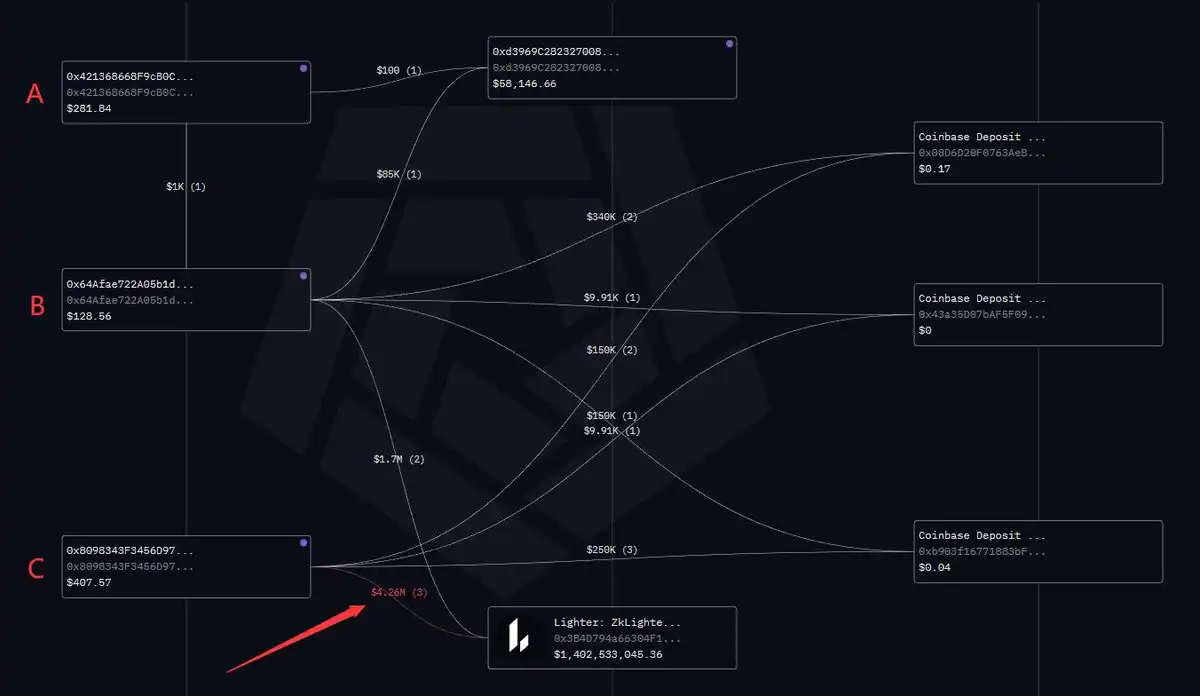
In recent days, several addresses suspected to be associated with Lighter team members have purchased $125,000 worth of "YES" shares in the polymarket's "Will Lighter TGE Before End of Year" market. Just a few days ago, Coinbase also announced that LIGHTER would be added to its listing roadmap. All signs point to Lighter's TGE finally being on the horizon.
The market will eventually punish every arrogant bystander, just as many initially viewed Hyperliquid as a performance-enhanced but more centralized GMX. Many people habitually saw Lighter as yet another imitator of Hyperliquid.
However, Lighter differs significantly from Hyperliquid in its business model, development strategy, and technical architecture. These differences suggest that Lighter will be the first real threat to Hyperliquid outside of CEX.
Retail-Friendly Fee Structure
Compared to Hyperliquid's tiered fee structure based on trading volume, Lighter has adopted a 0 fee approach to attract retail traders.
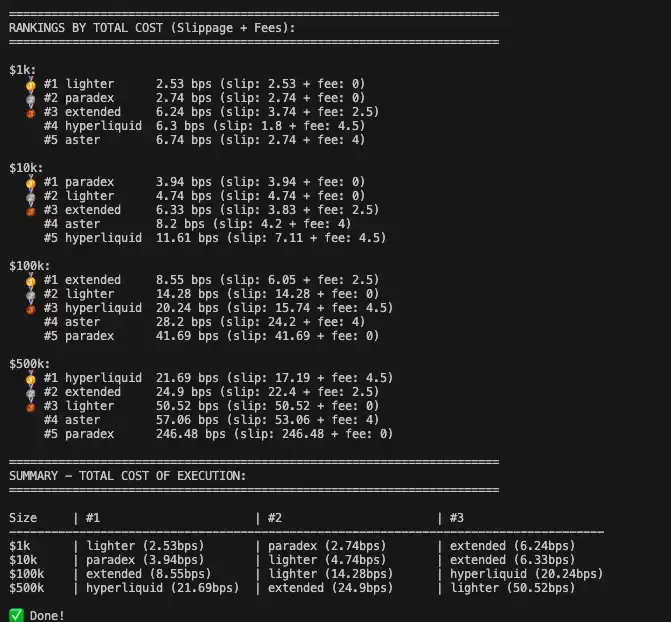
According to community user @ilyessghz2's calculations, for ordinary traders with principal between $1,000 and $100,000, Lighter's total execution cost (slippage + fees) is significantly lower than Hyperliquid's.
Hyperliquid's low fee advantage is mainly seen in large capital accounts of over $500,000, while in the broader long tail retail range, Lighter actually offers a more competitive trading cost. This "feeless" feature's perception is particularly evident for retail traders engaged in high-frequency trading.
Underrated Business Model
There's no such thing as a free lunch. Behind the 0 fee structure, Lighter essentially transplants Robinhood's business model—Payment For Order Flow (PFOF)—onto the blockchain.
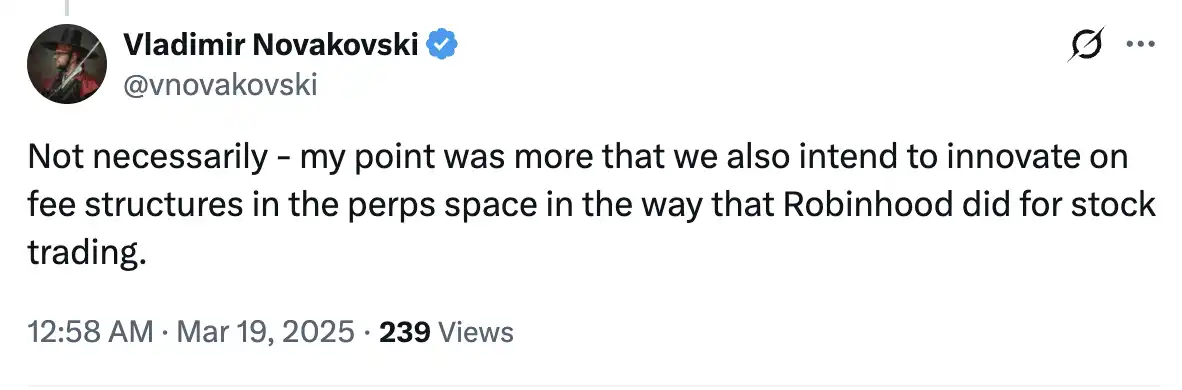
Lighter sells retail order flow to market makers, who profit from the bid-ask spread and pay kickbacks to Lighter. PFOF ingeniously transforms explicit trading costs into implicit execution costs (such as slightly wider spreads).
The fundamental reason behind the establishment of the PFOF model is that market makers are willing to pay for retail order flow because these orders are often seen as "ignorant liquidity." Compared to institutional orders, retail trade directions often lack accurate predictions of future price movements and are more based on emotion or short-term fluctuations, so market makers face very low risks of adverse selection and have significant profit potential.
As trading volume expands, Lighter is able to demand higher rebates from market makers. This model has long been validated in traditional finance, with Robinhood earning hundreds of millions of dollars per quarter solely through PFOF.
L1 Is a "Bug"
The statement by Lighter's founder that "L1 is a Bug, not a feature" once placed himself at the center of controversy, but this statement indeed alluded to the pain point of Hyperliquid.
In the "JellyJelly Attacks HLP" event, the team protected HLP's funds through a "cut-off" method. The "formalism" of validators' voting cannot conceal the platform's centralization issue itself.
In addition, Hyperliquid's spot trading relies on HyperUnit, a multisig cross-chain bridge controlled by a few nodes. The dark history of multisig cross-chain bridges like Ronin and Multichain has repeatedly shown that no matter how sophisticated the multisig design is, as long as it involves human trust, there is a risk of being 51% attacked by hackers through social engineering.
As a monolithic application chain, institutions must bear additional trust costs for the bridging nodes and the chain's security, which is almost an insurmountable barrier in terms of compliance.
Choosing to become an Ethereum L2 allows Lighter to eliminate the need for a third-party trust assumption. For risk-averse institutional funds, this is a fundamental difference. After entering Stage 1 of L2 in the future, even if Lighter's sequencer behaves maliciously or crashes, users can still force withdrawals through ETH mainnet contracts.
And this is just the beginning. The crown jewel of Lighter's technical architecture is a "universal full-asset guarantee" system achieved through zero-knowledge proofs that can be mapped back to the Ethereum mainnet.
DeFi liquidity is fragmented. Deposits on Aave, LP tokens on Uniswap, staked stETH on Lido—users' assets across platforms cannot directly serve as trading margins.
Using ZK technology, Lighter allows users to lock assets from the Ethereum mainnet (such as stETH, LP Tokens, or even future tokenized stocks) in an L1 contract, while directly mapping them to collateral on L2, without relying on a separate L1 <-> L2 cross-chain bridge. This means users can hold stETH on the mainnet to earn staking rewards while using it as collateral to open contracts on Lighter, enabling real-time settlement on the mainnet, achieving "yield stacking," and maximizing capital efficiency.
This mapping capability has brought security to Lighter that other L1 Perp DEXs cannot match, making it a key asset in attracting institutional funds.
「Iron Triangle」
An "iron triangle" consisting of "Robinhood-Lighter-Citadel" is emerging.
Lighter's founder, Vladimir Novakovski, previously worked at Citadel, the world's largest market maker, and served as an advisor to Robinhood. Robinhood is the most widely used retail stock brokerage, Citadel is Robinhood's largest market-making partner, and Robinhood is a direct investor in Lighter.
In an ideal scenario, this could become a perfect business loop. Robinhood is responsible for frontend user acquisition, bringing tens of millions of retail stock traders into the crypto world; Lighter serves as the backend execution engine, handling matching and clearing, providing a Nasdaq-level trading experience and the security benefits of ZK-rollup; while market makers like Citadel are responsible for handling this order flow.
Once Citadel decides to make Lighter its primary venue for hedging and trading tokenized stocks, stock perpetual contracts, and RWAs, all brokers relying on Citadel's liquidity will have no choice but to connect to Lighter. In this narrative, Lighter becomes the interface connecting traditional finance with the on-chain world.
Convergence
Through the HIP-3 proposal, Hyperliquid outsourced market deployment to an external team, leading to ecosystem prosperity and strong buying pressure on HYPE, but inevitably resulting in significant liquidity fragmentation—such as two HIP-3 exchanges, Felix and Trade.xyz, both supporting TSLA trading, causing liquidity dispersion for the same asset.
At the same time, exchanges under the HIP-3 model have blurred and difficult-to-unify compliance responsibilities, unable to centrally address compliance issues.
Backed by top-tier capital from investors such as Peter Thiel's Founders Fund, a16z, and Coinbase Ventures, Lighter has strategically positioned itself in the regulatory game.
Lighter's insistence on a monolithic unified architecture also echoes Citadel's call to the SEC: "Tokenized assets must have the same rules, the same protection, and the same market structure."
Privacy
Hyperliquid's transparent transaction feature is a clear disadvantage for large fund users. On-chain data exposes the entry price and liquidation point of all large positions, making whales vulnerable to front-running and targeted liquidation risks.
Lighter can conceal users' transaction and position data. For large funds and institutional investors, anonymity is a fundamental requirement when conducting large transactions. After all, no one wants to reveal their hand to a counterparty.
As the on-chain derivatives market matures, platforms that can effectively protect user transaction privacy will have a better opportunity to attract core liquidity.
The TGE Curse of Perp DEX
The Token Generation Event (TGE) is often a watershed moment for the fate of Perp DEX. Hyperliquid's key to success lies in its ability to maintain or increase trading volume post-incentive, breaking the "mine and dump" curse.
Lighter, with a clearly defined VC unlock schedule, faces an even more severe test. After the airdrop expectations are met, will users flock to the next Perp DEX? Liquidity loss post-TGE leads to worsened slippage, directly impacting the trading experience and triggering a continuous decline in trading volume known as the "death spiral."
Conclusion
Shifting the focus away from local stock games, a more grand narrative is unfolding.
A year ago, few could foresee Hyperliquid truly challenging centralized exchanges. Lighter and Hyperliquid are not bitter rivals but comrades in the same trench. They both point toward that long-standing old order.
The war of Perp DEX against CEX has only just begun.
You may also like

After two years, Hong Kong's first batch of stablecoin licenses finally issued: HSBC, Standard Chartered make the cut

The person who helped TAO rise by 90% has now single-handedly crashed the price again today

3-Minute Guide to Participating in the SpaceX IPO on Bitget

Top 5 Cryptos to Buy in 2026 Q1: A ChatGPT Deep Dive Analysis
Explore the top 5 cryptos to buy in Q1 2026 including BTC, ETH, SOL, TAO, and ONDO. See price outlooks, key narratives, and institutional catalysts shaping the next market move.

How to Earn $15,000 with Idle USDT Before Altcoin Season 2026
Wondering if altcoin season is coming in 2026? Get the latest market update, and learn how to turn your idle stablecoins waiting for entry into extra rewards up to 15,000 USDT.
Can You Win Joker Returns Without Large Trading Volume? 5 Mistakes New Players Make In WEEX Joker Returns Season 2
Can small traders win WEEX Joker Returns 2026 without huge volume? Yes—if you avoid these 5 costly mistakes. Learn how to maximize card draws, use Jokers wisely, and turn small deposits into 15,000 USDT rewards.

Altcoin Season 2026: 4 Stages to Profit (Before the Crowd FOMO In)
Altcoin Season 2026 is starting — discover the 4 key stages of capital rotation (from ETH to PEPE) and how to position before the peak. Learn which tokens will lead each phase and avoid missing the rally.

Will Alt season come in 2026? 5 Tips to Spot the Next 100x Crypto Opportunities
Will altcoin season arrive in 2026? Discover 5 rotation stages, early signals smart traders watch, and the key crypto sectors where the next 100x altcoin opportunities may emerge.

The bear market has arrived, and cryptocurrency ETF issuers are also getting involved

The richest man had a quarrel with his former boss

BTC Firm Above 70K! Saylor’s "Institutional Logic" vs. Moon’s "Retail Faith": Who is Really Harvesting the Market?
Bitcoin is holding firm above the $70,000 support level following a massive short squeeze that liquidated $427 million. As the "Four-Year Cycle" narrative shifts, the market is split: Michael Saylor’s cold, institutional "indiscriminate stacking" vs. Carl Moon’s high-energy retail "hopium." This article decodes these two polar-opposite strategies for the 2026 bull run and reveals how WEEX’s institutional-grade liquidity and AI trading tools empower every type of investor to convert market volatility into profit.

The Girl Who Created the SBTI Test: A Story of a Doomed Cyber Love, an E-Widow Ratfolk

B.AI Officially Launched: Building AI Agent Financial Bedrock Platform, Driving AGI Era Business Underlying Logic

B.AI Officially Launched: Breaking Down A2A Collaboration Barriers to Unlock the Smart Body Economy's Full Potential
We helped Xu Mingxing write a book called "<OK Life>".

Rare APY of 400%, is TradeXYZ handing out money to oil bulls?
a16z: Perpetual Contracts are Rewriting Global Trading Rules

Bitcoin Hits $73,000 Triggering $427M Short Liquidation | Carl Moon: $200,000 is the Target
April 9, 2026 (UTC+0), 22:17. Bitcoin (BTC) executed a high-velocity surge within minutes, heavy-hitting the $73,000 psychological barrier and touching a local high near $74,000. While the price has since retraced to consolidate above $72,000, this "instant ambush" successfully completed a $427M liquidation of short positions.
After two years, Hong Kong's first batch of stablecoin licenses finally issued: HSBC, Standard Chartered make the cut
The person who helped TAO rise by 90% has now single-handedly crashed the price again today
3-Minute Guide to Participating in the SpaceX IPO on Bitget
Top 5 Cryptos to Buy in 2026 Q1: A ChatGPT Deep Dive Analysis
Explore the top 5 cryptos to buy in Q1 2026 including BTC, ETH, SOL, TAO, and ONDO. See price outlooks, key narratives, and institutional catalysts shaping the next market move.
How to Earn $15,000 with Idle USDT Before Altcoin Season 2026
Wondering if altcoin season is coming in 2026? Get the latest market update, and learn how to turn your idle stablecoins waiting for entry into extra rewards up to 15,000 USDT.
Can You Win Joker Returns Without Large Trading Volume? 5 Mistakes New Players Make In WEEX Joker Returns Season 2
Can small traders win WEEX Joker Returns 2026 without huge volume? Yes—if you avoid these 5 costly mistakes. Learn how to maximize card draws, use Jokers wisely, and turn small deposits into 15,000 USDT rewards.


 App
App