
 Buy Crypto
- Markets
 Futures
- Spot
- Copy Trade
- Earn
- More
Can't Beat the Stock Market, Can't Outdo Precious Metals, Is Crypto Really Becoming the Bull Market for "Outsiders"?

Original Title: "Can't Beat the Stock Market, Can't Outperform Precious Metals, Is Crypto Really in a Bull Market as an 'Outsider'?"
Original Author: Nancy, PANews
Last night (December 29th), Bitcoin once again experienced a "trapdoor" market. Faced with this repeated tug-of-war situation, the market's nerves seem to have long been numbed.
From the Bitcoin peak to the present, it has been less than three months, but investors seem to have been in a deep winter for a long time. This psychological breakdown is not simply due to the retreat of on-paper assets, but more from a shaky confidence, with stocks surging, indices reaching new highs, and gold and silver skyrocketing...
Traditional assets are having a carnival, while crypto assets are unexpectedly falling behind. Under this huge gap, players have begun voting with their feet, expressing bearish sentiments, cutting losses, liquidating their positions, and the crypto market is now experiencing unprecedented existential anxiety.
Entering Purgatory Mode, Trading Activity Dips to Freezing Point
Wait-and-see and defense have become the main theme of the crypto market at the end of the year.
Indeed, stablecoin market capitalization has quietly climbed to a staggering $300 billion. According to historical experience, such a massive off-exchange fund reservoir should have been the fuel for a bull market, indicating that a large-scale bubble rally is about to begin. However, the reality is that instead of experiencing a collective celebration, the crypto market has entered purgatory mode.
Looking back at the market trends in the crypto market throughout the year, investor confidence has been severely hit. Although Bitcoin and Ethereum hit all-time highs this year, they failed to maintain their momentum and both turned downwards. The altcoin market was even more brutal, with even newly listed coins unable to escape the fate of a downward spiral, and liquidity depletion has become the norm.
In this meat grinder market, both veterans and newcomers are finding it hard to escape. Even Bitcoin holders are not having a good time, with over 30% of Bitcoin currently in a state of loss. The last time such a degree of supply shortage occurred was in October 2023 when the price of BTC was around $26,000.
With the market downturn, funds are rapidly retreating. According to Matrixport data, the Bitcoin spot ETF, a barometer of institutional sentiment, has seen net outflows for 9 consecutive weeks, with total outflows approaching $6 billion. If the month ends with a net outflow, this will be the most significant round of fund withdrawal since the ETF was listed in January 2024.
Trading activity has also dropped to freezing point. According to The Block data, the global cryptocurrency exchange spot trading volume in November dropped to $1.59 trillion, hitting the lowest level since June.
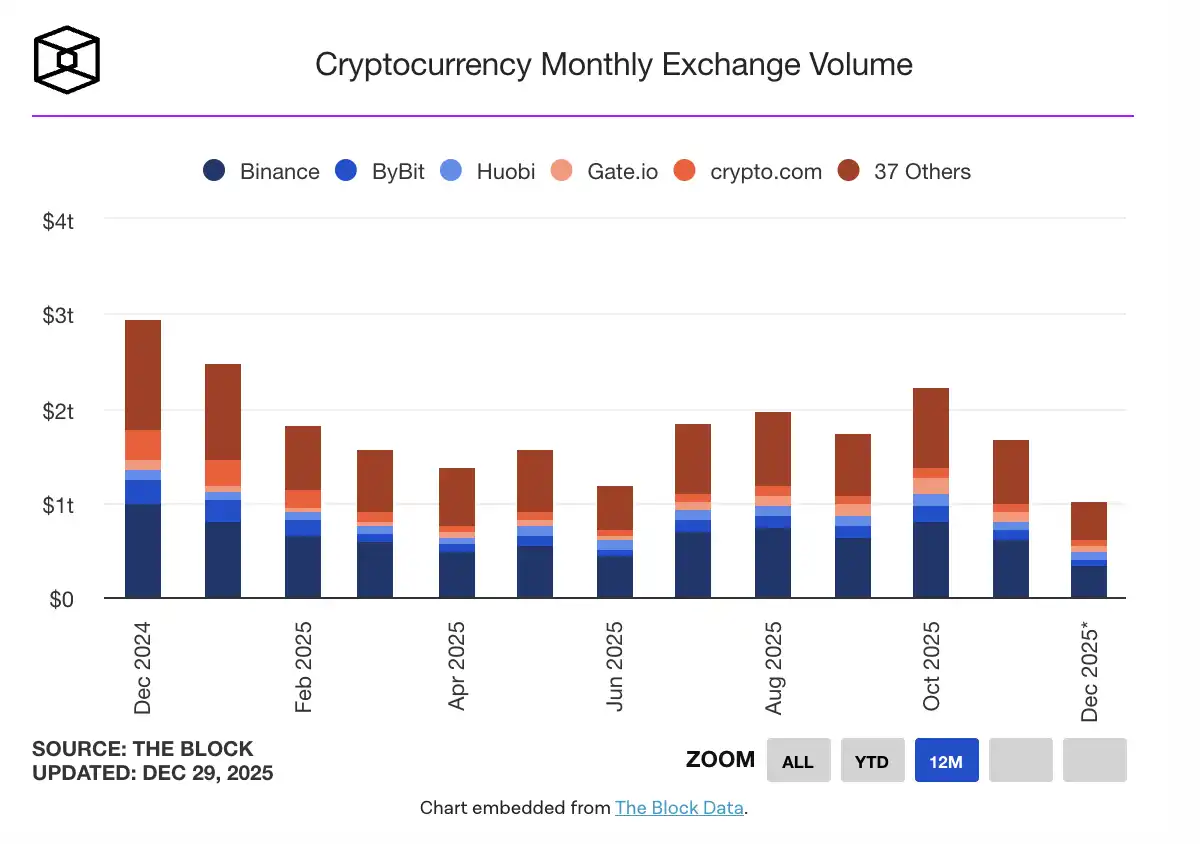
And market interest has plummeted. As a barometer of retail sentiment, Google Trends shows that global searches for "cryptocurrency" continue to decline, with the United States reaching its lowest point in a year.
CryptoQuant analyst Darkfost also pointed out that a market sentiment index based on media articles, on-chain data, and other platforms shows that the current prevailing consensus in the crypto market has shifted to bearish. However, he also believes that when a common consensus is formed, the market often reverses, proving that the majority is wrong.
Can't Outrun the Stock Market, Can't Beat Precious Metals
While the crypto market remains weak, many traditional assets are showing particular strength.
This year, major stock markets next door have seen a "short squeeze" rally. A-share IPOs have performed strongly, with an average first-day gain of over 256% and none breaking issue price; the Hong Kong stock market has rebounded, with over 40 stocks doubling in price; the three major U.S. indices closed strongly, with the S&P 500 rising nearly 18%, the Dow Jones rising 14.5%, and the Nasdaq rising by as much as 22%; and the Korean composite index Kospi has achieved a stunning surge, rising over 76%.
Retail investors are entering the race. Taking U.S. stocks as an example, KobeissiLetter data shows that this round of gains in the U.S. stock market is historic, with U.S. household equities exceeding real estate in net assets, a phenomenon that has only occurred three times in the past 65 years; JPMorgan analysts have pointed out that by 2025, retail investment funds in the U.S. stock market will grow by 53% to reach $303 billion, becoming the main force behind the stock market's rise.
In the showdown of safe-haven assets, physical precious metals have also outperformed Bitcoin. Gold, silver, and platinum have recently hit historic highs, despite experiencing a rollercoaster plunge, but their gains for the year remain significant. In contrast, Bitcoin's status as "digital gold" is facing a serious challenge. The BTC-to-gold and BTC-to-silver ratios have both fallen to new lows since November and September 2023, respectively.
This has also triggered ridicule from outside the crypto community. For example, staunch gold advocate Peter Schiff bluntly stated that one of the best trades in 2025 is to "sell Bitcoin and buy silver," as there was no crypto Christmas rally, the Bitcoin launchpad failed, and precious metals took off. If Bitcoin doesn't rise when tech stocks rise and doesn't rise when gold and silver rise, then it may never rise.
Just a month ago, Peter Schiff was at a disadvantage in a debate with CZ on the "value of gold and Bitcoin,".
In this highly anticipated policy dividend year, it ended with a Bitcoin yearly close lower, and the performance of other crypto assets was even more dismal. According to CoinGecko data, only RWAs, Layer1, and the U.S. domestic narrative sector saw gains this year, while the rest of the field experienced double-digit declines, resulting in a lack of a money-making effect in the market.
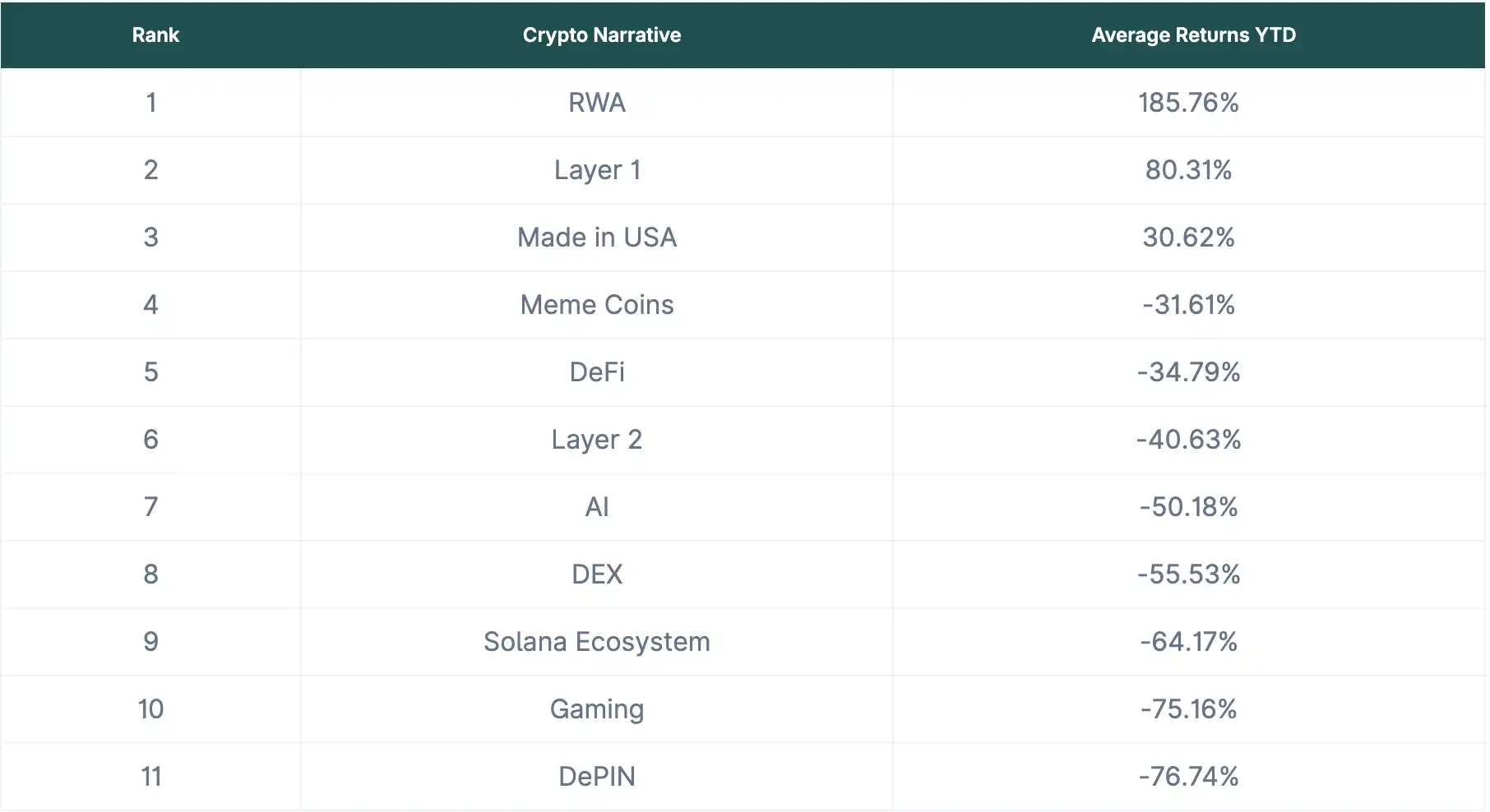
Money is always profit-driven. When the traditional market offers a more certain return, the attractiveness of crypto assets sees a steep decline. To retain liquidity and users, many crypto platforms have also started offering related traditional assets. For example, Binance, Kraken, Bitget, Hyperliquid, Robinhood, among others, have ventured into tokenized stocks. On-chain commodity trading is also on the rise, with a surge in tokenized gold trading volume. Some crypto DAT companies have even begun to include gold in their reserve assets to strengthen their balance sheets.
Guard Your Circle of Competence, Don't Be the "Fool" at the Table
Crypto funds and attention are flowing out, and even the "crypto trading nation" South Korea is showing clear signs of cooling down, with retail investors abandoning coins for stocks, attempting to find a more stable and sustainable income in a larger pool.
However, just as Buffett's Fool at the Table theory, entering a new arena does not necessarily mean having the qualification to stay at the table.
Take U.S. stocks, for example. For most people, opening an account only takes a few minutes, but that does not mean the barrier to entry is really low. Compared to the crypto market, the U.S. stock market is a highly mature, deeply institutionalized system. The vast majority of retail investors face a comprehensive downgrade in terms of information, resources, tools, experience, and risk management capabilities.
In the crypto field, retail investors can still capture some front-line emotions and structural changes through communities, social media, and on-chain data, and even dance with market makers at some moments. In the U.S. stock market, on the other side stand professional institutions with quantitative models, senior analyst teams, industry research channels, and long-term data accumulation, making the competition level unmatched.
Moreover, many investors who have transitioned from the crypto space to U.S. stocks have not simultaneously upgraded their cognitive frameworks. When faced with complex variables such as financial statements, industry barriers, business models, macro policies, they still rely on emotional games and short-term thinking from their crypto trading days, lacking the ability to understand and grasp the complete business cycle.
The reason U.S. stocks have been able to sustain a long-term bull market lies more in the continuous improvement of corporate profitability, a clear and stable shareholder return mechanism, and a long-term competitive environment of survival of the fittest. Companies like Microsoft, Amazon, Google, Apple, and others have gone through several cycles of tests and eventually surpassed fluctuations to achieve value accumulation.
More importantly, most of the newly emerged players are in a significant survivorship bias. Since the darkest days post-2009 financial crisis, the U.S. stock market has embarked on its longest bull run in history. This means that young investors have not truly experienced a full baptism by a deep bear market. The tailwind has amplified optimism towards the market, mistaking the Beta gains from the overall market surge as Alpha created by their own skill. According to a recent report by Coinbase, about 45% of U.S. cryptocurrency investors are from the younger demographic.
While it may seem like a gold rush everywhere, it is actually a heart-stopping journey at every step. The real barrier lies more in cognition. Instead of being led by the narrative, it is better to guard one's own competence circle, lower expectations, and patiently wait for the opportunity.
You may also like

Ray Dalio's new article: The world is entering a war cycle

IOSG: When Fintech Meets Crypto Native: The Next Decade of Digital Finance

They knew in advance that Trump would tweet about a ceasefire, entered with $20k, and exited with $400k.

The biggest bottleneck in DeFi development

CZ Memoir Released: Reveals a Large Amount of Industry Insider Information, Prompting Intense Rebuttal from Xu Mingxing

a16z: After securities are on the blockchain, why will intermediary institutions be replaced by code?

XRP Tokyo Is Here: What We Learn and What’s Next for XRP Price
Key Takeaways: Ripple’s 2025 XRP Tokyo event highlights a projected $33 trillion on-chain stablecoin volume by 2026. Significant…

Solana’s Future: Navigating the $285M Hack, Rug Pulls, and Milei Libra Scandal
Key Takeaways: Multiple Crises: Solana faces a $285 million hack, allegations of rug pulls, and the Milei Libra…

BTC USD Faces Tension: Markets React to Trump’s Dire Warning
Key Takeaways: Bitcoin’s price drops sharply below $70,000 amid geopolitical tensions, playing off Trump’s dramatic 8 PM ultimatum…
Bitcoin Price Surge: Ceasefire Sparks Optimism Hits $71K
Key Takeaways: After the US-Iran ceasefire announcement, Bitcoin surged beyond $71,000, marking its highest in a month. A…

Ethereum Price Forecast: Record $180 Billion Stablecoin Supply Marks Buyers’ Return
Key Takeaways: Ethereum’s stablecoin supply has surged to a record $180 billion, marking a 150% increase over the…

Emerging Evidence Links Argentina’s Milei to LIBRA Crypto Scandal
Key Takeaways: Evidence unveiled by Argentina’s federal prosecutors links President Javier Milei to the LIBRA token through call…

US Spot Bitcoin ETFs See Surge as BTC Nears $70K; LiquidChain and Layer-3 DeFi Rise
Key Takeaways: U.S. spot Bitcoin ETFs absorbed $471 million in a single day, moving BTC closer to the…

Bitcoin Price Prediction: Decoupling from Tech Stocks, Shaped by Geopolitics and AI Turmoil
Key Takeaways: Bitcoin is decoupling from tech stocks as geopolitical tensions and AI crises reshape the market, currently…

Chaos Labs Departure Leaves Aave Without Risk Management Amidst Governance Conflict
Key Takeaways: Aave, with a $50 billion TVL, is currently operating without a risk manager due to Chaos…
Grayscale Ethereum ETF Staking: A New Catalyst for $5,700?
Key Takeaways: Grayscale’s Ethereum Staking ETF introduces a yield-bearing structure that could significantly reshape investor sentiment. Ethereum’s price…

Polygon Crypto Enhances Finality Through the Giugliano Hardfork
Key Takeaways: Polygon’s Giugliano hardfork is operational on the mainnet, effectively reducing transaction finality by 2 seconds. The…

Senate’s Three-Week Deadline: Ripple XRP and the CLARITY Act’s Critical Moment
Key Takeaways: The Senate Banking Committee’s decision on the CLARITY Act in late April could define XRP’s future…


 App
App