
- Buy Crypto
- Markets
 Futures
- Spot
- Copy Trade
- Earn
- More
Bitwise Chief Investment Officer: Farewell to the 1% Allocation, Bitcoin is Experiencing its 'IPO Moment'

Original Article Title: The Days of 1% Bitcoin Allocations Are Over
Original Article Author: Matt Hougan, Chief Investment Officer at Bitwise
Original Article Translation: Saoirse, Foresight News
The sideways movement of Bitcoin precisely marks its 'IPO moment.' Why does this signify a higher percentage asset allocation? The answer is below.
In Jordi Visser's latest article, a key question is explored: despite the continuous good news — strong ETF inflows, significant regulatory progress, and ongoing institutional demand — Bitcoin's trading is still frustratingly stuck in a sideways pattern.
Visser believes that Bitcoin is undergoing a 'silent IPO,' transitioning from a 'wild concept' to a 'mainstream success story.' He points out that typically, when stocks go through this transformation, they often consolidate in a sideways pattern for 6 to 18 months before entering a bullish trend.
Take Facebook (now Meta), for example. On May 12, 2012, Facebook went public at a price of $38 per share. For over a year, its stock price remained stagnant and fluctuated between sideways movement and declines, failing to surpass the $38 IPO price for a full 15 months. Google and other highly anticipated tech startups exhibited similar trends in the early days of their IPOs.
Visser states that sideways movement does not necessarily imply issues with the underlying asset itself. This situation often arises because founders and early employees choose to 'cash out and exit.' Those bold investors who took significant risks in early-stage companies, now reaping returns of a hundredfold, naturally seek to secure their gains. The process of insiders selling off and institutional investors taking over needs time — only when this equity (or asset) transfer reaches a certain balance, will the price of the underlying asset resume its upward trajectory.
Visser points out that Bitcoin's current situation is highly similar to the above scenario. Early believers who acquired Bitcoin at $1, $10, $100, or even $1000 now hold wealth that spans generations. Today, Bitcoin has 'entered the mainstream' — with ETFs trading on the New York Stock Exchange, large corporations incorporating it into their reserves, and sovereign wealth funds entering the scene — these early investors finally have the opportunity to realize their gains.
This is worth celebrating! Their patience has finally paid off. Five years ago, if someone had sold $1 billion worth of Bitcoin, it would likely have caused chaos in the entire market; but today, the market has a diverse enough buyer base and sufficient trading volume to more smoothly absorb such large-scale transactions.
It is important to note that on-chain data regarding "who is selling" is not interpreted uniformly, so Visser's analysis is just one of the current factors influencing market trends. However, this factor is crucial, and contemplating its significance for the future market undoubtedly holds valuable insights.
Here are the two key conclusions I extracted from this article.
Conclusion One: Extremely Optimistic Long-Term Outlook
Many cryptocurrency investors felt disheartened after reading Visser's article: "Early whales are selling Bitcoin to institutions! Do they know some insider information that we don't?"
This interpretation is completely wrong.
The selling off by early investors does not signify the "end of life" for an asset; it merely represents the asset entering a new phase.
Take Facebook, for example. Indeed, its stock price lingered around below $38 after the IPO for a year, but today, its stock price has reached $637, a 1576% increase from the issue price. If we could go back to 2012, I would be willing to buy all Facebook stocks at $38 per share.
Of course, if you had invested during Facebook's Series A financing round, the returns might have been higher — but the risks you would have had to bear at that time were much greater than after the IPO.
Bitcoin is the same today. Although the possibility of Bitcoin achieving a hundredfold return in a single year may decrease in the future, once the "asset allocation phase" is over, it still has tremendous room for growth. As Bitwise pointed out in the "Bitcoin Long-Term Capital Market Assumptions" report, we believe Bitcoin will reach $1.3 million per coin by 2035, and I personally think this forecast is still conservative.
Additionally, I would like to add one point: the post-sell-off market by early whales in Bitcoin differs from a market after a company's IPO. After a company completes an IPO, it still needs to support stock prices through continued development — Facebook could not directly surge from $38 to $637 because it did not have enough revenue and profit at that time to support such a rise. It had to gradually achieve growth by expanding revenue, exploring new businesses, and focusing on mobile, among other ways — a process that still carries risks.
But Bitcoin is different. Once the early whales are done selling, Bitcoin doesn't need to "do" anything anymore—the only condition required for its market cap to grow from the current $2.5 trillion to the $25 trillion gold market cap is to "gain broad acceptance."
I'm not saying this process will happen overnight, but it's likely to be faster than the rise in Facebook's stock price.
From a long-term perspective, Bitcoin's sideways movement is actually a "godsend." In my view, this is a good opportunity to accumulate chips before Bitcoin restarts its uptrend.
Conclusion 2: The Era of a 1% Bitcoin Allocation is Over
As Visser mentioned in the article, companies that have completed an IPO have much lower risk compared to early-stage startups. Their equity is more widely distributed, subject to stricter regulatory scrutiny, and have more opportunities for business diversification. Investing in a post-IPO Facebook is much less risky than investing in a startup founded by a college dropout operating out of a party house in Palo Alto (the heart of Silicon Valley).
The current situation with Bitcoin is similar. As Bitcoin holders transition from "early adopters" to "institutional investors," coupled with its continuous technological maturity, today's Bitcoin no longer faces the kind of "existential risk" it did a decade ago; it has become a mature asset class. This can be clearly seen from Bitcoin's volatility—since the Bitcoin ETF started trading in January 2024, its volatility has greatly decreased.
Bitcoin Historical Volatility
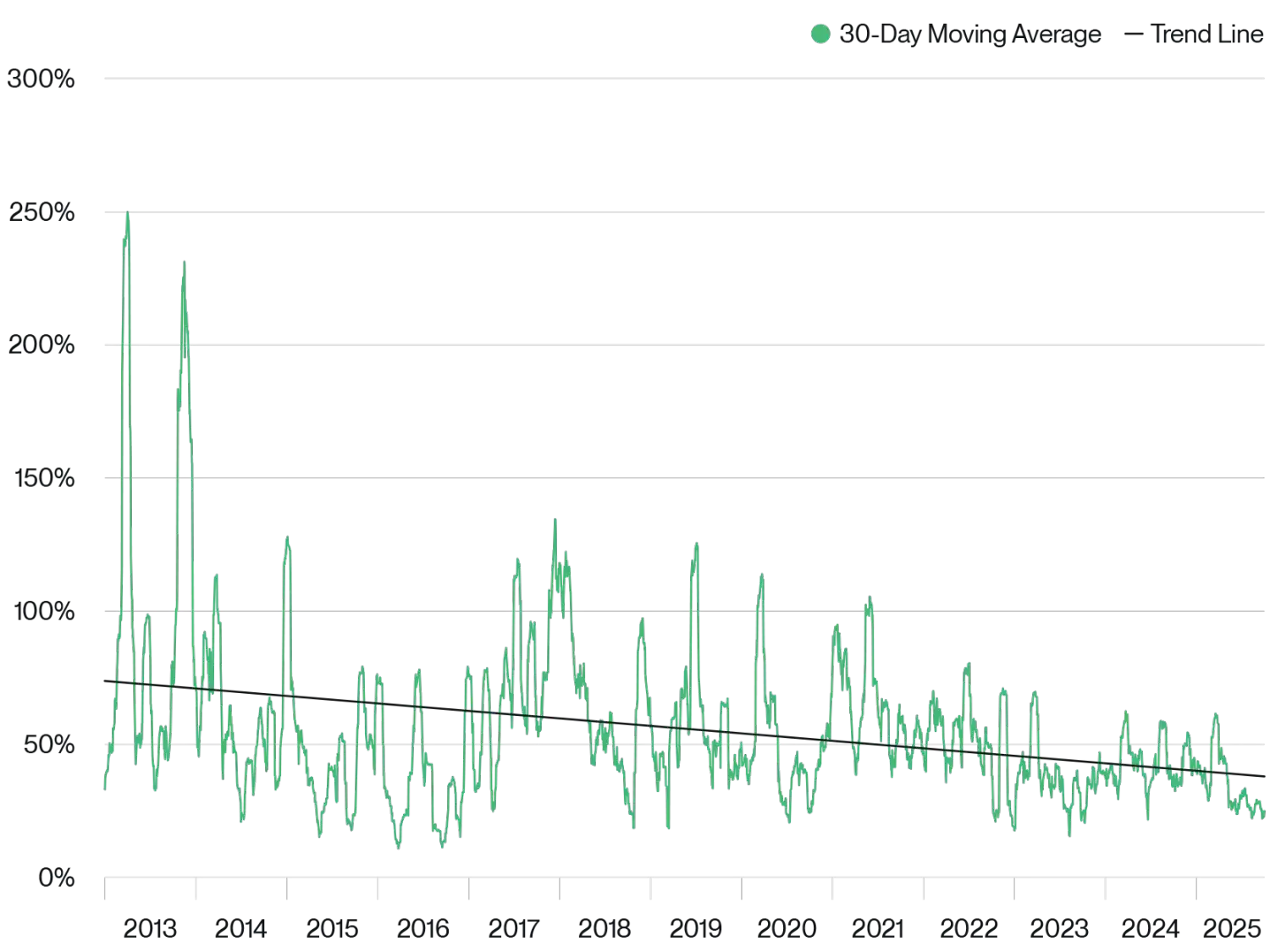
Data Source: Bitwise Asset Management. Data Range: January 1, 2013, to September 30, 2025.
This change brings an important insight to investors: in the future, Bitcoin's returns may slightly decrease, but its volatility will significantly decrease. As an asset allocator, faced with this change, my choice will not be to "sell off"—after all, we predict that in the next decade, Bitcoin will be one of the best-performing asset classes globally—instead, I will choose to "accumulate."
In other words, decreased volatility means "lower risk in holding more of this asset."
Visser's article also confirms a phenomenon we have long observed: over the past few months, Bitwise has held hundreds of meetings with financial advisors, institutions, and other professional investors and found a clear trend—the era of a 1% Bitcoin allocation is over. More and more investors are starting to believe that a 5% allocation should be the "starting point."
Bitcoin is experiencing its own "IPO moment." If history is any guide, we should embrace this new era through "HODLing."
You may also like

Bitcoin's Big Brother Scythe, a Nasdaq Heist Chronicle

ARK Invest: Stablecoins are Constructing the Next-Generation Monetary System

President Trump Asserts Imminent Passing of Crypto Market Structure Bill
Key Takeaways Presidential Confirmation: President Trump states the major crypto market structure bill is on the verge of…

Germany Central Bank Head Advocates for European Crypto Stablecoins Under EU MiCA Framework
Key Takeaways Joachim Nagel, head of the Germany Bundesbank, is advocating for the adoption of euro-based crypto stablecoins…

Polygon Surpasses Ethereum in Daily Fees as Polymarket Bets Rocket
Key Takeaways Polygon has outpaced Ethereum in daily transaction fees, a historic shift driven by activity on Polymarket.…

Bitcoin Price Prediction: BTC Short Squeeze Alert – Is a Significant Rebound on the Horizon?
Key Takeaways Recent data indicates Bitcoin shorts have escalated to unprecedented levels reminiscent of a major market low…

Google’s Gemini AI Predicts the Price of XRP, Solana, and Bitcoin by the End of 2026
Key Takeaways XRP’s Potential: Google’s Gemini AI forecasts XRP could reach $10 by 2026, leveraging Ripple’s payment solutions…

Top Analyst Warns Bitcoin Price Could Plummet to $10,000 Amid Deepening Bear Market
Key Takeaways Bitcoin’s value could potentially drop to $10,000 as part of an imploding bubble, suggests a renowned…

Best Crypto to Buy Now February 10 – XRP, Solana, Dogecoin
Key Takeaways XRP is poised for long-term growth with its recent strategic expansions in institutional-grade payments and tokenization.…

Kyle Samani Criticizes Hyperliquid in Explosive Post-Departure Market Commentary
Key Takeaways: Kyle Samani, after leaving Multicoin Capital, criticized Hyperliquid, a decentralized exchange, labeling it as a systemic…
XRP Price Prediction: A 50M Token Sell-Off Just Shook the Market — Is More Loss Imminent?
Key Takeaways Over 50 million XRP hit the market within a span of less than 12 hours, leading…

Strategy Plans to Equitize Convertible Debt Over 3–6 Years: What It Means for BTC
Key Takeaways Strategy, led by Michael Saylor, is equitizing $6 billion in convertible debt as a long-term strategy…

BlockFills Freezes Withdrawals as Bitcoin Declines, Heightening Counterparty Risk Concerns
Key Takeaways BlockFills, an institutional trading firm, has stopped client withdrawals amid rising market volatility and Bitcoin price…

Leading AI Claude Predicts the Price of XRP, Cardano, and Ethereum by the End of 2026
Key Takeaways Claude AI projects substantial growth for XRP, Cardano, and Ethereum by the end of 2026, with…
Crypto Price Forecast for 16 February – XRP, Ethereum, Cardano
Key Takeaways Technical trends and recent developments suggest potential growth for XRP, Ethereum, and Cardano. XRP is targeting…

Bitcoin Price Prediction: Alarming New Research Warns Millions in BTC at Risk of ‘Quantum Freeze’ – Are You Protected?
Key Takeaways Recent market movements have sparked concerns over a potential bear market for Bitcoin, marked by significant…
XRP Price Forecast: Can XRP Truly Surpass Bitcoin and Ethereum? Analyst Argues the Contest Has Already Begun
Key Takeaways XRP has maintained significant support around the $1.40 level despite a 12% decline over the past…
Best Crypto to Purchase Now February 6 – XRP, Solana, Bitcoin
Key Takeaways XRP’s Strength: Ripple’s focus on challenging traditional systems like SWIFT is driving XRP towards a potential…
Bitcoin's Big Brother Scythe, a Nasdaq Heist Chronicle
ARK Invest: Stablecoins are Constructing the Next-Generation Monetary System
President Trump Asserts Imminent Passing of Crypto Market Structure Bill
Key Takeaways Presidential Confirmation: President Trump states the major crypto market structure bill is on the verge of…
Germany Central Bank Head Advocates for European Crypto Stablecoins Under EU MiCA Framework
Key Takeaways Joachim Nagel, head of the Germany Bundesbank, is advocating for the adoption of euro-based crypto stablecoins…
Polygon Surpasses Ethereum in Daily Fees as Polymarket Bets Rocket
Key Takeaways Polygon has outpaced Ethereum in daily transaction fees, a historic shift driven by activity on Polymarket.…
Bitcoin Price Prediction: BTC Short Squeeze Alert – Is a Significant Rebound on the Horizon?
Key Takeaways Recent data indicates Bitcoin shorts have escalated to unprecedented levels reminiscent of a major market low…


 App
App