
 Buy Crypto
- Markets
 Futures
- Spot
- Copy Trade
- Earn
- More
Bitcoin getting ‘stable’? 2025 volatility lower than Nvidia

Original Title: Bitcoin is now less volatile than Nvidia, a statistical anomaly that completely changes your risk calculation
Original Author: Gino Matos, CryptoSlate
Original Translation: Saoirse, Foresight News
As Bitcoin closed out 2025, its actual daily volatility dropped to 2.24%, marking the lowest annual figure recorded for the asset.
K33 Research's volatility chart dates back to 2012 when Bitcoin's daily volatility was at 7.58%. The data reveals that in each subsequent cycle, Bitcoin's volatility has been steadily decreasing: 3.34% in 2022, 2.80% in 2024, and down to 2.24% in 2025.
However, there is a discrepancy between market perception and data. In October 2025, Bitcoin's price plummeted from $126,000 to $80,500, causing anxiety. On October 10, a liquidation event triggered by tariff policies wiped out $19 billion of leveraged long positions in a single day.
The paradox lies in this: while Bitcoin's volatility has indeed decreased by traditional standards, the inflows it attracts are larger compared to previous cycles, and the absolute price swings are higher.
Low volatility does not mean a "quiet market" but rather indicates that the market has matured enough to handle institutional-sized capital flows without relapsing into the "chain reaction" feedback loops seen in earlier cycles.
Today, ETFs, corporate treasuries, and regulated custodial institutions have become the "ballast" of market liquidity, with long-term hodlers continuously reallocating assets into this infrastructure.
The end result is that Bitcoin's daily returns are more stable, but market cap fluctuations still reach hundreds of billions of dollars — a level of volatility that would have caused an 80% collapse if seen in 2018 or 2021.
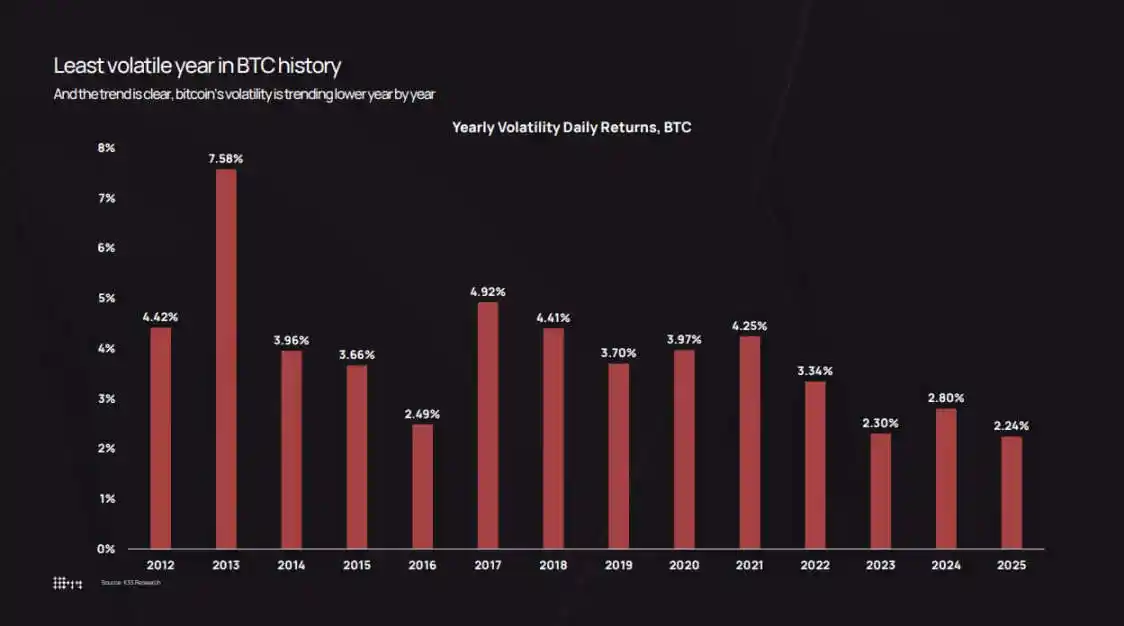
According to K33 Research data, Bitcoin's annual volatility has dropped from a peak of 7.58% in 2013 to a historic low of 2.24% in 2025.
Continued Decrease in Volatility
The annual volatility data for K33 has documented this transition process.
In 2013, the Bitcoin daily return rate had an average of 7.58%, reflecting a market characterized by thin order books and speculative frenzy. By 2017, this value had decreased to 4.81%; in 2020, it was 3.98%; during the 2021 pandemic bull market, it saw a slight increase to 4.13%. In 2022, with the collapse of the Luna project, Three Arrows Capital, and the FTX trading platform, the volatility surged to 3.34%.
Subsequently, the volatility continued to decline: it was 2.94% in 2023, 2.80% in 2024, and dropped to 2.24% in 2025.
A logarithmic scale price chart further confirms this trend. From 2022 to 2025, Bitcoin did not experience extreme price swings of "rapid surge followed by a steep decline" but rather steadily rose within an upward channel.
While there were pullbacks during this period—for example, the price fell below $50,000 in August 2024 and dropped to $80,500 in October 2025—there was no scenario of a "parabolic surge followed by a systemic collapse."
Analysis indicates that the approximately 36% decline in October 2025 still falls within the normal range of Bitcoin's historical retracements. The difference is that a 36% retracement in the past often occurred at the end of a high-volatility period around 7%, whereas this time, it occurred in a low-volatility environment of 2.2%.
This has led to a "perceptual gap": a 36% decline in six weeks may still feel drastic, but compared to earlier cycles (when daily 10% fluctuations were normal), the volatility in 2025 is relatively mild.
Asset management firm Bitwise points out that Bitcoin's actual volatility is now lower than that of Nvidia, a change that has shifted Bitcoin's positioning from a "pure speculative tool" to a "high-beta macro asset."
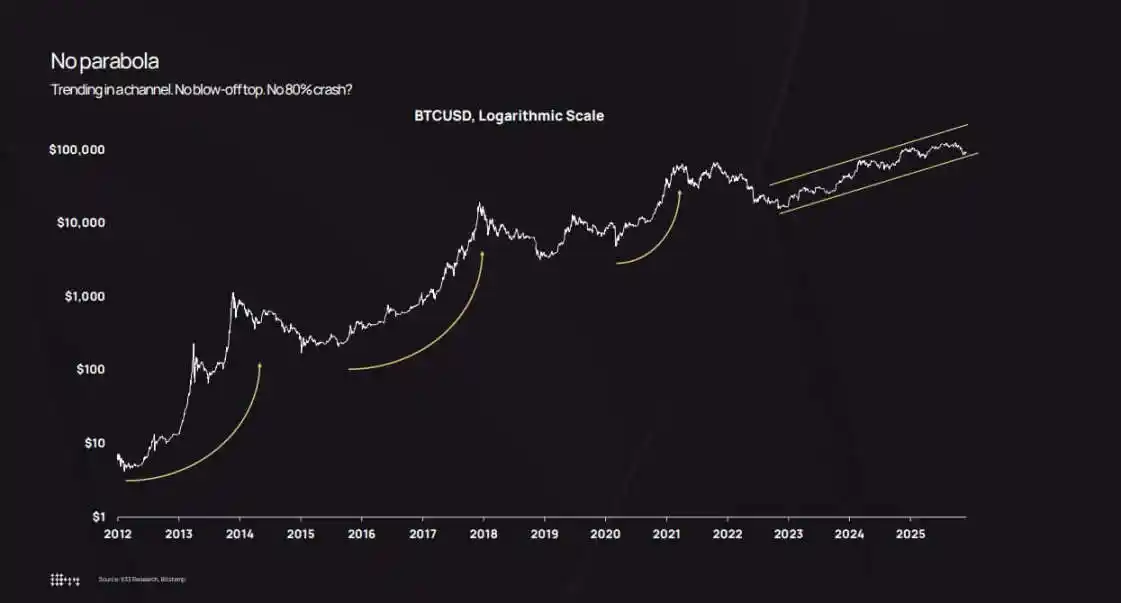
The logarithmic price chart of Bitcoin shows that since 2022, its price has been slowly rising within an upward channel, avoiding the parabolic surges and 80% crashes seen in earlier cycles.
Market Cap Expansion, Institutional Entry, and Asset Reallocation
K33's core viewpoint is that the actual decrease in volatility is not due to reduced capital inflows but because a much larger capital base is now needed to drive price changes.
The "Bitcoin Market Cap Three-Month Change Chart" produced by the institution shows that even during a low volatility period, the market cap can still fluctuate by billions of dollars.
During the retracement from October to November 2025, Bitcoin's market cap plummeted by around $570 billion, nearly on par with the retracement of $56.8 billion in July 2021.
The magnitude of the fluctuations has not changed; what has changed is the market's ability to absorb these fluctuations, known as "depth."
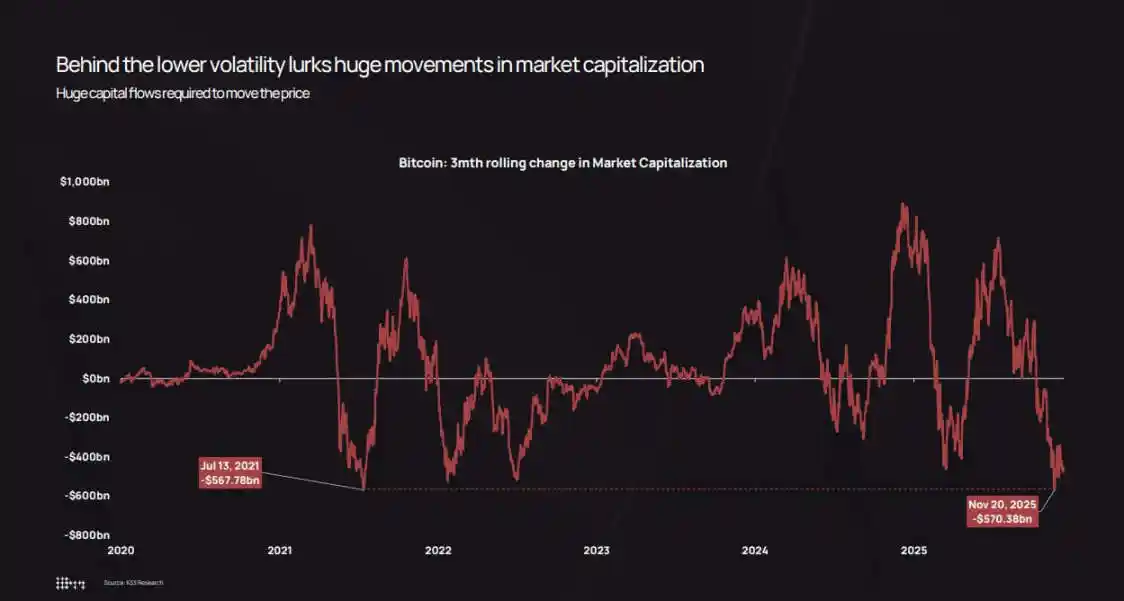
In November 2025, Bitcoin's market cap fluctuation over three months reached $570 billion. Despite lower volatility, this drop was comparable to the $56.8 billion drop in July 2021.
Three major structural factors have driven the decrease in volatility:
First is the "buying the dip" effect of ETFs and institutions. K33 statistics show that in 2025, ETFs net purchased around 160,000 bitcoins (lower than the 630,000+ bitcoins in 2024 but still significant). ETFs and corporate treasuries collectively increased their holdings by about 650,000 bitcoins, accounting for over 3% of the circulating supply. These funds entered the market through "programmatic rebalancing" rather than being driven by retail FOMO emotions.
K33 specifically notes that even with a price drop of around 30%, ETF holdings only decreased by single-digit percentages, without experiencing panic redemptions or forced liquidations.
Second is corporate treasuries and structural issuance. By the end of 2025, corporate treasuries collectively held around 473,000 bitcoins (with the pace of accumulation slowing in the second half of the year). The new demand mainly came from preferred stock and convertible bond issuances rather than direct cash purchases—financial teams execute capital structure strategies quarterly rather than chasing short-term market trends like traders.
Third is the redistribution of assets from early holders to a wider audience. K33's "Asset Holding Duration Analysis" shows that since early 2023, bitcoins held idle for over two years have begun to steadily "activate," with around 1.6 million long-held bitcoins entering circulation over the past two years.
2024 and 2025 were the two years with the largest scale of "dormant asset" activations. The report mentions that in July 2025, Galaxy Digital sold 80,000 bitcoins, and Fidelity sold 20,400 bitcoins.
This selloff neatly aligns with the "structural demand" from ETFs, corporate treasuries, and regulated custodians — the latter will gradually accumulate positions over a period of months.
This redistribution is crucial: early adopters accumulated Bitcoin at prices ranging from $100 to $10,000, with the asset mostly concentrated in a few wallets; when they sell, the asset flows to ETF shareholders, corporate balance sheets, and high-net-worth clients who enter through diversified portfolio small buys.
The end result is: Bitcoin ownership concentration decreases, order book depth increases, and the "feedback loop" weakens. In early cycles, a selloff of 10,000 Bitcoin could cause a price drop of 5% to 10% if faced with a illiquid market, triggering stop-losses and liquidations; but by 2025, such selloffs will attract buying interest from multiple institutional channels, potentially even driving a 2% to 3% price increase, weakening the feedback loop, and reducing daily volatility.
Portfolio Construction, Leverage Impact, and the End of the "Parabolic Cycle"
The actual volatility decline has altered institutions' calculation logic for "Bitcoin holding size."
Modern portfolio theory argues that asset allocation weights should be based on "risk contribution" rather than "return potential." With a 4% Bitcoin allocation: if the daily volatility is 7%, its contribution to the portfolio risk is much higher than in a 2.2% volatility scenario.
This mathematical fact forces asset allocators to make a choice: either increase the Bitcoin allocation or use options and structured products (assuming the underlying asset has smoother volatility).
K33's cross-asset performance table shows that in 2025, Bitcoin ranks near the bottom in asset return rankings—although it had outperformed for many years in the previous cycles, in 2025, it lagged behind gold and stocks.
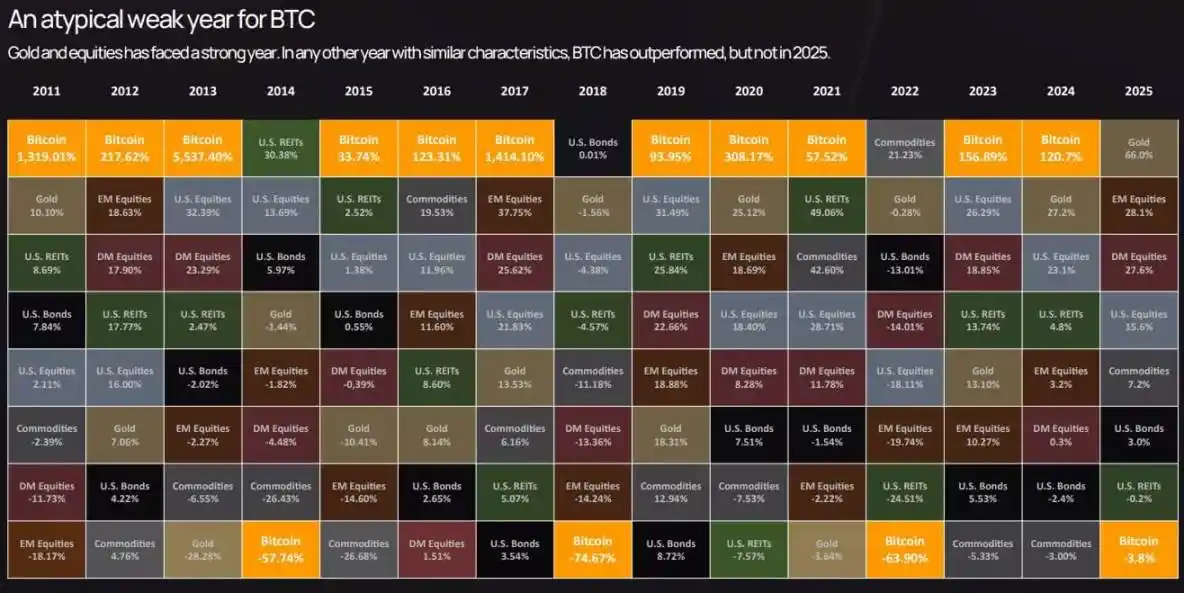
Bitcoin ranks near the bottom in asset performance in 2025, with a decline of 3.8%; in this atypical year for Bitcoin, its performance lags behind gold and stocks.
This "underperformance" coupled with low volatility shifts Bitcoin's positioning from a "speculative satellite asset" to a "core macro asset" — with risk similar to stocks, but driven by factors unrelated to other assets' returns.
The options market also reflects this shift: the implied volatility of Bitcoin options has synchronously decreased with actual volatility, reducing hedging costs and making synthetic structured products more attractive.
Previously, compliance departments often used "high volatility" as a reason to restrict financial advisor allocation to Bitcoin; now, advisors have quantitative evidence: by 2025, Bitcoin's volatility is lower than Nvidia's, lower than many tech stocks, and comparable to high-beta stock sectors.
This has opened up new investment channels for Bitcoin: inclusion in 401(k) retirement plans, Registered Investment Advisor (RIA) allocations, and insurance company investment portfolios subject to strict volatility constraints.
K33's forward-looking data predicts that as these channels open up, ETF net inflows in 2026 will surpass those in 2025, forming a "self-reinforcing cycle": more institutional funds flow in → reduced volatility → unlocking more institutional mandates → more funds flow in.
However, the market's "calm" is conditional. K33's derivative analysis shows that throughout 2025, Bitcoin perpetual futures open interest steadily rose in a "low volatility, strong uptrend" environment, eventually leading to a liquidation event on October 10th - wiping out $19 billion in leveraged longs in a single day.
This sell-off was related to President Trump's tariff statement and widespread "risk-off sentiment," but the core mechanism remains a derivative issue: excessive leveraged longs, thin weekend liquidity, cascading margin calls.
Even with an actual annualized volatility of 2.2%, there may still be "extreme volatility days triggered by leveraged liquidations" hidden. The difference is that these events are now resolved in a matter of hours, not weeks; and with ETF and corporate treasury spot demand providing a "price floor," the market can quickly recover.
The structural backdrop of 2026 supports the view of "maintaining low volatility or further decline": K33 expects that as the two-year Bitcoin supply stabilizes, early holders' sell-offs will decrease; furthermore, there are positive signals at the regulatory level - the U.S. "CLARITY Act," full implementation of Europe's MiCA, and JPMorgan Chase and Bank of America opening up 401(k) and wealth management channels.
K33's "Golden Opportunity" data forecast predicts that in 2026, Bitcoin will outperform stock indices and gold - due to the impact of regulatory breakthroughs and new fund inflows, surpassing the selling pressure from existing holders.
Whether this prediction will materialize is still uncertain, but the mechanisms driving the forecast - deepening liquidity, improving institutional infrastructure, and clear regulation - indeed provide support for low volatility.
Ultimately, the Bitcoin market will move away from the "speculative frontier" attributes of 2013 or 2017, closer to a "high liquidity, institutionally anchored macro asset."
This doesn't mean Bitcoin has become "boring" (e.g., low returns or lack of narrative), but rather that the "game has changed": the price path is more stable, the options market and ETF flows matter more than retail sentiment, and the market's core shifts are reflected in structure, leverage levels, and counterparty composition.
By 2025, despite Bitcoin undergoing the largest regulatory and structural transformation in history, from a volatility perspective, it has become an "institutionalized stable asset."
The value of understanding this shift is that low realized volatility is not a signal of "asset lethargy" but a sign that the "market is mature enough to handle institutional capital without collapsing."
The cycle is not over; it's just that the "cost" of driving market volatility has become higher.
You may also like

Ceasefire Overnight Erases War Premium, Three Fault Lines Only One Sealed | Rewire News Morning Brief

Robinhood Secures 'Trump Account': Enabling Millions of Newborns to Access the Stock Market

Afraid to Open the Pandora's Box? Anthropic's Most Powerful Model Ever Dares Not Be Disclosed

Iran Ceasefire Oil Prices: Why Crude Fell in April 2026
Iran ceasefire oil prices fell sharply on April 8, 2026 as traders removed part of the war premium tied to Strait of Hormuz supply disruption.

US-Iran Ceasefire: A Temporary Pause or Prelude to Renewed Conflict? Market Outlook for Oil, Gold, and Bitcoin
April 8, 2026 – A temporary ceasefire between the U.S. and Iran has provided some immediate relief to the global markets, but the fundamental question remains: Will the cessation of hostilities hold, or is this merely a brief reprieve before a resumption of conflict? As the situation unfolds, market observers are closely monitoring how key assets like oil, gold, and Bitcoin will react in the coming weeks. This article explores whether the ceasefire is a sign of lasting peace, assesses the short-term market implications, and delves into the evolving role of Bitcoin in the global financial landscape.

WEEX Market Update: U.S.-Iran Ceasefire Sparks Bitcoin Price Surge
April 8, 2026 – In a significant shift in global geopolitics, U.S. President Donald Trump has announced a temporary two-week ceasefire with Iran, resulting in a notable market reaction across various asset classes. This development comes after discussions between Trump, Pakistani Prime Minister Shahbaz Sharif, and Army Chief General Asim Munir. The announcement is already reverberating through markets, particularly in oil, gold, and cryptocurrencies.
Morning Report | South Korean financial institutions pilot stablecoin payments for foreign users; Morgan Stanley Bitcoin ETF is about to be listed; CME plans to launch AVAX and SUI futures contracts

EigenCloud Founder: AI and Cryptocurrency are Creating the Next Trillion-Dollar Asset Class

From Panic to Pumps: How Bitcoin Traders Are Playing the 2-Week US-Iran Ceasefire
For most people, the two-week US-Iran ceasefire is about geopolitics, oil prices, and whether World War III gets postponed. But for crypto traders glued to their screens late Sunday night, it was something else entirely: the clearest risk-on signal in months.

US-Iran Ceasefire Triggers Oil Plunge, Bitcoin Surge, and Gold Rally
Despite the sharp rally, caution is warranted. The $70,000–$72,000 zone has historically been strong resistance. The ceasefire is only temporary (two weeks), and any breakdown in negotiations could trigger a sell-off toward the $62,000–$65,000 support zone. For now, Bitcoin needs to close decisively above $72,500 to confirm a true breakout; failure to do so within 48–72 hours could lead to a swift retracement.

OpenAI has no "New Deal," a blueprint for AI that refuses to pay.

Wall Street Flash Mob Run? Mega-Cap Stock Plunge, Goldman's Great Escape, Illustrated Guide to Private Credit Crisis

OpenAI Feud: Power, Trust, and the Uncontrollable Boundaries of AGI
「AI Doomsday Cult」 Sends Operatives into the Strait of Hormuz: What Did They Find?
Everyone is waiting for the war to end, but is the oil price signaling a prolonged conflict?
Data Analysis: How Wide is the Liquidity Gap Between Hyperliquid and CME Crude Oil?
After a 40% Reduction in Staff, Twitter's Founder to Give Away $1 Million in Bitcoin

Trade.xyz: Pricing the World? On-Chain Markets Are Becoming the Market
Ceasefire Overnight Erases War Premium, Three Fault Lines Only One Sealed | Rewire News Morning Brief
Robinhood Secures 'Trump Account': Enabling Millions of Newborns to Access the Stock Market
Afraid to Open the Pandora's Box? Anthropic's Most Powerful Model Ever Dares Not Be Disclosed
Iran Ceasefire Oil Prices: Why Crude Fell in April 2026
Iran ceasefire oil prices fell sharply on April 8, 2026 as traders removed part of the war premium tied to Strait of Hormuz supply disruption.
US-Iran Ceasefire: A Temporary Pause or Prelude to Renewed Conflict? Market Outlook for Oil, Gold, and Bitcoin
April 8, 2026 – A temporary ceasefire between the U.S. and Iran has provided some immediate relief to the global markets, but the fundamental question remains: Will the cessation of hostilities hold, or is this merely a brief reprieve before a resumption of conflict? As the situation unfolds, market observers are closely monitoring how key assets like oil, gold, and Bitcoin will react in the coming weeks. This article explores whether the ceasefire is a sign of lasting peace, assesses the short-term market implications, and delves into the evolving role of Bitcoin in the global financial landscape.
WEEX Market Update: U.S.-Iran Ceasefire Sparks Bitcoin Price Surge
April 8, 2026 – In a significant shift in global geopolitics, U.S. President Donald Trump has announced a temporary two-week ceasefire with Iran, resulting in a notable market reaction across various asset classes. This development comes after discussions between Trump, Pakistani Prime Minister Shahbaz Sharif, and Army Chief General Asim Munir. The announcement is already reverberating through markets, particularly in oil, gold, and cryptocurrencies.


 App
App