
 Buy Crypto
- Markets
 Futures
- Spot
- Copy Trade
- Earn
- More
A “sexy casino,” where real-estate speculation has moved online.

Polymarket rose to prominence in 2024 by letting users bet on the U.S. presidential election, with trading volume hitting record highs on the night of Trump’s victory.
In November 2025, it signed a partnership with the UFC and entered sports betting. Then, on January 5, 2026, it announced a new experiment:
Betting on home prices.
Polymarket had previously offered markets tied to mortgage rates, but those were essentially derivatives on Federal Reserve policy. This time is different. The new markets allow users to directly bet on whether a specific city’s home price index will rise or fall.
The partner is Parcl, a real-estate data protocol on Solana. The mechanics are simple: choose a city and predict whether its home price index will go up or down next month.
The initial markets include Austin, San Francisco, Miami, New York, plus a national U.S. index.
No down payment.
No mortgage application.
No dealing with agents.
Bet USD 100. Get it right and double your money. Get it wrong and it goes to zero.
Polymarket’s CMO argues that real estate is the world’s largest asset class—worth USD 400 trillion—and therefore deserves to be a “first-class citizen” in prediction markets.
A USD 400 trillion casino, with the entry ticket now reduced to:
The price of a cup of coffee.
This is not entirely new.
Back in 2008, the UK betting exchange Betfair already offered markets on a housing crash. What happened that year needs no retelling. Wall Street was trading CDS, MBS, and CDOs—acronyms few ordinary people understood, but everyone ended up paying for them.
Polymarket has simply translated the same idea into plain language:
Will Miami home prices rise or fall before February 1? Pick one.
According to the partnership announcement, settlement data is provided by Parcl and updated daily—faster than traditional housing indices. Each market comes with a dedicated settlement page detailing final values, historical trends, and calculation methodology.
Transparent. Public. Verifiable on-chain.
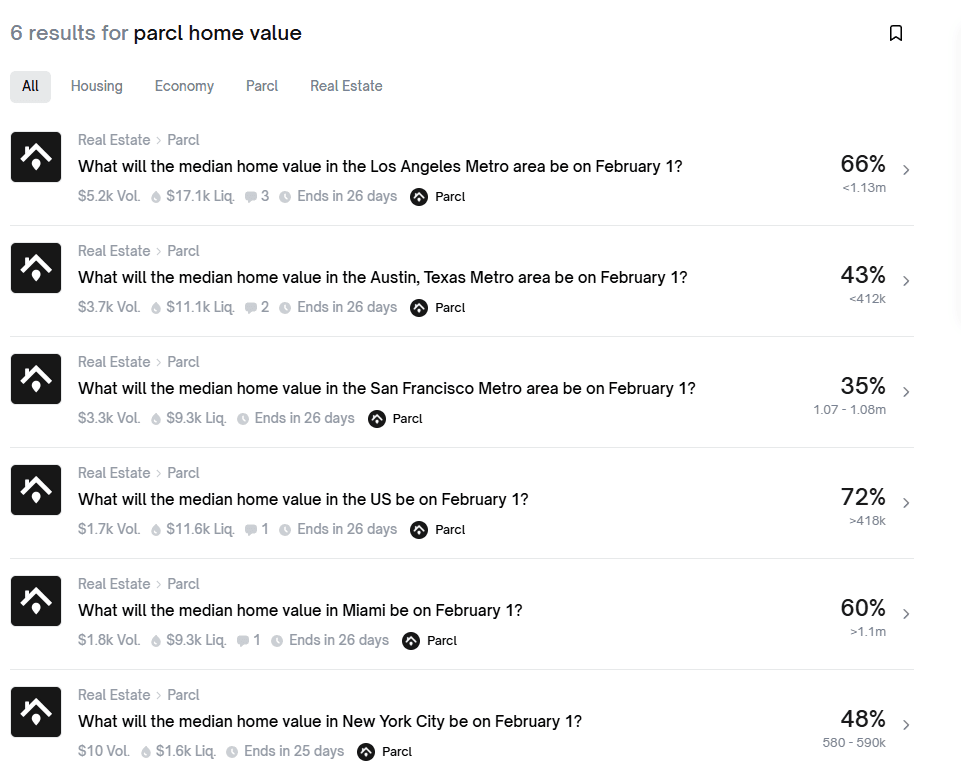
It sounds appealing. But current market data tells a quieter story. Even the most liquid market barely has USD 17,000 in liquidity. New York’s market sits at around USD 1,600, and after two days online, total trading volume there was just USD 10.
People are enthusiastic about betting on presidents. Betting on housing prices? It seems most haven’t figured out how to play yet.
For now, this looks less like a mass market—and more like an early adopter playground. Or, put differently:
A hunting ground for whales.
Parcl raised two funding rounds in 2022, with investors including Dragonfly, Coinbase Ventures, and Solana Ventures, totaling over USD 11 million.
Its earlier products were far more aggressive: long and short positions on housing indices, up to 10x leverage, perpetual contracts.
Yes—real estate trading with leverage.
After partnering with Polymarket, the design became more restrained. No leverage. No perpetuals. Just simple binary options: up or down, settle at expiry.
Polymarket itself has been expanding rapidly. Valued at USD 1.2 billion in 2024, by the end of 2025 the parent company of the NYSE, ICE, announced plans to invest USD 2 billion, pushing its valuation close to USD 9 billion.
From betting on presidents, to boxing, to home prices—the catalog keeps expanding. What’s next is unclear. Divorce rates? Birth rates? How long the bubble tea shop downstairs can survive?
As long as there is a data source, anything can become a market.
On-chain analytics have already shown that nearly 70% of Polymarket users lose money, with profits concentrated in a very small number of wallets.
That ratio looks familiar—to crypto trading, and to stock trading as well.
The difference is this: election outcomes are discrete and definitive. You win or you lose. Housing data is not. It comes with lags, noise, seasonality, and methodological disputes. You may think you are making a judgment, but in reality you are betting against statistical definitions.
The traditional logic of buying a home is straightforward: 30% down, a 30-year mortgage, monthly payments that may exceed your salary—but at least the house is yours.
The Polymarket version of “buying a home” is different: bet USD 100, wait a month, double it or lose everything. The house is never yours. It never was.
Which one looks more like gambling?
The last wave of financialized real estate ended with the subprime crisis in 2008. This time, retail traders are allowed at the table.
What progress.
You may also like

From Human Application to Intelligent Collaboration: How GOAT Network Builds the Next Generation Digital Economy

CZ Washington Dialogue: Crypto Entrepreneurs are Accelerating Their Return to the United States

Morning Report | Strategy increased its holdings by 1,031 bitcoins last week; Katana Blockchain acquires IDEX; NYSE completes rule change to eliminate trading limits on crypto ETF options

Electric Capital: Tracking 501 types of yield-generating RWA assets, we discovered these patterns
Those who are cut off by AI will not disappear; they will become the creators of the next round of the economy

Stablecoins reshaping cross-border payments in Asia? Strategic panorama and investment opportunity analysis

Zuckerberg is building an AI agent to help him as CEO

Bloomberg: Swiss Private Bank Old Guard Rifts, Is Bitcoin the Spark?

Zuckerberg is building an AI assistant to help him be CEO

Join WEEX AI Wars II: How WEEX API, Trader Skills Empower AI Trading Innovations
Join WEEX AI Wars II and be part of a global AI trading revolution. Compete with top AI agents and bots, showcase your strategies, and leverage WEEX API and Trader Skill to innovate, automate, and gain exposure in the AI trading ecosystem. Onboard your AI agent to WEEX AI Wars II NOW.

What kind of scenario will Backpack's TGE today play out in the bear market opening?

Polymarket Ten Million Dollar Winner Retrospective: 40 Addresses, 100,000 Transactions, Only Three Ways to Make Money

The Most Brutal Single-Month Plunge in 43 Years, Gold's Every Top Looks Like This
Jiang Xueqin's Latest Interview Transcript: How to View the Current Global Changes

Maximize Your USDT Yield: The Weex Auto Earn Strategy for Passive Crypto Income
Learn how to earn interest on USDT with WEEX Auto Earn. Discover how stablecoins can generate passive income and why some platforms now offer up to 300% APR.
1 million investment yields over 1 billion return, Airwallex co-founder Liu Yueting reviews key life investments

Polymarket Millionaire Review: 40 addresses, 100,000 transactions, only three ways to make money


 App
App