
- Buy Crypto
- Markets
 Futures
- Spot
- Copy Trade
 Earn
Earn- More
2024 NFT Year in Review: From Dreamy Start to Lackluster Finish, Has the Road to Recovery Begun?

Original Title: "2024 NFT Annual Awards: From Leading the Meme Trend to Coining the 'Last Dance'"
Original Author: Wenser, Odaily Planet Daily
As the year draws to a close, the crypto industry is also experiencing its "year-end summary moment." Compared to hot topics like AI, Meme, Desci, etc., NFTs have undoubtedly appeared somewhat lonely. If it weren't for the end-of-year surge in the fat penguin PENGU token, many people might have wondered, "Did the NFT bull market really exist?"
Looking back on the entire year of 2024, for the NFT track, it can be described as "full of twists and turns." Despite this, it undeniably holds a place in the crypto market and has even become a trendsetter, a consistent presence throughout. Through this article, Odaily Planet Daily will take readers through a series of representative events on the 2024 NFT track, allowing us to reminisce about this year of "love-hate entanglement" with NFTs.
2024 First Half: Dreamy Start and the "King of Meme"
Going back to the beginning of 2024, it is believed that for many NFT players, it can be described as a "dreamy start."
After experiencing a series of NFT hype waves in the BTC ecosystem, market sentiment briefly warmed up. BTC NFTs like Node Monkeys, Puppet Monkeys, etc., once reached prices as high as 0.5 BTC. Looking at the current BTC price breaking a new high of $108,000, it still seems unbelievable. Speaking frankly, perhaps for many BTC engraving players, NFT players, including later Rune players, it was a rollercoaster ride with constant FOMO. The likely outcome was "the harder you try, the more you lose," so it was better to just hold onto your assets.
However, regardless, with the upcoming positive catalysts such as the BTC spot ETF approval, the "2024 year belonging to the NFT track" finally began. The first to take the stage was the Ethereum ecosystem NFT project - Tinfun.
January Tianfang: The "IP Dream" of the Top KOL in the Chinese NFT Community
As the top KOL in the Chinese NFT community, Tinfun's launch undoubtedly embodies much of the efforts of the Laser Cat. Additionally, the Alpha community behind it, Tinfun NFT's oriental ink painting style, and the martial arts world narrative have also been among the many reasons Tinfun has attracted attention.
After the tremendous success of Azuki, numerous players in the Chinese NFT community hoped for a truly representative NFT project of "Eastern Aesthetics" to stand out and gather a group of fans in the crypto world, proving to the world that "Chinese culture is the coolest!" Based on the NFT sample images revealed by the project, Tinfun undoubtedly has the potential for this, so many people have high hopes for it. Moreover, at that time, Tinfun's mini-games were also once popular in the community, as the end of the year approached the Chinese New Year, the atmosphere of entertainment games was also strong. In addition, Tinfun also made a minor innovation to the NFT Minting process, creating the "Money-First Minting" gameplay, eliminating the trouble of NFT players wasting a large amount of gas when rushing to mint.
Due to favorable stimuli for various reasons, on the day of the public sale on January 7, the deposits received by the TinFun project had surpassed 10,000 ETH in less than 24 hours, equivalent to about $22.8 million; and on January 8, the participation amount in the public sale reached the target of 25,000 ETH, and the public sale ended early. Due to the large participation amount, there were still many overseas bloggers at that time who doubted that Laser Cat would "exit scam," after all, in the crypto world, such a completely untrustworthy dark forest, human nature is often difficult to withstand.
But Laser Cat and the team behind it are clearly not of that kind, and even Laser Cat himself said: "I may fail, but I will never exit scam."
The subsequent airdrop and secondary trading of Tinfun also once triggered market FOMO, with the floor price breaking through 0.8 ETH; but after the reveal, the artistic details and homogenization issues of Tinfun NFTs inevitably faced market scrutiny, coupled with Tinfun's planned "IP development route," ultimately could not escape the fate of the NFT project's "floor price downward spiral."
According to data from the NFTGo website, the current floor price of Tinfun NFT is around 0.11 ETH, but the average transaction price is around 0.5 ETH, and the number of holding addresses has gradually decreased to about 1400.
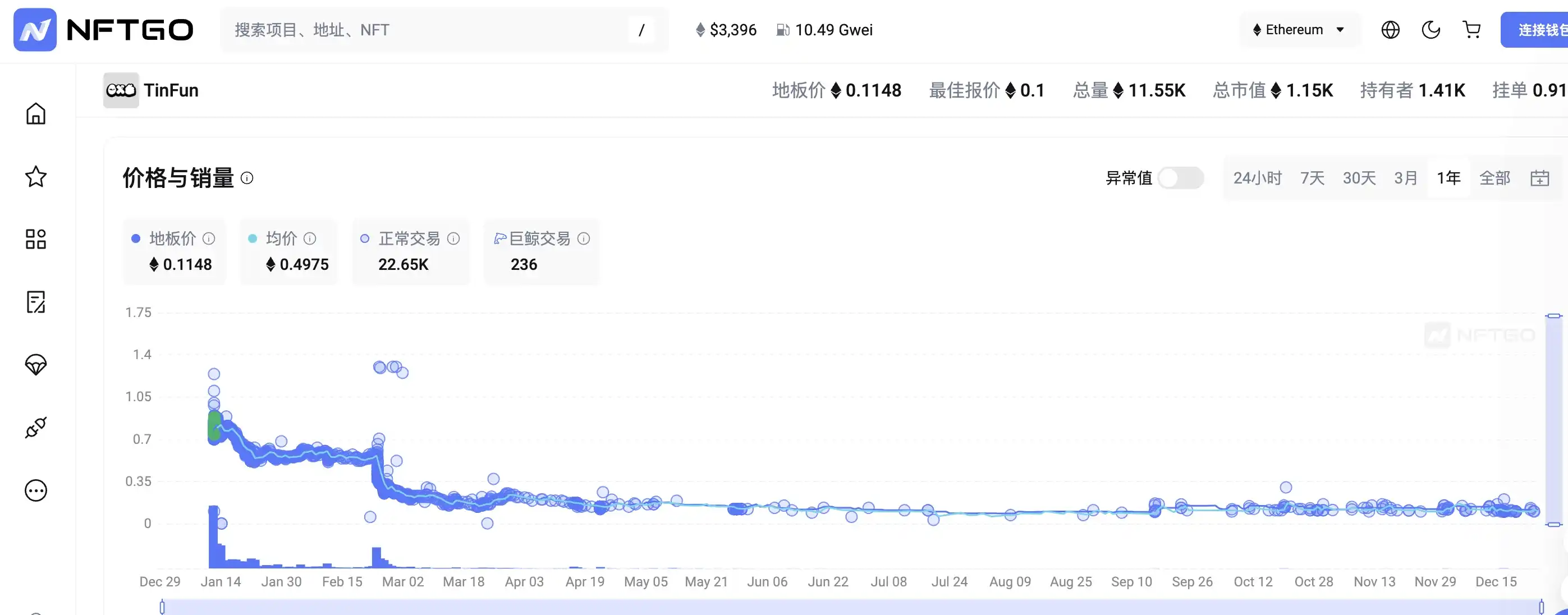
Tinfun Floor Price Information, Source: NFTGo
It is worth mentioning that, influenced by Blur's third-phase event and Blast's airdrop expectations, in early March, Tinfun once unanimously decided through community voting to migrate the project to the Blast chain. Some Tinfun holders have also received certain rewards such as Blast ecosystem gold points through various Blast projects or activities, but in terms of NFT rewards, it can only be said to be better than nothing.
Looking at it now, in a sense, the Tinfun project has shown something: NFT projects still cannot escape the "liquidity trap" and avoid the problem of project tokens/NFT prices spiraling down in the cryptocurrency market, especially in the IP development path, undoubtedly making a difficult situation even more challenging.
February Nobody: NFT Community Blessed by the "Stephen Chow Aura"
If Tinfun set a good example for NFTs in 2024, then the NFT project Nobody under Stephen Chow's name appears more like another "star-studded NFT project" that "rides the trend."
The project, spanning over half a year, drew inspiration from the famous moonlight treasure chest in Stephen Chow's iconic movie "A Chinese Odyssey." The project was initially named Moonbox, but to enhance its community attributes, it was changed to Nobody. Even some community members created songs and artwork under the name Nobody, initiating a series of derivative works. Following Tinfun's successful launch through the "money-printing Mint," Nobody also followed suit, using this method to conduct their NFT sale, which was completed successfully.
Moreover, after the sale concluded, Nobody's floor price quickly increased by about 5 times. On February 5th, the floor price briefly surpassed 0.9 ETH, with a trading volume of 2500 ETH, sparking FOMO in countless individuals who continuously joined the buying frenzy. It must be said that at the time, many NFT players, influenced by a series of preconceptions such as "celebrity NFT projects are all scams to rip people off and make a quick profit," did not deeply engage in this project and were equally unprepared for this violent surge.
Of course, those who did not catch this wave of rise in price naturally avoided the subsequent drop in floor price that they could have been hit with.
Although subsequently, Stephen Chow himself interacted with Nobody's NFT holders in the Discord community, even opened an X platform account to seek feedback from the community on the project's future development, and the founder of Memeland, a Hong Kong NFT celebrity and CEO of 9 GAG Kelvin Chow (9 gagceo.eth), once bought Nobody #889 NFT at a price of 19.52 WETH to directly express support, but as with most NFT projects, Nobody still followed the typical path. After facing "image quality questioning," the price steadily declined, eventually falling below the sale price of 0.19527 ETH in mid-March, gradually falling into silence.
According to NFTGo website data, Nobody's current floor price is around 0.054 ETH, with approximately 3000 holding addresses. As for Stephen Chow's X platform account, the last update has been stuck on a post from June 1st this year about a 9527 Theater short drama promotion.
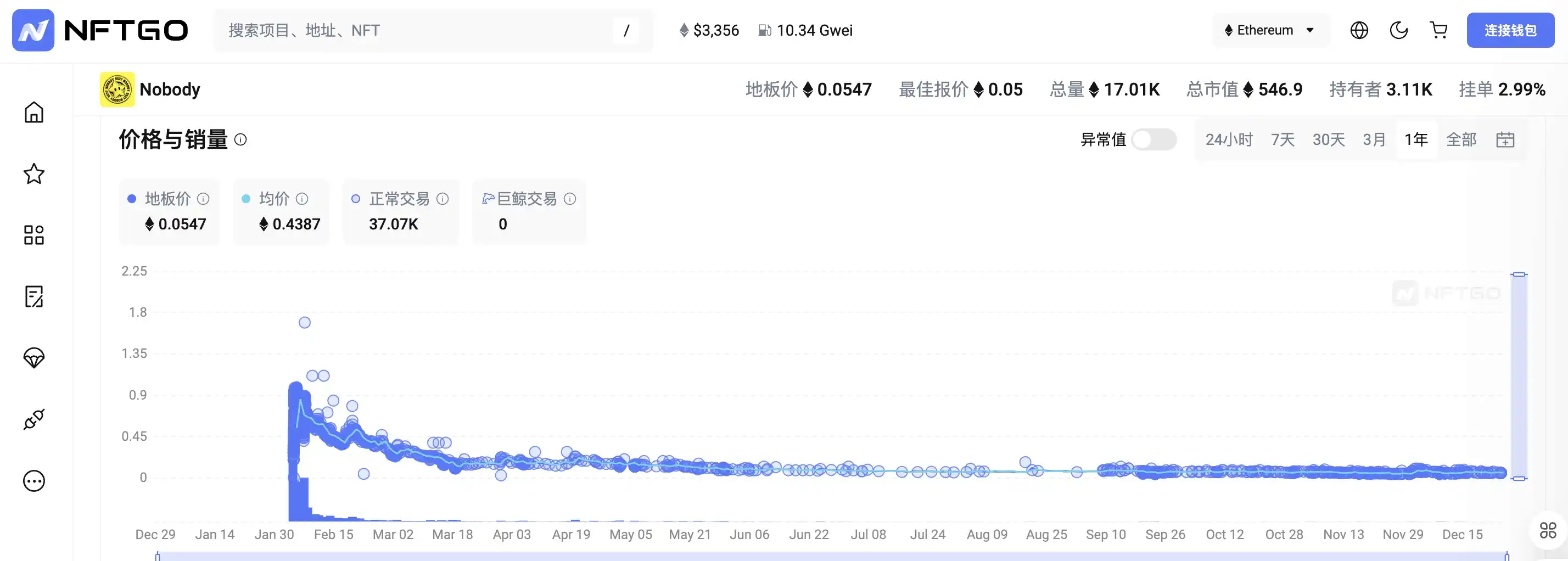
Nobody NFT Floor Price Information, Source: NFTGo
Thus, another chapter is added to the "Celebrity NFT Failure Case," as the king of comedy, the one-generation movie emperor Stephen Chow, also couldn't break this curse.
March BOME: A Meme Coin Frenzy Sparked by an NFT Artist
As March rolled in, there weren't many noteworthy NFT projects, but just as the theme song of "Ultraman" goes: "A new storm has appeared, how can we stand still?"
While the market was immersed in the joy of BTC breaking to new highs, a frenzy of Meme coins triggered by an NFT artist had been silently brewing in the background.
Cryptocurrency artist Darkfarms 1 was the first to start the "2024 NFT Artist Coin Release," perhaps others had done so before him, but none had reached the height of the project he released because this Meme coin was called — BOME (Book Of MEME). After raising 10,000 SOL in donations, Darkfarms 1 also withstood the test of humanity, not absconding with the funds but instead innovatively injecting a large sum into the token liquidity pool, thus initiating a "3-day express to Binance" Meme coin miracle.
On March 14th, shortly after the release of BOME, its market cap quickly surpassed $50 million; within 9 hours of launch, its market cap had exceeded $100 million, the price surging over 30 times from the issuance price;
On March 15th, BOME's price broke through $0.0025, hitting a new high; subsequently, its price soared like riding a rocket, around midnight on the 15th, the price of BOME successfully broke through $0.01, with a market cap growing to nearly $700 million.
Driven by the soaring price of BOME, the floor price of the NFT series SMOWL previously released by Darkfarms once exceeded 0.4 ETH, with a one-day increase of 71.14% and a 7-day increase of 713.66%; furthermore, on the day BOME was launched, the number of active addresses on the Solana network reached nearly a month-long peak (1.19 million), with the highest growth in active addresses between 02.14 and 03.14 at 115.66%; influenced by the BOME craze, from March 14 to 16, the Solana network saw a sharp increase in newly issued Meme tokens, with 8,849 new SPL tokens issued on March 14, expected to surpass the nearly one-month peak (9,690) this week.
Moreover, BOME also pioneered a new type of asset issuance called "Donation-based Coin Launch," triggering numerous imitators. For example, NFT artist and crypto influencer Kero (@KeroNFTs) launched the Meme project COCO (Little Crocodile), which received over 42,000 SOL worth over $7.5 million within 2 hours of the donation launch, causing a frenzy in the market. Additionally, founders such as Satoshi of Mfers and the co-founders of Doodles were quick to follow suit, with Meme coins issued by NFT artists like MFERSCOIN active in the Solana, ETH, and Base ecosystems.
Of course, this coin issuance path has also brought more scams to the market, including crypto influencers like VT, who later scammed over 20,000 BNB, cryptocurrency veteran Huang Licheng (Maji) who scammed over 190,000 SOL, and Dexter behind GM.ai, who raised nearly 160,000 SOL.
But all of this cannot surpass a crucial step, which is—the listing of BOME on Binance.
On March 16 at noon, according to an official announcement, Binance will list BOME perpetual futures contracts leveraged 1-50x at 20:30 on March 16, 2024 (UTC+8).
Upon this news, market sentiment transitioned from frenzy to mania.
After all, for many crypto projects that have been through multiple rounds of VC funding and community financing, getting a token queued for listing on Binance is no easy feat. Now, however, a Meme coin released by an NFT artist completes in just 3 days what many projects can't achieve in 3 years—the "Binance listing journey." This achievement is hard not to make people feel a sense of frustration that “launching a legitimate project is not as good as releasing a Meme coin.” With the emergence of the Solana ecosystem's one-click coin issuance platform pump.fun, the "Meme coin craze" that will set the tone for this year and even this cycle has begun.
Despite that, subsequently, when the market sentiment was high and liquidity was good, Binance took the opportunity to list a batch of "VC Coins." However, many project tokens with "high FDV, low circulation" besides absorbing liquidity unilaterally from the market, compared to meme coins with lower entry barriers, broader mass base, and lower buying costs, it's hard not to be abandoned.
After all, in many people's eyes, numerous seemingly serious VC Coins, from the perspective of usefulness, are not even as good as "meme coins that make people smile and provide emotional value."
And from another comparative perspective, meme coins are also Fungible Tokens of NFT, regarding this viewpoint, we have elaborated on it in detail in the article "Meme Coins: A Complete Substitute for NFT" in May of this year, feel free to review.
Regarding the NFT track, in the first half of the year, the 404 Protocol, which focused on the concept of "graphic coin conversion," once triggered market FOMO. The price of the Pandora Protocol token, PANDORA, once exceeded $30,000 with an exaggerated increase. The subsequent 314 Protocol (details can be seen in the article "Will the 314 Protocol Be the Next ERC 721?") also brought short-term market attention, but eventually faded away due to unsustainable liquidity.
Three noteworthy things about the first half of the NFT track:
First, leveraging the Solana ecosystem's meme coin craze, Base also attracted a certain amount of market liquidity in March and April due to the ecosystem's low-cost network interaction. During this time, NFTs also briefly gained some market attention. We introduced some representative projects in the article "Counting Base Ecosystem's Top NFTs, Who's Rising, Falling, and Issuing Tokens?" Although no projects successfully broke through later, it also brought some incremental changes to the 2024 NFT track.
Second, this year coincides with the U.S. presidential election year. As the Republican presidential candidate, Trump also "made frequent efforts" in the NFT track. Previously, he launched the first NFT series, "Trump Digital Trading Cards," in December 2022; in 2023, he released two new series of NFTs, "Trump Digital Trading Cards Series 2" and "Mugshot Edition." With these NFTs, Trump made a total profit of up to $7.15 million, indirectly confirming—the fundraising ability of celebrity NFTs is indeed strong, even though the result is highly likely to be a mess.
Third, Charlotte Fang, the founder of the well-known NFT series Milady, also initiated a fundraising campaign in June, teasing the release of an Ethereum blockchain-based Meme called CULT. In just 7 hours, the campaign raised over $20 million, showcasing the market's fervor and frenzy for Meme coins, which still surprises to an astonishing degree. However, no one expected that this anticipation was only the beginning, lasting just about half a year.
And in the second half of the year, the aftermath of the aforementioned events will continue.
2024 Second Half: Internal Challenges, External Threats, and the Coin Issuance Craze
As the year progresses into the second half, amidst the raging Meme coin craze, the NFT track once again experiences the so-called "garbage time."
Numerous blue-chip NFT projects have seemingly vanished from the public eye, leaving only a few NFT project founders such as Pudgy Penguins, Weirdo Ghost Gang, and others still active on social platforms, closely monitoring the market's fluctuations and occasionally updating the community on their project's progress and sharing their views on the industry's development.
Once again, redirecting people's limited attention back to NFTs is the former "world's largest NFT trading platform," OpenSea — along with its "crypto nemesis," the U.S. SEC.
By the end of August, according to market reports, the NFT marketplace OpenSea received a Wells Notice from the U.S. Securities and Exchange Commission (SEC), becoming another "crypto project under scrutiny" following Coinbase, Lido, Bittrex, Uniswap, and Robinhood. Through this incident, as we discussed in-depth in the article "OpenSea Receives SEC Wells Notice, Is the NFT Track Preparing for a Major Setback?" at that time, we elaborated on the industry-wide issues facing the NFT space. The subsequent trajectories of many NFT projects have since confirmed our previous assessments.
With the industry's continuous evolution, NFTs have gradually become the "identity proof" and "ownership proof" for many projects. The once-prominent "IP carriers" and "collectible value" have been compressed, leading to many Web2 companies and brands' high hopes for "marketing effects" yielding minimal results. However, the NFT space is gearing up for another round of market expectations — NFT platform or NFT project token launches.
Aside from Blast, closely tied to the NFT trading platform Blur, multi-chain NFT marketplace Magic Eden and the upcoming revamped version of OpenSea are also highly anticipated. NFT projects under Animoca Brands like Mocaverse, blue-chip NFTs such as Pudgy Penguins, Azuki, and Doodles are also among the potential token launch projects.
And thus, the NFT market languished in its own garbage time, waiting for new hope.
In September, during a crypto project WLFI event, U.S. presidential candidate Trump attributed his changed stance on Bitcoin and cryptocurrency to the success of his NFT series.
By the end of October, renowned crypto artist Beeple posted stating, "NFT speculators have left, leaving only core enthusiasts behind."
In November, according to CryptoSlam data, in October 2024, the NFT trading volume reached $356 million, an 18% increase from the previous month, breaking the trend of seven consecutive months of decline. Furthermore, the total volume of NFT trades also increased, with October seeing 7.2 million trades, a 42% increase from September's 5 million.
In early December, as the market's patience was wearing thin, the much-anticipated "NFT project token launch wave" had yet to arrive. Instead, ahead of that wave came the news that RTFKT, the studio behind the blue-chip NFT CloneX/Cloneme, once priced at a floor of over ten ETH, would cease operations in January 2025.
But the market had no time to mourn or grieve for it. Shortly after came the long-awaited NFT project token launch wave, which had been brewing for nearly six months—
On December 9, raising over $20 million, the Meme coin project CULT, initiated by NFT project Milady founder Charlotte Fang, finally went live, briefly evoking memories of NFT in people's minds. For more details, please refer to the article "CULT Goes Live, Is NFT's Last Hurrah A Bull Market Ride or Final Dance?";
On December 10, the ME Foundation announced in a post that the TGE had gone live, and users could claim and stake ME tokens. Claiming ME tokens required loading the Magic Eden mobile app and completing the claim. All unclaimed ME tokens would belong to ME stakers.
On December 17, the Pudgy Penguins team officially announced that PENGU was live and open for claiming. Eligible participants could start claiming PENGU, including holders of Pudgy Penguins, Lil Pudgys, Rogs, and SBTs. Holders had 88 days to claim, and all unclaimed supply would be permanently locked/burned after day 88. For more information on Pudgy Penguins and its parent company, please refer to our previous articles "Acquiring Frame, Building Abstract Chain, Disrupting Base, Can Pudgy Penguins Carry the Flag of Consumer Economy?" and "Pudgy Penguins Token Launch Imminent, Can PENGU, Abstract, OpenSea Have Triple Success?"
It is worth mentioning that the reason Fat Penguin's token issuance has gained widespread acceptance from the market users is because of its grand gesture of airdropping varying amounts of PENGU tokens to not only its own ecosystem but also to holders of NFT series in the Solana ecosystem, many other NFT series holders, and even Ethereum ecosystem OG wallet holders.
As we near the end of 2024, the suspense surrounding the issuance of NFT tokens is gradually being revealed. Later entrants include OpenSea, which has already registered a foundation in the Cayman Islands, Azuki whose founder declared, "Animecoin will embody a vision, product, and real-world use case, unlike other meme coins," and even Doodles, whose founder hinted at an upcoming token issuance. Whether they can replicate the wealth creation miracle of Fat Penguin and PENGU remains an unknown variable.
Epilogue: When the NFT Narrative Loses Its Allure, Token Issuance Becomes a Double-Edged Sword
Finally, from an industry data perspective, according to CryptoSlam data, the total NFT sales volume in 2024 amounted to approximately $8.5 billion. Although this figure is far below previous peak years, the number of buyers has remarkably increased by over 62%, reaching 7.5 million.
While the NFT narrative is no longer as glamorous as it was in 2022, easily attracting investments of millions, tens of millions, or even hundreds of millions of dollars, undoubtedly, as a technological tool, it still holds an indispensable position and function in the crypto market. Of course, for NFT projects, token issuance is not always a straightforward positive development; it is a double-edged sword with both advantages and disadvantages: if the issuance goes smoothly, the token price is reasonable, and market users receive significant or relatively satisfactory returns, then everyone is happy. However, if an NFT project lacks a clear and comprehensive plan and sees token issuance as a "last-ditch effort," the likely outcome will be drowning in failure.
After going through a period of high volatility followed by what can be more accurately described as a period of consistent low performance, the NFT market can now be said to have entered a stage of rebounding from its lows. Whether 2025 will usher in a new renaissance still depends on the market's narrative direction, capital flows, and areas of focus.
Nevertheless, the story continues, and NFTs will always be the endorphin that stimulates the ever-flowing crypto market, where money never sleeps.
You may also like

Token Cannot Compound, Where Is the Real Investment Opportunity?

February 6th Market Key Intelligence, How Much Did You Miss?

China's Central Bank and Eight Other Departments' Latest Regulatory Focus: Key Attention to RWA Tokenized Asset Risk
Foreword: Today, the People's Bank of China's website published the "Notice of the People's Bank of China, National Development and Reform Commission, Ministry of Industry and Information Technology, Ministry of Public Security, State Administration for Market Regulation, China Banking and Insurance Regulatory Commission, China Securities Regulatory Commission, State Administration of Foreign Exchange on Further Preventing and Dealing with Risks Related to Virtual Currency and Others (Yinfa [2026] No. 42)", the latest regulatory requirements from the eight departments including the central bank, which are basically consistent with the regulatory requirements of recent years. The main focus of the regulation is on speculative activities such as virtual currency trading, exchanges, ICOs, overseas platform services, and this time, regulatory oversight of RWA has been added, explicitly prohibiting RWA tokenization, stablecoins (especially those pegged to the RMB). The following is the full text:
To the people's governments of all provinces, autonomous regions, and municipalities directly under the Central Government, the Xinjiang Production and Construction Corps:
Recently, there have been speculative activities related to virtual currency and Real-World Assets (RWA) tokenization, disrupting the economic and financial order and jeopardizing the property security of the people. In order to further prevent and address the risks related to virtual currency and Real-World Assets tokenization, effectively safeguard national security and social stability, in accordance with the "Law of the People's Republic of China on the People's Bank of China," "Law of the People's Republic of China on Commercial Banks," "Securities Law of the People's Republic of China," "Law of the People's Republic of China on Securities Investment Funds," "Law of the People's Republic of China on Futures and Derivatives," "Cybersecurity Law of the People's Republic of China," "Regulations of the People's Republic of China on the Administration of Renminbi," "Regulations on Prevention and Disposal of Illegal Fundraising," "Regulations of the People's Republic of China on Foreign Exchange Administration," "Telecommunications Regulations of the People's Republic of China," and other provisions, after reaching consensus with the Cyberspace Administration of China, the Supreme People's Court, and the Supreme People's Procuratorate, and with the approval of the State Council, the relevant matters are notified as follows:
(I) Virtual currency does not possess the legal status equivalent to fiat currency. Virtual currencies such as Bitcoin, Ether, Tether, etc., have the main characteristics of being issued by non-monetary authorities, using encryption technology and distributed ledger or similar technology, existing in digital form, etc. They do not have legal tender status, should not and cannot be circulated and used as currency in the market.
The business activities related to virtual currency are classified as illegal financial activities. The exchange of fiat currency and virtual currency within the territory, exchange of virtual currencies, acting as a central counterparty in buying and selling virtual currencies, providing information intermediary and pricing services for virtual currency transactions, token issuance financing, and trading of virtual currency-related financial products, etc., fall under illegal financial activities, such as suspected illegal issuance of token vouchers, unauthorized public issuance of securities, illegal operation of securities and futures business, illegal fundraising, etc., are strictly prohibited across the board and resolutely banned in accordance with the law. Overseas entities and individuals are not allowed to provide virtual currency-related services to domestic entities in any form.
A stablecoin pegged to a fiat currency indirectly fulfills some functions of the fiat currency in circulation. Without the consent of relevant authorities in accordance with the law and regulations, any domestic or foreign entity or individual is not allowed to issue a RMB-pegged stablecoin overseas.
(II)Tokenization of Real-World Assets refers to the use of encryption technology and distributed ledger or similar technologies to transform ownership rights, income rights, etc., of assets into tokens (tokens) or other interests or bond certificates with token (token) characteristics, and carry out issuance and trading activities.
Engaging in the tokenization of real-world assets domestically, as well as providing related intermediary, information technology services, etc., which are suspected of illegal issuance of token vouchers, unauthorized public offering of securities, illegal operation of securities and futures business, illegal fundraising, and other illegal financial activities, shall be prohibited; except for relevant business activities carried out with the approval of the competent authorities in accordance with the law and regulations and relying on specific financial infrastructures. Overseas entities and individuals are not allowed to illegally provide services related to the tokenization of real-world assets to domestic entities in any form.
(III) Inter-agency Coordination. The People's Bank of China, together with the National Development and Reform Commission, the Ministry of Industry and Information Technology, the Ministry of Public Security, the State Administration for Market Regulation, the China Banking and Insurance Regulatory Commission, the China Securities Regulatory Commission, the State Administration of Foreign Exchange, and other departments, will improve the work mechanism, strengthen coordination with the Cyberspace Administration of China, the Supreme People's Court, and the Supreme People's Procuratorate, coordinate efforts, and overall guide regions to carry out risk prevention and disposal of virtual currency-related illegal financial activities.
The China Securities Regulatory Commission, together with the National Development and Reform Commission, the Ministry of Industry and Information Technology, the Ministry of Public Security, the People's Bank of China, the State Administration for Market Regulation, the China Banking and Insurance Regulatory Commission, the State Administration of Foreign Exchange, and other departments, will improve the work mechanism, strengthen coordination with the Cyberspace Administration of China, the Supreme People's Court, and the Supreme People's Procuratorate, coordinate efforts, and overall guide regions to carry out risk prevention and disposal of illegal financial activities related to the tokenization of real-world assets.
(IV) Strengthening Local Implementation. The people's governments at the provincial level are overall responsible for the prevention and disposal of risks related to virtual currencies and the tokenization of real-world assets in their respective administrative regions. The specific leading department is the local financial regulatory department, with participation from branches and dispatched institutions of the State Council's financial regulatory department, telecommunications regulators, public security, market supervision, and other departments, in coordination with cyberspace departments, courts, and procuratorates, to improve the normalization of the work mechanism, effectively connect with the relevant work mechanisms of central departments, form a cooperative and coordinated working pattern between central and local governments, effectively prevent and properly handle risks related to virtual currencies and the tokenization of real-world assets, and maintain economic and financial order and social stability.
(5) Enhanced Risk Monitoring. The People's Bank of China, China Securities Regulatory Commission, National Development and Reform Commission, Ministry of Industry and Information Technology, Ministry of Public Security, State Administration of Foreign Exchange, Cyberspace Administration of China, and other departments continue to improve monitoring techniques and system support, enhance cross-departmental data analysis and sharing, establish sound information sharing and cross-validation mechanisms, promptly grasp the risk situation of activities related to virtual currency and real-world asset tokenization. Local governments at all levels give full play to the role of local monitoring and early warning mechanisms. Local financial regulatory authorities, together with branches and agencies of the State Council's financial regulatory authorities, as well as departments of cyberspace and public security, ensure effective connection between online monitoring, offline investigation, and fund tracking, efficiently and accurately identify activities related to virtual currency and real-world asset tokenization, promptly share risk information, improve early warning information dissemination, verification, and rapid response mechanisms.
(6) Strengthened Oversight of Financial Institutions, Intermediaries, and Technology Service Providers. Financial institutions (including non-bank payment institutions) are prohibited from providing account opening, fund transfer, and clearing services for virtual currency-related business activities, issuing and selling financial products related to virtual currency, including virtual currency and related financial products in the scope of collateral, conducting insurance business related to virtual currency, or including virtual currency in the scope of insurance liability. Financial institutions (including non-bank payment institutions) are prohibited from providing custody, clearing, and settlement services for unauthorized real-world asset tokenization-related business and related financial products. Relevant intermediary institutions and information technology service providers are prohibited from providing intermediary, technical, or other services for unauthorized real-world asset tokenization-related businesses and related financial products.
(7) Enhanced Management of Internet Information Content and Access. Internet enterprises are prohibited from providing online business venues, commercial displays, marketing, advertising, or paid traffic diversion services for virtual currency and real-world asset tokenization-related business activities. Upon discovering clues of illegal activities, they should promptly report to relevant departments and provide technical support and assistance for related investigations and inquiries. Based on the clues transferred by the financial regulatory authorities, the cyberspace administration, telecommunications authorities, and public security departments should promptly close and deal with websites, mobile applications (including mini-programs), and public accounts engaged in virtual currency and real-world asset tokenization-related business activities in accordance with the law.
(8) Strengthened Entity Registration and Advertisement Management. Market supervision departments strengthen entity registration and management, and enterprise and individual business registrations must not contain terms such as "virtual currency," "virtual asset," "cryptocurrency," "crypto asset," "stablecoin," "real-world asset tokenization," or "RWA" in their names or business scopes. Market supervision departments, together with financial regulatory authorities, legally enhance the supervision of advertisements related to virtual currency and real-world asset tokenization, promptly investigating and handling relevant illegal advertisements.
(IX) Continued Rectification of Virtual Currency Mining Activities. The National Development and Reform Commission, together with relevant departments, strictly controls virtual currency mining activities, continuously promotes the rectification of virtual currency mining activities. The people's governments of various provinces take overall responsibility for the rectification of "mining" within their respective administrative regions. In accordance with the requirements of the National Development and Reform Commission and other departments in the "Notice on the Rectification of Virtual Currency Mining Activities" (NDRC Energy-saving Building [2021] No. 1283) and the provisions of the "Guidance Catalog for Industrial Structure Adjustment (2024 Edition)," a comprehensive review, investigation, and closure of existing virtual currency mining projects are conducted, new mining projects are strictly prohibited, and mining machine production enterprises are strictly prohibited from providing mining machine sales and other services within the country.
(X) Severe Crackdown on Related Illegal Financial Activities. Upon discovering clues to illegal financial activities related to virtual currency and the tokenization of real-world assets, local financial regulatory authorities, branches of the State Council's financial regulatory authorities, and other relevant departments promptly investigate, determine, and properly handle the issues in accordance with the law, and seriously hold the relevant entities and individuals legally responsible. Those suspected of crimes are transferred to the judicial authorities for processing according to the law.
(XI) Severe Crackdown on Related Illegal and Criminal Activities. The Ministry of Public Security, the People's Bank of China, the State Administration for Market Regulation, the China Banking and Insurance Regulatory Commission, the China Securities Regulatory Commission, as well as judicial and procuratorial organs, in accordance with their respective responsibilities, rigorously crack down on illegal and criminal activities related to virtual currency, the tokenization of real-world assets, such as fraud, money laundering, illegal business operations, pyramid schemes, illegal fundraising, and other illegal and criminal activities carried out under the guise of virtual currency, the tokenization of real-world assets, etc.
(XII) Strengthen Industry Self-discipline. Relevant industry associations should enhance membership management and policy advocacy, based on their own responsibilities, advocate and urge member units to resist illegal financial activities related to virtual currency and the tokenization of real-world assets. Member units that violate regulatory policies and industry self-discipline rules are to be disciplined in accordance with relevant self-regulatory management regulations. By leveraging various industry infrastructure, conduct risk monitoring related to virtual currency, the tokenization of real-world assets, and promptly transfer issue clues to relevant departments.
(XIII) Without the approval of relevant departments in accordance with the law and regulations, domestic entities and foreign entities controlled by them may not issue virtual currency overseas.
(XIV) Domestic entities engaging directly or indirectly in overseas external debt-based tokenization of real-world assets, or conducting asset securitization activities abroad based on domestic ownership rights, income rights, etc. (hereinafter referred to as domestic equity), should be strictly regulated in accordance with the principles of "same business, same risk, same rules." The National Development and Reform Commission, the China Securities Regulatory Commission, the State Administration of Foreign Exchange, and other relevant departments regulate it according to their respective responsibilities. For other forms of overseas real-world asset tokenization activities based on domestic equity by domestic entities, the China Securities Regulatory Commission, together with relevant departments, supervise according to their division of responsibilities. Without the consent and filing of relevant departments, no unit or individual may engage in the above-mentioned business.
(15) Overseas subsidiaries and branches of domestic financial institutions providing Real World Asset Tokenization-related services overseas shall do so legally and prudently. They shall have professional personnel and systems in place to effectively mitigate business risks, strictly implement customer onboarding, suitability management, anti-money laundering requirements, and incorporate them into the domestic financial institutions' compliance and risk management system. Intermediaries and information technology service providers offering Real World Asset Tokenization services abroad based on domestic equity or conducting Real World Asset Tokenization business in the form of overseas debt for domestic entities directly or indirectly venturing abroad must strictly comply with relevant laws and regulations. They should establish and improve relevant compliance and internal control systems in accordance with relevant normative requirements, strengthen business and risk control, and report the business developments to the relevant regulatory authorities for approval or filing.
(16) Strengthen organizational leadership and overall coordination. All departments and regions should attach great importance to the prevention of risks related to virtual currencies and Real World Asset Tokenization, strengthen organizational leadership, clarify work responsibilities, form a long-term effective working mechanism with centralized coordination, local implementation, and shared responsibilities, maintain high pressure, dynamically monitor risks, effectively prevent and mitigate risks in an orderly and efficient manner, legally protect the property security of the people, and make every effort to maintain economic and financial order and social stability.
(17) Widely carry out publicity and education. All departments, regions, and industry associations should make full use of various media and other communication channels to disseminate information through legal and policy interpretation, analysis of typical cases, and education on investment risks, etc. They should promote the illegality and harm of virtual currencies and Real World Asset Tokenization-related businesses and their manifestations, fully alert to potential risks and hidden dangers, and enhance public awareness and identification capabilities for risk prevention.
(18) Engaging in illegal financial activities related to virtual currencies and Real World Asset Tokenization in violation of this notice, as well as providing services for virtual currencies and Real World Asset Tokenization-related businesses, shall be punished in accordance with relevant regulations. If it constitutes a crime, criminal liability shall be pursued according to the law. For domestic entities and individuals who knowingly or should have known that overseas entities illegally provided virtual currency or Real World Asset Tokenization-related services to domestic entities and still assisted them, relevant responsibilities shall be pursued according to the law. If it constitutes a crime, criminal liability shall be pursued according to the law.
(19) If any unit or individual invests in virtual currencies, Real World Asset Tokens, and related financial products against public order and good customs, the relevant civil legal actions shall be invalid, and any resulting losses shall be borne by them. If there are suspicions of disrupting financial order and jeopardizing financial security, the relevant departments shall deal with them according to the law.
This notice shall enter into force upon the date of its issuance. The People's Bank of China and ten other departments' "Notice on Further Preventing and Dealing with the Risks of Virtual Currency Trading Speculation" (Yinfa [2021] No. 237) is hereby repealed.

Former Partner's Perspective on Multicoin: Kyle's Exit, But the Game He Left Behind Just Getting Started
Why Bitcoin Is Falling Now: The Real Reasons Behind BTC's Crash & WEEX's Smart Profit Playbook
Bitcoin's ongoing crash explained: Discover the 5 hidden triggers behind BTC's plunge & how WEEX's Auto Earn and Trade to Earn strategies help traders profit from crypto market volatility.

Wall Street's Hottest Trades See Exodus

Vitalik Discusses Ethereum Scaling Path, Circle Announces Partnership with Polymarket, What's the Overseas Crypto Community Talking About Today?

Believing in the Capital Markets - The Essence and Core Value of Cryptocurrency

Polymarket's 'Weatherman': Predict Temperature, Win Million-Dollar Payout

$15K+ Profits: The 4 AI Trading Secrets WEEX Hackathon Prelim Winners Used to Dominate Volatile Crypto Markets
How WEEX Hackathon's top AI trading strategies made $15K+ in crypto markets: 4 proven rules for ETH/BTC trading, market structure analysis, and risk management in volatile conditions.

A nearly 20% one-day plunge, how long has it been since you last saw a $60,000 Bitcoin?

Raoul Pal: I've seen every single panic, and they are never the end.

Key Market Information Discrepancy on February 6th - A Must-Read! | Alpha Morning Report

2026 Crypto Industry's First Snowfall
The Harsh Reality Behind the $26 Billion Crypto Liquidation: Liquidity Is Killing the Market
Why Is Gold, US Stocks, Bitcoin All Falling?

Key Market Intelligence for February 5th, how much did you miss out on?

Wintermute: By 2026, crypto had gradually become the settlement layer of the Internet economy
Token Cannot Compound, Where Is the Real Investment Opportunity?
February 6th Market Key Intelligence, How Much Did You Miss?
China's Central Bank and Eight Other Departments' Latest Regulatory Focus: Key Attention to RWA Tokenized Asset Risk
Foreword: Today, the People's Bank of China's website published the "Notice of the People's Bank of China, National Development and Reform Commission, Ministry of Industry and Information Technology, Ministry of Public Security, State Administration for Market Regulation, China Banking and Insurance Regulatory Commission, China Securities Regulatory Commission, State Administration of Foreign Exchange on Further Preventing and Dealing with Risks Related to Virtual Currency and Others (Yinfa [2026] No. 42)", the latest regulatory requirements from the eight departments including the central bank, which are basically consistent with the regulatory requirements of recent years. The main focus of the regulation is on speculative activities such as virtual currency trading, exchanges, ICOs, overseas platform services, and this time, regulatory oversight of RWA has been added, explicitly prohibiting RWA tokenization, stablecoins (especially those pegged to the RMB). The following is the full text:
To the people's governments of all provinces, autonomous regions, and municipalities directly under the Central Government, the Xinjiang Production and Construction Corps:
Recently, there have been speculative activities related to virtual currency and Real-World Assets (RWA) tokenization, disrupting the economic and financial order and jeopardizing the property security of the people. In order to further prevent and address the risks related to virtual currency and Real-World Assets tokenization, effectively safeguard national security and social stability, in accordance with the "Law of the People's Republic of China on the People's Bank of China," "Law of the People's Republic of China on Commercial Banks," "Securities Law of the People's Republic of China," "Law of the People's Republic of China on Securities Investment Funds," "Law of the People's Republic of China on Futures and Derivatives," "Cybersecurity Law of the People's Republic of China," "Regulations of the People's Republic of China on the Administration of Renminbi," "Regulations on Prevention and Disposal of Illegal Fundraising," "Regulations of the People's Republic of China on Foreign Exchange Administration," "Telecommunications Regulations of the People's Republic of China," and other provisions, after reaching consensus with the Cyberspace Administration of China, the Supreme People's Court, and the Supreme People's Procuratorate, and with the approval of the State Council, the relevant matters are notified as follows:
(I) Virtual currency does not possess the legal status equivalent to fiat currency. Virtual currencies such as Bitcoin, Ether, Tether, etc., have the main characteristics of being issued by non-monetary authorities, using encryption technology and distributed ledger or similar technology, existing in digital form, etc. They do not have legal tender status, should not and cannot be circulated and used as currency in the market.
The business activities related to virtual currency are classified as illegal financial activities. The exchange of fiat currency and virtual currency within the territory, exchange of virtual currencies, acting as a central counterparty in buying and selling virtual currencies, providing information intermediary and pricing services for virtual currency transactions, token issuance financing, and trading of virtual currency-related financial products, etc., fall under illegal financial activities, such as suspected illegal issuance of token vouchers, unauthorized public issuance of securities, illegal operation of securities and futures business, illegal fundraising, etc., are strictly prohibited across the board and resolutely banned in accordance with the law. Overseas entities and individuals are not allowed to provide virtual currency-related services to domestic entities in any form.
A stablecoin pegged to a fiat currency indirectly fulfills some functions of the fiat currency in circulation. Without the consent of relevant authorities in accordance with the law and regulations, any domestic or foreign entity or individual is not allowed to issue a RMB-pegged stablecoin overseas.
(II)Tokenization of Real-World Assets refers to the use of encryption technology and distributed ledger or similar technologies to transform ownership rights, income rights, etc., of assets into tokens (tokens) or other interests or bond certificates with token (token) characteristics, and carry out issuance and trading activities.
Engaging in the tokenization of real-world assets domestically, as well as providing related intermediary, information technology services, etc., which are suspected of illegal issuance of token vouchers, unauthorized public offering of securities, illegal operation of securities and futures business, illegal fundraising, and other illegal financial activities, shall be prohibited; except for relevant business activities carried out with the approval of the competent authorities in accordance with the law and regulations and relying on specific financial infrastructures. Overseas entities and individuals are not allowed to illegally provide services related to the tokenization of real-world assets to domestic entities in any form.
(III) Inter-agency Coordination. The People's Bank of China, together with the National Development and Reform Commission, the Ministry of Industry and Information Technology, the Ministry of Public Security, the State Administration for Market Regulation, the China Banking and Insurance Regulatory Commission, the China Securities Regulatory Commission, the State Administration of Foreign Exchange, and other departments, will improve the work mechanism, strengthen coordination with the Cyberspace Administration of China, the Supreme People's Court, and the Supreme People's Procuratorate, coordinate efforts, and overall guide regions to carry out risk prevention and disposal of virtual currency-related illegal financial activities.
The China Securities Regulatory Commission, together with the National Development and Reform Commission, the Ministry of Industry and Information Technology, the Ministry of Public Security, the People's Bank of China, the State Administration for Market Regulation, the China Banking and Insurance Regulatory Commission, the State Administration of Foreign Exchange, and other departments, will improve the work mechanism, strengthen coordination with the Cyberspace Administration of China, the Supreme People's Court, and the Supreme People's Procuratorate, coordinate efforts, and overall guide regions to carry out risk prevention and disposal of illegal financial activities related to the tokenization of real-world assets.
(IV) Strengthening Local Implementation. The people's governments at the provincial level are overall responsible for the prevention and disposal of risks related to virtual currencies and the tokenization of real-world assets in their respective administrative regions. The specific leading department is the local financial regulatory department, with participation from branches and dispatched institutions of the State Council's financial regulatory department, telecommunications regulators, public security, market supervision, and other departments, in coordination with cyberspace departments, courts, and procuratorates, to improve the normalization of the work mechanism, effectively connect with the relevant work mechanisms of central departments, form a cooperative and coordinated working pattern between central and local governments, effectively prevent and properly handle risks related to virtual currencies and the tokenization of real-world assets, and maintain economic and financial order and social stability.
(5) Enhanced Risk Monitoring. The People's Bank of China, China Securities Regulatory Commission, National Development and Reform Commission, Ministry of Industry and Information Technology, Ministry of Public Security, State Administration of Foreign Exchange, Cyberspace Administration of China, and other departments continue to improve monitoring techniques and system support, enhance cross-departmental data analysis and sharing, establish sound information sharing and cross-validation mechanisms, promptly grasp the risk situation of activities related to virtual currency and real-world asset tokenization. Local governments at all levels give full play to the role of local monitoring and early warning mechanisms. Local financial regulatory authorities, together with branches and agencies of the State Council's financial regulatory authorities, as well as departments of cyberspace and public security, ensure effective connection between online monitoring, offline investigation, and fund tracking, efficiently and accurately identify activities related to virtual currency and real-world asset tokenization, promptly share risk information, improve early warning information dissemination, verification, and rapid response mechanisms.
(6) Strengthened Oversight of Financial Institutions, Intermediaries, and Technology Service Providers. Financial institutions (including non-bank payment institutions) are prohibited from providing account opening, fund transfer, and clearing services for virtual currency-related business activities, issuing and selling financial products related to virtual currency, including virtual currency and related financial products in the scope of collateral, conducting insurance business related to virtual currency, or including virtual currency in the scope of insurance liability. Financial institutions (including non-bank payment institutions) are prohibited from providing custody, clearing, and settlement services for unauthorized real-world asset tokenization-related business and related financial products. Relevant intermediary institutions and information technology service providers are prohibited from providing intermediary, technical, or other services for unauthorized real-world asset tokenization-related businesses and related financial products.
(7) Enhanced Management of Internet Information Content and Access. Internet enterprises are prohibited from providing online business venues, commercial displays, marketing, advertising, or paid traffic diversion services for virtual currency and real-world asset tokenization-related business activities. Upon discovering clues of illegal activities, they should promptly report to relevant departments and provide technical support and assistance for related investigations and inquiries. Based on the clues transferred by the financial regulatory authorities, the cyberspace administration, telecommunications authorities, and public security departments should promptly close and deal with websites, mobile applications (including mini-programs), and public accounts engaged in virtual currency and real-world asset tokenization-related business activities in accordance with the law.
(8) Strengthened Entity Registration and Advertisement Management. Market supervision departments strengthen entity registration and management, and enterprise and individual business registrations must not contain terms such as "virtual currency," "virtual asset," "cryptocurrency," "crypto asset," "stablecoin," "real-world asset tokenization," or "RWA" in their names or business scopes. Market supervision departments, together with financial regulatory authorities, legally enhance the supervision of advertisements related to virtual currency and real-world asset tokenization, promptly investigating and handling relevant illegal advertisements.
(IX) Continued Rectification of Virtual Currency Mining Activities. The National Development and Reform Commission, together with relevant departments, strictly controls virtual currency mining activities, continuously promotes the rectification of virtual currency mining activities. The people's governments of various provinces take overall responsibility for the rectification of "mining" within their respective administrative regions. In accordance with the requirements of the National Development and Reform Commission and other departments in the "Notice on the Rectification of Virtual Currency Mining Activities" (NDRC Energy-saving Building [2021] No. 1283) and the provisions of the "Guidance Catalog for Industrial Structure Adjustment (2024 Edition)," a comprehensive review, investigation, and closure of existing virtual currency mining projects are conducted, new mining projects are strictly prohibited, and mining machine production enterprises are strictly prohibited from providing mining machine sales and other services within the country.
(X) Severe Crackdown on Related Illegal Financial Activities. Upon discovering clues to illegal financial activities related to virtual currency and the tokenization of real-world assets, local financial regulatory authorities, branches of the State Council's financial regulatory authorities, and other relevant departments promptly investigate, determine, and properly handle the issues in accordance with the law, and seriously hold the relevant entities and individuals legally responsible. Those suspected of crimes are transferred to the judicial authorities for processing according to the law.
(XI) Severe Crackdown on Related Illegal and Criminal Activities. The Ministry of Public Security, the People's Bank of China, the State Administration for Market Regulation, the China Banking and Insurance Regulatory Commission, the China Securities Regulatory Commission, as well as judicial and procuratorial organs, in accordance with their respective responsibilities, rigorously crack down on illegal and criminal activities related to virtual currency, the tokenization of real-world assets, such as fraud, money laundering, illegal business operations, pyramid schemes, illegal fundraising, and other illegal and criminal activities carried out under the guise of virtual currency, the tokenization of real-world assets, etc.
(XII) Strengthen Industry Self-discipline. Relevant industry associations should enhance membership management and policy advocacy, based on their own responsibilities, advocate and urge member units to resist illegal financial activities related to virtual currency and the tokenization of real-world assets. Member units that violate regulatory policies and industry self-discipline rules are to be disciplined in accordance with relevant self-regulatory management regulations. By leveraging various industry infrastructure, conduct risk monitoring related to virtual currency, the tokenization of real-world assets, and promptly transfer issue clues to relevant departments.
(XIII) Without the approval of relevant departments in accordance with the law and regulations, domestic entities and foreign entities controlled by them may not issue virtual currency overseas.
(XIV) Domestic entities engaging directly or indirectly in overseas external debt-based tokenization of real-world assets, or conducting asset securitization activities abroad based on domestic ownership rights, income rights, etc. (hereinafter referred to as domestic equity), should be strictly regulated in accordance with the principles of "same business, same risk, same rules." The National Development and Reform Commission, the China Securities Regulatory Commission, the State Administration of Foreign Exchange, and other relevant departments regulate it according to their respective responsibilities. For other forms of overseas real-world asset tokenization activities based on domestic equity by domestic entities, the China Securities Regulatory Commission, together with relevant departments, supervise according to their division of responsibilities. Without the consent and filing of relevant departments, no unit or individual may engage in the above-mentioned business.
(15) Overseas subsidiaries and branches of domestic financial institutions providing Real World Asset Tokenization-related services overseas shall do so legally and prudently. They shall have professional personnel and systems in place to effectively mitigate business risks, strictly implement customer onboarding, suitability management, anti-money laundering requirements, and incorporate them into the domestic financial institutions' compliance and risk management system. Intermediaries and information technology service providers offering Real World Asset Tokenization services abroad based on domestic equity or conducting Real World Asset Tokenization business in the form of overseas debt for domestic entities directly or indirectly venturing abroad must strictly comply with relevant laws and regulations. They should establish and improve relevant compliance and internal control systems in accordance with relevant normative requirements, strengthen business and risk control, and report the business developments to the relevant regulatory authorities for approval or filing.
(16) Strengthen organizational leadership and overall coordination. All departments and regions should attach great importance to the prevention of risks related to virtual currencies and Real World Asset Tokenization, strengthen organizational leadership, clarify work responsibilities, form a long-term effective working mechanism with centralized coordination, local implementation, and shared responsibilities, maintain high pressure, dynamically monitor risks, effectively prevent and mitigate risks in an orderly and efficient manner, legally protect the property security of the people, and make every effort to maintain economic and financial order and social stability.
(17) Widely carry out publicity and education. All departments, regions, and industry associations should make full use of various media and other communication channels to disseminate information through legal and policy interpretation, analysis of typical cases, and education on investment risks, etc. They should promote the illegality and harm of virtual currencies and Real World Asset Tokenization-related businesses and their manifestations, fully alert to potential risks and hidden dangers, and enhance public awareness and identification capabilities for risk prevention.
(18) Engaging in illegal financial activities related to virtual currencies and Real World Asset Tokenization in violation of this notice, as well as providing services for virtual currencies and Real World Asset Tokenization-related businesses, shall be punished in accordance with relevant regulations. If it constitutes a crime, criminal liability shall be pursued according to the law. For domestic entities and individuals who knowingly or should have known that overseas entities illegally provided virtual currency or Real World Asset Tokenization-related services to domestic entities and still assisted them, relevant responsibilities shall be pursued according to the law. If it constitutes a crime, criminal liability shall be pursued according to the law.
(19) If any unit or individual invests in virtual currencies, Real World Asset Tokens, and related financial products against public order and good customs, the relevant civil legal actions shall be invalid, and any resulting losses shall be borne by them. If there are suspicions of disrupting financial order and jeopardizing financial security, the relevant departments shall deal with them according to the law.
This notice shall enter into force upon the date of its issuance. The People's Bank of China and ten other departments' "Notice on Further Preventing and Dealing with the Risks of Virtual Currency Trading Speculation" (Yinfa [2021] No. 237) is hereby repealed.
Former Partner's Perspective on Multicoin: Kyle's Exit, But the Game He Left Behind Just Getting Started
Why Bitcoin Is Falling Now: The Real Reasons Behind BTC's Crash & WEEX's Smart Profit Playbook
Bitcoin's ongoing crash explained: Discover the 5 hidden triggers behind BTC's plunge & how WEEX's Auto Earn and Trade to Earn strategies help traders profit from crypto market volatility.


 App
App