
- Buy Crypto
- Markets
 Futures
- Spot
- Copy Trade
- Earn
- More
11 S&P 500 Sectors, 4 Different Chart Patterns. What the ROAR Scores Say.
By: barchartnews|2025/05/07 22:15:02
0
Share
Using my proprietary Risk Opportunity and Reward (ROAR) scores, here’s a map of the 11 S&P 500 Index ($SPX) sector-specific ETFs. Each represents a different economic area within the S&P 500 and is mandated to hold the stocks from that sector in their respective weights. Those weights are determined according to the market capitalization of each stock. ROAR Reviews S&P Sector ETFs I review all 11 sector ETFs daily, along with many other stocks and funds, using my ROAR system. As a reminder, ROAR’s goal is simple. Rather than use the traditional labels of buy, sell, and hold, ROAR estimates the probability of a single outcome. Specifically, will the next 10% move in the stock be up or down? ROAR is not an exact science, because nothing in modern investing is. However, I find it to be a useful guide for risk management. Anyone can buy a stock and try to make 10% or much more. Far fewer think about how to avoid losing 10% or more along the way. 2025 has richly rewarded those who prioritize risk management. Not by necessarily making them a lot more, but protecting them from a lot more downside. That has both financial and emotional benefits for investors.I divided the 11 sector SPDRs into four groups, since their visual chart patterns and their associated ROAR scores worked out quite cleanly that way. I felt I was looking at the same chart for multiple sectors. Here’s what I concluded:Most Promising Sectors Communications (XLC) and Consumer Discretionary (XLY) both have “spot” scores (most recent daily ROAR reading as of May 5) of at least 50. So I put them in this top tier based in part on that factor.www.barchart.comStable (But Unexciting) SectorsSo far, May has been exactly that – stable but unexciting. We have seen lots of little gyrations at the macro level, but nothing resolved. Utilities (XLU) and Consumer Staples (XLP) make up this set. ROAR scores for both have been rising over the past several weeks, but both are still slightly below 50, so they remain in neutral territory. www.barchart.comWild and Volatile Sectors Several sector ETFs have spent the past few months generating big returns. However, these sector ETFs have also been subject to a good deal of volatility. When a stock or ETF gyrates wildly, it can throw off all types of technical analysis, including the ROAR system. Still, I’d characterize these sectors as unpredictable, not necessarily ones to avoid. Risk tolerance, as always, is the trader’s guide.Nearly half (five) of the 11 S&P 500 sector ETFs are in this bucket. Those are REITs (XLRE), Financials (XLF), Technology (XLK), Basic Materials (XLB), and XLI (XLI). All are rebounding from deeply depressed ROAR scores set in March and early April.www.barchart.comSignificantly, while that handful of ETFs now sport higher scores, they are all in the 30-40 range as of the May 5 close. That tells us that while a recovery has occurred, there’s still a long way to go. Stuck-in-the-Mud Sectors These last two sector ETFs are just like some horses in this year’s Kentucky Derby. Stuck in the mud. The final two sector ETFs to highlight, if we can call it that, are Energy (XLE) and Healthcare (XLV). Both have ROAR scores around the 20 level. If you have read my recent ROAR analysis here at Barchart, you may recall that scores under 20, which implies a 20% chance that a stock or ETF will rally 10% before it falls 10% from here, are a bit of a “black hole.”www.barchart.comIn other words, under 20 on the ROAR scale does not need to be pinpointed. Once a stock or ETF is at that level, it needs to escape that basement before it can be seriously considered as a lower-risk potential holding.The same applies to scores over 80, but in the opposite direction. They tend to be the best reward/risk tradeoffs until that score dips under 80. But an 85 versus a 95 is not much different. Slim Pickings in Sector Land (for Now) Note that no sector ETF currently has a ROAR score of more than 50% as of May 5. Translation: all 11 sectors are more likely to fall 10% before they rise 10%. When we consider that these 11 ETFs comprise the S&P 500 Index, that tells us that while the future is uncertain, the odds lean toward down before up.That could also spell a range-bound market for a bit. Rather than consider the 10% band around the current stock or ETF price to be hard-coded, it is best to think of ROAR as a decision-making aid, to be considered alongside the broader investment process, whatever that is for each investor and trader. Given that lack of clarity across sectors, investors should be more careful than usual when considering how aggressive to be. Higher ROAR sectors have better odds, but there are no layups right now. On the date of publication, Rob Isbitts did not have (either directly or indirectly) positions in any of the securities mentioned in this article. All information and data in this article is solely for informational purposes. For more information please view the Barchart Disclosure Policy here.
You may also like

Particle Founder: The entrepreneurial insights I have gained the most from in the past year
Stop lean startup, stop lightning entrepreneurship, and think carefully about what your product aspirations are.

Huang Renxun's latest podcast transcript: The future of Nvidia, the development of embodied intelligence and agents, the explosion of inference demand, and the public relations crisis of artificial intelligence
The competition in the future is not just about whose model is larger or whose computing power is stronger, but also about who understands the industry better, who can embed AI more deeply into real processes, and who can organize these capabilities into a runnable and scalable system.

OKX Ventures Research Report: AI Agent Economic Infrastructure Research Report (Part 1)
The existing infrastructure is hostile to the Agent economy. Agents can think and act independently at the "capability level," but at the "economic level," they are still locked into infrastructure designed for humans.

The migration of settlement rights: B18 and the institutional starting point of on-chain banks
In the traditional system, banks decide the settlement; in the on-chain system, code begins to take over this responsibility.

From Tencent and Circle: Looking at the Simple and Difficult Questions of Investment
The AI narrative continues to ferment, but the recent performance of related stocks varies, with some in the midst of summer and others as if in winter.

The second half of stablecoins no longer belongs to the crypto circle
What Coinbase doesn't want, Mastercard is eager to buy.

Cursor "Shell" Kimi Controversy Reversed: From Copyright Infringement Allegations to Authorized Collaboration, China's Open Source Model Once Again Becomes a Global AI Foundation
Cursor was accused of being based on Kimi K2.5, which sparked controversy, and was later confirmed to be compliant through Fireworks AI due diligence.

The Real Reason Tokens Don't Sell: 90% of Crypto Projects Overlook Investor Relations
Provide an Investor Relations Best Practices Guide for Crypto Projects.

Is the income of pump.fun real, earning a million dollars a day despite the market downturn?
If it can really earn this much, what is the reason for the low price of $PUMP?

The real reason why tokens are not selling: 90% of crypto projects neglect investor relations
Investor Relations Practice Guide for Cryptocurrency Projects.

Who is the true winner of the "Tokenization" narrative?
Virtually everyone benefits, but the reason for the benefit, the timing, and the underlying logic are completely different.

Moss: The Era of AI-Traded by Anyone | Project Introduction
AI Trading Agent is rapidly growing its infrastructure.

Chip Smuggling Case Exposes Regulatory Loophole | Rewire News Evening Update
AI chips have become a strategic asset more sensitive than missiles

How a Structured AI Crypto Trading Bot Won at the WEEX Hackathon
Ritmex demonstrates how disciplined risk control and structured signals can make an AI crypto trading bot more stable and reliable on WEEX, highlighting the importance of combining execution discipline with scalable AI trading systems.

Old Indicator Fails, Three Major New Signals Emerge: BTC True Bottom May Still Be Below $60K
When the grocery shopping auntie on the subway, or Tony the hairdresser, start asking you about BTC, crypto, and cryptocurrency investments, selling immediately will be the only best option.

Meeting OpenClaw Founder at a Hackathon: What Else Can Lobsters Do?
Imperial College London MetaGame: AI Agent × Web3 Landing Three Major Directions.
Huang Renxun's Latest Podcast Transcript: NVIDIA's Future, Embodied Intelligence and Agent Development, Soaring Demand for Inferencing, and AI's PR Crisis
The future of competition is not only about whose model is bigger, whose computing power is stronger, but also about who understands the industry better, who can more deeply integrate AI into real processes, and who can organize these capabilities into a set of executable, scalable systems
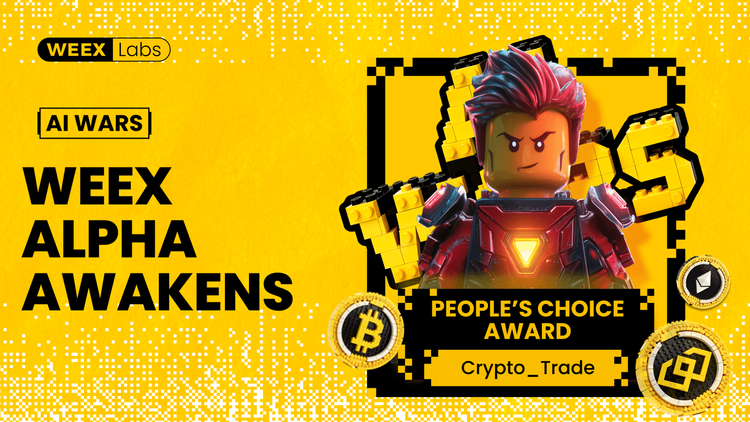
How a Structured AI Crypto Trading Bot Won at the WEEX Hackathon
Crypto_Trade shows how structured inputs and controlled adaptability can build a more stable and reliable AI crypto trading bot within the WEEX AI Trading Hackathon, highlighting a practical path toward scalable AI trading systems.
Particle Founder: The entrepreneurial insights I have gained the most from in the past year
Stop lean startup, stop lightning entrepreneurship, and think carefully about what your product aspirations are.
Huang Renxun's latest podcast transcript: The future of Nvidia, the development of embodied intelligence and agents, the explosion of inference demand, and the public relations crisis of artificial intelligence
The competition in the future is not just about whose model is larger or whose computing power is stronger, but also about who understands the industry better, who can embed AI more deeply into real processes, and who can organize these capabilities into a runnable and scalable system.
OKX Ventures Research Report: AI Agent Economic Infrastructure Research Report (Part 1)
The existing infrastructure is hostile to the Agent economy. Agents can think and act independently at the "capability level," but at the "economic level," they are still locked into infrastructure designed for humans.
The migration of settlement rights: B18 and the institutional starting point of on-chain banks
In the traditional system, banks decide the settlement; in the on-chain system, code begins to take over this responsibility.
From Tencent and Circle: Looking at the Simple and Difficult Questions of Investment
The AI narrative continues to ferment, but the recent performance of related stocks varies, with some in the midst of summer and others as if in winter.
The second half of stablecoins no longer belongs to the crypto circle
What Coinbase doesn't want, Mastercard is eager to buy.


 App
App