
 Buy Crypto
- Markets
 Futures
- Spot
- Copy Trade
- Earn
- More
10 Days, $2 Billion Trading Volume, Another Smash Hit for Hyperliquid

The unreachable wealth gap and the weakening of class mobility have led people to no longer believe in linear wealth accumulation.
Modern market participants, especially those dreaming of crossing class barriers as retail traders, are fervently pursuing high-leverage exposure. However, traditional financial instruments appear arrogant and inefficient when faced with this primal desire.
In the United States, futures dominate the commodity and index trading markets, but single-stock futures have always been absent. Behind this is the stubbornness of two institutions regarding regulatory authority.
In 1975, the CFTC was established, sparking a fierce conflict with the SEC over the jurisdiction of financial derivatives. Neither side backed down. In 1981, the chairmen of the two institutions signed the famous "Shad-Johnson Agreement," directly prohibiting single-stock futures in the United States. It was a ban for two decades. It wasn't until the Commodity Futures Modernization Act of 2000 that it was "legalized." Unfortunately, constrained by a strict dual regulatory framework, this market never truly developed.
So, when retail traders wanted to have leveraged exposure to individual stocks, they ultimately had to turn to the options market, also under SEC supervision.
Traders desiring simple leverage had to search for liquidity among thousands of options contracts scattered across different strike prices and expiration dates. Worse still, they had to endure those mysterious Greek letters.
The "great invention" of the crypto market, perpetual contracts, provided an elegant solution. It eliminates the hidden trading costs and operational risks associated with traditional futures' "rollover." More importantly, it pools all the liquidity that was originally spread across thousands of contracts onto a single order book, providing the purest and most efficient form of leverage.
Arthur Hayes first introduced perpetual contracts to the cryptocurrency market in 2016
This validated financial instrument in the crypto market is now attempting to conquer the world's largest speculative market—the U.S. stock market.
However, stock assets have distinct physical attributes. They are limited by fixed trading hours and have corporate governance actions such as dividends.
This is fundamentally different from native crypto assets like Bitcoin, which trade around the clock and lack cash flows, making it a challenging task to fit the vast and mature U.S. stock market into perpetual contracts.
trade.xyz is the first HIP-3 trading platform deployed by the Unit team on Hyperliquid, and is currently the largest on-chain stock perpetual contract trading venue.
This article will take trade.xyz as an example to dissect the design game behind this financial experiment.
Design Challenge 1: Pricing During Market Closure
The lifeline of a perpetual contract relies on the oracle's price feed, yet the spot trading of US stocks is limited by trading hours.
trade.xyz employs different strategies for various asset types:
For index contracts like XYZ100 (tracking the Nasdaq), trade.xyz uses the CME NQ futures price (trading 23 hours a day) with a cost-of-carry model to reverse-engineer the spot price.
For stock contracts, it utilizes stock quotes from Pyth, covering regular market hours, after-hours, and overnight sessions (Monday to Friday 9:30 AM - 8:00 PM ET).
When external inputs are unavailable (futures have a 1-hour daily market closure window, individual stocks have 48-hour weekend market closure), the oracle triggers an internal pricing mechanism: adjusting the slippage spread through a continuous-time Exponential Moving Average (EMA) with a time constant of 8 hours. The slippage spread is based on the order book depth to reflect market supply and demand pressure.
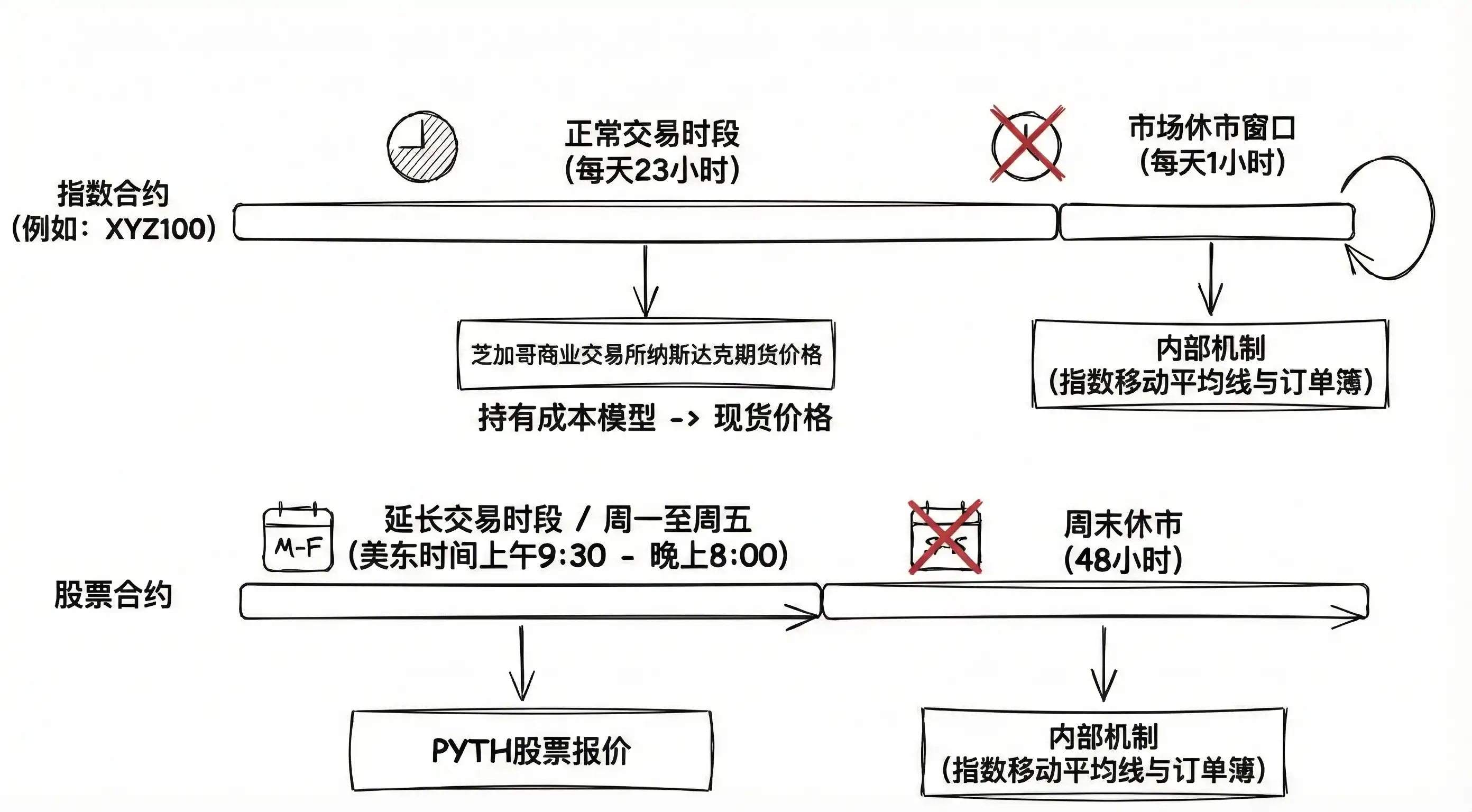
This design enables the oracle to self-adjust based on the on-chain order book when external data is lacking, maintaining responsiveness to market supply and demand. Once external data is restored, the oracle immediately reverts to external pricing.
Design Challenge 2: Dividends Are Not a Free Lunch for Shorts
Unlike Bitcoin, which does not generate cash flow, US stocks have regular dividend payments. In traditional markets, the ex-dividend date usually leads to an automatic stock price drop. In perpetual contracts, this seems to provide a perfect arbitrage opportunity for shorts: by shorting before the ex-dividend date, one can profit from the price decrease.
However, this clearly violates the "no-arbitrage principle." To address this issue, trade.xyz internalizes dividends into the funding rate. We can use reverse inductive reasoning to deduce this process:
Assuming the oracle price is $100, and in the future moment T, it drops to $98 due to a $2 dividend distribution. Every hour before T, the mark price must exhibit a smooth discounted curve.
At moment T-1, to prevent arbitrage, the funding rate paid by shorts must precisely equal the profit they receive as the price drops from the mark price to $98. According to the funding rate formula:
Funding Rate = ( Mark Price - Oracle Price ) / Oracle Price + Truncation Function (...)
By solving the no-arbitrage condition, we can deduce that the fair Mark price at time T-1 should be around $98.975. Continuing to T-2 and T-3, we find that the Mark price will preemptively form a discount curve.
Image Source: https://oldcoinbad.com/p/non-arbitrage-conditions-for-perpetual
In simple terms, while the short position seems to profit from the price drop spread, it actually pays out the full amount through the funding rate; whereas the long position, although enduring a nominal price drop, earns an income equivalent to holding the spot through the funding rate, a sort of "dividend."
Design Challenge Three: Who Bears the Cost of "Volatility Arbitrage"?
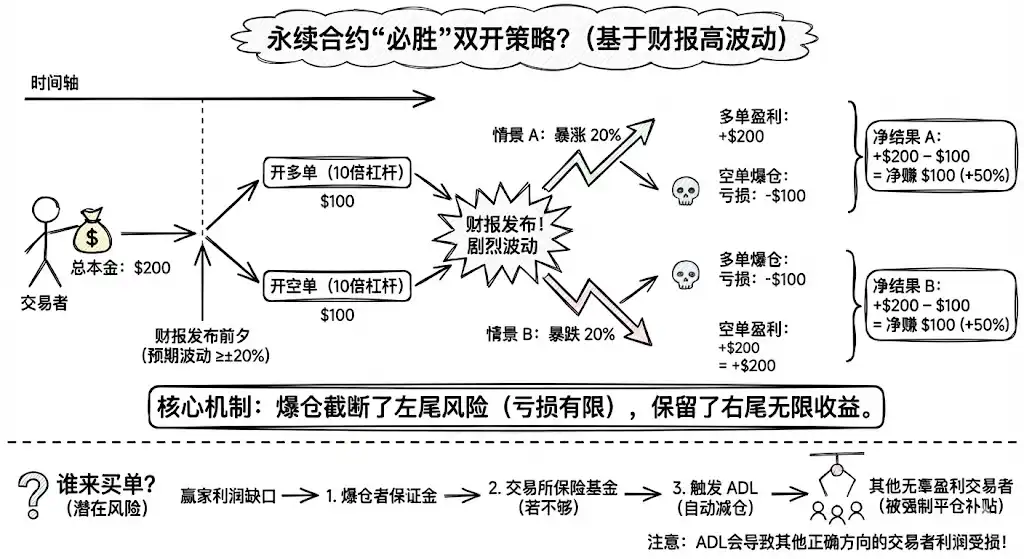
Perpetual contracts give linear assets a non-linear option-like property: the liquidation mechanism truncates left-tail risk (at most losing the entire principal), while retaining the infinite upside of the right tail.
An earnings report is a typical "known unknown" event: the timing is known, the direction is unknown, but the magnitude of volatility is often significant (e.g., ±20%).
This has led to a sure-win "doubling" strategy in perpetual contracts with 10x leverage.
Let's look at a specific example: suppose a trader has $200 in capital, and the implied volatility on earnings report day is 20%. Before the report is released, the trader opens a 10x long position with $100 margin and a 10x short position with $100 margin.
Scenario A (20% surge): Short position liquidates, losing $100; long position gains $200. Net profit is $100.
Scenario B (20% plunge): Long position liquidates, losing $100; short position gains $200. Net profit is $100.
Regardless of the price movement, the trader seems to achieve a 50% return. This is because the liquidation mechanism cuts off losses in the wrong direction while not affecting gains in the correct direction.
So who foots the bill?
In cases where the main net short is liquidated, a portion of the long's profits are covered by the short's margin, while the remaining profit gap is first filled by the exchange's insurance fund. After the insurance fund is depleted, the platform will initiate the Auto-Deleveraging mechanism (ADL), forcibly closing profitable trades and using their paper profits to subsidize the doubling arbitragers. This process causes the non-volatility arbitrage traders who bet correctly on the direction to lose a portion of their profits.
You cannot balance the system's fairness and stability while allowing users to freely choose high leverage.
Current solutions, such as dynamic deleveraging before financial reports or increasing margin requirements, seem to be imperfect.
Design Challenge Four: Market Manipulation
"The measuring cup cannot hold the giant whale, a single turn creates a stormy sea."
In addition to the challenges of mechanism design, the early market's fragile liquidity is also a major risk.
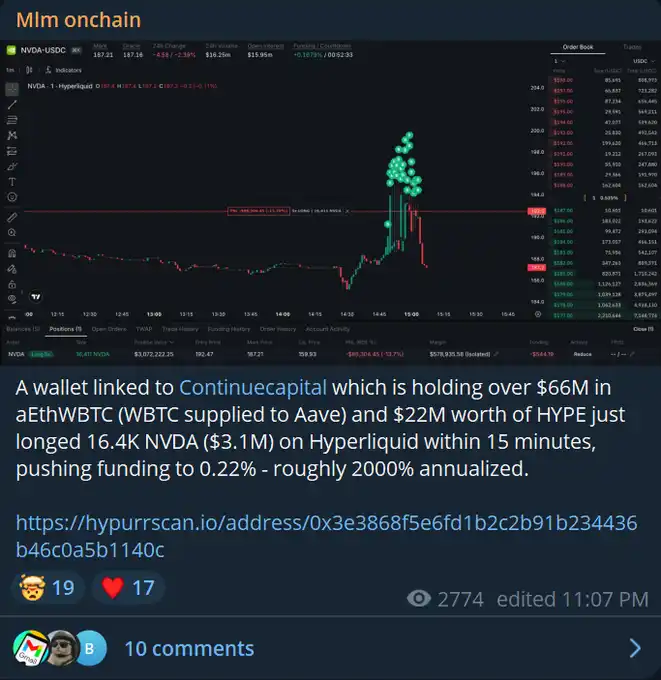
Recently, Continue Capital established a $3.1M long position in NVDA on trade.xyz, directly pushing the short-term annualized funding rate to an astonishing 2000%. KOL trader @CL207 complained, "This guy forced me to liquidate my position because at an hourly interest rate of 0.2%, I'll probably have to pay $200,000 by Wednesday, which will bankrupt me."
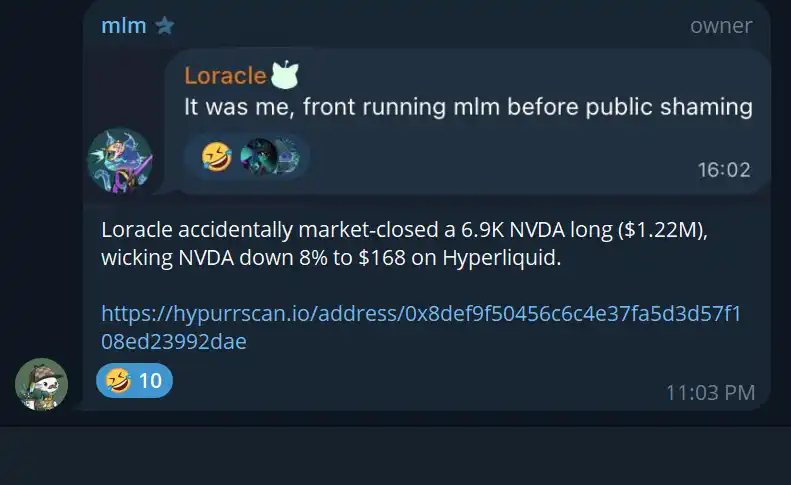
Another whale, Loracle, unexpectedly market liquidated a 1.2M NVDA long position, causing an instantaneous 8% price drop. If trade.xyz offers options with leverage greater than 13x in the future, this sudden liquidity drain will lead to numerous traders being liquidated.
Normally, a whale's "market manipulation" behavior would result in a hefty funding cost penalty, but during off-market hours, oracle prices lose their anchor to spot prices, weakening this "penalty."
To address this, Trade.xyz's oracle price algorithm during off-market hours maintains stickiness to the closing price and sets price limits based on the final opening price to prevent extreme fluctuations during off-market hours.
However, ultimately, before solving the liquidity issue, any "stopgap measure" is just "a Band-Aid on a wooden leg." You cannot prevent well-capitalized players from manipulating a fragile order book while keeping the market open.
Conclusion
Perpetual contracts are poised to be another crypto application with massive potential after stablecoins.
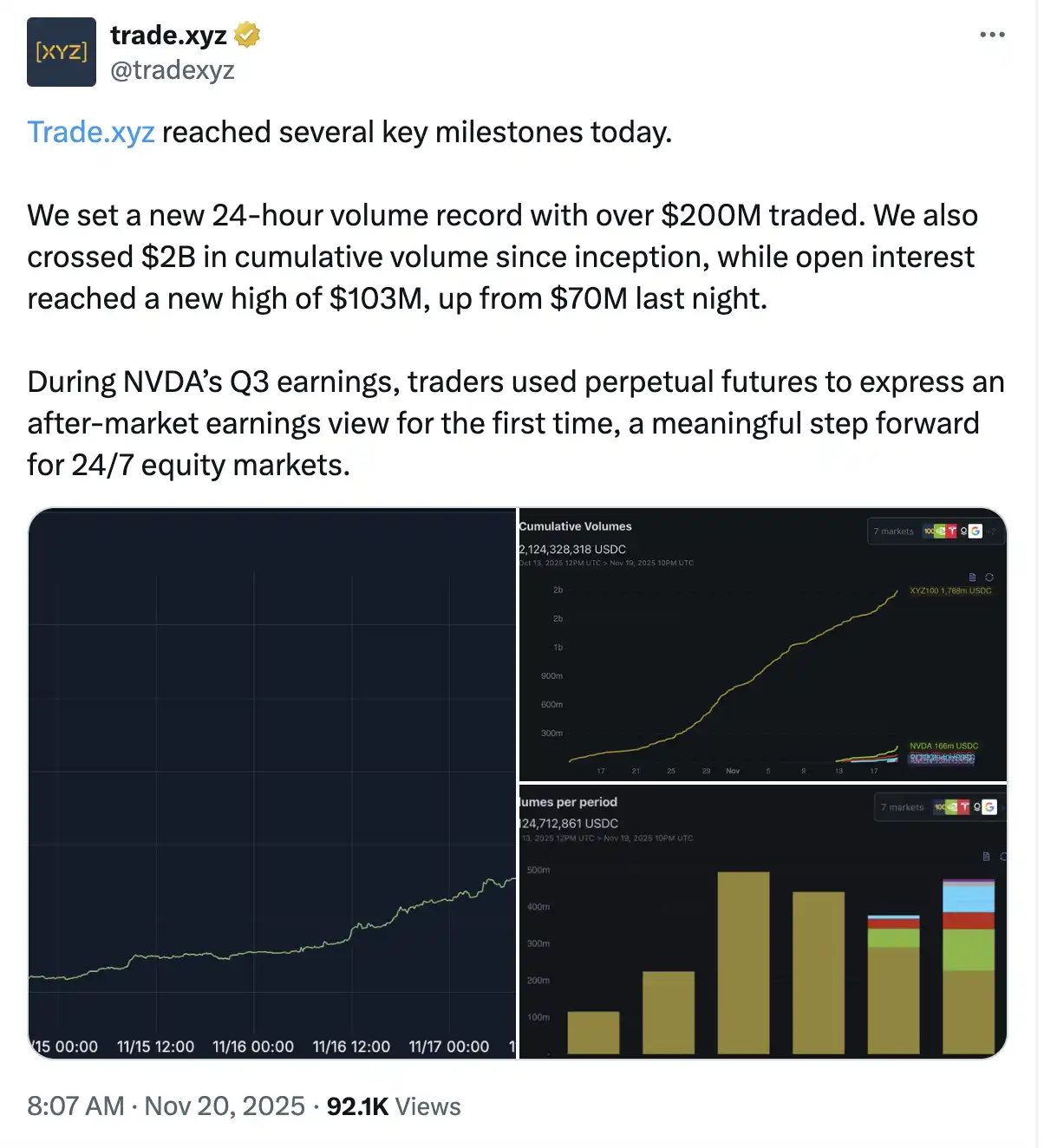
The PMF of US stock perpetual contracts has been preliminarily validated. Data shows that trade.xyz's cumulative trading volume has exceeded $2 billion, with a record-breaking $200 million in daily trading volume during NVDA's earnings release.
The history of the traditional financial markets tells us that the trading volume of derivatives often far exceeds that of the spot market. CME Gold futures trade 27 million ounces daily, more than 30 times the daily average of 800,000 ounces for the SPDR Gold ETF. The notional trading volume of interest rate derivatives reaches the level of several trillion dollars in the OTC market.
Compared to the spot market, the derivatives market does not involve physical delivery, provides higher capital efficiency, and has a leverage-driven, more efficient price discovery mechanism.
Perpetual contracts take these advantages to the extreme. They offer continuous exposure, extremely low costs, and maximum efficiency.
While Bitcoin struggles in a bear market, the U.S. stock market continues to thrive, highlighting more and more the potential of stock perpetual contracts.
Despite facing significant technical and game-theoretical challenges, perpetual contracts are starting to "swallow" the stock market in an irreversible manner.
References:
https://oldcoinbad.com/p/non-arbitrage-conditions-for-perpetual
https://docs.trade.xyz/xyz-perps-specification/equity-perpetuals/single-name-equities
https://docs.trade.xyz/xyz-perps-specification/equity-perpetuals/xyz100-and-index-perpetuals
You may also like

Found a "meme coin" that skyrocketed in just a few days. Any tips?

TAO is Elon Musk, who invested in OpenAI, and Subnet is Sam Altman

The era of "mass coin distribution" on public chains comes to an end

Soaring 50 times, with an FDV exceeding 10 billion USD, why RaveDAO?

1 billion DOTs were minted out of thin air, but the hacker only made 230,000 dollars

After the blockade of the Strait of Hormuz, when will the war end?

Before using Musk's "Western WeChat" X Chat, you need to understand these three questions
The X Chat will be available for download on the App Store this Friday. The media has already covered the feature list, including self-destructing messages, screenshot prevention, 481-person group chats, Grok integration, and registration without a phone number, positioning it as the "Western WeChat." However, there are three questions that have hardly been addressed in any reports.
There is a sentence on X's official help page that is still hanging there: "If malicious insiders or X itself cause encrypted conversations to be exposed through legal processes, both the sender and receiver will be completely unaware."
No. The difference lies in where the keys are stored.
In Signal's end-to-end encryption, the keys never leave your device. X, the court, or any external party does not hold your keys. Signal's servers have nothing to decrypt your messages; even if they were subpoenaed, they could only provide registration timestamps and last connection times, as evidenced by past subpoena records.
X Chat uses the Juicebox protocol. This solution divides the key into three parts, each stored on three servers operated by X. When recovering the key with a PIN code, the system retrieves these three shards from X's servers and recombines them. No matter how complex the PIN code is, X is the actual custodian of the key, not the user.
This is the technical background of the "help page sentence": because the key is on X's servers, X has the ability to respond to legal processes without the user's knowledge. Signal does not have this capability, not because of policy, but because it simply does not have the key.
The following illustration compares the security mechanisms of Signal, WhatsApp, Telegram, and X Chat along six dimensions. X Chat is the only one of the four where the platform holds the key and the only one without Forward Secrecy.
The significance of Forward Secrecy is that even if a key is compromised at a certain point in time, historical messages cannot be decrypted because each message has a unique key. Signal's Double Ratchet protocol automatically updates the key after each message, a mechanism lacking in X Chat.
After analyzing the X Chat architecture in June 2025, Johns Hopkins University cryptology professor Matthew Green commented, "If we judge XChat as an end-to-end encryption scheme, this seems like a pretty game-over type of vulnerability." He later added, "I would not trust this any more than I trust current unencrypted DMs."
From a September 2025 TechCrunch report to being live in April 2026, this architecture saw no changes.
In a February 9, 2026 tweet, Musk pledged to undergo rigorous security tests of X Chat before its launch on X Chat and to open source all the code.
As of the April 17 launch date, no independent third-party audit has been completed, there is no official code repository on GitHub, the App Store's privacy label reveals X Chat collects five or more categories of data including location, contact info, and search history, directly contradicting the marketing claim of "No Ads, No Trackers."
Not continuous monitoring, but a clear access point.
For every message on X Chat, users can long-press and select "Ask Grok." When this button is clicked, the message is delivered to Grok in plaintext, transitioning from encrypted to unencrypted at this stage.
This design is not a vulnerability but a feature. However, X Chat's privacy policy does not state whether this plaintext data will be used for Grok's model training or if Grok will store this conversation content. By actively clicking "Ask Grok," users are voluntarily removing the encryption protection of that message.
There is also a structural issue: How quickly will this button shift from an "optional feature" to a "default habit"? The higher the quality of Grok's replies, the more frequently users will rely on it, leading to an increase in the proportion of messages flowing out of encryption protection. The actual encryption strength of X Chat, in the long run, depends not only on the design of the Juicebox protocol but also on the frequency of user clicks on "Ask Grok."
X Chat's initial release only supports iOS, with the Android version simply stating "coming soon" without a timeline.
In the global smartphone market, Android holds about 73%, while iOS holds about 27% (IDC/Statista, 2025). Of WhatsApp's 3.14 billion monthly active users, 73% are on Android (according to Demand Sage). In India, WhatsApp covers 854 million users, with over 95% Android penetration. In Brazil, there are 148 million users, with 81% on Android, and in Indonesia, there are 112 million users, with 87% on Android.
WhatsApp's dominance in the global communication market is built on Android. Signal, with a monthly active user base of around 85 million, also relies mainly on privacy-conscious users in Android-dominant countries.
X Chat circumvented this battlefield, with two possible interpretations. One is technical debt; X Chat is built with Rust, and achieving cross-platform support is not easy, so prioritizing iOS may be an engineering constraint. The other is a strategic choice; with iOS holding a market share of nearly 55% in the U.S., X's core user base being in the U.S., prioritizing iOS means focusing on their core user base rather than engaging in direct competition with Android-dominated emerging markets and WhatsApp.
These two interpretations are not mutually exclusive, leading to the same result: X Chat's debut saw it willingly forfeit 73% of the global smartphone user base.
This matter has been described by some: X Chat, along with X Money and Grok, forms a trifecta creating a closed-loop data system parallel to the existing infrastructure, similar in concept to the WeChat ecosystem. This assessment is not new, but with X Chat's launch, it's worth revisiting the schematic.
X Chat generates communication metadata, including information on who is talking to whom, for how long, and how frequently. This data flows into X's identity system. Part of the message content goes through the Ask Grok feature and enters Grok's processing chain. Financial transactions are handled by X Money: external public testing was completed in March, opening to the public in April, enabling fiat peer-to-peer transfers via Visa Direct. A senior Fireblocks executive confirmed plans for cryptocurrency payments to go live by the end of the year, holding money transmitter licenses in over 40 U.S. states currently.
Every WeChat feature operates within China's regulatory framework. Musk's system operates within Western regulatory frameworks, but he also serves as the head of the Department of Government Efficiency (DOGE). This is not a WeChat replica; it is a reenactment of the same logic under different political conditions.
The difference is that WeChat has never explicitly claimed to be "end-to-end encrypted" on its main interface, whereas X Chat does. "End-to-end encryption" in user perception means that no one, not even the platform, can see your messages. X Chat's architectural design does not meet this user expectation, but it uses this term.
X Chat consolidates the three data lines of "who this person is, who they are talking to, and where their money comes from and goes to" in one company's hands.
The help page sentence has never been just technical instructions.
Parse Noise's newly launched Beta version, how to "on-chain" this heat?

Is Lobster a Thing of the Past? Unpacking the Hermes Agent Tools that Supercharge Your Throughput to 100x

Declare War on AI? The Doomsday Narrative Behind Ultraman's Residence in Flames
Crypto VCs Are Dead? The Market Extinction Cycle Has Begun
Claude's Journey to Foolishness in Diagrams: The Cost of Thriftiness, or How API Bill Increased 100-Fold

Edge Land Regress: A Rehash Around Maritime Power, Energy, and the Dollar
Arthur Hayes Latest Interview: How Should Retail Investors Navigate the Iran Conflict?
Just now, Sam Altman was attacked again, this time by gunfire

Straits Blockade, Stablecoin Recap | Rewire News Morning Edition
From High Expectations to Controversial Turnaround, Genius Airdrop Triggers Community Backlash


 App
App